
A Short History of Bradford City’s Free Libraries
Before the introduction of free public libraries, access to books was a luxury reserved for those who could afford private subscriptions.
- 1832: The Bradford Mechanics’ Institute was founded. It provided technical education and a library of books explicitly for working-class men.
- Exclusivity: While revolutionary, these spaces still required small membership fees, leaving the poorest citizens without free access to literature or learning.
The Birth of the Free Library (1871–1878)
Following the national Public Libraries Act of 1850, Bradford became the fifth town in Yorkshire to adopt the legislation after a public meeting called by the mayor in 1871.
15th June 1872: The Bradford Free Library opened its doors in rented premises on Tyrrel Street, inaugurated with major civic pride by Mayor Matthew Thompson.
When it first opened in June 1872, Bradford Public Library enabled people from all walks of life and of all ages to access information and education freely for the first time.
The 1872 initial collection of the Bradford Free Library was anchor-funded and heavily comprised of a singular massive acquisition: the private collection of Alderman Samuel Smith. See picture below.
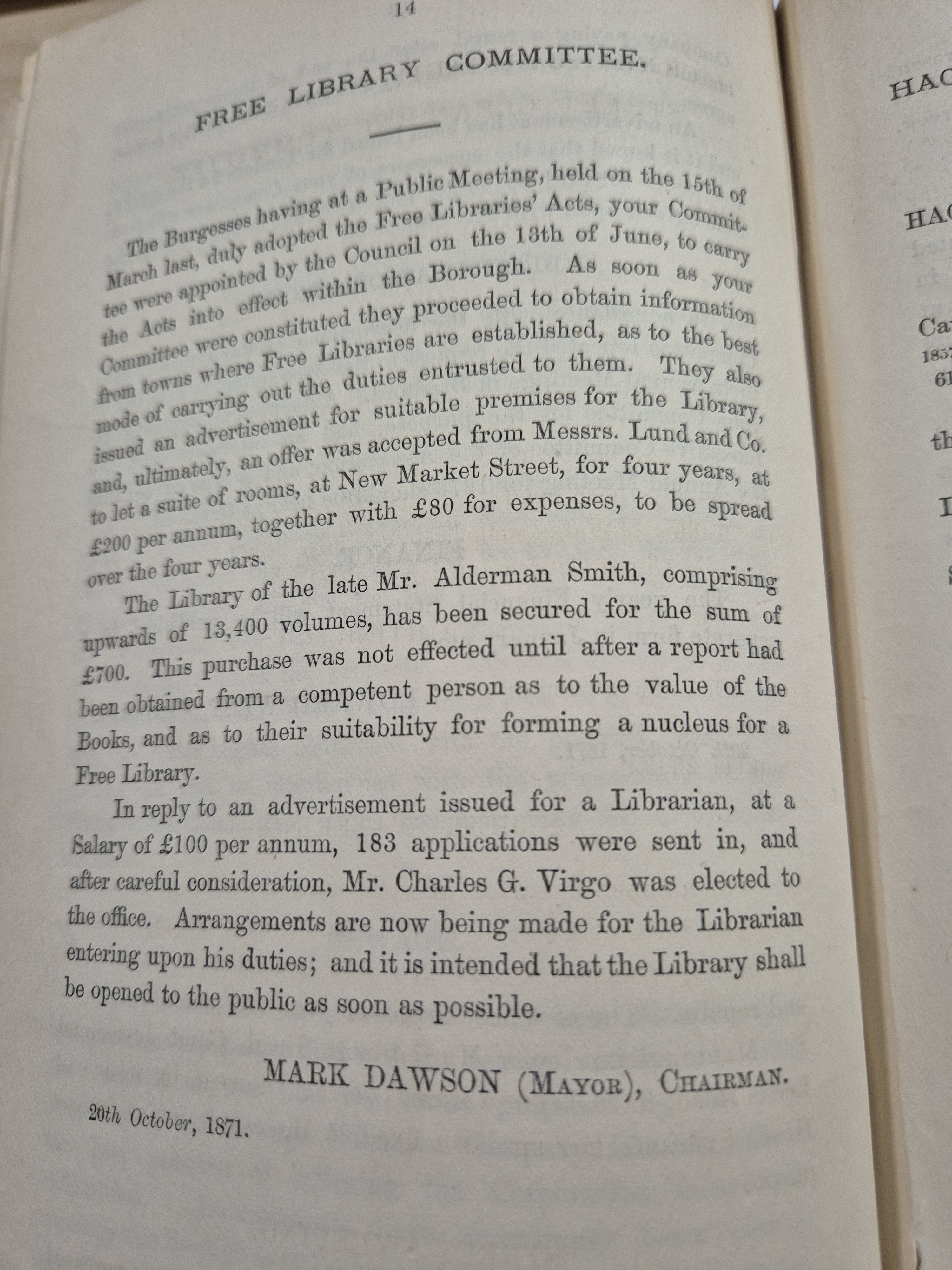
Bradford Local Studies Library
Alongside city leaders Briggs Priestley and John Venimore Godwin, the library acquired 13,400 volumes from Smith’s estate to rapidly stock the shelves at Tyrrel Street before opening day.
What the 1872 Collection Included
Because it was established strictly as a Reference Library and Newsroom during its first few months, the collection was selected to prioritize information density and public utility rather than casual fiction:
- Local History and Antiquities: Early efforts focused heavily on preservation, creating a repository for local political pamphlets, transcripts of the Bradford Parish Registers, and topographical maps of the West Riding.
- Newspapers and Periodicals: The newsroom floor featured a vast selection of local daily and weekly broadsheets, including early bound volumes of the Bradford Observer (later the Telegraph & Argus), alongside commercial trade sheets to support the booming wool and textile sectors.
- Scientific & Commercial Reference: Directories, patent records, gazetteers, and standard 19th-century encyclopaedias designed to help local working-class men educate themselves.


Reports of Committees of Bradford City Council 1872, p13,14. Property of Bradford Local Studies Library
- February 1873: The lending department officially opened to the public, allowing citizens to take books home for the first time.
- 1878: To accommodate rapidly growing demand, the library migrated to a grander, purpose-built facility on Darley Street. This site offered a newsroom, reference and lending blocks, separate reading rooms for men and women, and an art gallery.
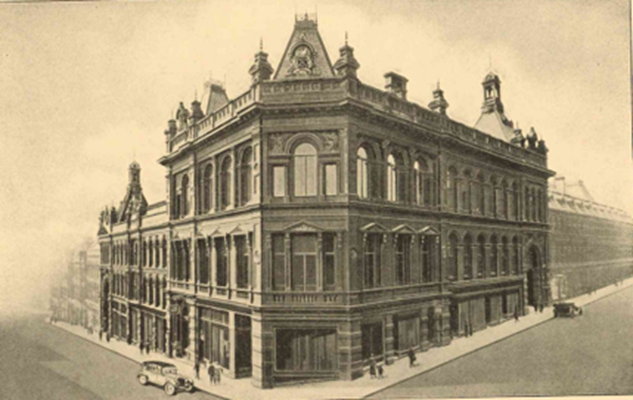
Central Public Library Location: Darley Street, Bradford, Source/Collection: Bradford Libraries Archive

Reading Room / Reference Library area at the Central Public Library Location: Darley Street, Bradford, Source/Collection: Bradford Libraries Archive
The Libraries Committee was responsible for overseeing the maintaining/expansion and governance of the Bradford Free Library. James Duncan Law’s grandfather, James Law JP, was a central pioneer of Bradford’s initial municipal expansion. During his tenure as Mayor in 1867, he advocated heavily for Bradford to adopt the 1850 Free Libraries Act, (The Public Libraries Act 1850 was a monumental piece of UK legislation that laid the foundation for the modern public library system. Introduced to Parliament as a backbench bill by William Ewart MP and Joseph Brotherton MP, it gave local authorities discretionary power to establish free public libraries for the very first time, paving the way for the opening of the first branch at Tyrrel Street in 1872. Following his mayoralty, James Law JP served as a dedicated director of the Bradford Library for over 25 years, steering its transition into the larger, grander Darley Street premises.
Inheriting this role, James Duncan Law (1882–1940) carried the family’s oversight into the early 20th century. Operating through the Committee, he managed the strategic upkeep, library staffing, and expanding catalogue of the Darley Street Central Lending and Reference Library. His primary focus was maintaining the library’s educational resources to support the local working class during the height of Bradford’s industrial textile boom.
When the landmark, eight-storey Bradford Central Library officially opened on Monday 17 July 1967, it introduced two major historical “firsts” to the United Kingdom’s library infrastructure:
1. First Major Post-War Central Library in the UK
The building was a structural milestone for British municipal design. It stood as the very first major, newly built post-war central library building in the entire United Kingdom. It was commissioned as a flagship symbol of the 1960s urban redevelopment of Bradford city centre.
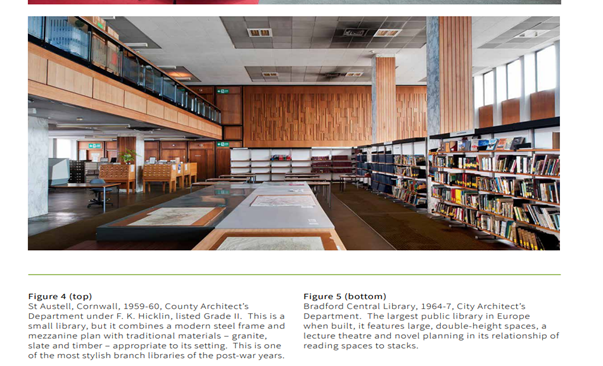
HEAG136 Publication date: September 2013 © English Heritage Reissue date: July 2016 © Historic England Design: Historic England
- The building was commissioned to solve extreme overcrowding at the old Darley Street premises. It was designed by Bradford Corporation’s City Architect, Clifford Brown. He worked closely with the pioneering City Librarian, Harold Bilton, who had pushed for a modern premises since taking the role in 1951. The complex was built as an eight-story high-rise paired alongside an adjacent 400-seat Library Theatre. The structure made extensive use of glass facades and large reinforced concrete spans to maximize open space, natural light, and structural visual flexibility.
- Financial Scale: When the building was finalized and officially opened by H.R.H. Princess Alexandra in 1967, the total construction and fitting cost was £800,000. For context, at the time, this massive investment was equivalent to buying multiple professional football clubs.

2. First UK Library Using the “Subject-Department” Principle
Before 1967, British libraries strictly separated their lending books from their reference books (often keeping reference texts tucked away in a closed-off area). Inspired by modern American systems, Bradford’s City Librarian, Harold Bilton, broke tradition:
- Integrated Departments: Bradford Central Library became the first in the country to combine lending and reference materials together into designated subject departments.
- The Layout: If you visited the 5th floor, for example, you found all social science lending books, reference texts, and specialists in that field grouped in one single zone.
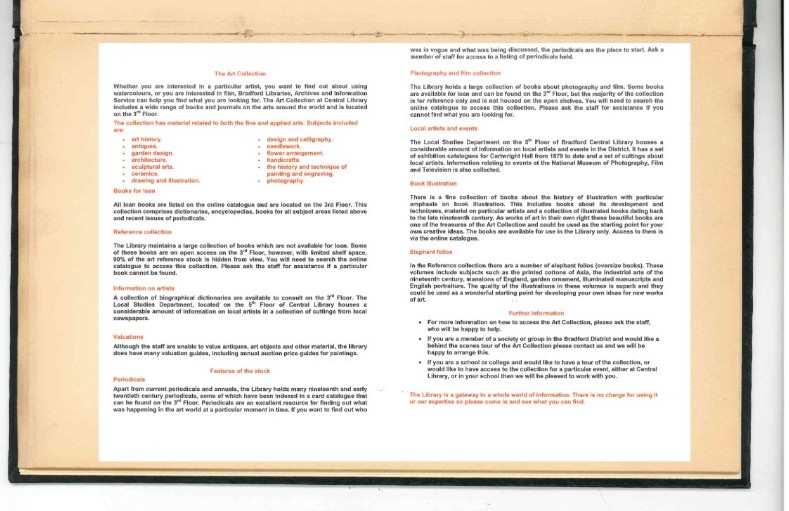
Evolution of the Stock
- June 1872: The Reference Library opened with the 13,400 general and local volumes.
- February 1873: The library added a popular Lending Department, expanding the collection to include classic 19th-century literature and standard science textbooks.
In 2013, the library moved from Margaret McMillan Tower into a building in City Park which was shared with Bradford Museum and Galleries. This obviously caused a reduction in stock, and the entire library now only covered 2 floors. This did not deter usage as City Library as it is now known is still one of the busiest libraries in the district.
There is a display of photos on display in Bradford Local Studies, which people are welcome to come and see. These will be up until 31st August when the display will change to Septembers subject.
Discover more from Bradford and District Local Studies
Subscribe to get the latest posts sent to your email.

Saltaire’s library was established in 1854. It was a key part of the Saltaire Literary Institute, founded just a year after completion of Salts Mill.
The funding came from William Henry, Titus’s eldest, who gave £100 (a fortune!) for a library for the workpeople – and by 1855, the library already had 714 volumes, helped on no doubt because Titus himself put another £100 into the kitty!
In addition to those volumes, the library was “well furnished with newspapers and periodicals”, and several members “took it in turn to read aloud… the most valuable portions of the daily press”.
The initial location of the library was a house on Albert Terrace. Later it was above the shops, also close to Saltaire station.
Finally, the Saltaire Literary Institute folded into the Saltaire Club and Institute in the princely building now called Victoria Hall. The library enjoyed a significant space and, decades on, became part of the local authority’s library service.
This story is based on a slideshow by the Saltaire History Club. Together with two other presentations, it will be showing in Victoria Hall during the 2026 Heritage Open Days, from 11 till 3 on Saturday 12 September. No need to book, and it’s free.
Les Brook Chair/Secretary Saltaire History Club
LikeLike