Bradford Firsts – Blog Series No.3

A Short History of Bradford Free Libraries

Before the introduction of free public libraries, access to books was a luxury reserved for those who could afford private subscriptions.

  • 1832: The Bradford Mechanics’ Institute was founded. It provided technical education and a library of books explicitly for working-class men.
  • Exclusivity: While revolutionary, these spaces still required small membership fees, leaving the poorest citizens without free access to literature or learning.

The Birth of the Free Library (1871–1878)

Following the national Public Libraries Act of 1850, Bradford became the fifth town in Yorkshire to adopt the legislation after a public meeting called by the mayor in 1871.

15th June 1872: The Bradford Free Library opened its doors in rented premises on Tyrrel Street, inaugurated with major civic pride by Mayor Matthew Thompson.

When it first opened in June 1872, Bradford Public Library enabled people from all walks of life and of all ages to access information and education freely for the first time.

  • The access to the library was detailed in the above article in the Yorkshire Post and Leeds Intelligencer in April 1878.

The 1872 initial collection of the Bradford Free Library was anchor-funded and heavily comprised of a singular massive acquisition: the private collection of Alderman Samuel Smith.  See picture below.
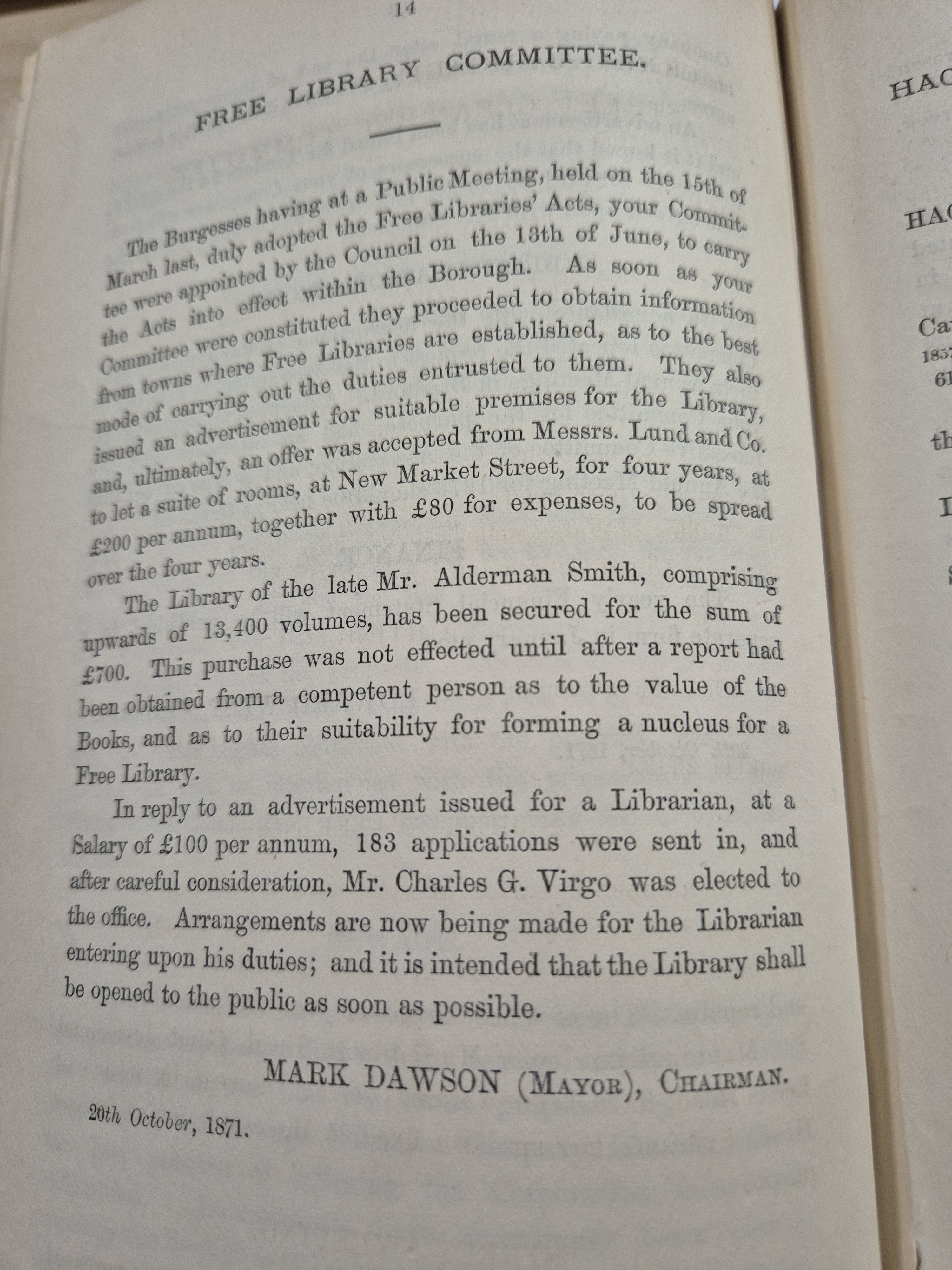
Page from Report of Committees of Bradford City Council 1871
reports-of-committees-of-bradford-city-council-1867-1876-1871.png
Bradford Local Studies Library

Alongside city leaders Briggs Priestley and John Venimore Godwin, the library acquired 13,400 volumes from Smith’s estate to rapidly stock the shelves at Tyrrel Street before opening day. 

What the 1872 Collection Included

Because it was established strictly as a Reference Library and Newsroom during its first few months, the collection was selected to prioritize information density and public utility rather than casual fiction: 

  • Local History and Antiquities: Early efforts focused heavily on preservation, creating a repository for local political pamphlets, transcripts of the Bradford Parish Registers, and topographical maps of the West Riding. 
  • Newspapers and Periodicals: The newsroom floor featured a vast selection of local daily and weekly broadsheets, including early bound volumes of the Bradford Observer (later the Telegraph & Argus), alongside commercial trade sheets to support the booming wool and textile sectors. 
  • Scientific & Commercial Reference: Directories, patent records, gazetteers, and standard 19th-century encyclopaedias designed to help local working-class men educate themselves. 

Reports of Committees of Bradford City Council 1872, p13,14. Property of Bradford Local Studies Library

  • February 1873: The lending department officially opened to the public, allowing citizens to take books home for the first time.
  • 1878: To accommodate rapidly growing demand, the library migrated to a grander, purpose-built facility on Darley Street. This site offered a newsroom, reference and lending blocks, separate reading rooms for men and women, and an art gallery.
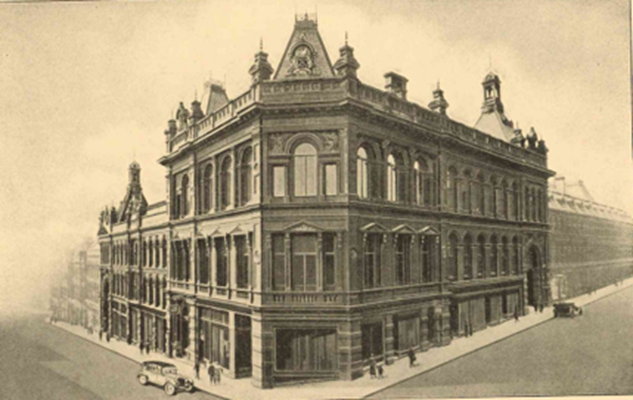
Central Public Library Location: Darley Street, Bradford, Source/Collection: Bradford Libraries Archive

Reading Room / Reference Library area at the Central Public Library Location: Darley Street, Bradford, Source/Collection: Bradford Libraries Archive

The Libraries Committee was responsible for overseeing the maintaining/expansion and governance of the Bradford Free Library. James Duncan Law’s grandfather, James Law JP, was a central pioneer of Bradford’s initial municipal expansion. During his tenure as Mayor in 1867, he advocated heavily for Bradford to adopt the 1850 Free Libraries Act, (The Public Libraries Act 1850 was a monumental piece of UK legislation that laid the foundation for the modern public library system. Introduced to Parliament as a backbench bill by William Ewart MP and Joseph Brotherton MP, it gave local authorities discretionary power to establish free public libraries for the very first time, paving the way for the opening of the first branch at Tyrrel Street in 1872. Following his mayoralty, James Law JP served as a dedicated director of the Bradford Library for over 25 years, steering its transition into the larger, grander Darley Street premises.

Inheriting this role, James Duncan Law (1882–1940) carried the family’s oversight into the early 20th century. Operating through the Committee, he managed the strategic upkeep, library staffing, and expanding catalogue of the Darley Street Central Lending and Reference Library. His primary focus was maintaining the library’s educational resources to support the local working class during the height of Bradford’s industrial textile boom.

When the landmark, eight-storey Bradford Central Library officially opened on Monday 17 July 1967, it introduced two major historical “firsts” to the United Kingdom’s library infrastructure:

1. First Major Post-War Central Library in the UK

The building was a structural milestone for British municipal design. It stood as the very first major, newly built post-war central library building in the entire United Kingdom. It was commissioned as a flagship symbol of the 1960s urban redevelopment of Bradford city centre.
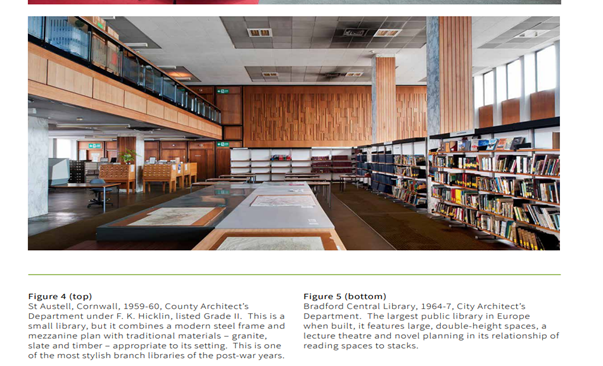
HEAG136 Publication date: September 2013 © English Heritage Reissue date: July 2016 © Historic England Design: Historic England

  • The building was commissioned to solve extreme overcrowding at the old Darley Street premises. It was designed by Bradford Corporation’s City Architect, Clifford Brown. He worked closely with the pioneering City Librarian, Harold Bilton, who had pushed for a modern premises since taking the role in 1951. The complex was built as an eight-story high-rise paired alongside an adjacent 400-seat Library Theatre. The structure made extensive use of glass facades and large reinforced concrete spans to maximize open space, natural light, and structural visual flexibility.
  • Financial Scale: When the building was finalized and officially opened by H.R.H. Princess Alexandra in 1967, the total construction and fitting cost was £800,000. For context, at the time, this massive investment was equivalent to buying multiple professional football clubs.

2. First UK Library Using the “Subject-Department” Principle

Before 1967, British libraries strictly separated their lending books from their reference books (often keeping reference texts tucked away in a closed-off area). Inspired by modern American systems, Bradford’s City Librarian, Harold Bilton, broke tradition:

  • Integrated Departments: Bradford Central Library became the first in the country to combine lending and reference materials together into designated subject departments.
  • The Layout: If you visited the 5th floor, for example, you found all social science lending books, reference texts, and specialists in that field grouped in one single zone.
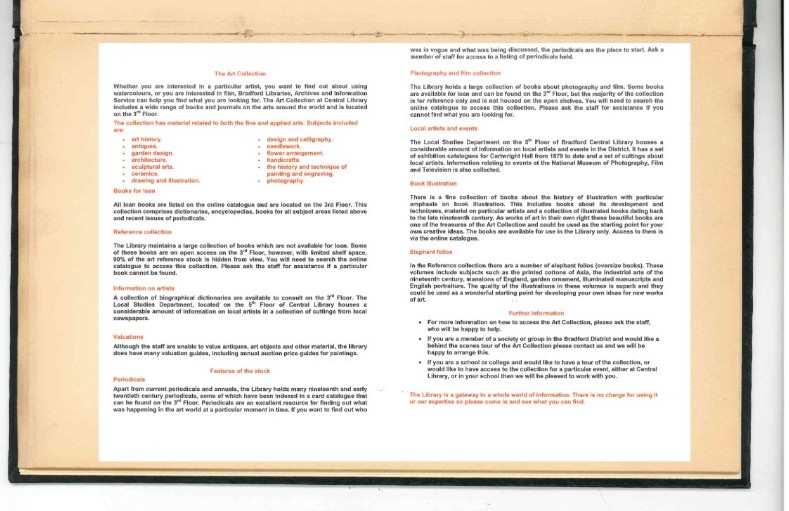
Evolution of the Stock

  • June 1872: The Reference Library opened with the 13,400 general and local volumes.
  • February 1873: The library added a popular Lending Department, expanding the collection to include classic 19th-century literature and standard science textbooks. 

In 2013, the library moved from Margaret McMillan Tower into a building in City Park which was shared with Bradford Museum and Galleries. This obviously caused a reduction in stock, and the entire library now only covered 2 floors. This did not deter usage as City Library as it is now known is still one of the busiest libraries in the district.

There is a display of photos on display in Bradford Local Studies, which people are welcome to come and see. These will be up until 31st August when the display will change to Septembers subject.

HISTORY SOCIETY @ KEIGHLEY LOCAL STUDIES LIBRARY

The History Society held another of their research sessions at Keighley Local Studies Library on the morning of Saturday 31st May 2025. Around twenty members attended, with Angela, Gina and Janet from the library staff opening up various photographic archives and maps of the area for people to peruse.

The session started with History Society committee member Tim Neal talking to attendees about 3D or stereoscopic photography. Many of those there could remember the phenomenon of View-Masters that were around from the 1950s to the 1980s. These handheld viewers used to be loaded with a cardboard circular disc holding seven different colour stereoscopic photos. When looking through the viewer these images appeared in 3D. Tim had brought along half-a-dozen View-Master viewers and a selection of geographical and event-based discs covering subjects as varied as Princess Margaret’s wedding in 1960 to a mid-century of Ottawa in Canada. Members were able to peruse these at their leisure.

Mel Whitaker, writing after the event: “Tim’s collection of ‘View Masters’ brought back many happy memories for all of us who had owned one – and really impressed those who had never seen one before!”

People were then introduced to a collection of card-backed slides from the library’s collection. These were stereoscope images of Keighley in the Victorian era. Local historian Eddie Kelly had already studied the cards and had been able to conclude that they must have been produced around 1895, judging by some of the businesses depicted and the development of some of the buildings in some of the pictures. Using either the vintage wooden viewer or modern plastic equivalents, attendees were able to see Victorian Keighley brought back to life in 3D.

Accompanying these stereoscopic images were selections of photographs, organised by area of town, from a variety of the library’s archive collections, showing the town from the 1900s to the 1960s. It was a period that saw enormous changes in the landscape of the town.

Andy Wade, writing after the event: “Had an excellent session in Keighley Library’s Local Studies room looking at stereoscopic photographs and some of the old photo archives and in particular, the chance to talk about what we were looking at, as there were some unique views of Keighley which I’ve never seen before.”

Finally, bringing us right up to date, the staff had set up the library’s virtual reality equipment, enabling members to view 3D recreations of a 1970s living room, and to explore potential habitats fifty years in the future.

Several members also brought their own items to add to collections,  and could also explore their own research lines of query with the staff and the amazing resources that the library has to offer. The session was summed up by society member Jean McClennon: “An excellent and interesting session, thanks very much to all involved.”

The History Society will be holding another similar session on Saturday 18th October, focusing in how to use the library’s resources to research the history of your own home.

Tim Neal
Keighley & District Local History Society
1st June 2025

The History Society and the Library

The Keighley & District Local History Society was formed in late 2004. It was created to focus on the history of the town and the surrounding area, looking at the industries and mills, the shops and streets, the parks and buildings, key players such as business people, mayors and politicians, and was designed to complement the Keighley and District Family History Society which already existed (and which continues today as Airedale and Wharfedale Family History Society).

The history of the History Society is inextricably linked with that of Keighley Library, although there are no official or formal bonds. The need for the existence of the History Society emerged from discussions around how to celebrate the centenary of the Public Library, which was 100 years old in 2004. One of the key players in those discussions was Pauline Barfield, who was Senior Information Manager in the Local Studies Library at the time. Pauline was also the guest-speaker at the very first open meeting of the society, held in the Local Studies Library on Wednesday 15th December 2004, and was later made Honorary President of the society.

Another important crossover figure is the late Ian Dewhirst, who was Reference Librarian at the Library from 1967 to 1991. As well as being a driving force behind building the invaluable collection of locally focussed documents, photographs and paraphernalia that now form the backbone of the Local Studies Library’s collections, Ian also wrote over twenty books focussed on the history of the town and the wider Yorkshire area that brought awareness and knowledge to a broad and grateful readership. It was only natural that Ian was supportive of the idea of a local history society for the town. Although never formally involved in its running, Ian gave at least half-a-dozen talks to the Society before his untimely death in January 2019.

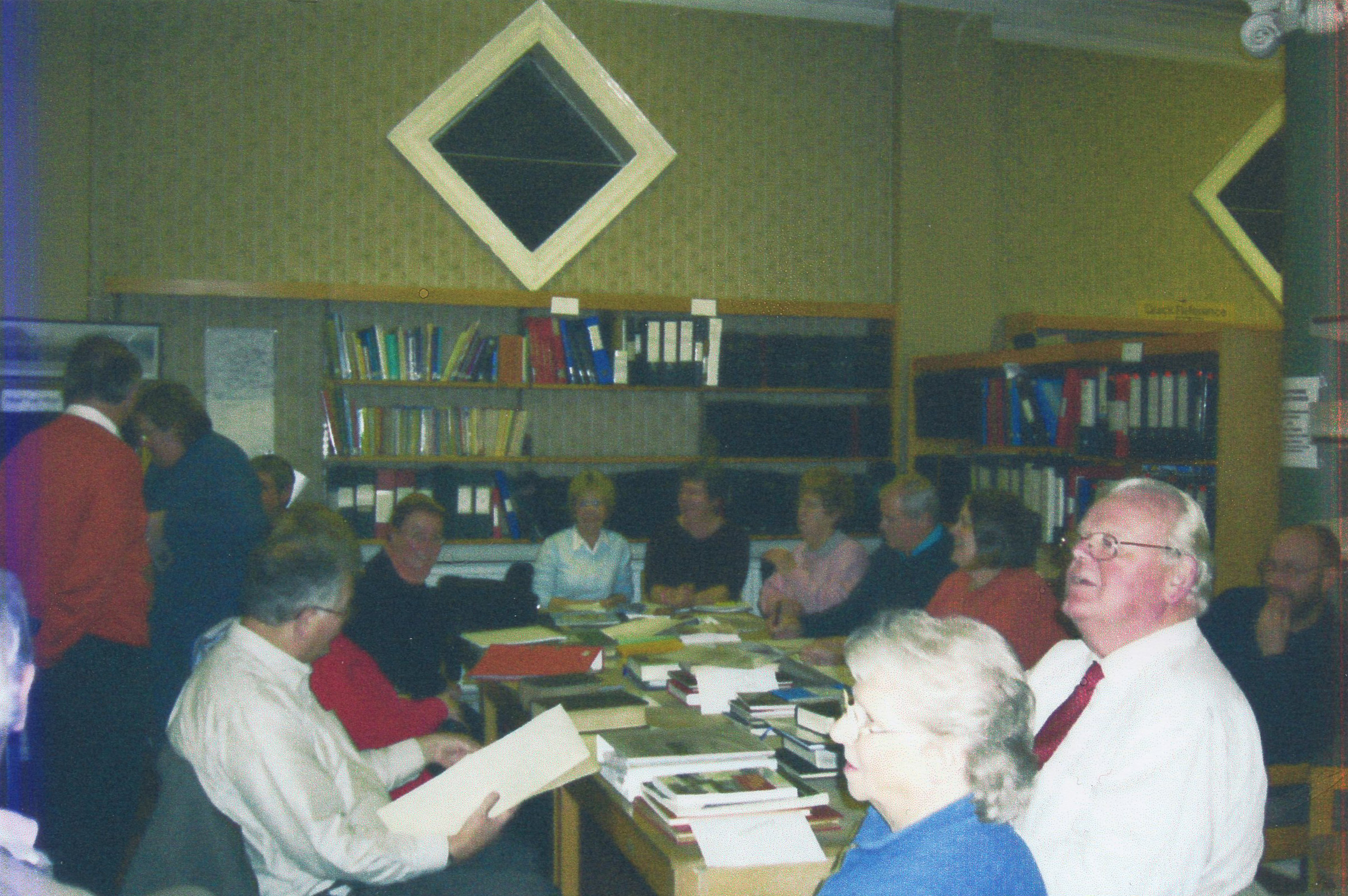
Ian Dewhirst talk 2009

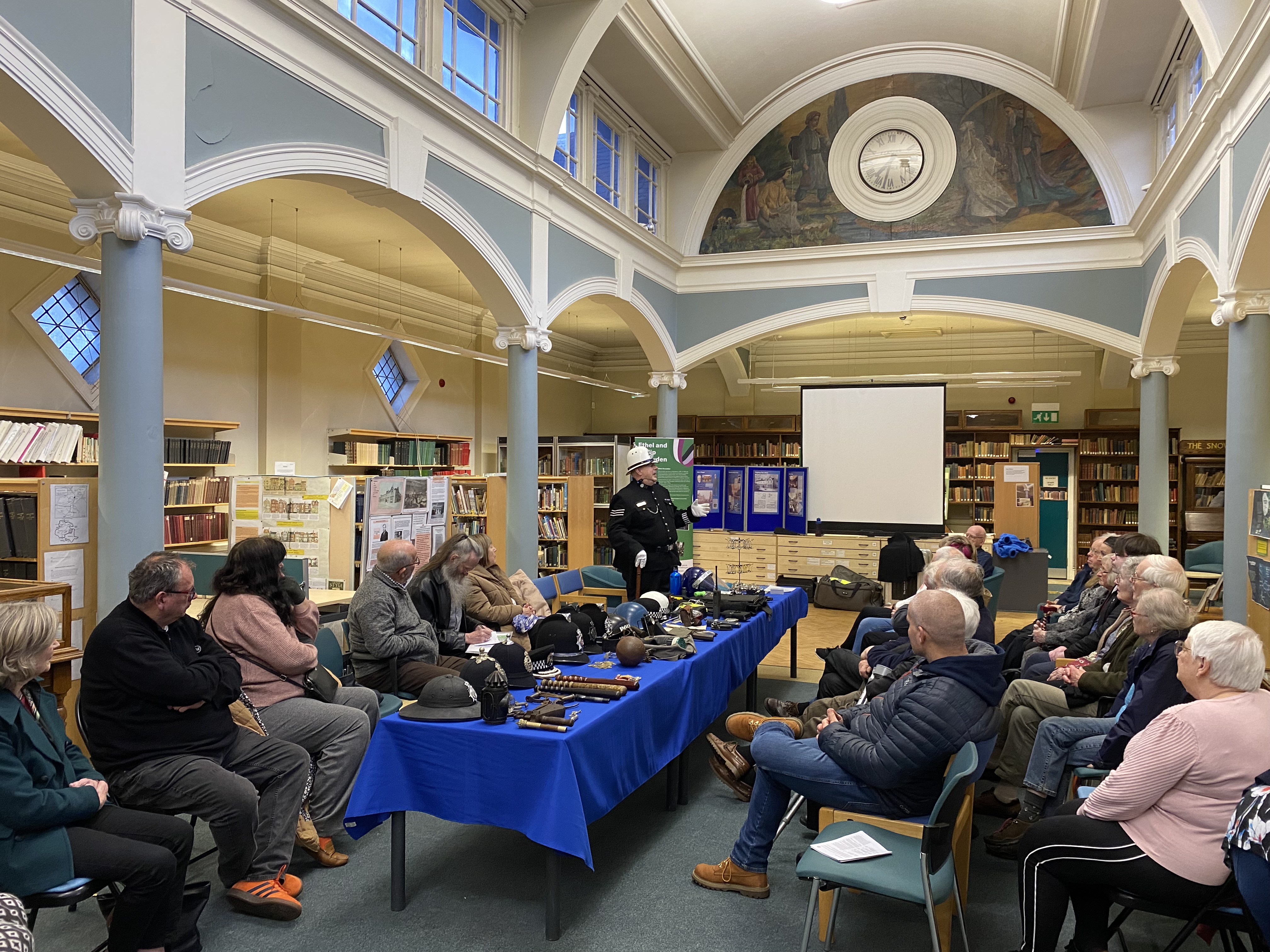
With very few exceptions, the History Society has held open meetings on the second Wednesday of each month ever since it started. These have mainly been held in the Local Studies Library (and we are extremely grateful to the Library for facilitating this) – which is a very natural fit, committed as we both are to “preserving and sharing” the stories of the town and surrounding area. For various reasons (including when the Library was undergoing a major facelift for most of 2007) we held our meetings in other local venues. These have included the Swire Smith Hall of Keighley College (when it was on the other side of North Street to the Library), the service room of The Knowle funeral home, the Civic Centre, and St. John’s Church in Ingrow. Of course, along with the rest of the world, we had to move our meetings in 2021 onto Zoom as a result of the coronavirus outbreak, and we continue to offer this ‘innovation’ today as we broadcast the majority of meetings over Zoom live from the Library for those members unable to join us in person.

But the Library has always been our main home, and we have held around 200 hundred monthly meetings and other events there. Guest speakers over the years have included former town mayor Graham Mitchell, Haworth historian Steven Wood, principal curator of the Bronte Parsonage Museum Ann Dinsdale, Ian Walkden and Andy Wade from the Men of Worth Project, former Keighley News journalist Sharon Wright, postcard collector Kevin Seaton, textiles expert Pam Brook, art historian Colin Neville, local stalwart Charlie Bhowmick, Bradford historian Kathryn Hughes, and many many others. And the range of topics is way too expansive to even start listing.

The success of the History Society is stronger now than it has been at any point in its twenty year history. We continue to meet on the second Wednesday of each month, mostly still upstairs in the Library. We have over 75 members who live both locally but also come from further afield – people keen to maintain links with a town that was important to them in their past. We try and spread the word about the fascinating history of the town at events like Keighley Show, the Heritage Open Days, Yorkshire Day celebrations, and other history-related celebrations.

Our single objective remains “to preserve and share” the history of the town and the surrounding area. People continue to be extremely generous and continue to loan or donate items that enable us to do this. We record and catalogue these items, from personal photographs, postcards, leaflets, publications – all sorts of items! – which we then seek to share via our digital archive on Flickr. Our Flickr site currently has over 25,000 items available to view by anyone, and continues to grow.

If you’d like to find out more about the History Society, please look us up on our website or our Facebook page – or better still drop into one of our meetings on the second Wednesday of the month in Keighley Library!

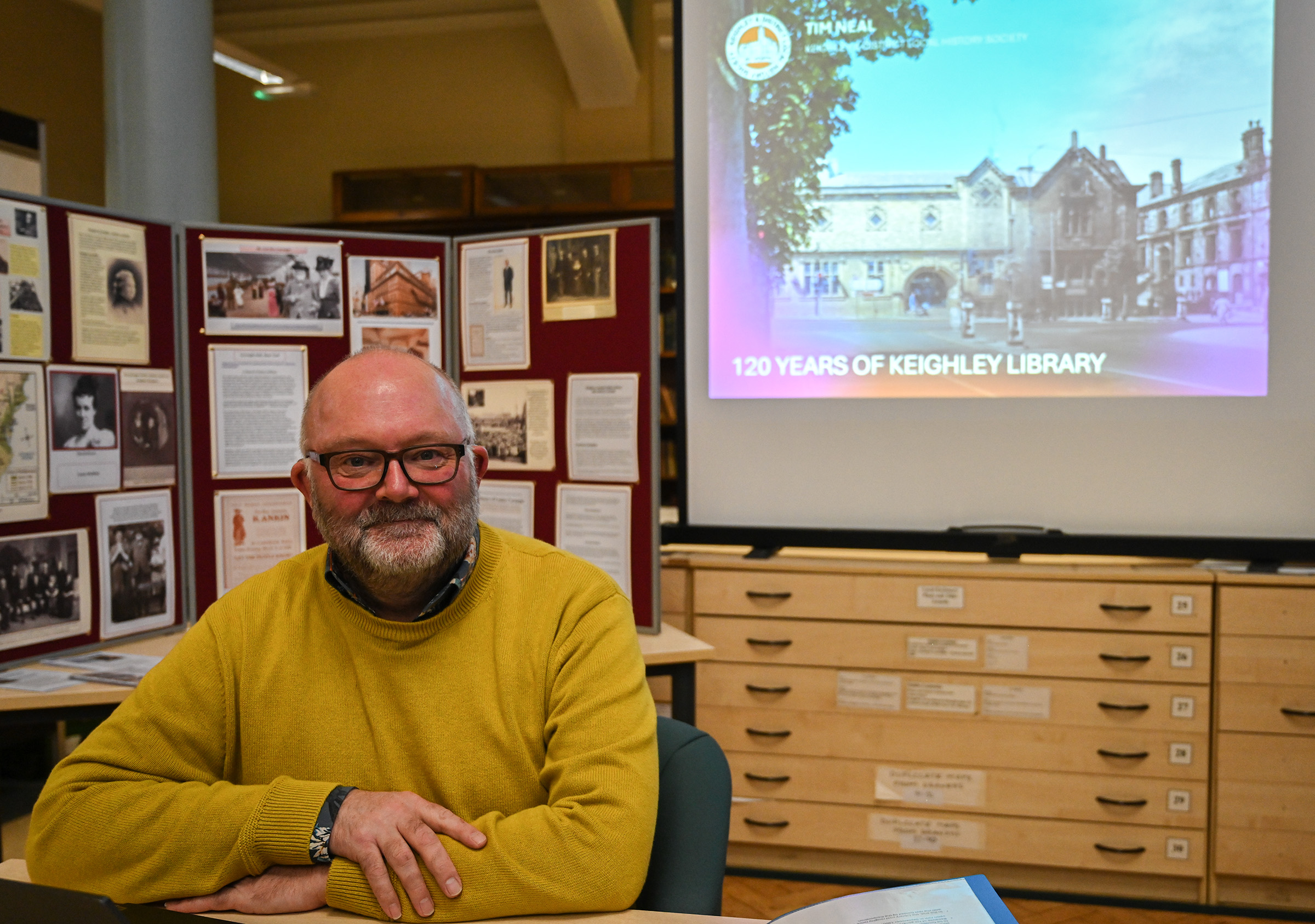
Tim Neal

Tim Neal
Keighley & District Local History Society
keighleyhistory.org.uk
facebook.com/keighleyhistorysociety
flickr.com/keighleyhistory

All the photographs are “courtesy of the Keighley & District Local History Society”. The one of Tim Neal on his own at his desk is by “Cath Muldowney Photography”