Join us at Bradford Local Studies Library to watch the award-winning documentary “Painted” by Bradford filmmakers Faith+Bones on Saturday 24thOctober, with screenings at 10:30 – 11:30 and 14:00 – 15:00. This is a free event but places are limited – please book via local.studies@bradford.gov.uk or by calling 01274 433688.
As a portrait artist attempts to capture their essence on canvas, four Afro-Caribbean elders in Bradford share their extraordinary Windrush stories of rebuilding Britain, confronting racism, and finding resilience, revealing the layers of identity that define a generation.
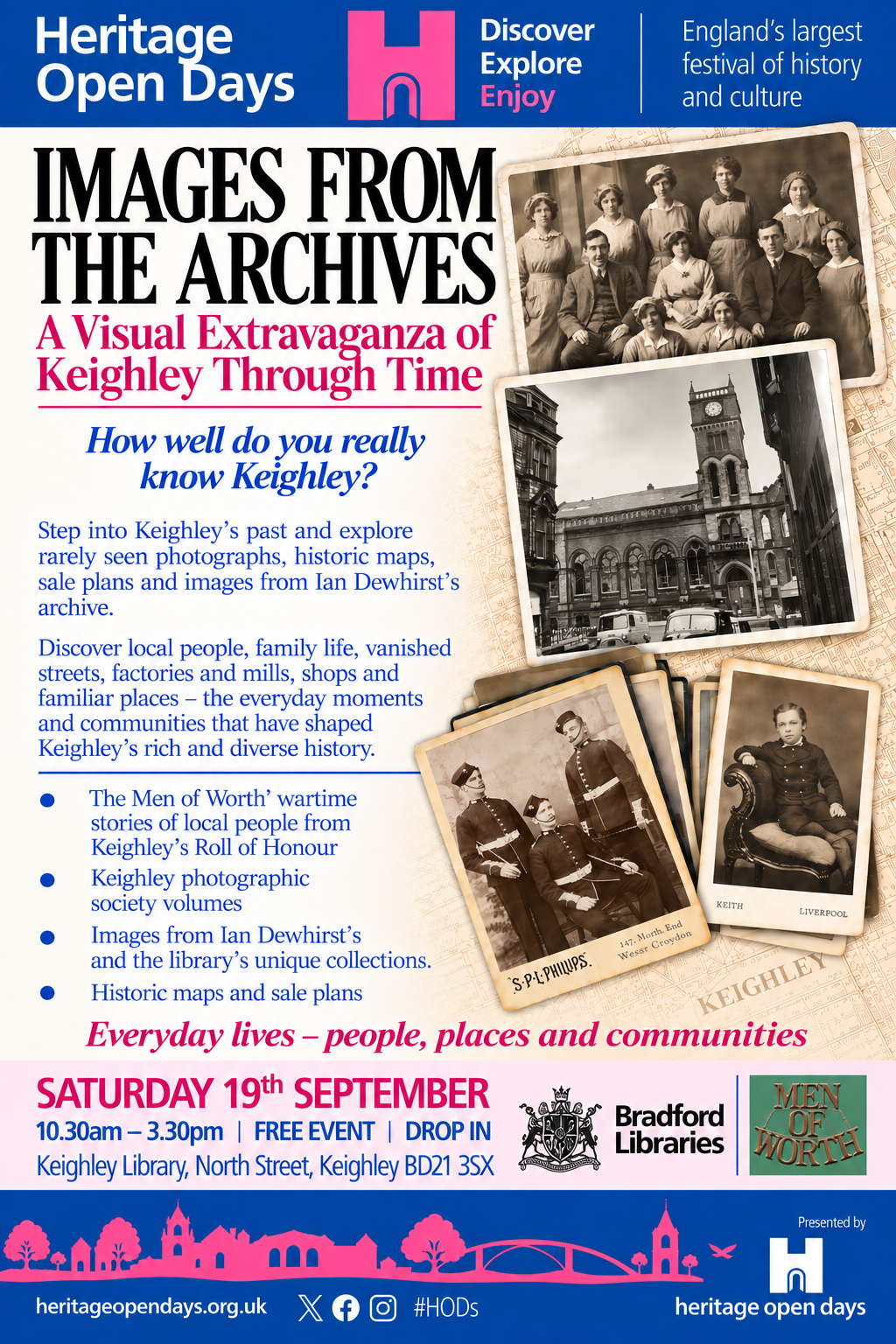
Come along on Saturday to Keighley Local Studies Library and discover some of the amazing images held within our archive collections. Explore rarely seen photographs, including images from Ian Dewhirst’s archive. Celebrating this years Heritage Open Days theme ‘Everyday Lives’, uncover fascinating glimpses of Keighley’s past, from local people and family life to long gone streets, bustling factories, mills, shops and familiar places.
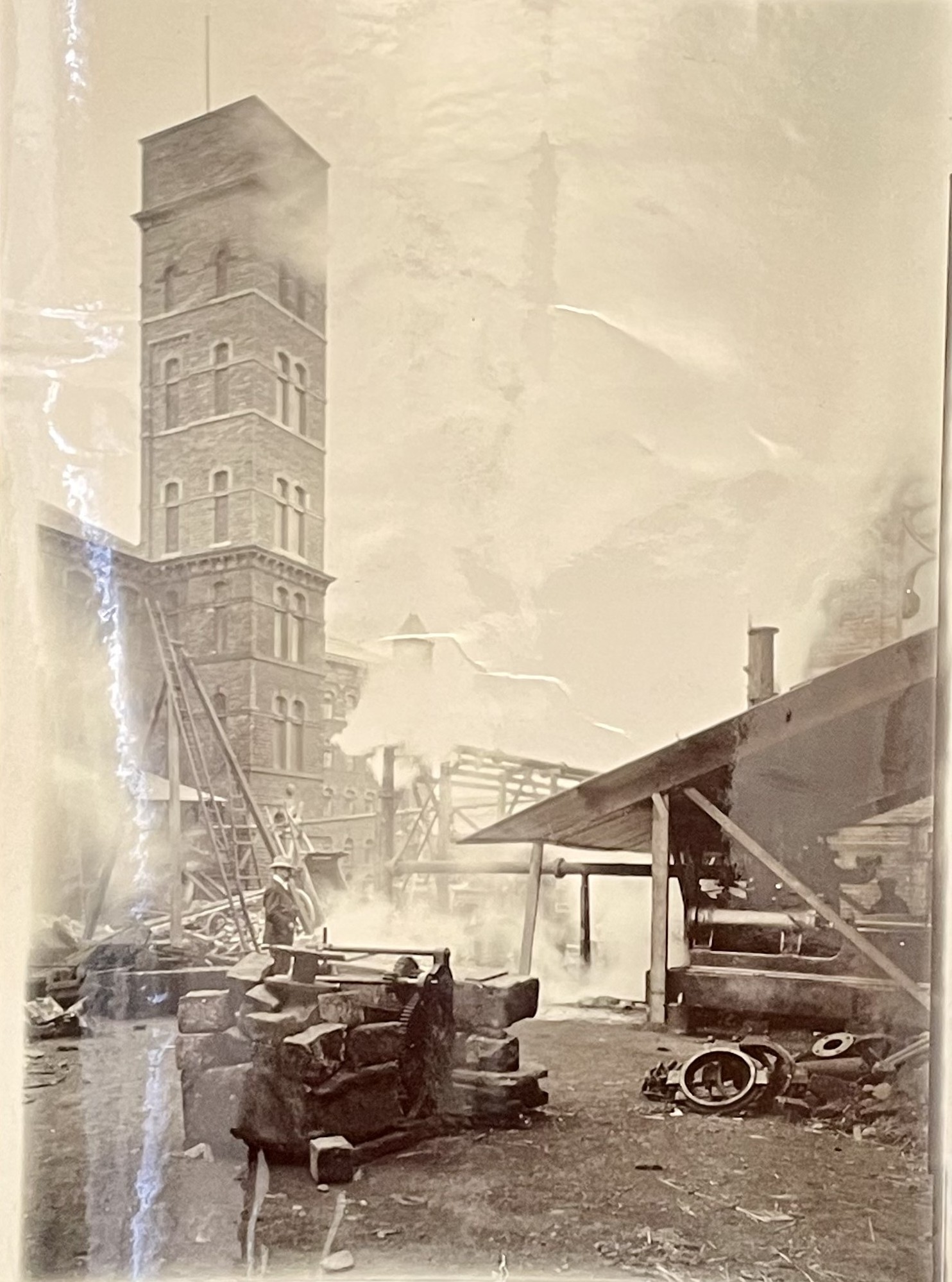
Dalton Mills from an unusual perspective.
We will have our archive of Stereoscopic images showing life in Keighley from the 1890s. You will be able to see old Keighley come to life in 3D.
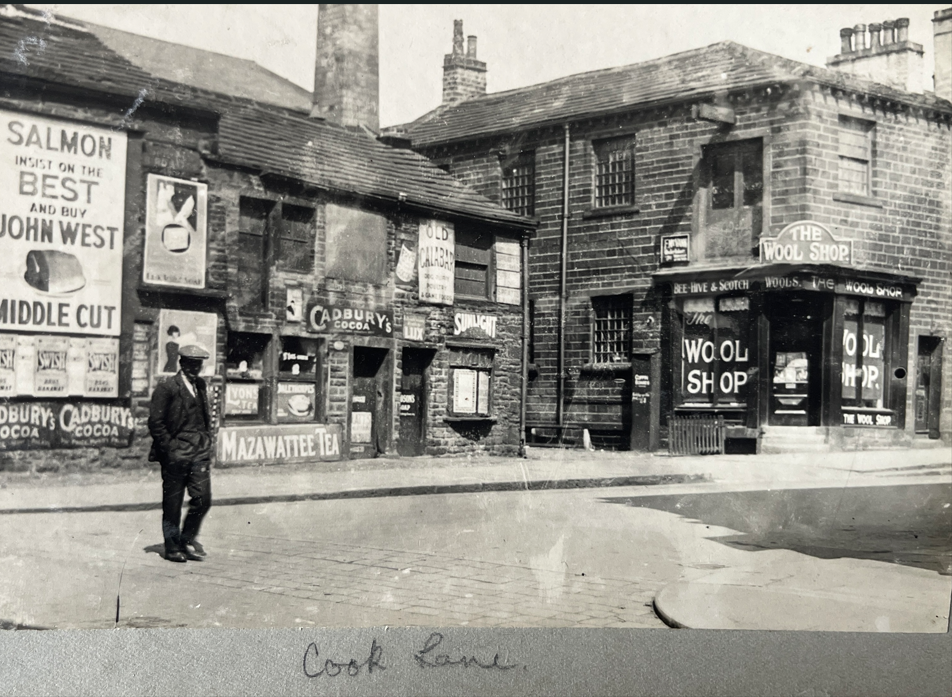
COOK LANE BEFORE THE REDEVELOPMENT OF THE TOWN CENTRE IN THE 1960s AND THE CONSTRUCTION AIREDALE SHOPPING CENTRE
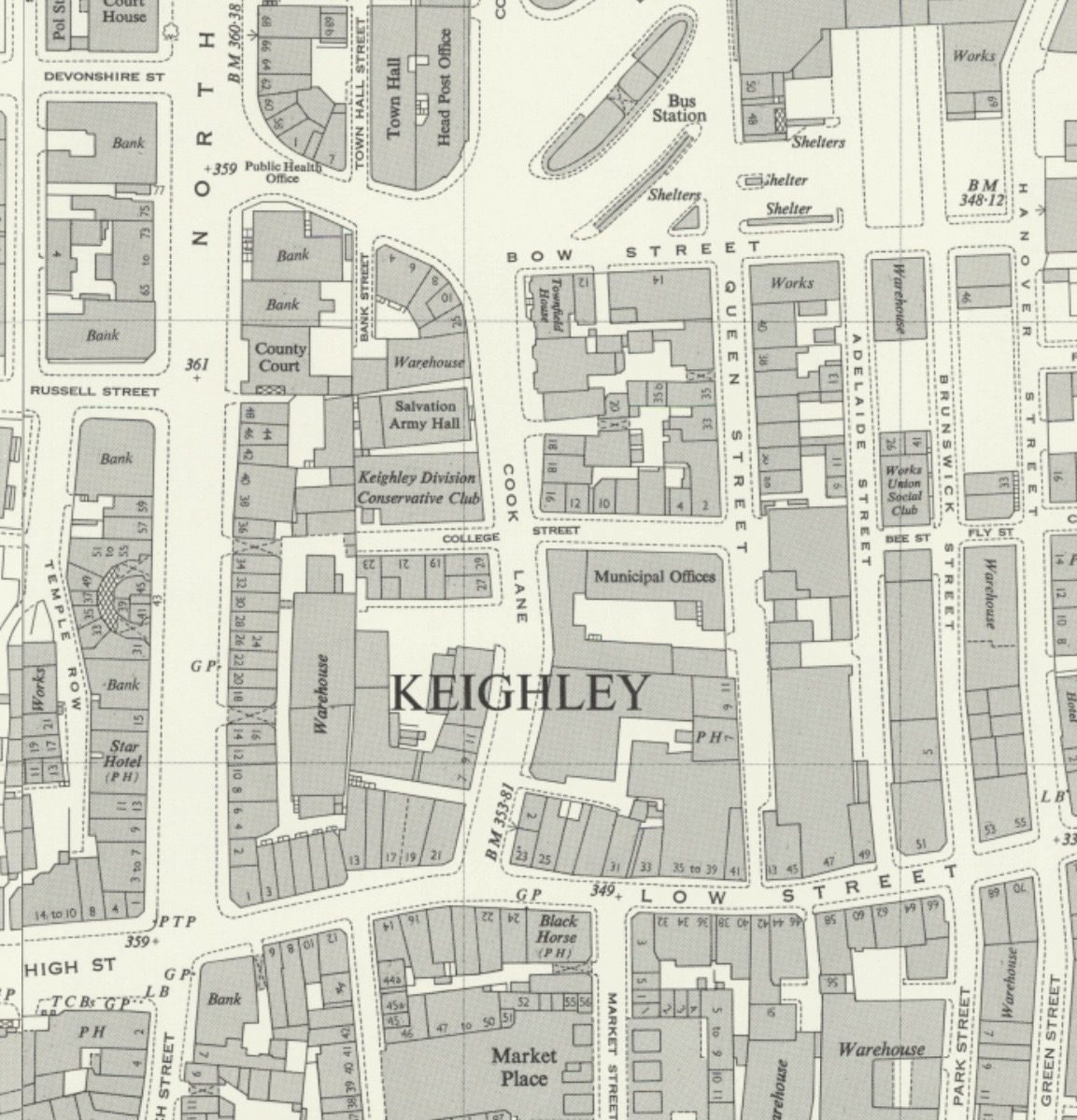
OS MAP SHOWING COOK LANE BEFORE DEMOLITION AND THE AIREDALE SHOPPING CENTRE WAS BUILT
We will also have the ‘Men of Worth’ with us with a selection of the groups research available to see. Discover the people behind the names on Keighley’s Roll of Honour. Find out about their wartime experiences and the stories of their lives back home in Keighley and the Worth Valley
Before the introduction of free public libraries, access to books was a luxury reserved for those who could afford private subscriptions.
1832: The Bradford Mechanics’ Institute was founded. It provided technical education and a library of books explicitly for working-class men.
Exclusivity: While revolutionary, these spaces still required small membership fees, leaving the poorest citizens without free access to literature or learning.
The Birth of the Free Library (1871–1878)
Following the national Public Libraries Act of 1850, Bradford became the fifth town in Yorkshire to adopt the legislation after a public meeting called by the mayor in 1871.
15th June 1872: The Bradford Free Library opened its doors in rented premises on Tyrrel Street, inaugurated with major civic pride by Mayor Matthew Thompson.
When it first opened in June 1872, Bradford Public Library enabled people from all walks of life and of all ages to access information and education freely for the first time.
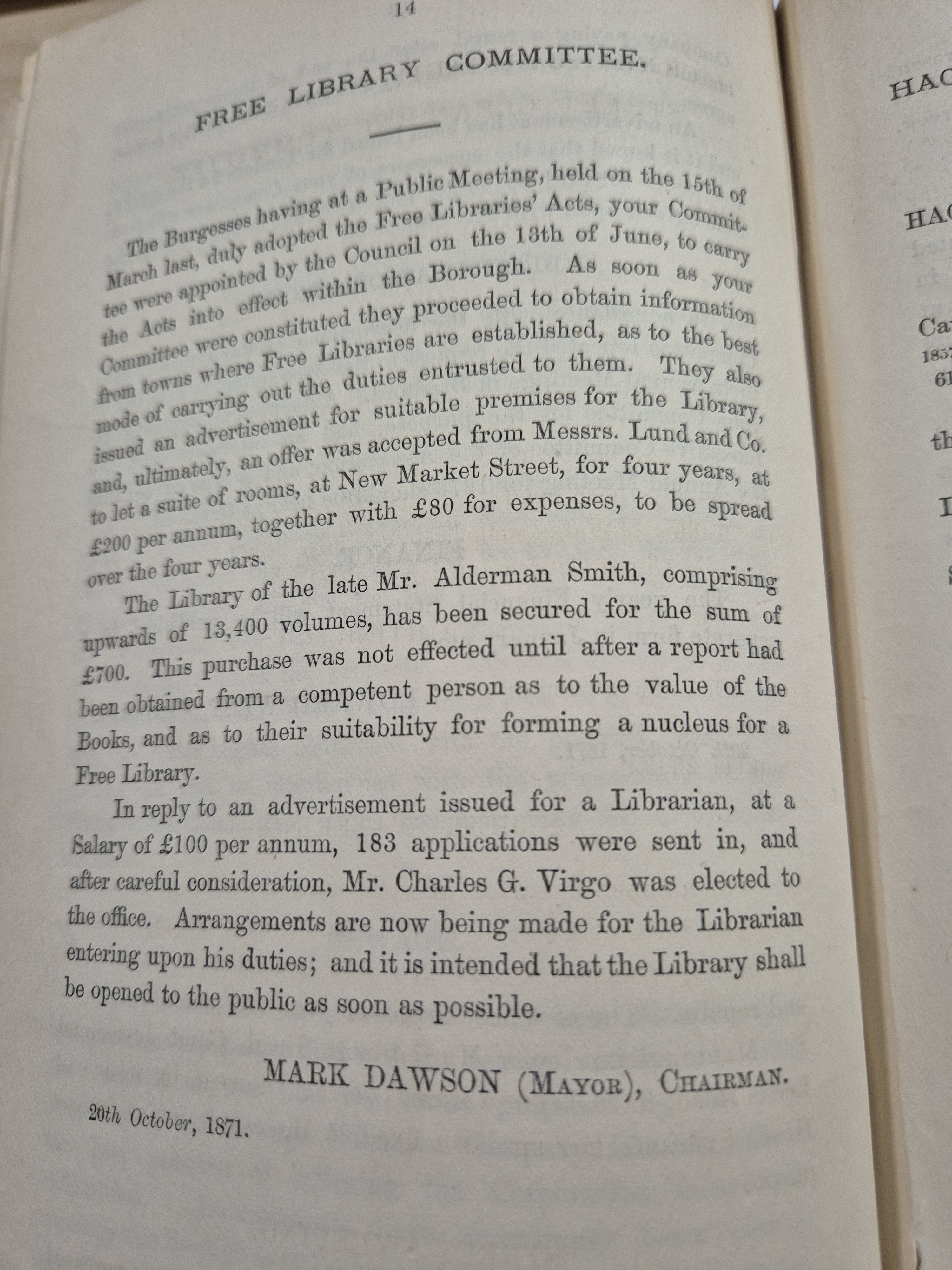
The 1872 initial collection of the Bradford Free Library was anchor-funded and heavily comprised of a singular massive acquisition: the private collection of Alderman Samuel Smith. See picture below.
reports-of-committees-of-bradford-city-council-1867-1876-1871.png Bradford Local Studies Library
Alongside city leaders Briggs Priestley and John Venimore Godwin, the library acquired 13,400 volumes from Smith’s estate to rapidly stock the shelves at Tyrrel Street before opening day.
What the 1872 Collection Included
Because it was established strictly as a Reference Library and Newsroom during its first few months, the collection was selected to prioritize information density and public utility rather than casual fiction:
Local History and Antiquities: Early efforts focused heavily on preservation, creating a repository for local political pamphlets, transcripts of the Bradford Parish Registers, and topographical maps of the West Riding.
Newspapers and Periodicals: The newsroom floor featured a vast selection of local daily and weekly broadsheets, including early bound volumes of the Bradford Observer (later the Telegraph & Argus), alongside commercial trade sheets to support the booming wool and textile sectors.
Scientific & Commercial Reference: Directories, patent records, gazetteers, and standard 19th-century encyclopaedias designed to help local working-class men educate themselves.
Reports of Committees of Bradford City Council 1872, p13,14. Property of Bradford Local Studies Library
February 1873: The lending department officially opened to the public, allowing citizens to take books home for the first time.
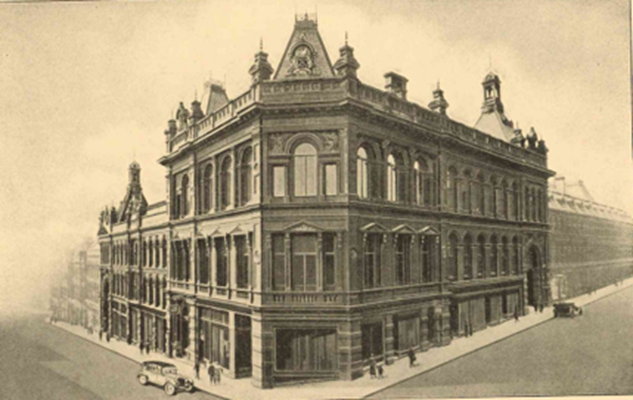
1878: To accommodate rapidly growing demand, the library migrated to a grander, purpose-built facility on Darley Street. This site offered a newsroom, reference and lending blocks, separate reading rooms for men and women, and an art gallery.
Central Public Library Location: Darley Street, Bradford, Source/Collection: Bradford Libraries Archive
Reading Room / Reference Library area at the Central Public Library Location: Darley Street, Bradford, Source/Collection: Bradford Libraries Archive
The Libraries Committee was responsible for overseeing the maintaining/expansion and governance of the Bradford Free Library. James Duncan Law’s grandfather, James Law JP, was a central pioneer of Bradford’s initial municipal expansion. During his tenure as Mayor in 1867, he advocated heavily for Bradford to adopt the 1850 Free Libraries Act, (The Public Libraries Act 1850 was a monumental piece of UK legislation that laid the foundation for the modern public library system. Introduced to Parliament as a backbench bill by William Ewart MP and Joseph Brotherton MP, it gave local authorities discretionary power to establish free public libraries for the very first time, paving the way for the opening of the first branch at Tyrrel Street in 1872. Following his mayoralty, James Law JP served as a dedicated director of the Bradford Library for over 25 years, steering its transition into the larger, grander Darley Street premises.
Inheriting this role, James Duncan Law (1882–1940) carried the family’s oversight into the early 20th century. Operating through the Committee, he managed the strategic upkeep, library staffing, and expanding catalogue of the Darley Street Central Lending and Reference Library. His primary focus was maintaining the library’s educational resources to support the local working class during the height of Bradford’s industrial textile boom.
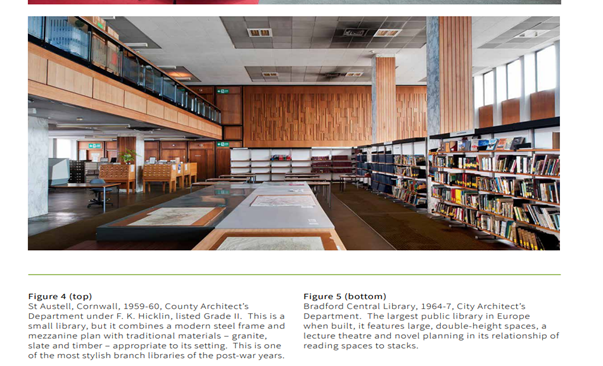
When the landmark, eight-storey Bradford Central Library officially opened on Monday 17 July 1967, it introduced two major historical “firsts” to the United Kingdom’s library infrastructure:
1. First Major Post-War Central Library in the UK
The building was a structural milestone for British municipal design. It stood as the very first major, newly built post-war central library building in the entire United Kingdom. It was commissioned as a flagship symbol of the 1960s urban redevelopment of Bradford city centre.
The building was commissioned to solve extreme overcrowding at the old Darley Street premises. It was designed by Bradford Corporation’s City Architect, Clifford Brown. He worked closely with the pioneering City Librarian, Harold Bilton, who had pushed for a modern premises since taking the role in 1951. The complex was built as an eight-story high-rise paired alongside an adjacent 400-seat Library Theatre. The structure made extensive use of glass facades and large reinforced concrete spans to maximize open space, natural light, and structural visual flexibility.
Financial Scale: When the building was finalized and officially opened by H.R.H. Princess Alexandra in 1967, the total construction and fitting cost was £800,000. For context, at the time, this massive investment was equivalent to buying multiple professional football clubs.
2. First UK Library Using the “Subject-Department” Principle
Before 1967, British libraries strictly separated their lending books from their reference books (often keeping reference texts tucked away in a closed-off area). Inspired by modern American systems, Bradford’s City Librarian, Harold Bilton, broke tradition:
Integrated Departments: Bradford Central Library became the first in the country to combine lending and reference materials together into designated subject departments.
The Layout: If you visited the 5th floor, for example, you found all social science lending books, reference texts, and specialists in that field grouped in one single zone.
Evolution of the Stock
June 1872: The Reference Library opened with the 13,400 general and local volumes.
February 1873: The library added a popular Lending Department, expanding the collection to include classic 19th-century literature and standard science textbooks.
In 2013, the library moved from Margaret McMillan Tower into a building in City Park which was shared with Bradford Museum and Galleries. This obviously caused a reduction in stock, and the entire library now only covered 2 floors. This did not deter usage as City Library as it is now known is still one of the busiest libraries in the district.
There is a display of photos on display in Bradford Local Studies, which people are welcome to come and see. These will be up until 31st August when the display will change to Septembers subject.
Following on from the school meals, we are now looking at Bradford and it’s MILK history.
THE BRADFORD MODEL MILK COMPANY
The Bradford Model Milk dairy was the brainchild of Wilfred Lowe, who is recognized as a key pioneer of the milk industry which developed its prominent operations and milk processing footprint in Bradford during the 1930s. As many dairies went completely over to pasteurized milk, which became the normal daily doorstep delivery across most of Britain, the Bradford Model Dairy became famous for its sterilised milk, which it continued to process. In a time when most back-to-back houses would not have had fridges, sterilised milk, was preferred because it lasted longer.
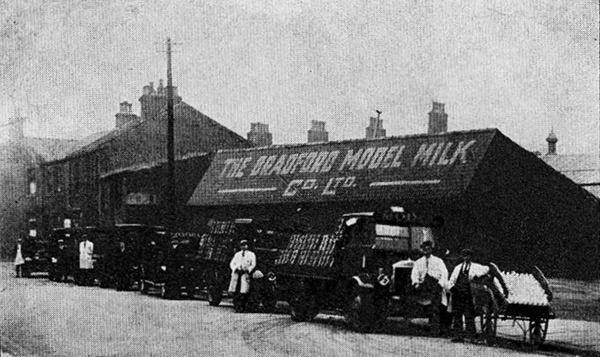
The Bradford Model Milk Company Laisterdyke Dairy building
Bradford Model Milk Dairy, Laisterdyke, Bradford. With it’s famous chimney.
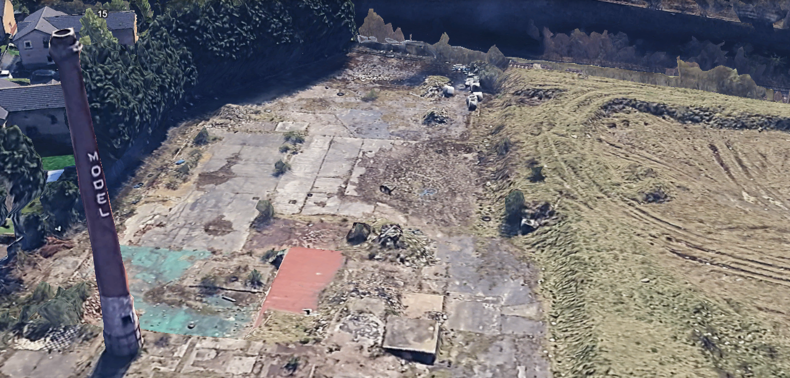
The famous chimney with the word ‘MODEL’ painted down the side is all that is left at the site now.
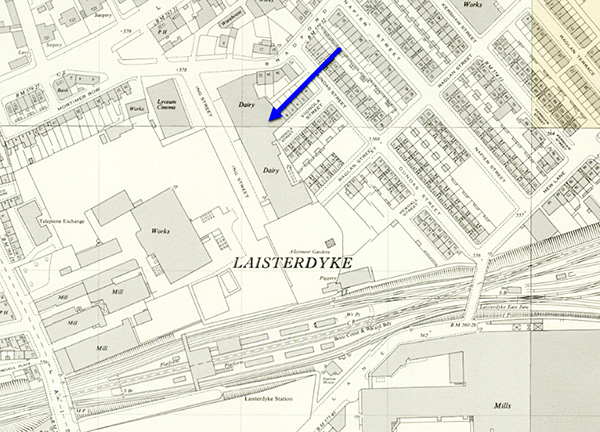
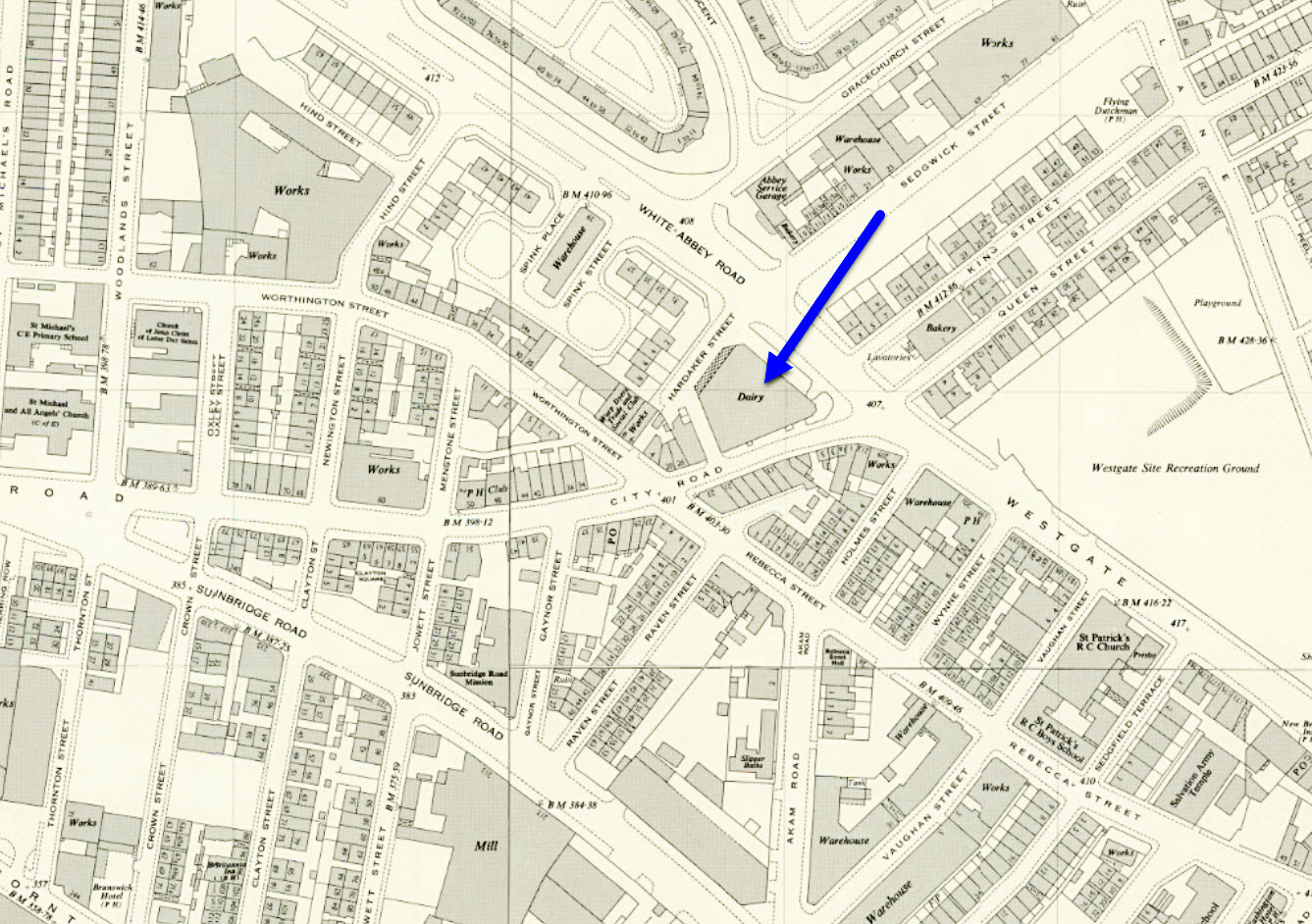
1957 map of the Laisterdyke Dairy site next to the mills and the sidings yard.
The Bradford Model Milk Co. Ltd (later known as the Bradford Model Dairy) opened its Laisterdyke milk bottling plant at the Argonaut Mill site in Laisterdyke in 1926. The company operated from this location until 1952, when it moved to a new, larger dairy plant on White Abbey Road.
The Bradford Model Dairy operated separate industrial processing lines to cater to different market needs:
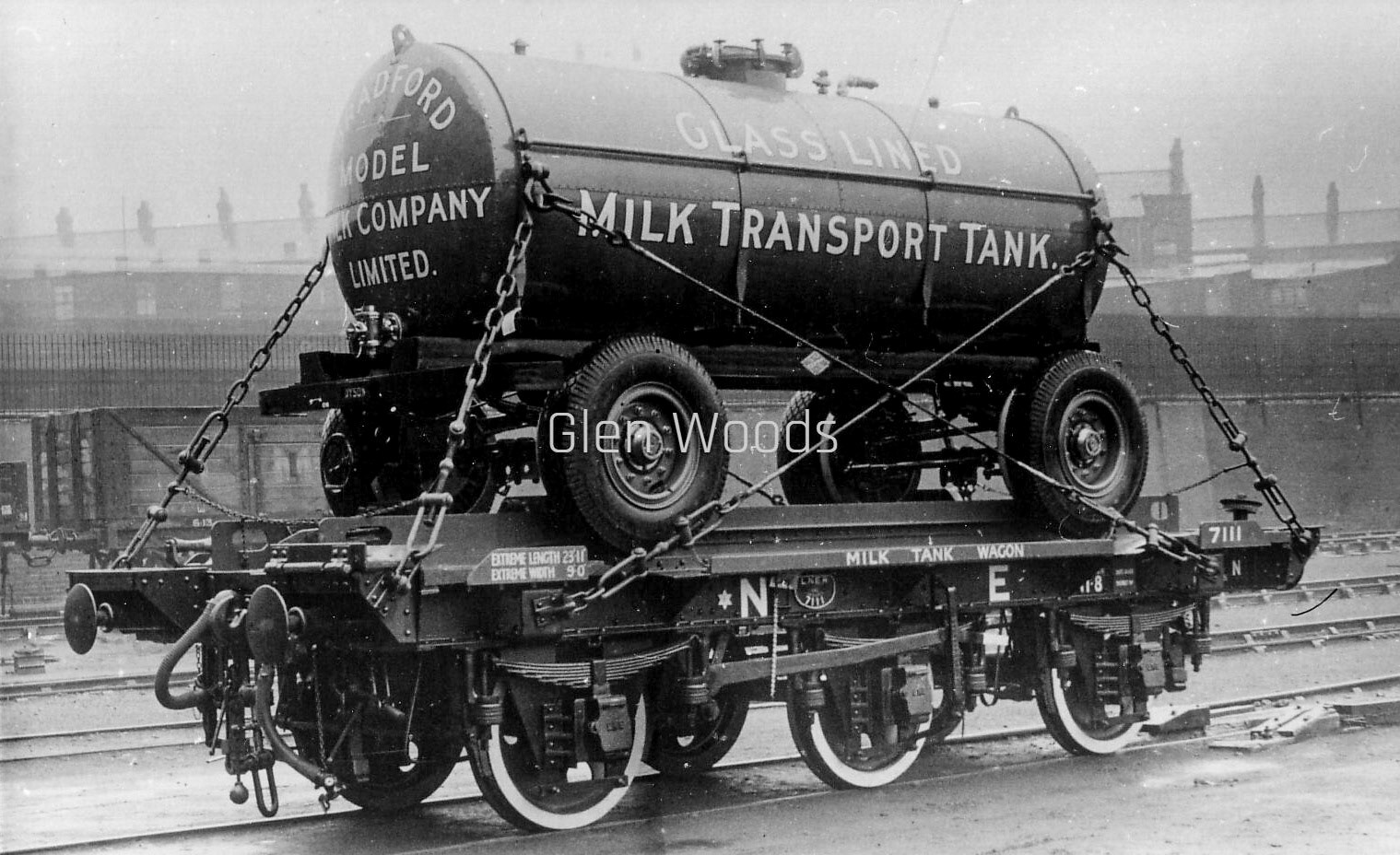
The Pasteurisation Line: Raw milk arriving by rail tanks like the one in the picture above, via Bowling Back Lane/ Laisterdyke rail was pasteurised—heated to roughly 72°C for 15 seconds—to destroy immediate pathogenic bacteria while preserving a natural cream line and fresh taste. It still required continuous refrigeration.
The Sterilisation Line: For “Model Milk”, the dairy took processing a step further. The milk was homogenised so the cream would not separate, sealed in airtight glass bottles with distinct swing-tops (and later crown caps), and heated intensely in excess of 100°C
In the 1930s, the rail line running via the viaduct above Bowling Back Lane in Bradford connected Bowling Junction to Laisterdyke. 2,000-gallon milk tank trucks were removed from train wagons, and these were sent to local facilities like the Bradford Model Dairy, which was built alongside the Laisterdyke Sidings yard.
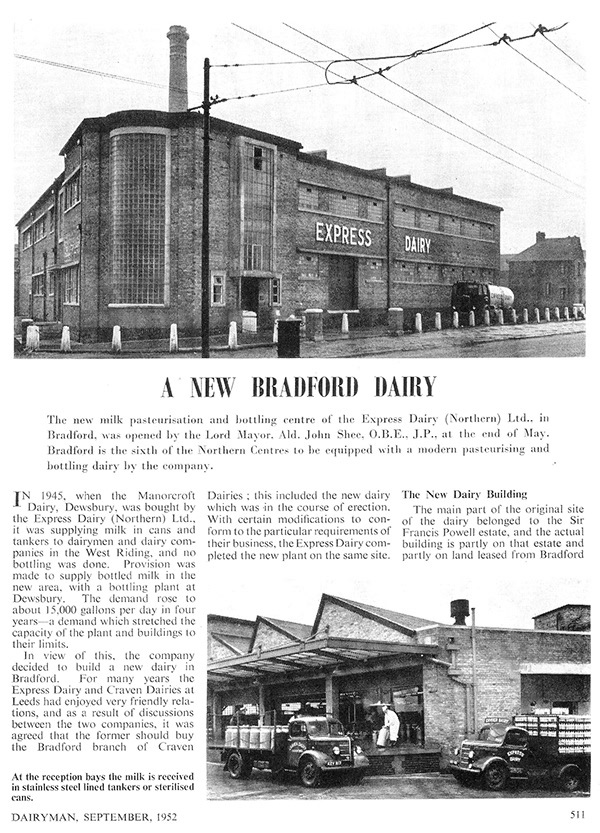
In the late 1930s or early 1940s, Craven bought out Wilfred Lowes business and immediately started looking at expanding. He required a new location, so work started on the new dairy on White Abbey Road. Shown below.
In 1949, after talks with Express dairies, a deal was made between the two and Express became the new owners and sole milk delivery company in the immediate area, delivering milk in cartons to hospitals during the 1962 Bradford smallpox outbreak.
White Abbey Road Dairy , after opening in 1952.
The dairy has undergone a few transitions:
1969: Express Dairies was acquired by Grand Metropolitan, the hotel group, who in 1969 diversified into fresh food.
1991: Sold on to Northern Foods, who began as an East Yorkshire dairy, called Northern Dairies in 1937. In post war Britain, they diversified and eventually became the ready meal company that partnered with Marks and Spencer.
2003–2006: Following restructuring, the business was bought by Arla Foods in 2003 and later transferred to Dairy Crest in 2006.
Thank you to https://expressdairytales.uk/ed-bradford for letting me use some of their images and history. Please head over to their website to learn more about the fascinating history of Express Dairies.
On Thursday, Keighley Library staff received the very sad news that one of their most dedicated Library friends and volunteers, Mr Philip Jackson had passed away.
It was only last year that library staff celebrated Mr Jackson’s 100th birthday and the work that he had undertaken in the library during his retirement, over an astonishing period of twenty-five years.
Keighley Library has been blessed with a number of volunteers, but Mr Jackson was one of the most dedicated and along with the late Steve Wood, Ian Walkden and David Kirkley kept abreast of developing technology so that their work was doubly valuable to staff and the service that faced such rapidly changing and challenging times in information delivery and storage.
Nothing fazed Mr Jackson who scanned photographs and regularly submitted word processed transcripts and indexes in Excel. Over the years we have bound over 15 volumes of his work that have helped staff and family history researchers at home and abroad. He was also very knowledgeable about the local area, having lived in Keighley most of his life and would happily share that knowledge when asked to do so by staff or customers. Last month we were very honoured to receive his collection of local and family history material which we know will be invaluable to the library and researchers of local and family history of the future.
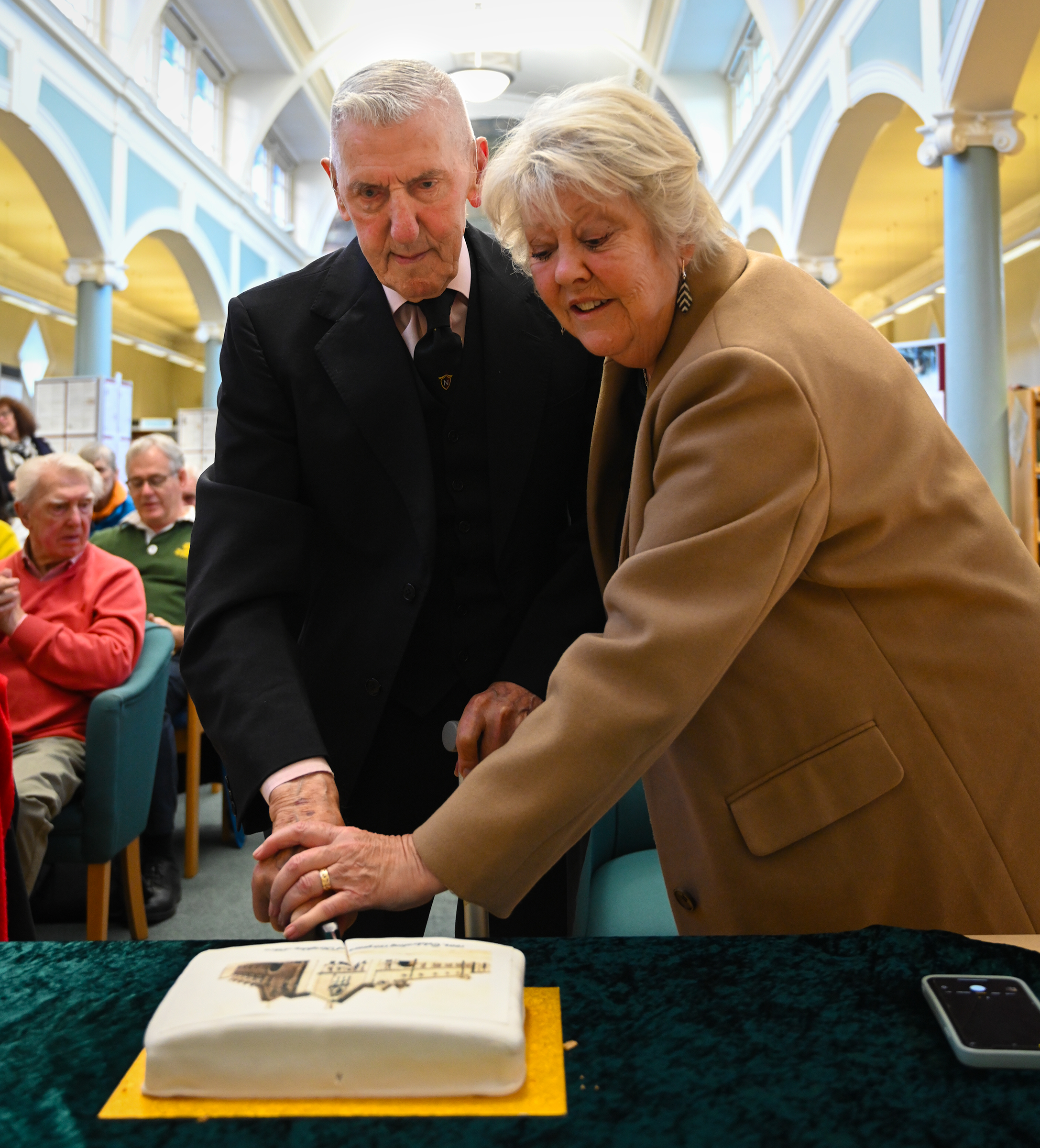
In his 100th year, Mr Jackson cut the cake for us to celebrate Keighley Library’s 120th anniversary year, 2024 and, despite failing eyesight continued to attend events and support us. Staff always enjoyed his visits and his friendship and he will be very sadly missed by us all.