
Bradford Firsts – Blog Series No. 2
As part of the Bradford Heritage Festival, running from 13–19 July 2026, Bradford Local Studies is working with West Yorkshire Archives and Bradford Heritage Connection to launch a new series exploring Bradford Firsts—innovations and social movements that began right here in the city.
With this year’s Festival theme focusing on Education, our first blog looks at something that has shaped childhood for generations: the creation of school meals.
This week we will be looking at the meals themselves and the role steam in making them.
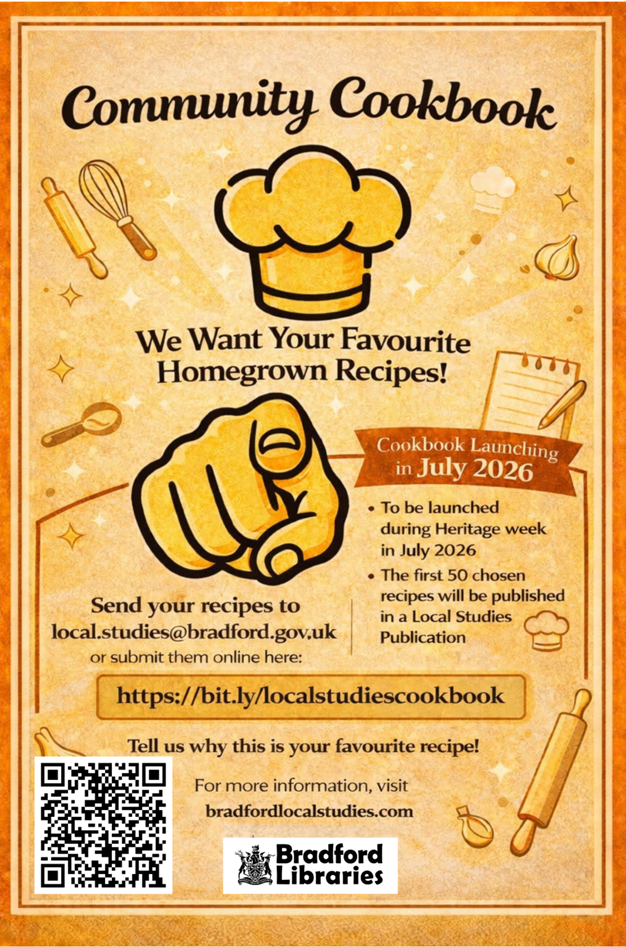
A Bradford Community Cookbook – We Need Your Recipes!
To celebrate the diverse heritage that makes Bradford the most culturally rich city in Yorkshire and the Humber, we are creating a Bradford Community Cookbook.
We’re inviting you to share:
- a treasured family recipe,
- a favourite school pudding, or
- a dish passed down through generations.
The first submissions will be compiled into a published community cookbook celebrating Bradford’s vibrant food heritage.
In the first in the series, we looked at the Cinderella Club, reports made for the Education Board and the introduction of the meals into schools.
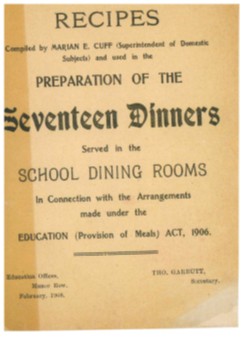
Today we will look at the meals themselves, what they were, what they were made with and even try to recreate a couple using an original 1906 recipe. The 1906 recipe booklet was compiled by Marion E. Cuff, the Superintendent of Domestic Subjects, which today would probably be called Home Economics or Family and Consumer Sciences (FCS).
Who was Marian E Cuff? She wasn’t just a superintendent; she was a pioneer of what became known as “Domestic Science.” She developed 17 different recipes for the Bradford scheme, ensuring that even on a tight budget, the meals were varied—including two vegetarian days and a fish-based Friday. These meals were introduced on a rotating basis across the month, so that the children had a nutritional diet. The “Bradford Experiment”: The menu booklet we have is connected to the famous 1907 study where Crowley and Cuff monitored the weight and health of “necessitous” children. Their findings—that children’s health declined during school holidays when they weren’t fed—were instrumental in making school meals a national standard
Including, 4 soups, 1 fish, 6 vegetarian and 6 meat dinners. The ingredients ranged from Green Peas, Haricot Beans, Lentils and Scotch barley pulses, to the specific mention of Egyptian lentils by Marian Cuff, is a significant detail that links Victorian social reform with global trade.
Why “Egyptian” Lentils?
In the early 1900s, lentils were imported from various regions, but Egyptian lentils (typically the red or orange split variety) were highly favoured for large-scale institutional feeding like school meals for several reasons:
Cost and Efficiency: As Bradford was the first local authority to use public funds for these meals, cost-effectiveness was paramount. Egyptian lentils were an affordable mass-import from Britain’s colonial interests. Unlike whole brown or green lentils, the “Egyptian” split variety cooked much faster and broke down into a thick, filling soup or “mush,” which was ideal for serving thousands of children quickly.
Nutritional Value: Marian Cuff worked closely with Medical Superintendent Ralph Crowley to design meals that could physically “repair” undernourished children. Lentils provided a high-protein, iron-rich alternative to expensive meat, which was crucial for the “experiment” they conducted to prove that better food led to better school performance and weight gain.
Victorian “Reform” Food: By the late 19th century, lentils had been popularised in Britain by reformers and cookbooks (such as Mrs. Beeton’s) as a “scientific” and “economical” food for the working classes. The specific use of “Egyptian” lentils likely refers to the commercially available Red Split Lentil, which remains a staple in Middle Eastern and British institutional cooking today.
A “Civilising” Influence: Cuff insisted that these meals be “educational.” The children were served on tablecloths with flowers, and older pupils (monitresses) were trained to serve the younger ones, turning the lentil soup into a lesson in social conduct.
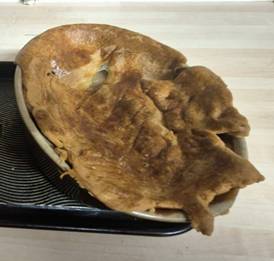
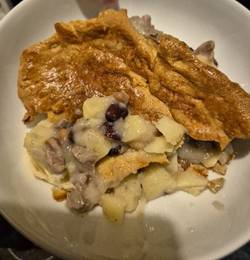
Taking one of the recipes from the menu/recipe booklet, I tried to recreate it at home, it was not good.
“Dinner No 9. Cottage Pie (Meat and Potato). Bread. Green Peas and Gravy.
Ingredients:
Contents of pie: 1lb beef without bone; 1 1/2lbs potatoes; 1/2lb onions; 11/2 pints water; pepper and salt.
Pastry: 3/4lb flour; ¾ teaspoonful baking powder; ½ teaspoonful salt; 6ozs margarine or dripping; cold water to mix; a little milk or beaten egg.) 1
Following the instructions (which can be read in Local Studies), the below was the result.
Although, by modern standards, it was unpalatable, by Late Victorain and Early Edwardian Poor Law standards it would have been deemed a luxurious feast.
Next time we will look at the “necessitous” children and the Bradford Experiment, as well as trying to recreate one of the vegetarian meals.
Ref: 1. City of Bradford Education Committee, recipes booklet. Bradford Local Studies Library. B371.716COR
Don’t forget to send in your recipes to be included in Bradford Local Studies Community
Cookbook.
Discover more from Bradford and District Local Studies
Subscribe to get the latest posts sent to your email.
