
Another piece of Bradford Food/Drink History

Following on from the school meals, we are now looking at Bradford and it’s MILK history.

THE BRADFORD MODEL MILK COMPANY

The Bradford Model Milk dairy was the brainchild of Wilfred Lowe, who is recognized as a key pioneer of the milk industry which developed its prominent operations and milk processing footprint in Bradford during the 1930s. As many dairies went completely over to pasteurized milk, which became the normal daily doorstep delivery across most of Britain, the Bradford Model Dairy became famous for its sterilised milk, which it continued to process.  In a time when most back-to-back houses would not have had fridges, sterilised milk, was preferred because it lasted longer.
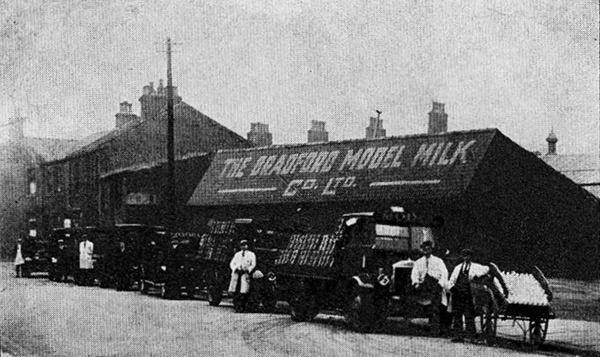
A black-and-white historical photograph from the 1930s showing a fleet of delivery trucks and workers lined up outside a large brick building. The building features a painted roof sign that reads "THE BRADFORD MODEL MILK CO. LTD." Several men in white worker coats and flat caps stand beside the vehicles, which are loaded with milk crates. A caption at the bottom of the image reads, "1930's 'Bradford Model's pioneer Wilfred Lowe would find little difficulty in recognising the original extension' (Express News Christmas 1976)."
The Bradford Model Milk Company Laisterdyke Dairy building

Bradford Model Milk Dairy, Laisterdyke, Bradford. With it’s famous chimney.

A high-angle black-and-white aerial photograph from 1954 showing the industrial landscape of Laisterdyke, Bradford. A prominent blue arrow at the top left points down toward a white-roofed industrial building building complex. Dense rows of terraced houses, factories with chimneys, and a multi-track railway line running alongside a bridge are visible across the urban area. A detailed caption at the bottom reads: "1954 Aerial shot of Laisterdyke, Bradford, with Bradford Model Dairy arrowed, 'Model' on the chimney. The bottling plant opened in 1926 and was acquired by Express in the 1950's; a new dairy was opened in 1951. (Courtesy Matthew Pinto, Milk on the Rails, Photo: C.H. Wood)."

The famous chimney with the word ‘MODEL’ painted down the side is all that is left at the site now.
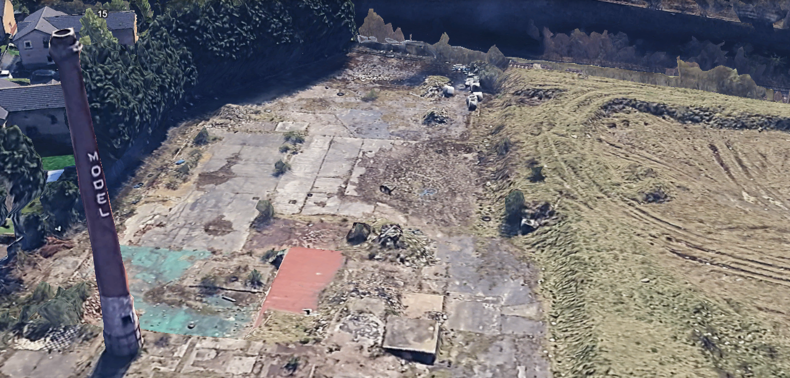
A high-angle 3D satellite image showing the abandoned, demolished site of a former industrial facility. A tall brick chimney stack stands prominently on the left side, with the word "MODEL" painted vertically down its side in white letters. The rest of the plot consists of overgrown concrete foundations, patches of dirt, scattered debris, and vegetation. The site is bordered by thick green trees on the left and an earthen bank or field on the right.

1957 map of the Laisterdyke Dairy site next to the mills and the sidings yard.
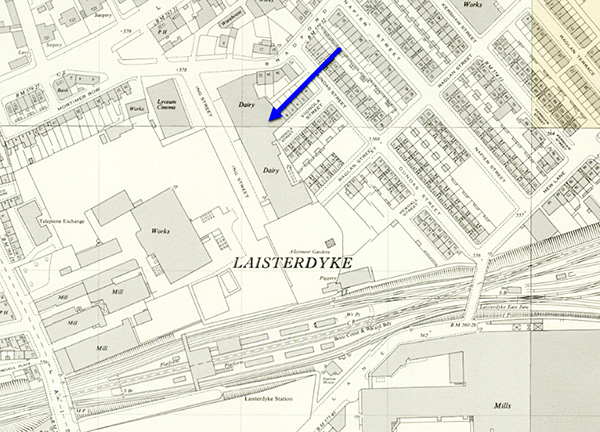
A historical Ordnance Survey map excerpt of the Laisterdyke area in Bradford, showing a detailed street and building layout. A prominent blue arrow points down and to the left toward a large building complex labeled "Dairy." Surrounding landmarks include the Lyceum Cinema, Mortimer Row, Ing Street, Dundas Street, and a Telephone Exchange. The lower section features a large railway corridor labeled "Laisterdyke Station," complete with multiple tracks, platforms, and a station house, bordered by allotment gardens and surrounding mills.

The Bradford Model Milk Co. Ltd (later known as the Bradford Model Dairy) opened its Laisterdyke milk bottling plant at the Argonaut Mill site in Laisterdyke in 1926. The company operated from this location until 1952, when it moved to a new, larger dairy plant on White Abbey Road.

The Bradford Model Dairy operated separate industrial processing lines to cater to different market needs:
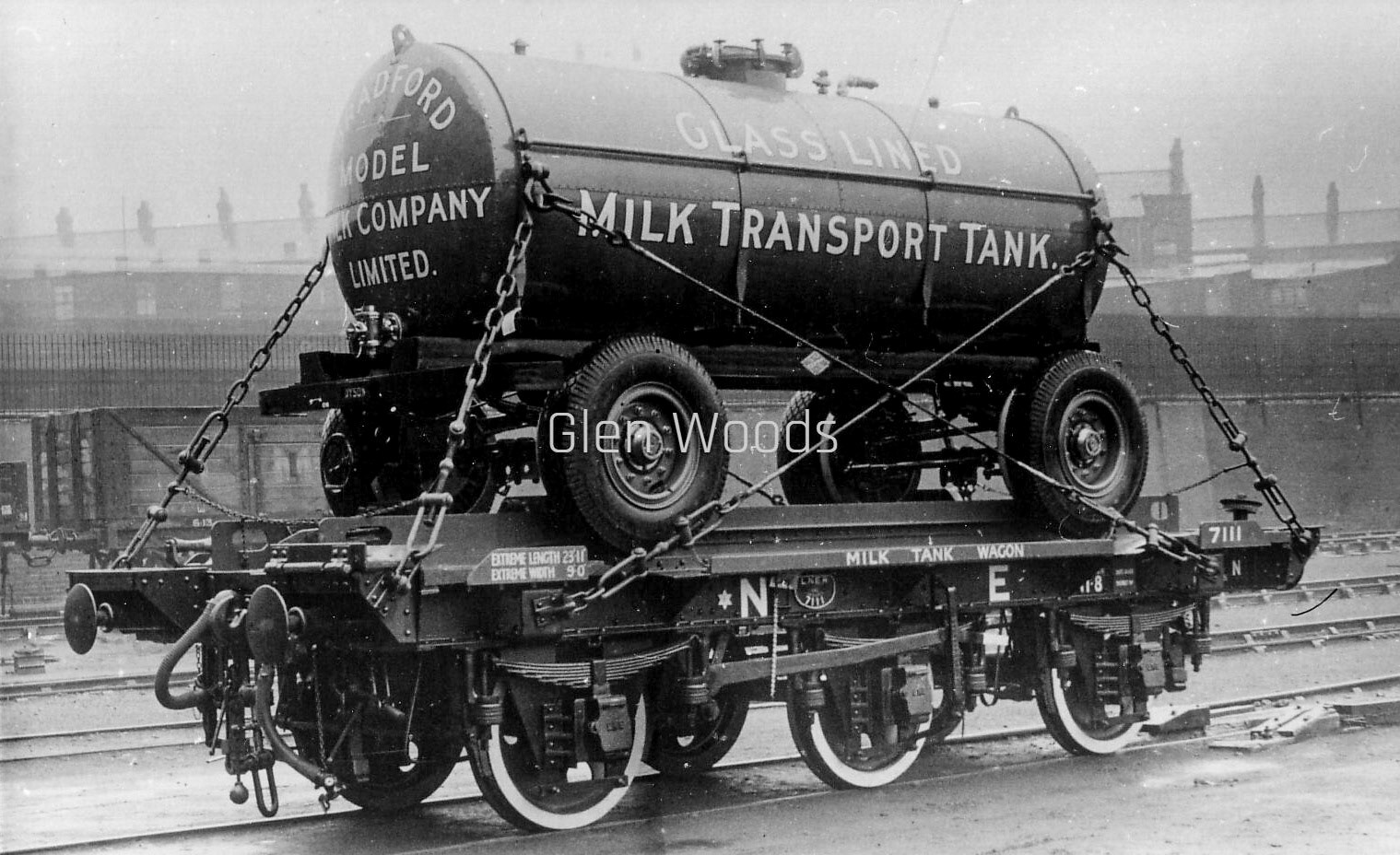
A black-and-white historical photograph of a specialized railway wagon carrying a large road tanker trailer on a set of tracks. The large cylindrical tank is painted a dark color with white lettering that reads "GLASS LINED MILK TRANSPORT TANK" on the side, and "BRADFORD MODEL MILK COMPANY LIMITED" on the circular end. The tanker trailer has large rubber tires and is securely chained down to a flatbed railway carriage labeled "MILK TANK WAGON" and marked with "NE" branding. A prominent "Glen Woods" watermark is centered across the image.
  • The Pasteurisation Line: Raw milk arrived by rail tanks like the one in the picture above, via Bowling Back Lane/ Laisterdyke rail was pasteurised—heated to roughly 72°C for 15 seconds—to destroy immediate pathogenic bacteria while preserving a natural cream line and fresh taste. It still required continuous refrigeration.
  • The Sterilisation Line: For “Model Milk”, the dairy took processing a step further. The milk was homogenised so the cream would not separate, sealed in airtight glass bottles with distinct swing-tops (and later crown caps), and heated intensely in excess of 100°C

In the 1930s, the rail line running via the viaduct above Bowling Back Lane in Bradford connected Bowling Junction to Laisterdyke. 2,000-gallon milk tank trucks were removed from train wagons, and these were sent to local facilities like the Bradford Model Dairy, which was built alongside the Laisterdyke Sidings yard.

In the late 1930s or early 1940s, Craven bought out Wilfred Lowes business and immediately started looking at expanding. He required a new location, so work started on the new dairy on White Abbey Road. Shown below.
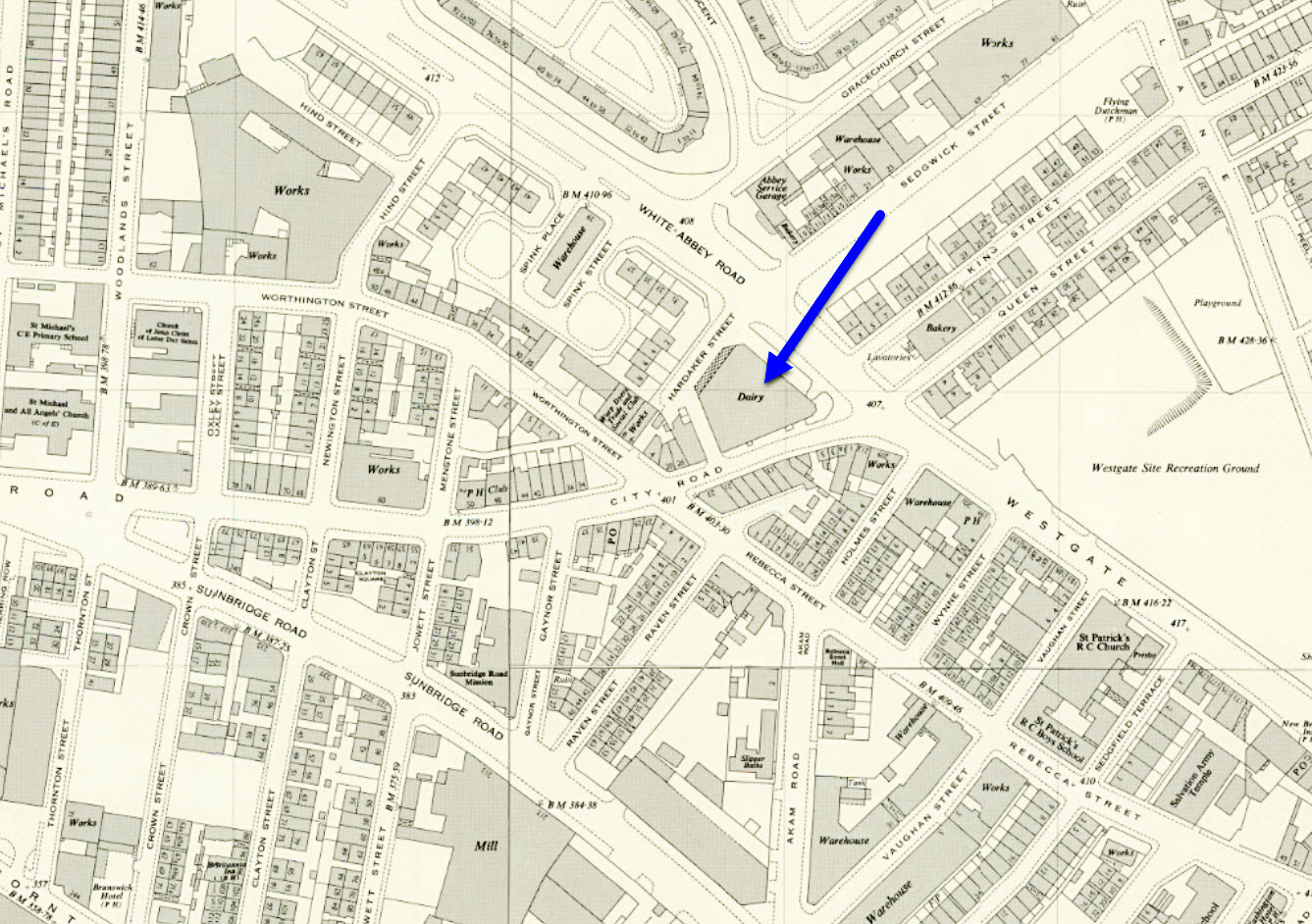
A historical Ordnance Survey map excerpt showing a dense urban and industrial sector, with a prominent blue arrow pointing down and to the left toward a building labeled "Dairy." The dairy sits at a major junction bordered by City Road, White Abbey Road, and Hardaker Street. Surrounding urban features include Worthington Street, Sunbridge Road, Westgate, several factories marked "Works," a playground, and the Westgate Site Recreation Ground.

In 1949, after talks with Express dairies, a deal was made between the two and Express became the new owners and sole milk delivery company in the immediate area, delivering milk in cartons to hospitals during the 1962 Bradford smallpox outbreak.

White Abbey Road Dairy , after opening in 1952.
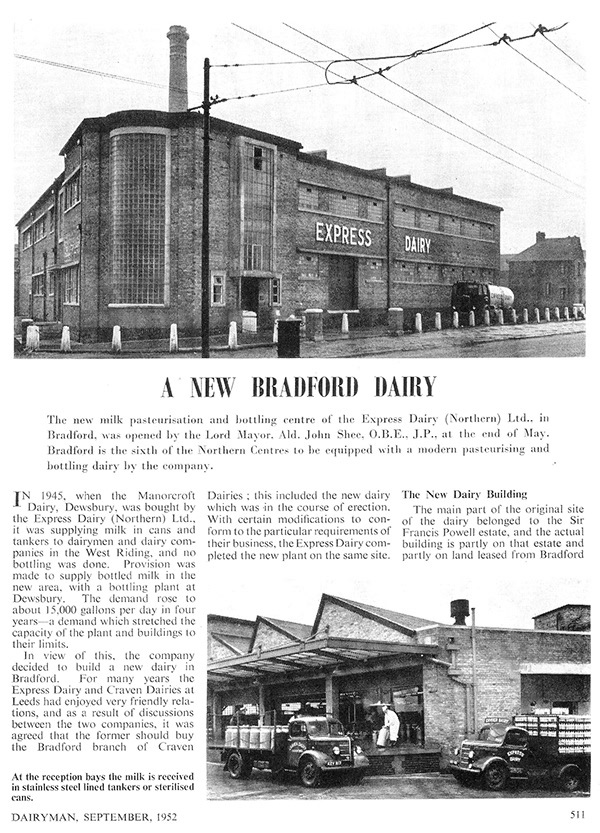
A vintage magazine page from "Dairyman, September 1952" titled "A NEW BRADFORD DAIRY." The top half features a large black-and-white photograph of a multi-story brick factory building with "EXPRESS DAIRY" painted prominently on its side walls. The bottom half contains printed historical columns describing the opening of the milk pasteurization and bottling centre by the Lord Mayor. A smaller photograph at the bottom right shows two Express Dairy delivery trucks loaded with milk crates parked underneath a sheltered reception bay.
A black-and-white architectural illustration of a modern Art Deco style industrial building. The corner entrance features a curved facade with a tall, vertical glass block window, lettering that reads "EXPRESS DAIRY," and a Union Jack flag flying from the roof. The main side of the building has rows of large horizontal windows and features prominent signage reading "EXPRESS DAIRY (NORTHERN) LTD." Pedestrians walk on the sidewalk in the foreground, and handwritten script in the bottom right corner reads, "Our New Dairy at Bradford."

The dairy has undergone a few transitions:

1969: Express Dairies was acquired by Grand Metropolitan, the hotel group, who in 1969 diversified into fresh food.

1991: Sold on to Northern Foods, who began as an East Yorkshire dairy, called Northern Dairies in 1937. In post war Britain, they diversified and eventually became the ready meal company that partnered with Marks and Spencer.

2003–2006: Following restructuring, the business was bought by Arla Foods in 2003 and later transferred to Dairy Crest in 2006.

Thank you to https://expressdairytales.uk/ed-bradford  for letting me use some of their images and history. Please head over to their website to learn more about the fascinating history of Express Dairies.


Discover more from Bradford and District Local Studies

Subscribe to get the latest posts sent to your email.

Leave a comment