Sad Passing of a Library Friend and Volunteer, Steven Wood

It was with great sadness that Keighley Library staff heard of the death of Steven Wood early Monday morning, 13th July.

Steve, as he was known to us, was a great friend of the library and of its staff. As a well-known local historian and authority on the history of the Haworth area, he often visited the library for research purposes. He gave freely of his time and expertise when we had any particularly challenging enquiries and helped not only staff but many other researchers and even appeared on television programmes about the Brontës in Haworth.

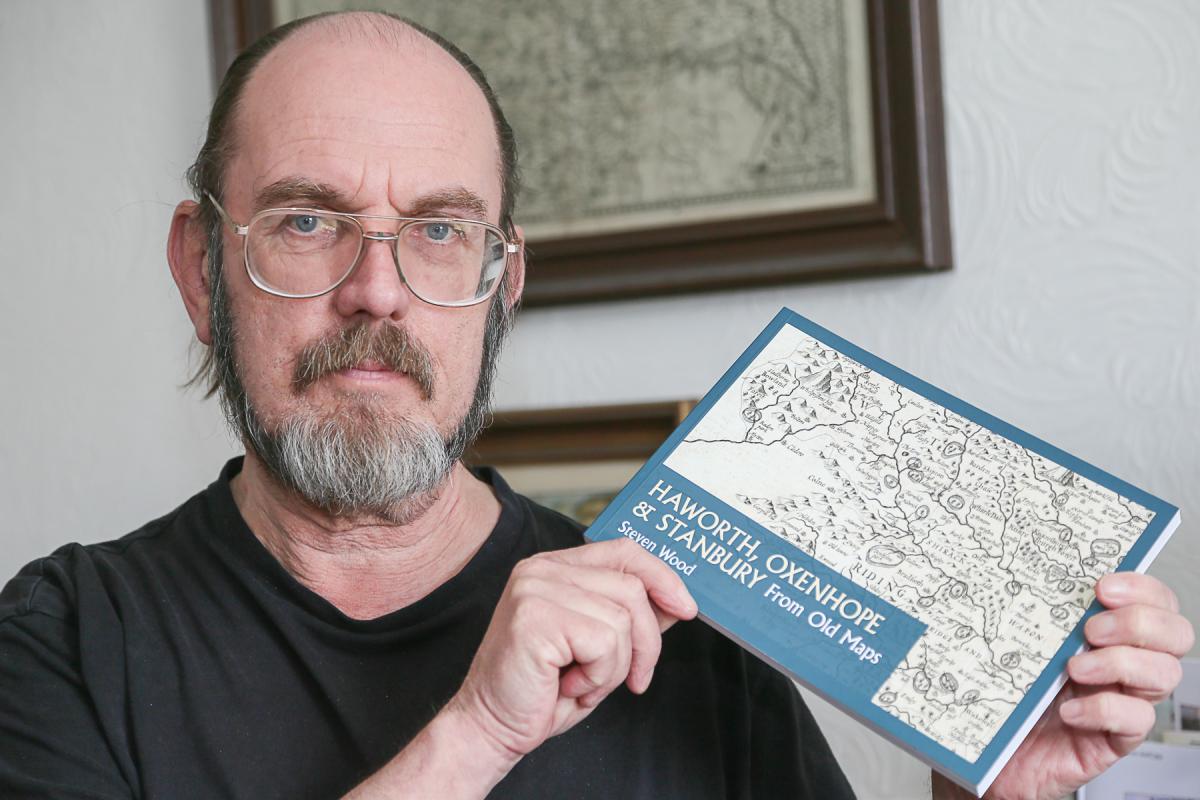
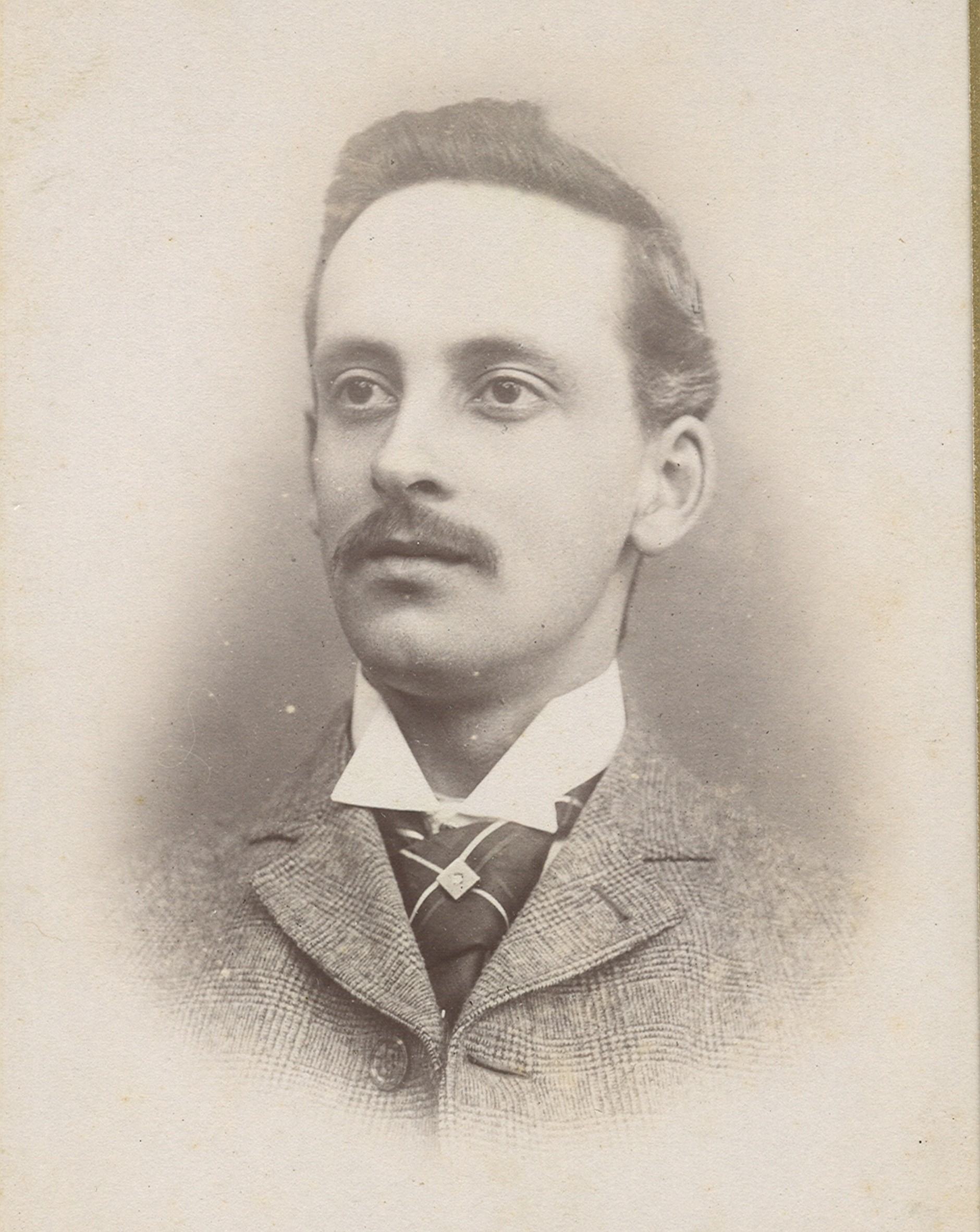
Steven Wood with his 2014 book, Haworth, Oxenhope & Stanbury From Old Maps. (image from the Keighley News)


Only recently, Steve helped library staff in the production of the Brontë trail booklet around Keighley, when we tried to work out the different routes the Brontës walked from Haworth to Keighley.  Some staff can also fondly recall a legendary winter ramble with him years ago and being thoroughly informed by him about the history and topography of the Haworth area, including water courses, so that by the end of the walk, it wasn’t just a drink that we hurried to the pub for on such a cold day.

Steve became a regular library volunteer, his work digitising the library’s archive collections on the Haworth area are of immense value. Always happy to share his research with us, his copies of databases, images and information were regularly deposited with the library as he kept abreast of developing digital technology from hard copy transcriptions of Haworth Parish registers to image indexes and maps and plans on CD.

Steve’s published works continue to be an invaluable source of information on Haworth and its locality and it’s a relief to note that he managed to complete his history of Haworth Parish Church that was a project he had set his heart on and his scholarship as an historian will be well showcased on publication. We look forward to adding this history to our library and to his collection of many other fine works here.

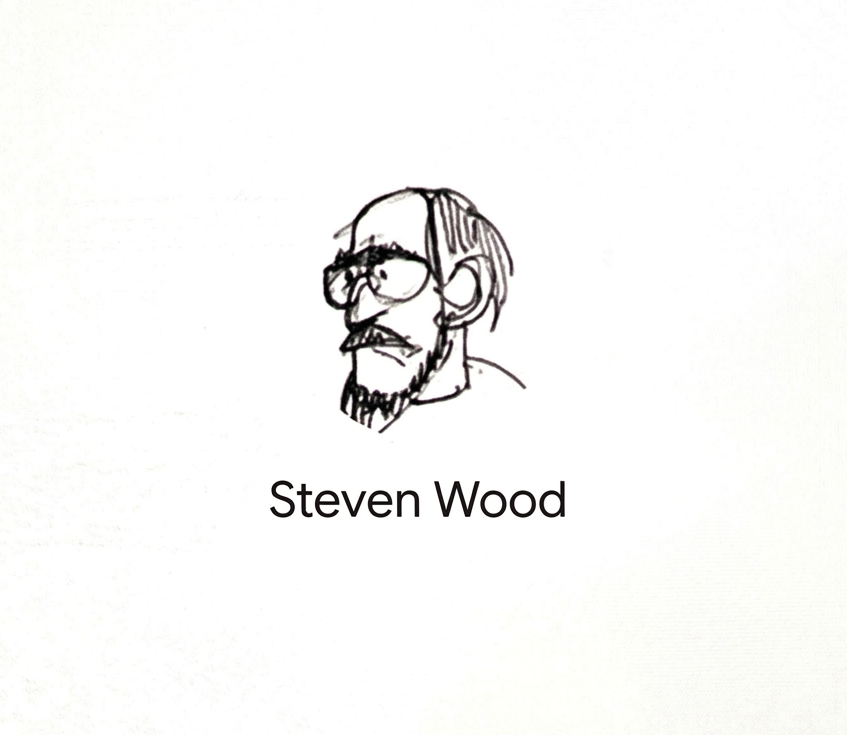
We shall miss our friend and chats with him about his other passion – books and book fairs that he used to visit. Steve was a regular bibliophile and knew such a lot on this subject that, again, he was happy to share with us. On a lighter note, he had a lovely sense of humour and would send us the occasional funny cartoon about having too many books in the house (like one or two staff here) and about libraries generally. At Christmas, he would shop for chocolate goodies and never fail to bring some in for a tea break. Steve was a lovely and very accomplished gentleman, generous with his time and knowledge, and we shall continue to miss him very much.

Keighley Local Studies Team

Bradford’s Forgotten author: A Blog Post on Bradford’s Willie Riley. A recent talk at Bradford Local Studies by David M. Copeland

Thanks to the tireless efforts of David, a University of Bradford graduate and Riley enthusiast, there has been a recent revival of interest in the life of Willie Riley. Copeland’s work has included:

A Master of Philosophy thesis on Riley’s life and works: From Bradford Moor to Silver Dale.

  • The establishment of a dedicated Willie Riley website.
  • An introduction to the re-issued edition of Windyridge, which is now back in print.

Bradford Local Studies holds most of his fiction catalogue which can be perused in the Library.

The University of Bradford Library Special Collections holds an extensive archive of his work, including manuscripts, correspondence, and photographs, which are available for researchers and fans alike.

Willie Riley’s story reminds us that literary fame can be fleeting, but the power of a good story well told endures. His work offers a charming window into a bygone era of Yorkshire life, and its high time he was rediscovered.

Born in Bradford in 1866, Willie Riley was a fascinating figure who went from a successful businessman in the textile and optical lantern slide industries to a best-selling author of over 30 novels. Though a household name in his time, particularly across Yorkshire, his work is now largely forgotten, making a revival of interest in this unique regional voice even more important, especially as it coincides with a renewed interest in the Yorkshire Dialect, with ‘Let’s Talk Tyke’ workshops and the appointment as President of The Yorkshire Dialect Society, Yorkshire-born British Library linguist and dialectologist Jonnie Robinson.

From Boardroom to Bookstore


Riley’s journey to becoming an author was unconventional. He started working for his father Joseph, in his ‘stuff business’, straight after leaving school in 1882.

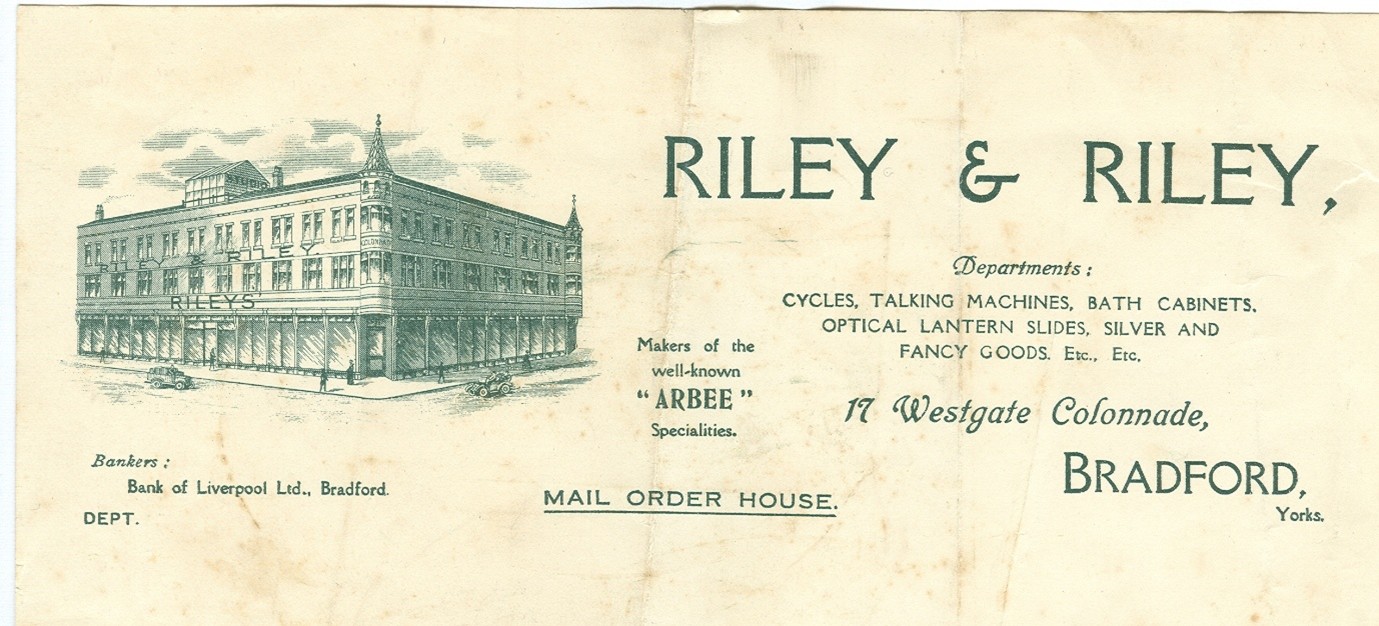
Credit: University of Bradford, The W. Riley Archive., Special Collections. RIL10/2.	Headed notepaper for Riley & Riley. 17 Westgate Colonnade, Bradford.
Credit: University of Bradford, The W. Riley Archive., Special Collections. RIL10/2. Headed notepaper for Riley & Riley. 17 Westgate Colonnade, Bradford.

In 1884, Joseph created The Optical Lantern Business and Willie transferred to this part of the family business, which was a firm that sold and hired magic lantern equipment internationally. In 1889, Willie was made a partner in the company. The business thrived until World War I, when it collapsed.

(The National Science and Media Museum in Bradford has a collection of the Riley Magic Lantern Slides.)

However, even though he worked in the family businesses, his writing career had already begun as a personal project. In early 1911, to amuse his wife and two bereaved friends, the Bolton sisters, he began writing a story in weekly chapters. This heartwarming tale, full of the detail of Yorkshire life and set in a fictionalised version of the village of Hawksworth near Baildon, was eventually published as Windyridge in 1912.

Windyridge was an instant sensation, selling around half a million copies and remaining in print until his death in 1961. Its success even led to houses across the country being named after the fictional location.

Riley became a full-time writer after his business closed, producing a steady stream of novels, short stories, newspaper articles, and travel works, most of which were set in his beloved Yorkshire Dales. His work is characterised by:

  • A deep love for Yorkshire: His stories used real places under disguised names, capturing the landscape and local character.
  • Methodist faith: A dedicated local preacher for 75 years, his strong religious beliefs underlie all his writings.
  • Heartwarming storytelling: His books offered a comforting escape, full of gentle humour and moral reflection.

Despite his immense fame during his lifetime (he died in 1961 at the age of 95), Riley’s popularity waned significantly after his death, and he became almost completely forgotten.

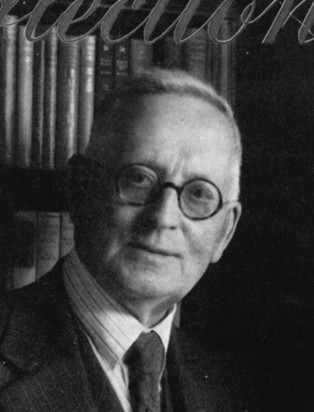
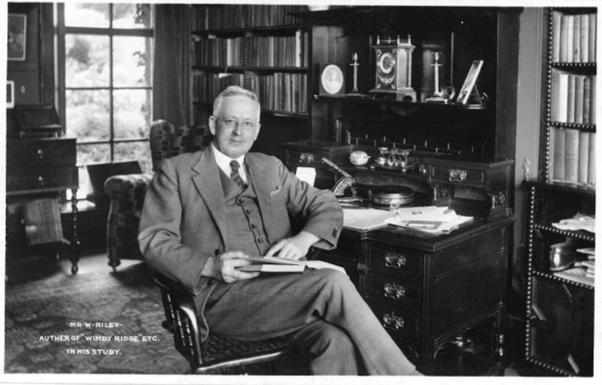
Willie Riley, in his study. Published by J.E. Lacy, Post Office, Silverdale.
Part of the Bradford Local Studies Library Postcard Collection.
Willie Riley, in his study. Published by J.E. Lacy, Post Office, Silverdale.
Part of the Bradford Local Studies Library Postcard Collection.

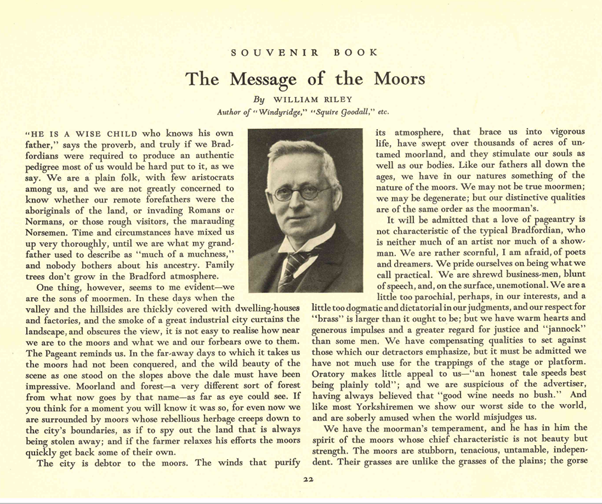
Riley also contributed his Message of the Moors to the historical 1931 Bradford Pageant.

Bradford Pageant Souvenir Book 1931. Image courtesy of the owner.
Copies also available to read onsite at Bradford Local Studies.

Thank you to

Bradford Local Studies Library.

David Copeland – https://www.willieriley.org.uk/

Julie Parry- Bradford University Special Collections

Written by Vicki Warner, Bradford Local Studies and Archives

Readers can access his collection of stories at Bradford Local Studies,to read in the library.      

Please contact us on 01274-433688 or local.studies@bradford.gov.uk to book an appointment.

The Impact of German Butchers in Keighley

‘Meeting the Meat Demand’ with Karl-Heinz Wüstner.

Over the summer, the History Society was presented with the opportunity for a talk by Karl-Heinz Wüstner on German immigration to West Yorkshire. With all of our regular slots already filled (and the budget pretty much used up), our solution was to book Keighley Local Studies Library for an extra talk on the afternoon of Wednesday 1st October. The talk, entitled ‘Meeting the Meat Demand’ will start at 2.30pm and will finish around 4.30pm (time for the talk plus discussion at the end). There is a charge of £2 per person (fee applies to members and visitors).

Karl-Heinz Wüstner is a retired high school teacher from Ilshofen, Germany. As a local historian he has studied labour migration and conducted research on trade and craftsmanship in the Hohenlohe region of Germany for many years. He is a committee member of the Historical Society for Württemberg-Franconia and chairman of a local museum that exhibits painted furniture. He writes books and articles, and has given talks at numerous conferences and seminars.

Karl-Heinz Wüstner: “The continuing industrialisation of Yorkshire in the 19th century created many additional jobs in wool mills and factories. Industrial centres grew rapidly and the large number of newly arrived workers needed to be fed. German immigrants in particular took advantage of these circumstances. As butchers, they not only offered meat, but also produced a variety of tasty sausages, meatloaf, rissoles and many other products that could be eaten either cold or warm after brief heating. With the introduction of takeaways, also offering hot meals, they broke new ground in food supply and thus established new eating habits.

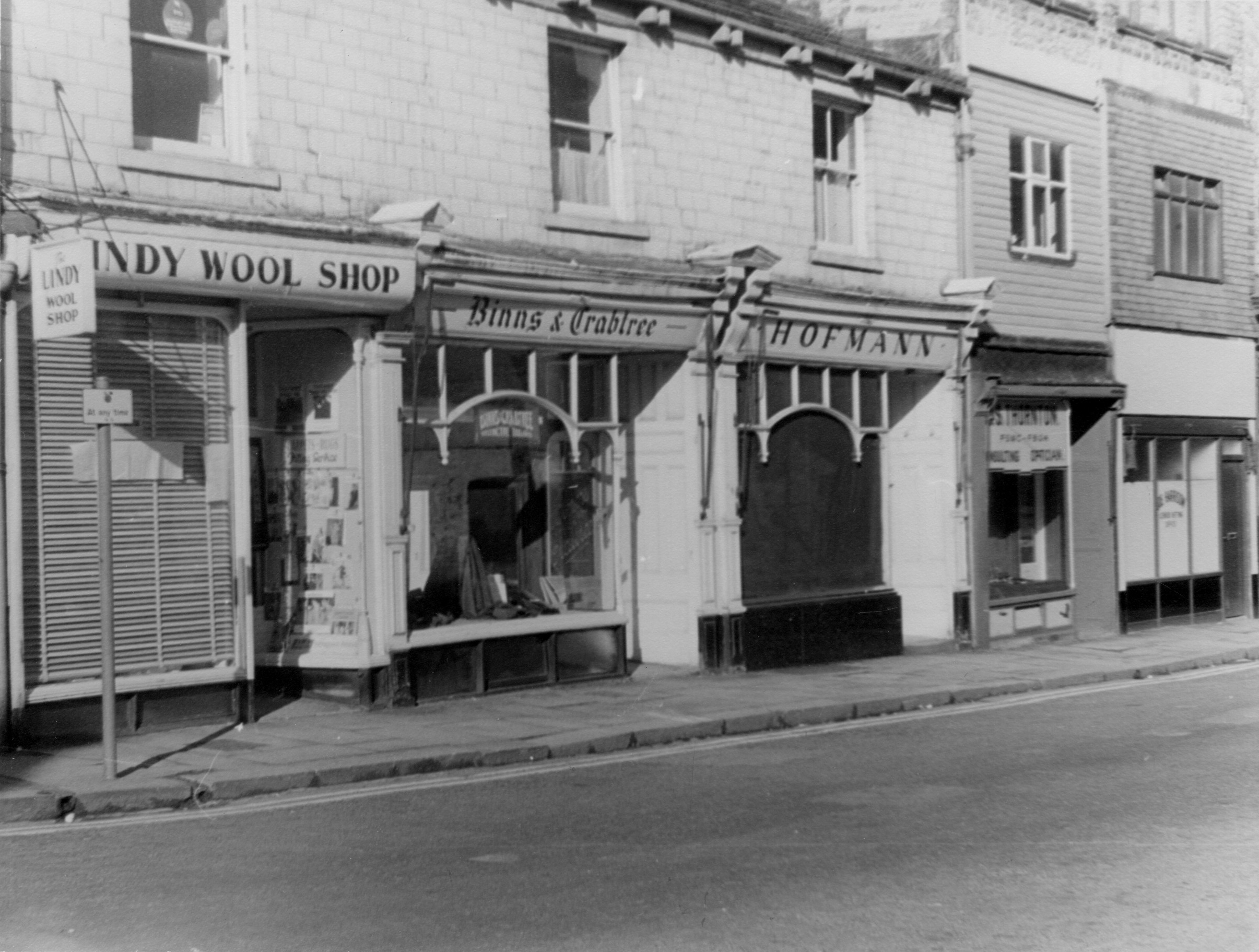
“Quite a number of such pork butchers settled in the up-and-coming town of Keighley. A whole series of butcher’s shops with more than thirty female and young employees dominated the streetscape. Names such as Andrassy, Pfeiffer, Hofmann and Schneider may still be remembered by some today.

“I will try to explain why the butchers and their families left their homeland and how they were able to succeed as immigrants. I will explore the important role they played in the development of the towns and cities, as well as their personal fates.” 

Article and Photos by Tim Neal, Keighley & District Local History Society.

HISTORY SOCIETY @ KEIGHLEY LOCAL STUDIES LIBRARY

The History Society held another of their research sessions at Keighley Local Studies Library on the morning of Saturday 31st May 2025. Around twenty members attended, with Angela, Gina and Janet from the library staff opening up various photographic archives and maps of the area for people to peruse.

The session started with History Society committee member Tim Neal talking to attendees about 3D or stereoscopic photography. Many of those there could remember the phenomenon of View-Masters that were around from the 1950s to the 1980s. These handheld viewers used to be loaded with a cardboard circular disc holding seven different colour stereoscopic photos. When looking through the viewer these images appeared in 3D. Tim had brought along half-a-dozen View-Master viewers and a selection of geographical and event-based discs covering subjects as varied as Princess Margaret’s wedding in 1960 to a mid-century of Ottawa in Canada. Members were able to peruse these at their leisure.

Mel Whitaker, writing after the event: “Tim’s collection of ‘View Masters’ brought back many happy memories for all of us who had owned one – and really impressed those who had never seen one before!”

People were then introduced to a collection of card-backed slides from the library’s collection. These were stereoscope images of Keighley in the Victorian era. Local historian Eddie Kelly had already studied the cards and had been able to conclude that they must have been produced around 1895, judging by some of the businesses depicted and the development of some of the buildings in some of the pictures. Using either the vintage wooden viewer or modern plastic equivalents, attendees were able to see Victorian Keighley brought back to life in 3D.

Accompanying these stereoscopic images were selections of photographs, organised by area of town, from a variety of the library’s archive collections, showing the town from the 1900s to the 1960s. It was a period that saw enormous changes in the landscape of the town.

Andy Wade, writing after the event: “Had an excellent session in Keighley Library’s Local Studies room looking at stereoscopic photographs and some of the old photo archives and in particular, the chance to talk about what we were looking at, as there were some unique views of Keighley which I’ve never seen before.”

Finally, bringing us right up to date, the staff had set up the library’s virtual reality equipment, enabling members to view 3D recreations of a 1970s living room, and to explore potential habitats fifty years in the future.

Several members also brought their own items to add to collections,  and could also explore their own research lines of query with the staff and the amazing resources that the library has to offer. The session was summed up by society member Jean McClennon: “An excellent and interesting session, thanks very much to all involved.”

The History Society will be holding another similar session on Saturday 18th October, focusing in how to use the library’s resources to research the history of your own home.

Tim Neal
Keighley & District Local History Society
1st June 2025

International Women’s Day Event

On Saturday, 8th March, it’s International Women’s Day and to celebrate it, Keighley Local Studies Library, first floor of Keighley Library, is hosting a day of talks by popular women speakers. All talks are free as part of Keighley Library’s 120 Years’ anniversary celebrations and there is no need to book, so please come along and help us to celebrate women, women’s work and achievements.

At 10am, Diane Park is going to talk about her strong women book shop in Haworth, Wave of Nostalgia, that is as popular as ever and has certainly raised awareness of women writers and artists. Sharon Wright, author, journalist and playwright will speak at 11.30am. Sharon is no stranger to highlighting the lives of women in history who have been neglected and has written about the unique and daring lives of women balloonists and shone a light at last on the life of the mother of the Brontë children, Maria Branwell, with Maria’s very first biography. Sharon will be talking about an increasingly popular genre in book shops and libraries alike, narrative

non-fiction. In the afternoon at 2.15pm, Jude Rhodes, local historian and genealogist, a speaker very much in demand in Yorkshire as well as Keighley Library will address the question – who were the women nurses? As a former practising nurse herself, now nurse tutor, we can look forward to Jude’s professional incite along the way. The day will continue its high note with the multi-talented local historian, actress, author and raconteur, Irene Lofthouse, who will speak about those women in Keighley who few might have heard of in their life time or since but  who  entered politics, ran businesses and generally helped to put Keighley on the map during a period when hearth and home was regarded as a woman’s only natural sphere outside a few caring professions.

There will be accompanying displays of archive records, a sale of authors’ publications and a display by the Men of Worth about women serving as nurses and as land army personnel. Refreshments will be served mid- morning and mid- afternoon between speakers.