
Map of the Week – Coliseum Theatre

This map from the Local Studies Library reserve collection would seem to be the plan of a theatre or music hall drawn up prior to its enlargement. When I first saw it I recognised the location, between Duckett Lane and James Street, (which connect Godwin Street and John Street) but I could not see how a theatre could ever have been positioned there.  I could not then have named a single Bradford theatre besides the Alhambra and the Star Music Hall. The Star had an important role during the great Manningham Mills strike of 1890/91 when its lessee, a Mr Pullan, placed his premises at the disposal of the strike committee during the early days of the dispute. In Charles Dickens’s rather neglected novel Hard Times Mr Sleary, a circus manager, says: ‘People must be amused…they can’t be always a working, nor yet they can’t be always a learning’. So, how were they amused in Bradford? In the late eighteenth and early nineteenth centuries itinerant entertainers visited public houses, and there were also visits from fairs and circuses. It appears that permanent theatre building had commenced by the 1840s.
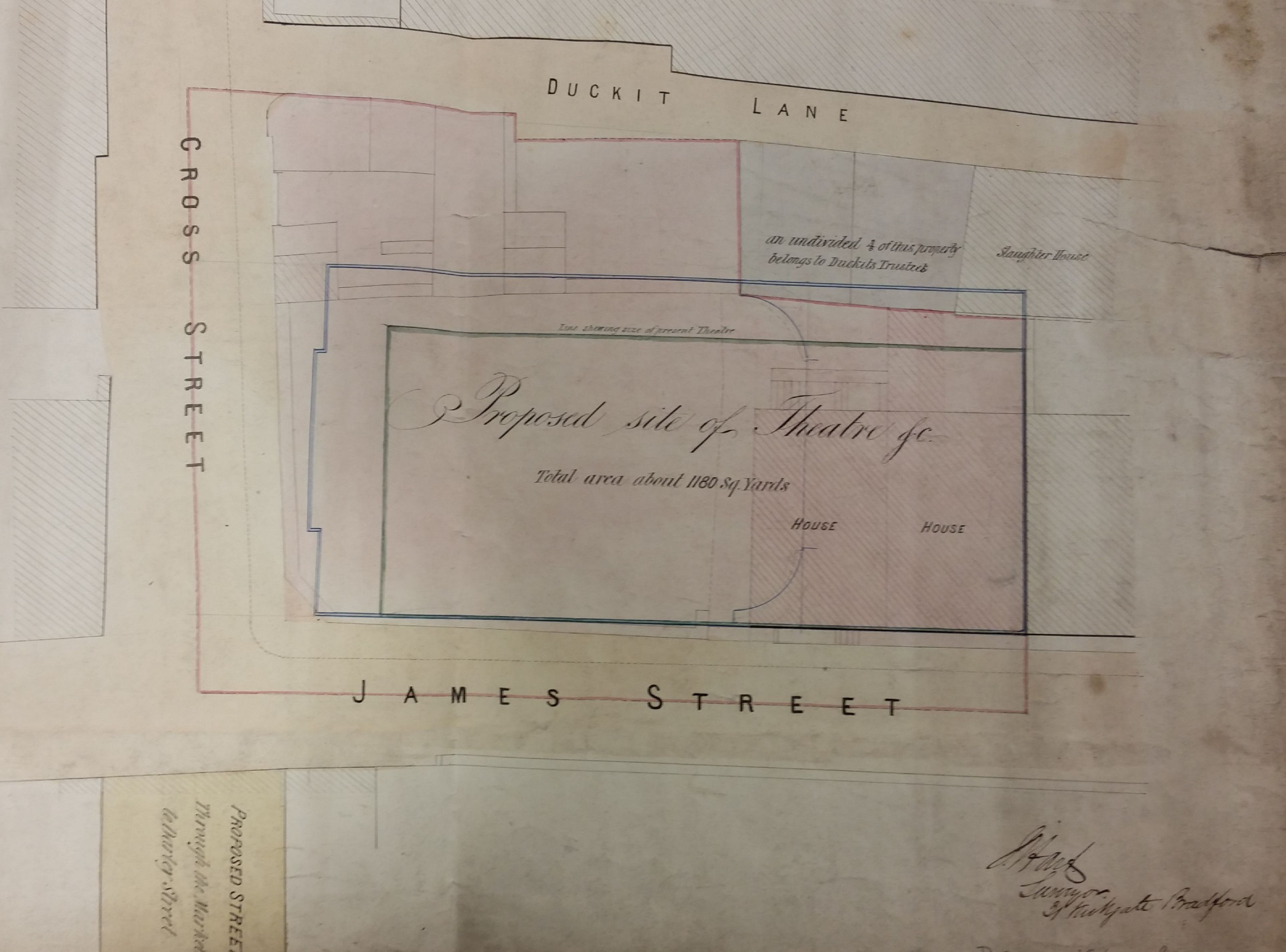
Map of the Week 008

The theatre in this plan was placed near Westgate and in 1849 Henry Pullan is known to have built the Coliseum Theatre ‘off Westgate’. However I cannot be sure that this map is actually of the Coliseum Theatre. Pullan had previously managed the Bermondsey Saloon in Cannon Street, a noted place of entertainment. His Coliseum was unusual in that it was not directly linked to a public house. Twenty years later he moved to a new theatre called Pullan’s ‘New’ Music Hall, Brunswick Place (now Rawson Street, by the multi-storey car park). This had an amazing 3,000 seats; the modern Alhambra has less than half that number. Pullen’s new musical hall remained in existence in the years 1869-89 at the end of which time it burned down. The vacant site left after the fire eventually evolved into John Street open market. Thomas Pullen and his son seem later to have taken over as managers of the Prince’s theatre and Star Music Hall, which brings us back to the Manningham Mills strike.

Although this plan was not dated it does mention St George’s Hall (opened 1853) and the New Exchange assembly rooms (foundation stone laid 1864), so presumably it was drawn after 1865. It seems plausible that it represented an intention to enlarge the old Coliseum theatre around 1868 although in the end a wholly new building was constructed on a nearby site. The older theatre evidently survived, being later renamed as St James’s Hall and then The Protestant Working Men’s Hall. It was finally demolished in 1892. This is a plausible date for the construction of the Commercial Inn still standing in James Street. This certainly looks like a late Victorian building.

The Coliseum was not Bradford’s first theatre which is said to have been owned by an L.S. Thompson in a converted barn on Southgate (now Sackville Street) around 1810-25. This hosted travelling theatre troops. A few years later, in 1841, the New Theatre opened at the city end of Thornton Road using the upper room in an existing Oddfellows Hall which had been opened in 1839. The Oddfellows were a friendly society who had 39 branches in Bradford and surrounding areas. I understand that the New Theatre was intended to hold ‘superior performances’. In the same year the Liver Theatre, Duke Street, became Bradford’s first purpose built theatrical premises. In 1844 it was remodelled and re-opened as Theatre Royal, Duke Street. The fact that it was widely known as the ‘wooden box’ may say something about the standards of its construction but in illustrations it looks stable enough. In 1864 the Alexandra Theatre had opened in Manningham Lane but in 1869, when the original Theatre Royal finally found fell victim to a series of street improvements, the Alexandra took over its discarded name. The Theatre Royal’s moment of fame occurred in 1905 when the great actor Sir Henry Irving gave his final performance as Thomas Becket on its stage. Shortly afterwards he collapsed and died in Bradford’s Midland Hotel.

In 1876 the Prince’s Theatre was built above Star Music Hall in Victoria Square. The proprietor of this curious double establishment was entrepreneur William Morgan who started his career as a Bradford hand wool-comber and concluded it as mayor of Scarborough. I think its site is the garden that is now in front of the Media Museum. Both theatres were fire damaged and restored in 1878. The Star Music Hall was renamed as Palace Theatre in 1890s and finally demolished in the 1960s. In 1899 the Empire Theatre was built at the end of Great Horton Road. All three theatres were just across the road from the present Alhambra which was built in 1914 and is associated with the name of Bradford’s pantomime king, Francis Laidler. In 1930 the New Victoria was opened on an adjacent site but this was eventually converted to the iconic Odeon Cinema. Finally I should mention that in 1837 the Jowett Temperance Hall had been built and this was also converted into a cinema as early as 1910. This building was also destroyed by fire and was rebuilt in 1937 as the Bradford Playhouse, Chapel Street.

If you would like a more detailed, and very well written, introduction to the subject of our theatres there is a splendid website:

http://www.arthurlloyd.co.uk/BradfordTheatresIndex.htm

A long account of the theatres is given in William Scruton’s Pen & Pencil Pictures of Old Bradford. Scruton provides many details of the largely forgotten actors who performed in Bradford. More recently the development of the early theatre was described by David Russell in The Pursuit of Leisure (in Victorian Bradford, 1982).

Derek Barker, Local Studies Library Volunteer


TSO World War One Centenary Archive

Bradford Libraries's avatarBradford Libraries World War One Blog

To mark 100 years since the beginning of World War One, TSO have produced a carefully selected collection of official documents relating to the war. Dating from 1914 to 1927, the bibliography lists 100 key military, political and strategic documents published by the British government throughout this period.

It includes original reports of key events and Gazette notices of awards and commemorations.

Bradford Libraries have gained free access to the above resources.  They can be accessed free in any of Bradford’s Libraries, using library PCs or using your own devices via our Wi-Fi.

For a full list of Bradford’s Libraries please click here.

You can access the resources here:

TSO World War One Centenary Archive
(Remember you can only access these resources from within the library)

View original post

Map of the Week – Mining in Wilsden

Extractive industries once contributed substantially to the wealth of West Yorkshire. Local coal mining may well have had medieval roots and there is good evidence for the industry in early seventeenth century Bradford. At that time, in addition to domestic use, coal was employed as a fuel for lime burning and black-smithing. The value of the mineral was transformed by Abraham Darby’s discovery at Coalbrookdale that it could be coked to produce a replacement for charcoal in iron-smelting. This occurred at the beginning of the eighteenth century, although it took several decades for the technology to be widely adopted. In south Bradford iron-smelting developed at Bowling and Low Moor using coked  coal from the Better Bed seam, and ironstone from the Black Bed seam roof. Around the same time the need to fuel rapidly increasing numbers of steam engines also greatly increased the demand for black diamonds.

Few, if any, districts of the city are unmarked by some evidence of old mining activity. Coal exploitation had long been undertaken in the townships of north Bradford including: Heaton & Frizinghall, Shipley & Northcliffe, Baildon, Idle & Eccleshill, Thornton & Clayton, Denholme, and Wilsden. In these communities the first two seams in the Coal Measures series of rocks were accessed, those being the Soft Bed and Hard Bed. Mining in Wilsden is well recorded by maps held by both West Yorkshire Archives (Bradford) and the LSL. The Archives has a plan (WYB346 1222 B16) of Old Allen Common in Wilsden including its collieries. This shows the area where Edward Ferrand Esq, as Lord of the Manor, had mineral rights over common land. This was ‘made for the purpose of ascertaining the best method of leasing the coal’ by Joseph Fox, surveyor, in 1829. Fox has already featured in this series. The collieries named were operated by Padgett & Whalley, and Messrs. Horsfall.

The Local Studies Library has two Wilsden colliery plans. The first shows Norr Hill. This was a drift mine at which the deeper Soft Bed was accessed down an inclined plane. The coal was removed through galleries but large pillars of the mineral were left to support the roof. The ‘take’ was perhaps 60%. If you are sharp-eyed you may be able to make out the words ‘geal (or goul) 4½ yards down to south’. This must be a local mining dialect term indicating that a geological fault interupted the seam.

Wilsden 007a

The other illustrated mines at Old Allen Common and Pudding Hill were the more common shaft mines. The Soft Bed was accessed by the Jack Pit and Jer Pit. Tom Pit accessed the shallower Hard Bed. Again there is a system of galleries and evidence of faulting. One gallery heads towards Padgett’s Colliery. Many areas are ‘old’ or worked out.

Wilsden 007b

Mines like these would need to be drained and ventilated. Drainage was often achieved by digging a long underground channel or ‘sough’ to take water to a lower level surface watercourse. As well a shaft to access the galleries a second ‘air’ or ventilation shaft was often sunk. In operation active men were needed as ‘getters’ to hew the coal. As the seams were thin this must have been undertaken in a lying or kneeling position illuminated only by flickering candlelight. Hewed coal was then conveyed in wicker baskets, called corves, by ‘hurriers’ to the shaft bottom. If they were physically capable children and women could fulfil this function, although women working underground were seemingly becoming rare in the Bradford area by the early nineteenth century. The full corves of coal could be extracted by a hand-windless or, if the shaft were deep, a horse gin, and then removed by carts or packhorses to the nearest roadway. To men labouring as miners in the early nineteenth century the industry must have seemed timeless. Could they ever have imagined that in 2015, with the closure of Kellingley Colliery, the deep-mining of coal in Britain would be brought to an end?

Derek Barker, Local Studies Library Volunteer

The Brontë Collection in Keighley Local Studies Library

In this, the 200th anniversary year of Charlotte Brontë’s birth (21 April 1816), Keighley Local Studies Library must celebrate its own excellent collection of Brontë literature, critical works, articles and news cuttings. It is now second only to that of the Parsonage Library itself in importance, especially since Bradford Local Studies Library has recently deposited much of its own collection with Keighley.  Staff  are presently working to catalogue, index and promote the collection to a wider audience of readers and researchers both at home and abroad and an information booklet will be published later this year about the book collection.

The history of the collection dates back to the nineteenth century and includes the archives and some book stock (Milligan collection) from the Keighley Mechanics’ Institute, of which Patrick Brontë was an active member, and where the family attended lectures and gained some art tuition (see leaflets). The library has also been privileged to receive a bequest from the library of the late Joanna Hutton, first female curator of the Brontë Parsonage Museum, and this is an important addition.

Anyone who is also interested in Haworth and Keighley at the time of the Brontës can also consult maps, photographs, plans, tithe records, trade directories, mill reports,  Parish and Non-Conformist records and local family archive collections. The library holds a wealth of published works on the history and development of the local area, many of them recently researched. Haworth and Keighley are fortunate in having some excellent local historians who have contributed greatly to the scholarly canon of local history publications, including Ann Dinsdale (Curator, Brontë Parsonage), Steve Wood (specialist Haworth historian), the late Michael Baumber, local teacher and historian and Ian Dewhirst MBE (former Reference Librarian and renowned Keighley historian).

So, as you settle down for the new Brontë costume drama now being filmed in Haworth and prepare to look at yet another screen in your life, please think of the wonderful original material that is waiting for you in Keighley Local Studies Library and the exciting discoveries that can be made through reading a well researched and illustrated book on a fascinating local subject.

Resources on Haworth

Keighley’s Bronte connection

Threads of War

Threads of War

Bradford Libraries's avatarBradford Libraries World War One Blog

A textile display of contemporary textiles inspired by the First World War will be at Bradford Local Studies Library from 4th – 29th July.

This is part of a larger open exhibition ‘Bradford and the Global War’ at Bradford Cathedral and Bradford Mechanics Institute Library running during July 2016.

The exhibition has been created by Commemorative Quilts,

www.1914-18commemorativequilts.com

Here is an extract from an article by a member of the group.

Commemorative Quilts

We are a large, informal group of textile artists; at the last count we numbered 49 but this is very fluid, people drop in and out according what else is going on in their lives.  A few have textile qualifications, some are professional artists, others belong to embroidery or quilters’ groups, but much of the work comes from people who have always sewn, knitted or stitched but never had their work exhibited before.

We set…

View original post 238 more words