Basque Child Refugees from Northern Spain welcomed in Keighley and Bradford, 1937-1939

To mark the 80th Anniversary of the arrival of child refugees a talk and an exhibition will be held in Keighley Local Studies library on Saturday 28th October at 2.00pm by Simon Martinez and John Birkbeck..

On the 13 September 1937, the Morton Banks Sanatorium in East Riddlesden and the Dr Barnardo children’s home on Manningham Lane, Bradford were turned over to voluntary groups to house children from Northern Spain.

These children had been evacuated at the height of the Spanish Civil War to avoid bombing and hunger following the bombing of Guernica forever immortalised by the painting by Pablo Picasso.

Keighley welcomed 100 of these child refugees and the adults who accompanied them.

They were very happy in Keighley. One later recalled ‘it was a town of twenty to twenty five thousand people, not pretty, not ugly, without a coastline but with swimming pools, a big park, and three cinemas (later there was one more, The Ritz) The Picture House, The Regent, and The Cosey Corner, and a lake which in winter froze over.’

This is a rare opportunity to hear two experts on this often forgotten piece of history speak together. John Martinez is the son of one of the refugee children Ruperta Martinez, (see picture) and he is a leading figure in the Basque Children organisation.

http://www.basquechildren.org

Ruperta Martinez

John Birkbeck’s grandfather was a significant figure in the lives of the Basque children who came to Keighley in 1937 and he has gathered a wealth of knowledge about the experiences of local refugees.

The event is free and all are welcome.


Treasure of the Week No. 16: ‘Rhodes’s Lump Butter is Always Unique’

JND 233/1 (Please quote this number if requesting this item)

RHODES & SONS.   Bradford: Past & Present. A Sketch of the Progress of the Town from the Earliest Period.   Bradford: J. F. Rhodes & Sons, 54 Kirkgate, 1890. 98 pages.

jnd223 1 c 001

This is a remarkable book. So also was 98 pages for 1d.! It is a publication marketed by a grocery shop which is a full and well-illustrated history of Bradford. The text and illustrations are excellent, with engravings of old street scenes and line drawings of local celebrities of the time. Of particular interest today is the information about the products advertised by the publishers, J. F. Rhodes & Sons, Grocers. Every page has a strap line featuring one of the shop’s grocery products, of which the following are a few:

  • Rhodes’s Lump Butter is always unique
  • Rhodes’s 2s. Teas, is the Tea Drinker’s Favourite
  • Rhodes’s are Agents for Armour Ox Tongues
  • Rhodes’s Coffee is roasted daily
  • Rhodes’s White Cheshire Cheese

There are several full-page adverts for such products as Reckitt’s Starch, Brown & Polson’s Corn Flour, and Kilvert’s Pure Lard.    The engravings are a little faded, but full of historical interest, with horse-drawn and steam trams, a balloon ascent and a boy in the hand-stocks in Kirkgate! Illustrated are:

  • The Old Cockpit
  • The Old Market Place
  • The New Midland Station
  • Forster Square
  • The Old Manor Hall
  • Old Wool Pack Inn
  • Old Broadstones
  • Old paper Hall
  • Old Piece Hall & Talbot Hotel
  • The Sun Hotel
  • Bowling Green Hotel
  • First Balloon Ascent in Bradford
  • The Alexander Theatre
  • Old Theatre Royal, Duke Street
  • Bradford Mechanics’ Institute
  • Bull’s Head and Pillars


Stackmole

Book Review: Punjab to Bradford: Life Stories of Punjabi Immigrants in Bradford

Punjab to Bradford: Life Stories of Punjabi Immigrants in Bradford. By Ramindar Singh and Kashmir Singh Rajput. Privately published (ramindar.singh@ntlworld.com), 2013
204 pp.  ISBN: 978-0-907734-71-10.  £10.00.

Available at Bradford Libraries

Dr Ramindar Singh MBE

This book presents the lives of 44 Punjabi migrants who came to Bradford in the 1950s and made the city their home. With only a few pounds to their name they came here with great hopes and some with good academic qualifications. They were obliged at first, however, to take up unskilled work on the buses, in mills and foundries, finding their qualifications were not recognized in Bradford. They suffered much discrimination too, until opportunities arise where they could use their knowledge and skills more appropriately.  Local colleges, particularly Bradford Technical College, played a significant role in making this transition possible. It was good to find, too, that most of their children became well-qualified and successful in their occupations. As seen with other migrant groups, early arrivals often gave room in their homes to new arrivals, in spite of difficulties it caused. This of course had a substantial effect in promoting community cohesion. The reunion of families when wives came to join their husbands and find work themselves outside the home, must have contributed significantly towards social mobility of their families.

This book gives personal accounts of how the early Punjabi immigrants in the 1950’s coped with their frustrations, humiliations and discrimination.  After an editorial introduction explaining how the book was compiled, there follows an account of the Punjab and reasons of why migration occurred, and its process.  An account is then given of the development of the development of the Punjabi community in Bradford.  The main part of the book contains the stories of individuals who left their homes and families in the Punjab during the 1950s through 1970s to seek their fortunes in vilayat (England).  At the conclusion of these accounts there is a chapter entitled: Reflections of life through Mehfil (informal gatherings). Topics covered here are: Community spirit and mutual support; Understanding local people; Learning new work norms; Duality of conduct; Life in a male dormitory; Entertainment; Women’s position and experience; and Utopian Vilayat vanished.  Finally there is a useful Glossary of Punjabi words and phrases.

In their Conclusion, the compilers note how the Bradford that the 1950 pioneer migrants experienced is no more, and that their children and grandchildren experience a very different world. Reminiscences such as those here are important in keeping the heritage alive. Something, of course, which is true of all cultures, whether migrant (from overseas or other parts of Great Britain ) or even non-migrants. This book is a valuable contribution to Bradford’s social history.

Dr Singh is a former Bradford College lecturer, JP, and deputy chairman of the Commission of Racial Equality. He is author of The Struggle for Racial Justice: From Community Relations to Community Cohesion in the Story of Bradford 1950-2002. K.S.Rajput was a senior education officer with Bradford Council. Bob Duckett

Review reprinted from the Bradford Antiquary, 2016, courtesy of the Bradford Historical and Antiquarian Society.


Neglected Bradford Industries: Limestone & lime-burning

Bradford is famous for spinning and weaving but textile production was only one of a group of important industries which ‘Worstedopolis’ supported. Since several  are now almost forgotten by contemporary citizens I should like to draw attention to those which seem unreasonably neglected, in a series of short articles.

Limestone was a most valuable commodity. It could be cut into ashlar for building construction. It could be burned in kilns to produce quick lime which was then slaked with water. In either of these forms it could be spread on the land to ‘sweeten’ acid soils, making them more fertile. Slaked lime was also the essential ingredient of lime mortar, render and whitewash. To charge a blast furnace crushed limestone was added to coke and iron ore because it assisted in the separation of the slag waste. Some hard fossil-containing limestones which took a good polish, like Purbeck stone, were regarded as ‘marbles’ and used for decorative purposes. It is common today to employ limestone aggregate for path and road construction, but this is a relatively recent development.

Limestone consists largely of a single mineral called calcite (calcium carbonate). Immensely thick limestone strata are common near Skipton and in the Dales.  Geologists recognise many sub-types of limestone classified by age, appearance, and fossil content. Since most of the stone reaching the Bradford area was burned we need not be too concerned these complexities.

Image A

Lime quarry at Stainforth, North Yorkshire.

Although limestone strata do not reach the surface in the Bradford area there was nonetheless an early lime-burning industry based on the extraction of boulders from glacial moraines in the Aire and Wharfe valleys. Boulder pits were well established in Bingley by the early sevemteenth century, and three groups of pits are still marked on the first OS map of the area (1852). In 1931 the Bradford Historical & Antiquarian Society published a series of West Yorkshire Deeds which are still available in the Local Studies Library. An indenture of 1604 between Alexander Woodde of East Morton and Abraham Bynnes, with others, mentions the ‘digging of greetstones’. In 1620 Thomas Dobson of Bingley leased four closes of land to his father Michael ‘with authority to dig there for lymestones and to burn, sell and dispose of them’. Glacial erratic limestone found elsewhere was almost certainly exploited in the same way. In the nineteenth century, on at least one occasion, the digging of a railway cutting seems to have exposed similarly valuable boulders.
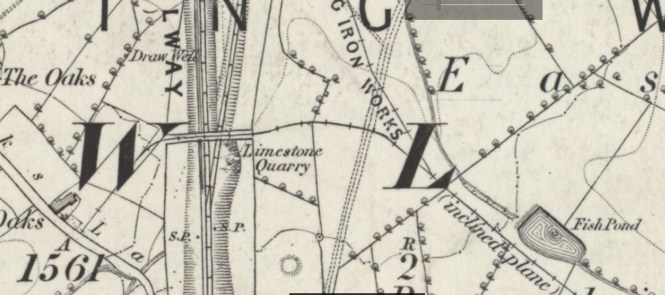
Image B

Lime stone quarry near Bowling Junction, and close to a mineral way to Bowling Iron Works. In this position it must represent the working of a moraine deposit (detail from 1852 OS map).

With the construction of the of the Shipley to Skipton sections of Leeds-Liverpool Canal (1773-74) plentiful supplies of limestone became available from the Skipton quarries.  The cheap movement of limestone and coal were among the original ambitions of the canal promoters. Once you had supplies of limestone you required some means of burning it. Local scholar Maggie Fleming, is currently collecting information about canal-side lime kilns, and early lime-burning from erratic boulders, particularly at Micklethwaite and Bingley. Between 1774-83 the Bradford Lime Kiln Co. had eight kilns in Bradford at a site between Broadstones and Spinkwell Lock.  There was evidently an extensive canal-side lime-burning industry since the first OS map also records kilns at, among other places: Silsden, Riddlesden, Micklethwaite, Crossflatts, Bingley (Toad Lane), Dowley Gap, and Shipley.

image C

A map of 1863 recording lime kilns near the centre of Bradford.

There were a number of lime kiln designs including some very advanced Hoffman continuous kilns like the one preserved at Stainforth, N.Yorks. Simple stone built field kilns were once common in this area. They were charged with broken stone and coal from above, with quicklime and ashes being raked out from below. The field name ‘lime-kiln close’ or ‘kiln close’ may reflect this older lime-burning industry. There are two fields in Heaton with these names, now located in Heaton Woods. Local historian Tony Woods has studied Rosse archive records from Ireland and can demonstrate that Heaton coal pits were supplying a lime-kiln, somewhere near, with fuel as long ago as 1776.

Image D

Field kiln near Grassington

If you would like to do more reading on this topic may I suggest:

J.V. Stephens et al. Geology of the country between Bradford and Skipton, HMSO, 1953, 149-151, 149. This is essential reading for geological background to any local extractive industry.

David Johnson, Limestone Industries of the Yorkshire Dales, Amberley, 2010. It is inconceivable that anyone could ask a question about limestone that this book cannot answer.

Gerald & Sheila Young, Micklethwaite: the History of a Moorland Village. The early section of this book describes has an interesting account of the exploitation of local mineral resources.

Derek Barker, Local Studies Library Volunteer
