Map of the Week: Bradford in the mid-nineteenth century

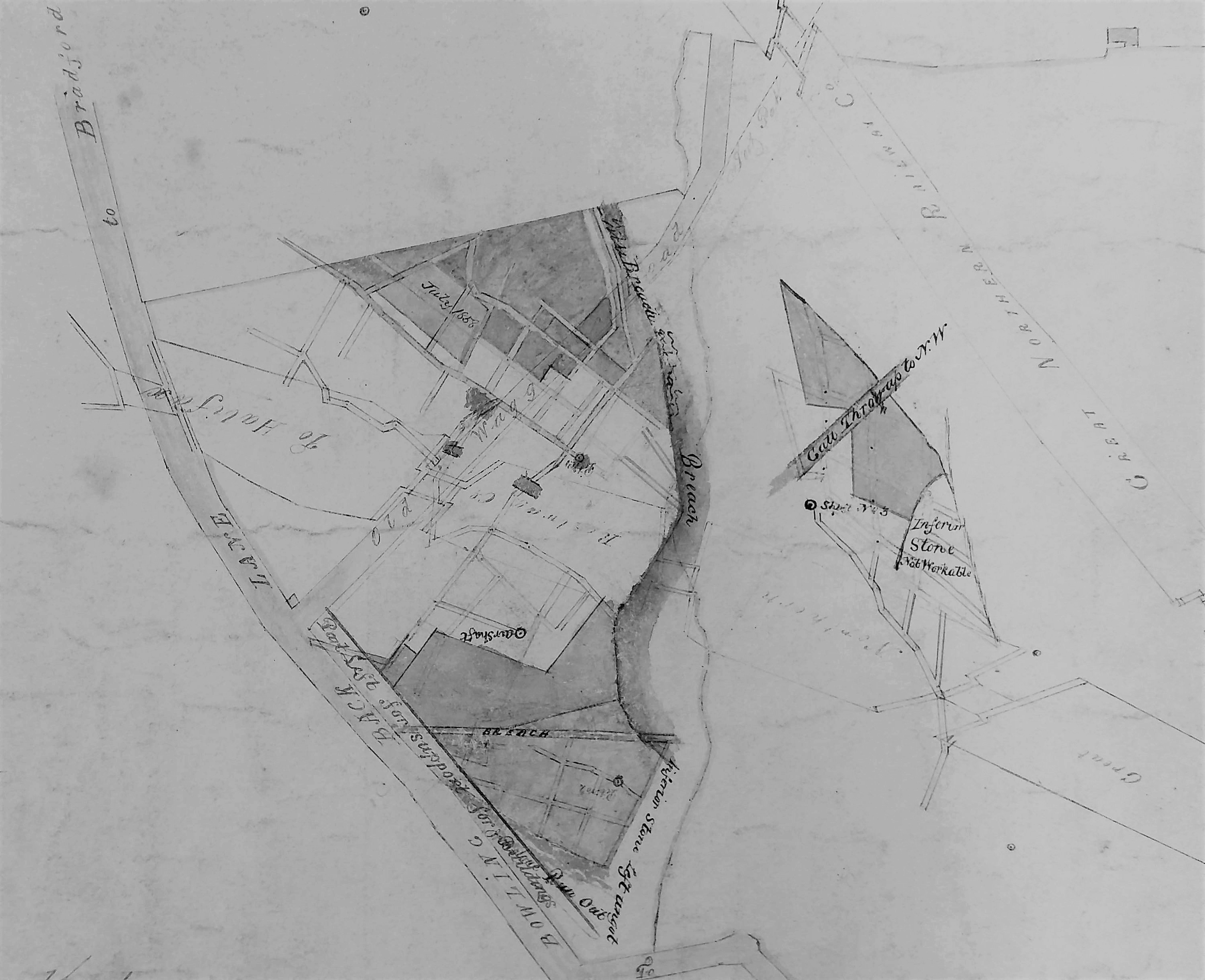
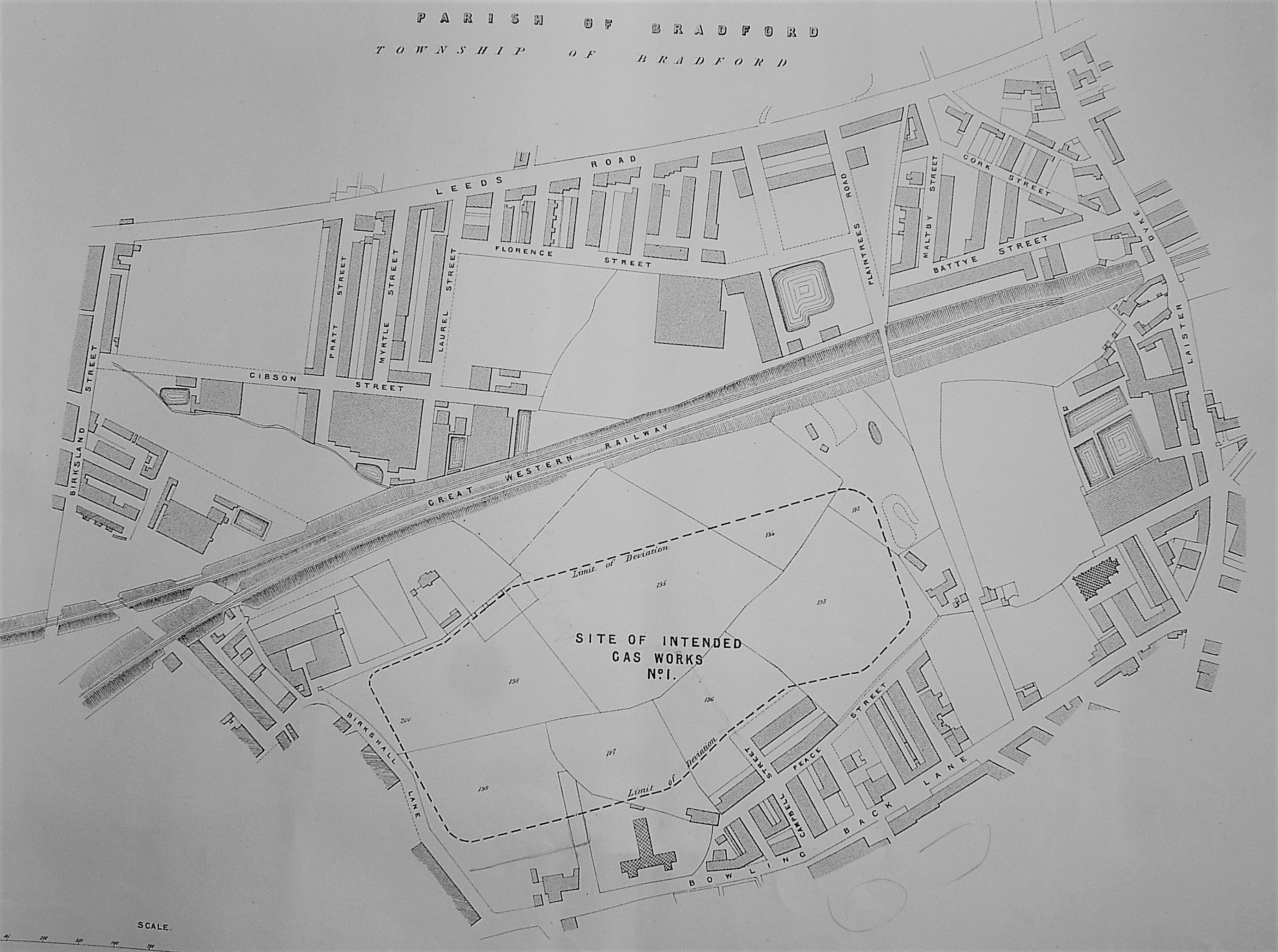
For this article I have drawn on details from two maps in the Local Studies Library reserve collection. Often I have to estimate the dates of plans and maps so it is a relief to have this information provided for once. Both maps have Bradford’s railway connection from the north-west at their heart.

The first is described as ‘Regina v The Midland. Railway Company, plaintiff’s plan, showing Commercial Street previous to 1849’. The second is entitled as a ‘plan of part of the Borough of Bradford showing the Midland Railway Station and Approaches, 1863’.  The maps can be reasonably regarded as showing the situation at the time of the 1851 and 1861 censuses. An even better match for the second map is the Jones Mercantile Bradford Directory 1863, made available on line by the Bradford Family History Society:

http://www.bradfordfhs.org.uk/files/Trade%20Directories/JMDB1863.pdf

In 1847, just before the date of the older map, Bradford had become a Borough.  In the mid-nineteenth century the skeleton of the modern city was in the process of erection.  Bradford Infirmary had been  built on its Westgate site in 1844. The building has been long demolished but Infirmary Field survives as a green space. In the 1850s St George’s Hall, Peel Park, and Sir Titus Salt’s Saltaire were all created. The first work on Little Germany was being done in the 1860s, as the second map was being surveyed, but would continue for several decades.

The Bradford canal had opened much earlier in 1774 and ended at a canal basin and a large warehouse. These locations show well on the earlier map. Nearby, at the end of Well Street, is a large coal staithe. This had been present for many years and also features in a map of c.1825 where it is identified as ‘J.J. & Co’. Sadly I cannot identify the owner. The movement of coal was an important consideration in the minds of the original canal promoters, but water transport of goods was in large part superseded by the railway. The Leeds-Bradford Railway, in which George Hudson ‘the Railway King’ was closely involved, arrived via Shipley in 1846. The route to Keighley was created the following year. To construct the line’s terminus Dunkirk Street was razed to the ground and on 5 March 1846 the Bradford Observer noted the ‘deserted and desolate’ street. Two years earlier a famous resident had died there at the age of 46 years. This was Reuben Holder who was noted, as the same newspaper observed, for ‘eccentric rhymes with which….he was wont to create lights and shadows for the monotonous occupations of brick maker and bill sticker.’

Our map showing the situation in 1849 describes the building as ‘Leeds & Bradford Railway Station now called Midland Station’ which strongly suggests that the great Midland Railway Company acquired the line soon after that year. The 1850 Bradford directory still uses the Leeds-Bradford name and gives the address as ‘bottom of Kirkgate’. Its superintendent is Mr M Crabtree. The map would seem to have been drawn up for litigation purposes but what the action actually involved I cannot establish. The whole district between the station and Cheapside seems to have been known as Bermondsey in 1849 and this appellation survives as a road in 1863. Is the name Bermondsey ever used today?

On the left of the 1863 map you can see Trafalgar Street with its well-known brewery. The Trafalgar Steam Brewery had been founded in the 1850s and in this period was associated with the name of Cllr. Charles Waller. The company regularly advertised its porter, mild, and bitter beers in the pages of local newspapers. It survived until the 1930s, but I’m really not sure what they did with the steam. Manor Row had been constructed in 1820. The map of 1863 clearly shows the place where Manor Row and North Parade divide. On this spot one of Bradford’s most iconic buildings, the Yorkshire Penny Bank (1895), was eventually constructed, the architect being James Ledingham. Opposite this junction was the Bradford Grammar School with School (or Grammar School) Street.  John Richards was its headmaster in the 1850s. I believe the the history of the school stretches back into the Tudor period but the building in North Parade or Manor Row was constructed in 1820. There is known to have been an earlier school building near the cathedral.  BGS has occupied its Keighley Road site, once the centre of the Clockhouse estate, since shortly after the Second World War.

Salem Street, with its listed early nineteenth century terraced houses, was presumably named after the nearby Congregationalist Chapel. ‘Salem’ is a shortened form of Jerusalem and was a popular name for non-Conformist places of worship. This classical revival building was constructed in 1835-6 using ashlar sandstone. It was one of the earliest designs of the Lockwood & Mawson architectural partnership who later moved on to St George’s Hall and Saltaire.  I have included William Mawson’s portrait from his obelisk at Undercliffe cemetery.

Map of the Week 024 C

William Cudworth records that Salem’s minister during the mid-19th century was Rev J C Miall. A new chapel was opened in Oak Lane in 1888 after which the Manor Row building was reused as school board offices, and a school clinic for many years. It still exists as Kenburgh House. While considering churches the 1863 map shows Christ Church in Darley Street which was built as a chapel of ease for the Parish Church and consecrated in 1815. It was close to Bradford market but I believe that the site was eventually needed for a Darley Street extension. The building was demolished in 1879 and Rawson Square exists at its former site. The church was moved to nearby Eldon Place where it survived until 1940.

My limitations concerning Bradford theatre history have been exposed before but there clearly was a Duke Street Theatre in 1863. On this occasion I have retrieved information from Arthur Lloyd’s theatre website:

http://www.arthurlloyd.co.uk/BradfordTheatresIndex.htm

In 1841 the Liver Theatre, Duke Street, probably became Bradford’s first purpose built theatre. In 1844 it was remodelled and re-opened as Theatre Royal, Duke Street. The fact that it was widely known as the ‘wooden box’ may say something about its construction. In 1864 the Alexandra Theatre had opened in Manningham Lane. Five years later, when the Duke Street Theatre Royal finally fell victim to another series of Bradford street improvements, the Alexandra took over the discarded name.

If from Duke Street you continued down Piccadilly and across Kirkgate you would be walking down Piece Hall Yard. According to the City Heritage blue plaque the Bradford Piece Hall had been constructed in 1773. The development of a building for trading in ‘pieces’ of cloth had been proposed by the hugely influential Quaker merchant John Hustler who died in 1790. I’m not sure when the Piece Hall was demolished, in the late 1850s perhaps. Piece Hall Yard has been, since 1877, the location of the Bradford Club. Today the Club holds an importance for Bradford studies second only to the Local Studies Library itself, since it generously allows the Bradford Historical & Antiquarian Society and the Bradford U3A to hold their meetings within its gracious portals. John Hustler’s name survives in Hustlergate. In the newer map this is recorded as the site of the Old Market but the Gothic revival Wool Exchange, which survives largely as Waterstones, was built here a few years later, between 1864-67. It was another design of Lockwood & Mawson. The foundation stone laid by Lord Palmerston, and some magnificent glazed ceramic tiles, can still be seen in the Market Street pizza restaurant.


Naturally there is a great deal of history locked up in street names. Hustlergate has already been mentioned and Market Street must reflect the old market. But look at the streets at the top right of the second map. A water source is the obvious explanation for Well Street. The older map indicates that Collier Street (or Gate) was named for its closeness to the coal staithe. The Swaines and the Booths were wealthy local families and Charles St, Booth St, and Swaine St probably all derived their names from Charles Swaine Booth Sharp (1734-1805) who owned land in the area of Hall Ings and married Hannah Gilpin Sharp, who had inherited Abraham Sharp’s Horton estate via his niece Faith Sawrey. The name Brook St must reflect the course of the Bradford Beck. This is seemingly on the surface before 1849, but the 1851 and 1861 Bradford maps suggest that it was by then culverted and underground at this point. Only the names Well St and Market St have survived to the present day.

Derek Barker, Local Studies Library Volunteer

Map of the Week: Turf Tavern & Airedale College

Old plans of Heaton, my own part of Bradford, are not very common in the Local Studies Library map collection. In the late 18th and early 19th centuries a great deal of the land in the township was owned by the Field family. On the death of John Wilmer Field in 1837 this estate passed quietly, by virtue of the marriage of his daughter Mary, to the future Earl of Rosse. Land sales often generated surveyed plans and it is not surprising that the area identified in the first map was not part of the Rosse estate and so did change hands.


The 3rd Earl of Rosse died in 1867 so the map must be later than this date since his Countess is identified as a neighbouring landowner. She took over the direction of her Heaton and Shipley property until her own death in 1885. By this time portions of property was being offered for sale with villa development in mind. The present Earl of Rosse still maintains an archive at Birr Castle, Co. Offaly, Eire where many historic maps and documents are curated. But any questions readers might have about this area can almost certainly be solved more accessibly by consulting Heaton: the best place of all by the late Stanley King, the premier student of Heaton history. Several copies of his work are available on the library shelves.

Map of the Week 023 A

The map probably dates from c.1875 since it shows a block of land near the corner of Emm Lane and Keighley Road on which it was proposed to build Airedale College. This was to be dedicated to the training of Congregationalist ministers. An earlier college had been in existence at Undercliffe since 1831. The new premises at Heaton were opened in 1877 but the name was changed to United College in 1888, following the closure of a similar institution at Rotherham. The building is now part of the University of Bradford. Another part of the Emm Lane University Campus is an adjacent house named Heaton Mount which was built in 1863 by Robert Kell, whose name appears near the top of the map. Throughout this period Heaton did not form part of the Borough of Bradford; its incorporation was not until 1881. In fact the map even pre-dates the construction of Heaton’s first public sewer which, according to Stanley King, only occurred in 1877. The resulting sewage was discharged straight into the Bradford Beck which is really not a pretty thought. It looks as if the site destined for the college was part of a small parcel of land called the Turf Tavern Estate. The three field names are given as: Top Close, Quarry Field and Kitching Field.

The Local Studies Library has a second earlier map of 1840 which suggests that most of the area was then called Kitching Field, Kitching being a well-known local surname. Perhaps there was a small quarry here between 1840-75 that accounted for the name change. The Turf Tavern itself, briefly known recently as The Park, is present on this 1840 map and all the OS maps of Heaton. There is a datestone above the door carved with the year 1894, but this must indicate a rebuilding since the original structure was much older. Historian William Cudworth suggests that the tavern, and the nearby Branch Hotel (formerly the Coach & Horses), were both erected when the Bradford to Bingley turnpike was opened in 1825. He records that the builders of the Turf were William Clarke, a Heaton butcher, and his brother Joseph, a stonemason. Another brother, John Clarke, developed many delphs or quarries around Heaton village, although all evidence of those has long since vanished. The owner of the Turf Tavern estate at the time of the first map is likely to have been William Lister Marriner of Greengate House, Keighley. His family came into property around Frizinghall by marriage. Local historian Tony Woods has confirmed their possession of this area from the Heaton Local Board Rate Books 1860s-1881 (WYAS Bradford Archives BBT6/5/5/1-19). The same family also gave their name to Marriner’s Drive. This roadway is not present on the 1906 OS map but appears on the 1911 Rosse sale plan, without as yet any attendant houses.

Map of the Week 023 B

The sale plans, of which the third map is an example, were produced because in 1911 the 5th Earl sold off all his remaining property in Heaton and Shipley.

Map of the Week 023 C

What else does the first image show? Emm Lane was originally a track through Emm Field (perhaps originally Elm Field) when this was one of the three ‘great fields’ of Heaton in which farmers were allotted strips of land to cultivate. Nearby Manningham Park, now Lister Park, was originally a deer-park surrounding Manningham Hall, the home of the Cunliffe Lister family. The land was eventually purchased by Bradford as a public open space and Cartwright Hall, which opened in 1904, was built as an art gallery and museum. I’m not sure about the building in the extreme right of the map, above the words ‘to Bradford’. I think the same structure appears, sketchily drawn, at the bottom left of the second map. This area was called Carr Syke and there was known to be a turnpike toll house in this position. The fairly substantial building is drawn and identified in the Heaton tithe map but does not seem to be clearly indicated in the 1852 OS map for some reason. The Turf has recently been sold and I am not sure what future is planned for it. Hopeful the building will survive to feature in further Heaton maps.


Derek Barker, Local Studies Library volunteer

Treasure of the week no. 13: Arctic explorer defends the Church in Bradford

JND 197/14 (Please quote this number if requesting this item)

SCORESBY, Rev. W.  The Position of the Church, and Duties of Churchmen to Unite for her Defence. An Address delivered at the formation of The Church Institution at Bradford, July 4th, 1843. Published at the request of the meeting. Reprinted for the Halifax Guardian by J. U. Walker of Halifax. 28 pages. 1843.

jnd 197 14a 001

In the early years of the reign of Queen Victoria, the established Church of England was under threat from the growing number of rival non-conformist churches such as the Methodists, Baptists and Quakers. This pamphlet records an address by the Vicar of Bradford, the Rev. William Scoresby, to the Bradford clergy, at the formation of The Church Institution which would focus on the defence of the Church. After the meeting the following invitation was issued:

‘To the Churchmen of the Parish of Bradford’:

We, the undersigned, Invite the Attendance of Members of the Church (Females as well as others) at a meeting to be held in the large room recently occupied by the Socialists, in Hall Ings, on Tuesday, July 4th, 1842, at Half-past Seven in the Evening.

William Scoresby, Vicar of Bradford
J. Fawcett, Incumbent of Wibsey
W. Sherwood, Incumbent of St. James
J. Cooper, Incumbent of St. Jude’s
G. A. Hamilton, Incumbent of Wilsden
T. Newbery, Incumbent of Shipley
J. Barber, Incumbent of Bierley Chapel
J. L. Frost, Incumbent of St. John’s, Bowling
P. Bronte, Incumbent of Haworth
J. Bourne, Incumbent of St. Paul’s, Wibsey
G. Thomas, Incumbent of Thornton
J. C. Boddington, Incumbent of Horton

It is interesting to see who were the ministers of the churches in Bradford at this time – the Anglican Churches.

The phrase ‘Females as well as others’ is a little odd. Who are the ‘others’? 1843 is a little early for ‘transgenders’!

The appearance of Patrick, father of the famous Brontë sisters, and ‘Socialists’ in the same 1842 document is also a surprise; it got me wondering when the phrase ‘socialist’ was first used.

The Rev. Dr. Scoresby was a renowned scientist and explorer before coming to Bradford. He was Vicar from 1839 to 1847. He did not have an easy time.

Stackmole

jnd197 14b 001William Scoresby 001

Neglected Bradford industries: Coal mining

Bradford is famous for spinning and weaving but textile production was only one of a group of important industries which ‘Worstedopolis’ supported.  Since several are now almost forgotten by contemporary citizens I should like to draw attention to those which seem unreasonably neglected, in a series of short articles.

Bradford lies on the northern edge of the great Yorkshire & Nottinghamshire coal field. The solid rocks under the city, called the ‘Coal Measures’, were laid down on top of the Millstone Grit in the Carboniferous geological period around 320 million years ago. In the Carboniferous ‘Bradford’ was near the equator and must have witnessed episodes of luxuriant tropical fern and horsetail growth, together with muddy coastal lagoons, vast debris deposits from a river delta, and occasional incursions of the sea. A little like the Florida Everglades today perhaps. The rocks created in this way resemble a pile of sponge cakes cut in half and consisting of layers of grey mudstone, sandstones, coal and fireclay. All these minerals once had a commercial value. The remains of many living creatures survive in mudstones or sandstones.  Cliffe Castle Museum, Keighley has an important collection of such fossils.

If you examine any portion of the first Ordnance Survey map of Bradford, surveyed in the late 1840s, you will see collieries, coal pits and ‘old pits’ scattered everywhere. Coal production was clearly a huge industry and in the 1860s Bradford produced as much of the mineral as Barnsley. In addition to a domestic supply coal was needed for coke manufacture, town gas production, and to power many hundreds of the Borough’s steam engines. It would have fuelled industries such as brick-making and lime-burning which will be examined in future articles. Coal was brought into the town centre and sold from staithes, this being a place adjacent to a highway from which merchants could collect a supply for subsequent delivery to their customers.

02 Image A

This 200 year old map of east Bradford shows the position of two coal staithes. The date is probably around 1825 since Leeds Road is labelled as ‘New Road’.

In this map one staithe is clearly marked J.S. & Co. This must represent John Sturges (or Sturgess) & Co., which was the company that operated Bowling Iron Works. The ‘new rail road’ drawn is in fact a mineral carrying tramway bringing coal in trucks to the Eastbrook staithe, by rope haulage. There is second coal staithe (or stay) at the junction of Well Street and Hall Ings. This is evidently operated by J.J. & Co. who I cannot yet identify. There were staithes adjacent to the canal basin and the bulk transport of coal was very much in the minds of the first canal promoters.

In north Bradford the coal mined was largely from the Hard Bed, Soft Bed and 36-Yard seams which are the deepest in the Coal Measures. As you move up the Aire Valley from Bingley towards Keighley there were a further set of collieries based on even deeper seams of coal in the underlying Millstone Grit series of rocks. Coal mining in north Bradford may have been very extensive, but the coal seams were thin and relatively unproductive.  At the better capitalised late 18th and 19th century south Bradford pits mineral tramways took at least 50% of the coal mined to supply fuel for the profitable blast furnaces at Bowling and Low Moor. Here thicker seams, higher in the Coal Measures series, were exploited. Ironstone and coal were removed from the Black Bed and, underneath this, the Better Bed provided coal low in sulphur and phosphorus, ideal for coke fuelled iron smelting. Most old mine workings are now concealed by urban development but even today walks in Heaton or Northcliffe Woods, or on Baildon Moor, will reveal unmistakable evidence of a mining landscape.

02 Image B

One of the many capped colliery shafts on Baildon Moor.

It is likely that the Romans exploited coal in Britain and there were certainly medieval collieries in northern England. I know of good historical evidence for mining in Baildon, Heaton, Shipley, Frizinghall, and Eccleshill in the early 17th century but the Bradford industry is almost certain to have been older, and more widespread. As an example of the evidence there are a series of West Yorkshire Deeds, published in 1931 by the Bradford Historical & Antiquarian Society,  and available in the Local Studies Library. One deed reveals that in 1684 Ellen Robinson conveyed her ‘Coles, mynes, seames and quarries of cole’ near a place called Mooreside. Would this be the Moorside, Eccleshill where the Industrial Museum is now situated? Remarkably the rent required of William Rawson, yeoman of Bowling, is ‘one red rose yearly’. Was a ‘rose rent’ effectively a way of giving the beneficiary, a relative perhaps, all the income from a parcel of land while not transferring its title of ownership? The colour of the rose is rather surprising if the parties involved were both from Yorkshire.

The earliest mining described by Bradford historian William Cudworth was a little later in 1699 when about twenty freeholders of Bolton entered into a mutual agreement for ‘getting’ coal in that township. The rights to the coal were generally vested in the landowner but a Lord of the Manor retained rights to coal under common land or ‘wastes’. The most frequent way of reaching coal seams was by means of shafts sunk from the surface. Once a shaft was in place the miners created galleries from which the coal was actually removed, with pillars of mineral being left to support the gallery roof. This technique is often called ‘pillar and stall’ mining with the stall (or bord) being the place in which the miners worked at a coal face. Because of these unmined pillars the ‘take’ of coal from a seam may have been as little as 60%. Traditionally coal was not mined under churches, nor the mine-owner’s house!

02 Image C

A beautiful colliery plan from the  reserve map collection showing  pillar & stall mining below Old Allen Common, Wilsden.

As well a shaft to access the galleries a second ventilation shaft was often sunk. When a colliery was working active men were needed as ‘getters’ to hew the coal. If the seams were thin this must have been undertaken in a lying or kneeling position illuminated only by flickering candlelight. Hewed coal was then conveyed in wicker baskets, called corves, by ‘hurriers’ to the shaft bottom from which it could be wound up to the surface by ‘gins’ of various types. Where the topography was favourable seams could also be approached by driving in roughly horizontal tunnels, called inclines, drifts, or ‘day-holes’. Local mining by both methods is well recorded. For Wilsden, for example, there are maps held by both West Yorkshire Archives (Bradford) and the LSL. The Archives have a plan (WYB346 1222 B16) of Old Allen Common in Wilsden including all its collieries. This was ‘made for the purpose of ascertaining the best method of leasing the coal’ by Joseph Fox, surveyor, in 1829. It shows the area where Edward Ferrand, as Lord of the Manor, had mineral rights over common land.

The name ‘bell pit’ is commonly encountered in accounts of early mining. In this method a short shaft was sunk down to a seam and its base was then expanded as the mineral was removed, creating a bell-like profile. When unsafe, because of potential roof collapse, the bell was abandoned and a new shaft sunk nearby. Each bell was filled in turn by waste dug out of its successor. I feel that if shafts were connected underground, or were drained by a passage to the exterior (called an adit or sough), or had some means of providing fresh air for its miners, it seems misleading to call such arrangements ‘bell pits’. ‘Shallow shaft mining’ is perhaps to be preferred which covers all these possibilities.

If you want to explore local coal mining further I would suggest:

J.V. Stephens et al., Geology of the country between Bradford and Skipton, HMSO, 1953. This is essential reading for geological background to any extractive industry.

Richardson, A Geography of Bradford, University of Bradford (1976). This work provides a gentle introduction to mining as it also does to Bradford’s development.

M.C. Gill, Keighley Coal, NMRS, 2004. A most detailed study by an eminent mining authority.

D.J. Barker & T. Woods, Cash from the Coal Measures: the Extractive Industries of Nineteenth Century Shipley.  Bradford Antiquary, (2013) 3rd series, 17, 17-36.


Derek Barker, Local Studies Library Volunteer


Keighley Local Studies Library: Branwell Brontë

BBKeighley Local Studies Library holds a nationally important collection of books and articles on the Brontë family, Society and Museum.

This year marks 200 years since the birth of Patrick Branwell Brontë, the brother of the Brontë sisters. To summarise the life of any of the Brontë children is to put in stark relief the struggles faced by these talented young adults with little money and few connections, trying to make a living from the few employment opportunities available in any early nineteenth century Yorkshire town. The subsequent toll on their brilliance and creativity, necessarily frustrated by having to pursue work beyond their scope of interest, their subsequent lack of time, inhospitable surroundings and health concerns, led to thwarted ambition in all cases but, in that of Branwell, to the ultimate early destruction of body, mind and spirit.

The following is a short summary of Branwell’s tragic life, highlighting some of the publications and resources available for further study in Keighley Library’s newly extended Brontë collection.

Patrick Branwell Brontë was born in Thornton on the 26th June 1817, fourth child and only son of Patrick and Maria. Largely educated in the classics by his father, he was soon making his own contributions to the Glasstown/Angrian saga and became an early avid reader of Blackwood’s magazine of satire, political commentary, prose stories, book reviews, pictures and poetry. In fact, Branwell pursued literary publication throughout his life, experimenting with all forms of the written word but was especially successful with poetry which was published in newspapers of the time.

Branwell also received art and music lessons locally. He showed early promise as a painter and received lessons from John Bradley, a founder of Keighley’s Mechanics’ Institute and William Robinson, a professional Leeds portrait painter. In 1836, in pursuit of a career as a painter, he went to study at the Royal Academy schools with letters of introduction from Robinson. He returned after a few days, penniless, however, apparently having got no further than The Castle Tavern at Holborn.

Branwell took early music lessons from Keighley’s parish organist, Abraham Sunderland, and eventually played the church organ, though he seemed to prefer the after service entertainments in the Black Bull to more serious spiritual contemplation. However, one should always remember that he was hardly out of his teens at this time (1836-1838). Branwell frequently sought out the company of John Brown, Church sexton, in the neighbouring Black Bull pub and here his conversation was known to be entertaining and witty. He also became a Freemason and secretary in the local lodge.

Between 1838-1839, Branwell became a portrait painter in Bradford, but apparently only got sufficient commissions to cover his basic costs. For the professional challenges he faced in terms of established competition, please see Juliet Barker’s The Brontës, (Abacus, 2010), p.354. He returned home but in 1840 became teacher to the sons of Mr Postlethwaite of Broughton-in-Furness. He continued to write poetry. He was dismissed in June 1840 and recent researchers have speculated that it was perhaps for fathering a child out of wedlock.

Following this dismissal, Branwell became Clerk on the Leeds and Manchester Railway, first at Sowerby Bridge, then Luddenden Foot but following the theft of money by an employee in Branwell’s charge, he was dismissed in March 1842. Nevertheless, this period had been a creative one with the publication of poetry in the Halifax Guardian and he had made a lifelong friend in Francis Grundy, to whom we owe one of the few thoughtful descriptions of Branwell’s character by a personal friend of his own.

Between December 1842 -1845, Branwell was tutor to the Robinson family of Thorp Green, York but, in June 1845, he was dismissed, this time thought to be as a result of an affair with Mrs Robinson.

After this dismissal, Branwell attempted to find another job, wrote more poetry and attempted to write a novel, based on his earlier Angrian writings. Mrs Robinson’s husband died in 1848 but Branwell was unable to forge any kind of a reconciliation with her and his health declined at home rapidly. Branwell died on 24th September 1848, just 31 years old. His death certificate stated death due to, ‘Marasmus’ which is ‘physically wasting away’, The Brontës by Juliet Barker, 92, p1093.

Select Bibliography of books and articles relating to Branwell Brontë at Keighley Local Studies Library

Biographies

  • Branwell Brontë by Winifred Gérin (Hutchinson & Co (Publishers) Ltd, 1961)
  • The Infernal World of Branwell Brontë by Daphne Du Maurier (Victor Gollancz Ltd, 1960)
  • The Brontë Family with special reference to Patrick Branwell Brontë by Francis A. Leyland (Hurst & Blackett 1886)
  • Pictures of the past: Memories of men I have met and places I have seen by Francis H. Grundy (Griffith and Farran, 1879)

Articles

Many articles have appeared in the Brontë Society Transactions from 1895, including subjects such as Branwell and his connections to the Freemasons, and his possible contribution to Wuthering Heights as well as discussions on his letters and works and life generally. For a full list of articles, please ask to see the index. Keighley Library has a near complete run to date of the Transactions, available for reference.

Brontë Scrapbooks of news cuttings are updated regularly in Keighley Local Studies Library.  They are indexed and include articles and news reports from local newspapers and magazines covering all the latest research, Parsonage Museum acquisitions, film, theatre, radio and television productions.

Works of Branwell Brontë

General

  • Brother in the Shadow, Stories & Sketches by Patrick A Branwell Brontë, Research and Transcriptions by Mary Butterfield, Selection and Editing by R.J. Duckett (Bradford Libraries, 1988)

In 2017, Keighley Library should acquire new publications of Branwell’s letters and works.

Art works

Books in Keighley Library that show Branwell’s art works most clearly and comprehensively:

  • The Art of the Brontës by Christine Alexander and Jane Sellar (Cambridge University Press, 1995) shows the most comprehensive collection of works, for reference only.
  • The Brontës and their World by Phyllis Bentley (Book Club Associates by arrangement with Thames & Hudson Ltd, 1972)
  • The Brontës by Juliet Barker, photograph of the lost oil painting of sisters with Branwell, ‘gun’ portrait, plate 16.

Portraits of friends and places frequented

William Robinson of Leeds from a self-portrait, Branwell Brontë (Winifred Gerin), plate 7
John Brown, Haworth sexton and Hartley Colderidge, Joseph Bentley Leyland of Halifax, sculptor, one of Branwell’s closest friends; The Black Bull, Haworth photo in the Brontës’ day; Lord Nelson Inn and Luddenden Inn, all in The Brontës and Their World (Phyllis Bentley).

National & Local Archive Collections

Search http://discovery.nationalarchives.gov.uk for Branwell Brontë for a comprehensive listing.

Haworth Parsonage’s Museum and Library holds amongst other items the Bonnell Collection. Henry Houston Bonnell was a life member of the Brontë Society and collected Brontë material from the 1890s. It includes manuscripts, letters and drawings by Branwell Brontë and annotated books owned by the family. Leeds University also has a collection of note: http://www.library.leeds.ac.uk

Please ask staff for the catalogue and new information booklet.

Download the factsheet here.