Ian Dewhirst MBE

We are very sad to hear the news that Ian Dewhirst has passed away:

‘He will be greatly missed by all those many, many people who had the delight of his company, his knowledge and enthusiasm for local history and his constant support for those of us working to collect and share the local history of Keighley and the district of Bradford.’

Maggie Pedley Libraries, Museums and Galleries Manager

‘If you are a native of Keighley you probably don’t think of a Keighley without an Ian Dewhirst. It seems somehow that he was woven into the very fabric of the town itself.

Keighley has not only lost its greatest authority on its own history but also one its most exciting and entertaining  public speakers, a dedicated custodian and protector of its heritage and a valuable source of knowledge for the local historian. He was a man generous with his time and expertise and a man with a great sense of humour.

It has been a privilege to hear him speak over the years and all us Keighlians owe him an immense debt of gratitude for what he has done for not only Keighley but also the library and its archives in his long and remarkable career.’

Rest in Peace Ian.’

Simon Rourke, Team Leader, Keighley Library

“Ian Dewhirst was a true historian and a joy and inspiration to all who had the privilege to know him. He showed us how our history is shaped by personalities who live on by virtue of what they leave behind. His legacy will live on through his wonderful life and work.”

Caroline Brown, Keighley Library 

Please click here for more tributes


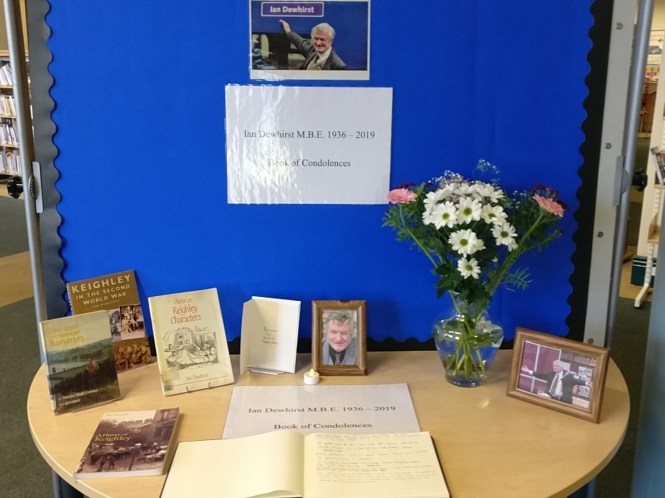
‘With the help of Keighley Library, I have arranged for a condolences book to be placed in the entrance of Keighley Library for anyone who wants to write a few words in remembrance  of the late great Ian Dewhirst MBE. It will then be kept in Keighley Archives as a lasting tribute to Ian.

 If you have been inspired, helped, educated or entertained by Ian Dewhirst over the years please come along to the library and share your memories of him and offer your condolences so that future generations can learn first hand from the people of Keighley what an important contribution he made to Keighley, to its history and to its people.’

Regards,

Charlie Bhowmick M.B.E.
charlie 5charlie 2

New Map Website

Bradford Libraries are pleased to announce the launch of a new website, focusing on the hidden histories within maps and plans in the Local Studies Library

Maps and plans, especially when used in conjunction with other documents, are one of the most valuable sources of information for the local historian and geographer.

In this continuing series of regular posts, the author of our ‘Map of the Week’ feature, local historian Derek Barker, explores the hidden history within a selection of the maps and plans from the collection at Bradford Local Studies Library, focusing in particular on the 19th Century.

You can visit our new website here

Map of the Week: Shipley and the Good Templars, 1878

map of the week 032

This map originally accompanied a sale by Messrs. Best & Crewe of various freehold properties in Shipley, and elsewhere in West Yorkshire. Fortunately the sale was advertised in the Leeds Mercury on April 9th 1878 so we have a good deal of information concerning the auction lots involved. John & Joseph Denby, Worsted Manufacturers, were ‘trustees for the sale’ although it is not made clear who the original owners are or were. Not shown on the plan were three farms in Haworth, Oxenhope and Kippax that were also offered for sale.

Among the lots surveyed was Ashley Mill (then occupied by J Crowther) together with the adjacent builder’s yard occupied by John Ives. There was a timber yard, also occupied by John Ives, and a substantial dwelling called Moor House, then lived in by Fred Ives a son of John born in 1845. John Ives & Son were a firm of Shipley builders and contractors active in the late nineteenth century; the firm employed several hundred men. John Ives himself was born around 1814 and in 1871 he and his wife Grace lived at 11 Commercial Street, Shipley. Their most famous construction was Bradford Town (now City) Hall (1870-1873), but they were also one of the contracting firms who worked for Sir Titus Salt at Saltaire.

On the plan there was also a house and shop in Saltaire Road, and a vacant lot next to a complex of three quarries complete with ‘the ungotten stone therein’. Determining the owners and operators of quarries is never easy. Operators may change quite frequently and quarries might work or ‘stand’ depending on the prevailing economic situation. This plan, and the  OS map of 1889, certainly show extensive evidence of quarrying in this area. The Earl and Countess of Rosse are mentioned as neighbouring landowners on the plan. In the early 1870s their agents produced a definitive map and list of Rosse Estate quarries. The two in this immediate area were operated by John Learoyd (died 1874) and Mr E Butterfield. How you distinguished between their quarries and the stone bearing land for sale, on the ground, I am not sure.

The solicitor handling the sale was George E Mumford. Mumford’s chambers were in Piece Hall Yard, Bradford and then at Bradford Yorkshire Bank Chambers. He was solicitor for Samuel Cunliffe Lister of Manningham Mills and also secretary to the governors of Bradford Grammar School. The surveyor was William Booth Woodhead who I assume drew up this plan.

The sale was to be held at ‘The Good Templars Hall’, Shipley. The Independent Order of Good Templars (IOGT) was an American institution founded in 1851 and introduced to the UK in 1868. The Templars were described as ‘secret and mystic’ (Bradford Observer January 1873) and were evidently concerned with promoting teetotalism. Angus Holden was a noted local member. They had lodges, regalia and officers, in which respect they seemed to have resembled Freemasons who numbered Fred Ives among their number. Unlike the Masons both men and women could be members of IOGT. They had at least 16 lodges in Bradford and several thousand members. The Licensed Victuallers Protection Society considered that they needed to ‘combat the actions’ of the Good Templars who they regarded as aggressive teetotallers. How IOGT differed in outlook from the Band of Hope or the Rechabites I am not certain.

Templars Hall is often mentioned in contemporary newspapers but without a postal address being given. Where was it? In Shipley the Templars seem to have gathered in an old Primitive Chapel at Briggate, which had been bought by Edward Holden. Perhaps this was the Templars’ Hall.

There is a 25 inch OS map of 1889, that is about a decade after the sale. Ashley Mill survived and has extended into the builders yard. In fact the building is still standing today. The timber yard became a wharf. Moor House looks unchanged and in the 1881 census Fred Ives still seems to be living there; however the quarry has extended into its garden. The adjacent Shipley House, not part of this sale, has been demolished and replaced by new housing. On the other side of Moor House, Crow Gill quarry has become a small public park.


Derek Barker, Local Studies Library Volunteer


Keighley Local Studies Re-opens

The work on Keighley Local Studies staircase has been done and Keighley Local Studies will be open as normal from tomorrow at 9.00 am.

We apologise for any incovenience caused while these works were carried out.

Noise of the Valleys


Gary Cavanagh, the author of ‘Noise of the Valleys’ and expert on the local pop and rock music scene will give a talk in Bradford Local Studies Library on Saturday 26th January at 2.00pm.

The talk will feature the stories of local bands, local and social history and highlight some of the livelier characters from Bradford’s music scene of the last 50 years.

The event will be accompanied by recordings of their music.

This is a free event and all are welcome….