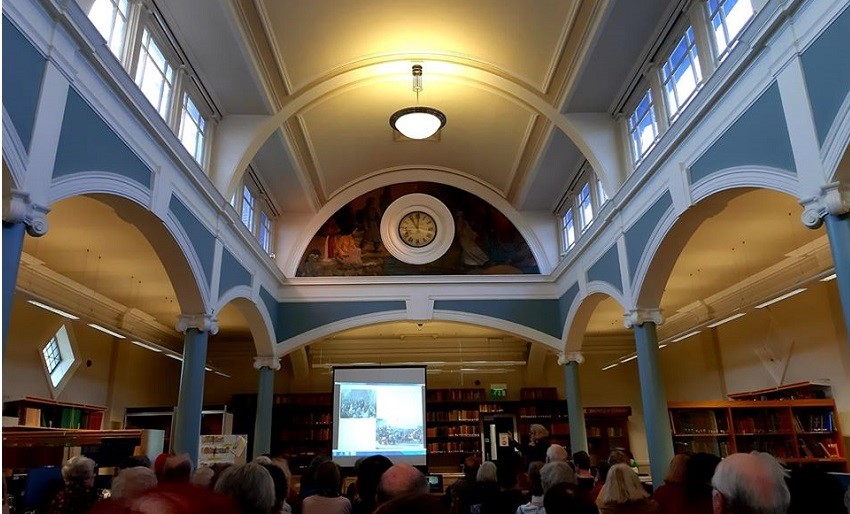
Art for Everyone

Getting through Lockdown well has involved many people turning to hobbies and interests, including arts and crafts. If you are interested in art and artists and are inspired by the works of others, then check out the latest publications coming to Bradford Libraries based on Bradford and District’s very own.

In the last couple of years, 3 well illustrated books by Colin Neville have been published. Past Silsden Artists;  Lesser Known Artists of the Bradford District 1860-1997 and the latest publication that has particular resonance with recent events,  as it looks at the highs but also the lows of a selection of artists and how this affected their art and work, The Highs-The Lows, Past Artists of the Bradford District (Imprint 2021). For more details of these books, please follow the link below to the Not Just Hockney web site. These books will be available for reference and for loan in Bradford Libraries.

Very many people are looking forward to the re-opening of local art galleries and museums in May. Until then, however, there is a great web site that champions and promotes local professional artists past and present:
Not Just Hockney:  https://www.notjusthockney.info/  
This is a non-commercial web site that was launched in 2015 by Colin Neville, a Silsden resident and  former lecturer. By December 2020, the site had come to include 450 artists past and present who had significant residency and/or works, links with the Bradford district”. It’s a fully illustrated site so there is a lot of art to inspire, including of course David Hockney himself.

The site also helps to promote local art trails, The Young Masters Visual Art School (primary school age children), the Art School Ilkley, and also works with the Bradford UNESCO City of Film to present local artists on the public Big Screen in Centenary Square, Bradford.

Bradford’s own museums and art galleries will be opening in mid -May but you can keep up to date and hone your art skills using their online services, their brilliant, illustrated blog post, https://www.bradfordmuseums.org/blog/ , online exhibitions  and  AtHome Activities. This last provides weekly home art projects to inspire you to “draw, write, think, talk, move, make, build, explore, invent, reflect or play” at any age. Please follow this link and get inspired by amazing objects, beautiful art works and historic buildings.

https://www.bradfordmuseums.org/whats-on/you-inspire-me-to-draw-like-david-hockney-2020-04-03

Meanwhile Bradford Libraries have a wonderful stock of teach yourself art and drawing books, DVDs of art techniques (Keighley Local Studies), and regular online story times with related activities https://www.youtube.com/user/bradfordlibraries

Many Bradford and District adults and children in Lockdown turned to art to express their emotions, moods, to escape and to find a sense of fulfilment in difficult times. Bradford Libraries published some in the books: Stay at Home: Poetry and art from the people of Bradford in response to COVID-19 and Stay at Home: Poetry and art from Bradford children and young people in response to the Covid-19 pandemic 2020 (Bradford Libraries paperback 2020) both available in Bradford Libraries . Let’s hope that such comforts can be carried with us into the future for whatever challenges face us and thankfully there’s plenty of advice and inspiration out there to help us to do that.

Keep up to date with what’s opening up and available in your area through Bradford Libraries, Galleries and Museums at: www.bradford.gov.uk

Gina Birdsall, Keighley Local Studies

Census 2021 – history in the making

Another first is about to happen in March with the digital-first census in 2021 but when was the first census, why was it taken and what use has it served and will serve in the future?

The census is a head count of everyone in the country on a given day. A census has been taken in England and Wales, and separately for Scotland, every ten years since 1801, with the exception of 1941, due to WW2.

In 1801 to 1831, the government basically wanted to know the number of people in each area, their sex and age groups. The government was not bothered about personal details, just statistics. Sometimes the enumerator took down more details but this is a rare occurrence. This changed in 1841, when the names of people in each household were included together with information about each person.  Thereafter more information was added each decade.

How the census was taken in the past?

In the week preceding census night, the appointed enumerator delivered the forms to all households in an Enumeration District (approximately 500 people). Censuses did not strictly follow county boundaries. The first page of each District states the route taken. Everyone who slept in the house that night had to be included, even if it wasn’t their permanent home. No person absent was included so salesmen, for example, were included in the census where they lodged on their journey. Census dates are important and vary but they were taken on a Sunday as the night when most people would be at home. Earlier in the year is preferred, since 1851, because many people helped with harvesting in the summer and daylight was always needed for enumerators to carry out their rounds. Forms were filled in for anyone who was unable to read and/or write and there are often many spelling mistakes and some names spelled differently.

On the Monday the forms were collected. The information was then transferred to the Enumerator’s books. The General Record Office compiled the statistics. The date for our 2021 census is Sunday 21 March. For more information, please follow these links:

https://www.nationalarchives.gov.uk/help-with-your-research/research-guides/census-records/

https://www.nrscotland.gov.uk/research/guides/census-records

The Release of the 1921 Census

There is a 100 year closure for freedom of information and data protection reasons for the full household census returns so that the last census to be released was the 1911 in 2012. In 2022 the 1921 census will be released on Findmypast to which Bradford Libraries already have a subscription. https://www.nationalarchives.gov.uk/about/news/contract-awarded-to-publish-the-1921-census-online/

However, a Register was taken in 1939 and this provides some householder information. It is not a full census. https://www.nationalarchives.gov.uk/help-with-your-research/research-guides/1939-register/  

To obtain free access to historical censuses and the 1939 Register, Bradford Libraries have provided free use of Ancestry from your own home during lockdown. Please follow these instructions:

To access Ancestry Library you will need a Bradford Libraries membership card.

Go to https://www.bradford.gov.uk/libraries247  and join the library and/or log in to your library account with your card number and pin. Remember to input just the numbers. Next, click on the special link to Ancestry Library Edition.

How useful is the information collected?

Census returns can be used for social and economic historical research for the Victorian period. As they also give place of birth, they can be used for the study of migration, for trades and occupations, and of course for household and family structures. They are a must for family history and house history researchers and can be used in the study of town and village growth and development.

Why we should take part most especially in 2021.

As a thorough analysis of population the census helps determine social needs and future development. Census information helps plan and fund services in your own area including healthcare, education and transport. It is also used by charities for funding arrangements and businesses for market research and start-up and so impacts on job opportunities. After Covid,  the 2021 census will have particular importance.

To learn more about the census in 2021 please follow these links:

In Bradford: https://www.bradford.gov.uk/browse-all-news/press-releases/working-together-to-deliver-a-successful-census-2021/

 Nationally:   https://census.gov.uk/about-the-census/

Initiative for Bradford Secondary School Students to contribute

https://bso.bradford.gov.uk/Schools/News_View.aspx?Id=19771

Gina Birdsall, Keighley Local Studies Library

International Women’s Day – March 8th 2021: The Indomitable Molly Jones.

From time to time people who I remember from my earliest days working at Keighley Library will suddenly pop into my head, usually for no particular reason, sometimes stirred by memories from a newspaper article or picture that I have been looking at. Not long ago I was thinking about a man called Reg Jones. Reg was a good man and we would often pass the time of day on his frequent visits to Keighley Library. This got me thinking again about that old adage ‘behind every good man there’s a great woman’ and in Reg’s case no truer word was spoken.

When I was invited to write this blog (my first one ever incidentally) there was one lady who’s name immediately sprang to mind. On International Women’s Day 2021 with the NHS very much to the fore, this lady’s life is well worth celebrating. In my eyes she is an unsung hero of whom Keighley owes a huge debt. I never met Molly Jones, but growing up in Keighley in the 70s and 80s I heard her name mentioned constantly. Looking back at Molly’s life and her remarkable achievements, it is only now that I have come to realise what a true pioneer she was in every sense of the word. Keighley should be extremely proud to claim Molly Jones as one of its own, she paved the way for health services that exist in this town to this day.

Molly, christened Mary, was born on a farm in Cockerham and attended Lancaster Girls Grammar School. Her father was not keen on her choice of a career in nursing, so at first Molly took a clerical job with the school health service. However her desire was such that Molly decided to leave her well paid secretarial job behind and enrolled to train as a state registered nurse and midwife on her 21st birthday. By 1942 she was working as a nurse in London and recalled that her pay was £30 a year which increased at the rate of £5 annually until it reached £75. She then transferred to St. Pancras where her work involved supporting new mothers by visiting them when the midwives ended their duties fourteen days after giving birth. As a trainee Molly had to sit with three women who died as a result of back street abortions and this horrendous experience would drive her on to campaign vigorously for abortions to be made legal.

Molly’s next move was to Keighley where she was a health visitor in 1948 on the day the NHS was born describing it as ‘a normal working day’. She was very impressed by the new council estates that were springing up all over the town. Health visitors in their navy uniforms were instantly recognisable and were often called in by mothers who saw them on their way to visit new borns. In that same year Molly married Reg Jones and settled in to her home at Utley going onto have four children of her own. It was soon after her marriage to Reg that Molly retired from paid work, however her involvement in health matters was as committed as ever.

Molly, who had taken mothers under her care in London to a family planning clinic, was by now well positioned to give advice on the subject in Keighley. She told them about a Marie Stopes Clinic in Leeds despite being warned by her superiors not to do so. A pioneer in the field of contraception, Molly was also keen to help women who did not want more children. In 1952 she worked as a volunteer at an evening clinic in Shipley set up by the Family Planning Association. It proved so popular that women started to arrive way before it opened just to make sure that they were seen. Molly would laugh as she recalled ‘they used to make a night out of it with a fish and chip supper on the way home!’

As a health visitor half a century ago Molly also set up a baby and anti-natal clinic at Westgate. She recalled giving out National Dried Milk alongside brand named baby milk, orange juice, virol and cod liver oil. She firmly believed that parenting was the most important thing for any child and that the government should not be encouraging mothers to go out to work.

Molly set about learning relaxation techniques so that women might not need pain killers when giving birth and spearheaded relaxation classes. She was keen to highlight the over-prescribing of tranquilizers and set up several support groups.
Fast-forwarding to the year 2000, Molly called on health chiefs in Airedale National Health trust to provide Macmillan nurses in order to support patients from the moment they are diagnosed with cancer. She believed that it offered a more focused and specialised service compared to district nurses.

I know that a lot of Molly’s achievements will have never been recorded so I will not be aware of them but in later years she became involved in the care of older people and founded SHAPE (a pioneering Senior Health Awareness Project) on Temple Street. She was a staunch supporter of Keighley’s Voluntary Sector through membership of several management and working groups, including Keighley Council for Voluntary Services (KCVS). Heavily involved in many other groups, such as Airedale Community Health Council (KCVS), the Women’s Health Group and a support group for Parkinson’s disease.

Her accolades include winning a Yorkshire Women of Achievement Award and Keighley Community Personality of the Year in 1989.

Molly eventually benefited from some of the services she had supported during her lifetime, such as the Parkinson’s group. She was still attending a keep fit class at the Salvation Army well into her 80s.

On Molly’s death in 2015 at the age of 98, Val Mills, the long-time leader of Keighley Voluntary Services, paid tribute in the ‘Keighley News’ to Molly’s long and active time as a dynamic and determined community health campaigner and volunteer. She said “Molly was an ardent and very vocal campaigner on public health issues, particularly for women. She was often well ahead of the game in new public health issues and growing concerns. She gave many hundreds of hours of volunteer time during 40 plus years.”

Molly’s daughter, Chris Baillie, said “some of my earliest memories are connected with mum’s tireless work for the health of the people of Keighley. She was a campaigner who always fought to right any injustices she saw. My mother’s memory let her down in the last few years, but the spirit carried on.”
Molly’s son, Mike jones was a canoeist who at 19 descended the Grand Canyon and led an expedition down the Blue Nile, later writing a book about his exploits. He drowned in 1978 in Pakistan trying to save his best friend. A film was made about his life.

Molly’s grandson, Tim Baillie, won a gold medal for pair’s canoe slalom at the 2012 Olympic Games.

Molly’s life was well lived and thinking back to Reg in the library back in the day, I think he was a very lucky man indeed to have Molly in his life. I’ll leave the last word to Molly Jones (not many people can say this) summing up her lifetime in health care she said simply “I’ve enjoyed every minute of my work.”

Janet Mawson.
Keighley Local Studies Library.

Captain Sir Tom Moore

We were all saddened to hear of the passing of Captain Sir Tom Moore earlier this month.  A truly remarkable man, whose determination and show of ‘true Yorkshire grit’ during an incredibly difficult year, proved a beacon of hope to us all during lockdown. Raising over £32 million for the NHS he was an inspiration to us all.

A ‘Son of Keighley’, Sir Tom was presented with the Freedom of the Borough last summer on a visit back to his hometown, where a plaque was unveiled in his honour. Here is a look back at Captain Sir Toms’ Keighley origins.

Tom was Born on the 30th of April 1920, to Wilson ‘Wilfred’ Moore, a Mason, and Isabella Hird, a Headmistress.    

Tom’s paternal grandfather, Thomas Moore, came to Keighley in the 1870s after his marriage to Hannah Whitaker. Originating from a farming family in the Yorkshire Dales, seeing no prospect in farming, Tom set out to become a Stone Mason. Having trained in Bradford, Thomas took up building work in Keighley and an early job of his was the building of the impressive wall which surrounds the Cliffe Castle estate. Tom became quite successful and contributed to building many prominent buildings in and around the town. These include, Keighley Town Hall, shops down Cavendish Street, as well as the family home ‘Club Nook, at Riddlesden. Most notably Keighley’s War Memorial, The Cenotaph, situated in Town Hall Square was also Thomas’s firm’s work.

Keighley War Memorial unveiling 1924 (Keighley Photographic Society vol)
W. N. Hird The family shop

Tom’s grandfather on his mothers’ side, John Hird, worked as a barber in the family hairdressing and barbers on Church Street.
During his early childhood Toms’ family lived at 14 Cark Road, a small but modern terrace near to the Town Centre. However on the death of his grandfather Thomas, Wilfred inherited the family home and moved to ‘Club Nook’. Situated in Riddlesden on the edge of Rombald’s moor, it was an idyllic spot for a young Tom, who enjoyed the outdoors and spent much time up on the moors with his pet dog.

Club Nook – the family home

An active and bright lad, Tom entered ‘Keighley Grammar School’ in 1933.

Keighley Boy’s Grammar School. (Keighley Boys Grammar School Archive BK 211)

Although he did not consider himself academic, Tom did well at school and was a member of the debating club of which, Sir Asa Briggs, notable Historian, was also a member.

Tom’s love of machines was spurred by Tom’s Uncle Billy, a motorbike trials rider in his spare time. As a child Tom would watch his uncle take part in races and help him work on his bikes. Tom got his first motorbike at the age of 12, a Royal Enfield, which he proudly restored to working condition himself with no help. This love of motorsports stuck with him and Tom himself took part in motorcycle racing in adulthood. One of Tom’s old bikes from the 1950’s, a Scott Flying Squirrel, was even found at the Bradford Industrial Museum.

Photography was another family pursuit enjoyed not just by Tom’s father Wilfred, but Tom himself, both were Members of the Keighley Photographic Association.

Page from Keighley Photographic Association membership book 1935-1945 (BK83)

Wilfred once had aspirations to become a professional photographer but a complete loss of his hearing unfortunately put an end to any idea of a career.  An excellent photographer, he contributed to the Keighley Photographic Association, with many fine images of Keighley and the surrounding area, some of which appeared in the Keighley News at the time.

Having gained a good education Tom left school at 15 matriculating in, French, English, History, Maths, Chemistry and Physics. He took up an apprenticeship with the Keighley Water Engineer for three years, then at 18 he started a course at Bradford Technical College to study Engineering.  When War came in 1939, Tom a young man of 19 was still studying, but war service was mandatory for all men aged 18-49, so Tom’s War Service started just after he had turned 20, when he was conscripted and joined the 8th Battalion of the Duke of Wellingtons Regiment.  Tom was soon selected for officer training. Having achieved the rank of Second Lieutenant Tom was posted to India. As part of his service he ran a training programme for army motorcyclists. In 1945 now promoted to temporary Captain, Tom returned to England to become a Tank training instructor.         

Post war Tom returned to Keighley to work as a sales manager for a roofing materials company in Yorkshire. A successful career in business ensued and he went on to become general manager of Cawoods Concrete Products Ltd, manufacturing concrete pipes, Cambridgeshire. 

Tom married Pamela in 1968 and the couple went on to have two children, Lucy and Hannah. Sadly Tom lost his wife to Dementia in 2006. So in 2008 Tom went to live with his daughter Hannah and her family in Marston Moretaine, Bedfordshire, where he lived until his death.

His visit back to his hometown in August last year for the unveiling of his plaque was met with much excitement and delight. Here are some of the picture of Captain Sir Tom’s visit. 

The Autobiography, ‘ Tomorrow Will Be A Good Day: My Autobiography by  Captain Tom Moore’ is available with proceeds going to supporting  the  ‘Captain Tom Foundation’  set up in his name.

Copies are also available free to borrow at Bradford Libraries https://www.bradford.gov.uk/libraries and also via ebook on Borrow Box, the free online ebook and audiobook available through your library membership.      

Keighley Local Studies Library was asked if we could help provide details of photographs for the documentary on Sir Tom’s life, showing the Keighley of Tom’s childhood. The documentary about his life ‘The Life & Times of Captain Sir Tom’ is still available through the ITV hub. https://www.itv.com/hub/the-life-times-of-captain-sir-tom/10a0447a0001

Written by Angela Speight, Keighley Local Studies, with thanks to Eddie Kelly, Gina Birdsall, Rachel Shearer, Amy Moore for providing photographs.

A walk with Sidney Jackson #8

Never take dry-stone walls for granted, although any walker in this area will see plenty of them. A great many miscellaneous materials will be built into the walls, often as small repairs. Since my own main interests are in industrial archaeology and geology I am on watch for bricks, iron-making slag, fragments of carved stone, fossils and glacial erratic boulders. I have never been lucky enough to see a ‘rack stone’, three of which are included in SJ’s drawing here.

In the March 1965 edition of the Archaeology Group Bulletin he explains that they obtain their name because their notched shape resembles the rack in a rack-and-pinion arrangement.

Such stones seem to have been reasonably common even if I have never encountered one. They can be built into cottages and boundary walls. The ones pictured were considered to have originally been fragments of a single stone over 6 feet long. SJ states that they were original part of a grain drying kiln but doesn’t explain exactly how they functioned. As I understand it the corn grains were dried on a heavy wool cloth suspended by poles over a low fire. The poles seemingly sat on groves cut into stones placed near the fire, and I assume the rack stones were upright Were there multiple levels of drying? I have seen Iron Age and Roman corn driers but these seemed to employ a stone drying floor, so I will not claim to understand exactly how the rack stones functioned. Can anyone help?

At first sight Bradford seems an unpromising place to grow wheat and barley, with oats being a more plausible grain crop. But in Heaton alone I know of three malting kiln sites and the survival of the place name ‘Whetley’ suggests that wheat was also grown. Corn driers must once have been quite common since the cool, damp, climate in northern upland Britain must have made outdoor drying of wheat prior to storage difficult. But as a child in sunny Sussex, nearly 70 years ago, I well remember ‘stooks’ assembled in the cornfields where the drying took place.