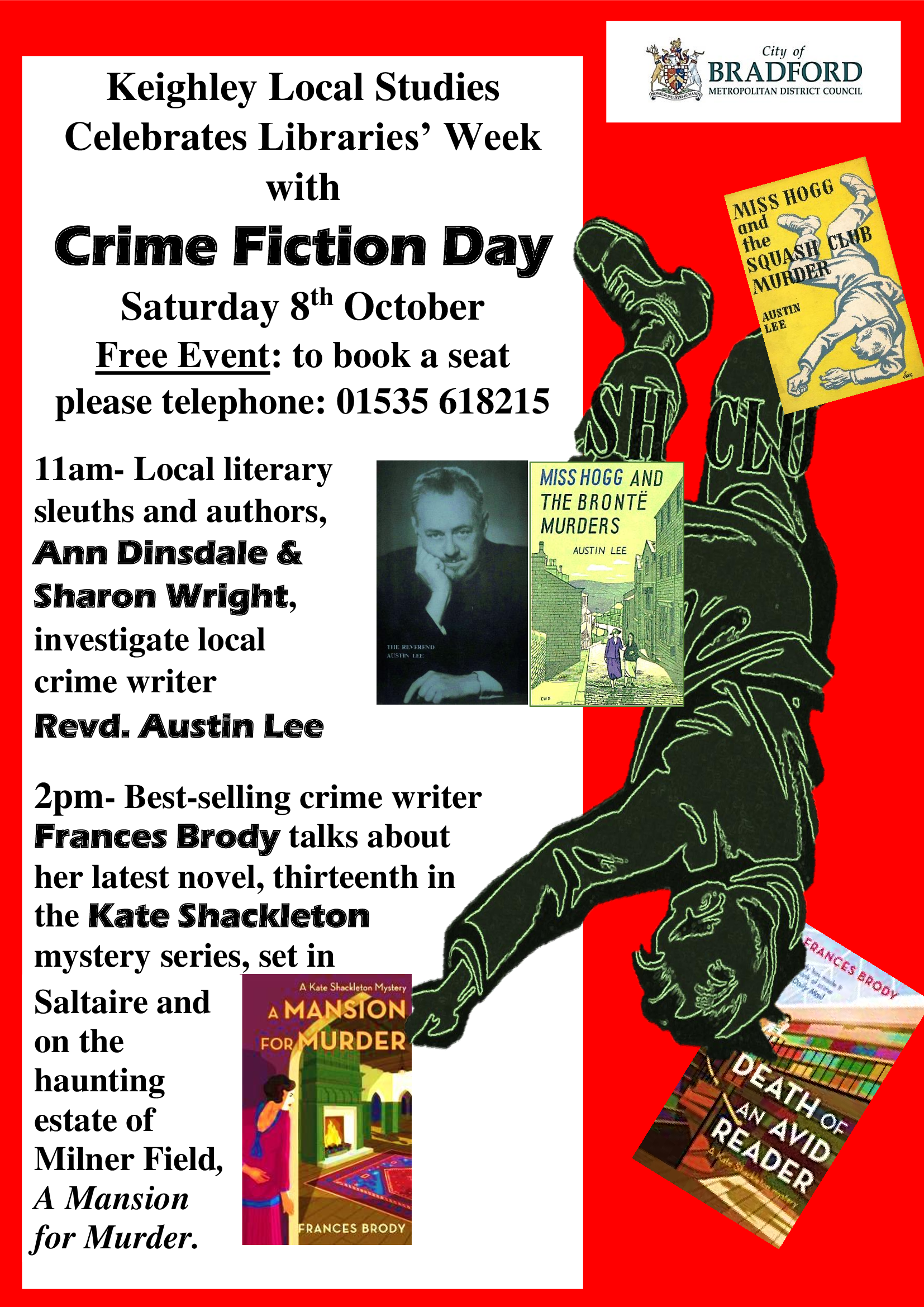
On Saturday 8th October, Keighley Library will be bursting with activity, not least Keighley Local Studies with a major investigation into local crime fiction, past and present.
At 11 am, please join us as local literary super sleuths and authors, Ann Dinsdale (Principal Curator of Haworth Parsonage) and Sharon Wright (journalist, speaker and author) thrash out the mysterious twists, turns and crimes in the life of the Revd. Austin Lee who was one of Keighley Library’s most borrowed crime authors in the 1950s with a curious fascination for Haworth and the Brontës.
In the afternoon at 2pm, dust down for finger prints with the popular crime author Frances Brody, whose Kate Shackleton mysteries reach their 13th challenge, this time set in the grounds of the mysterious Milner Field and Saltaire Village. Find out what inspires crime story writing that is set in Yorkshire locations and investigate the creative impulse, as well as the challenges of local history research for fiction.
Both events are free but seats are limited so please telephone us on 01535 618215 to book a seat.
Keighley Library will also be hosting events for the Keighley Arts and Film Festival with a Create, Connect and Make Festival and the popular local history speaker, Irene Lofthouse, will be taking a walk around Keighley: Past and Present. Details for this to be released in the press and on social media.
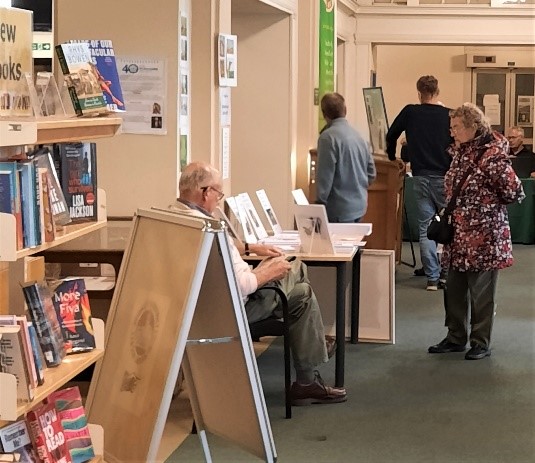
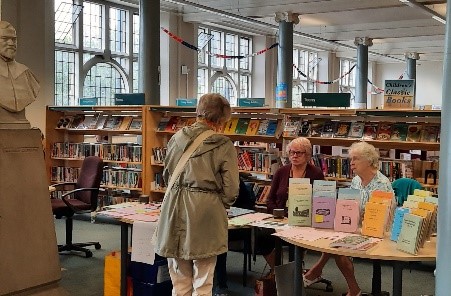
The first Heritage Day in Keighley Library was held on Saturday 10th September. Everyone seemed shocked at the sad news of the passing of Her Majesty Queen Elizabeth II and the general mood felt was that by holding and attending the event, we were following an example set for 70 years of continued service even in difficult times.
For Keighley Library, Keighley Local Studies in particular, the day had some important successes, in large part because this was the first “Heritage Day” of events held at the library since Covid and in fact it became clear as the day progressed that we had achieved a return to the popularity enjoyed pre Covid, a popularity that we hope to build on and increase into the future.
All the heritage stands reported busy times during the day. Colin Neville from Not Just Hockney, who has another new book out on popular local artist Joseph Pighills, had interest as well as sales. https://www.notjusthockney.info/
Airedale and Wharfedale Family History Society were very happy with their reception and one fortunate member of the public even had a large portion of their own family tree discovered. https://awfhs.org/
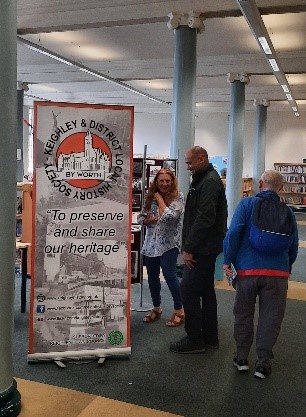
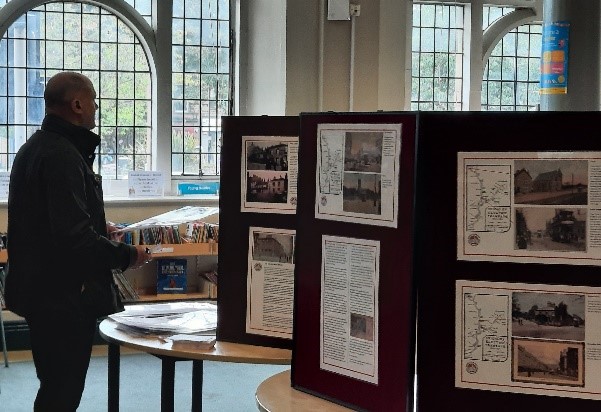
Keighley & District Local History Society had several displays covering trams, the train and bus stations, pubs, historic buildings and businesses. They also created some items honouring Her Majesty Queen Elizabeth II. Staffed by Joyce and Melissa, the day is reported to have been amongst the most successful yet, with plenty of interest and several people making offers of donations and assistance. www.keighleyhistory.org.uk
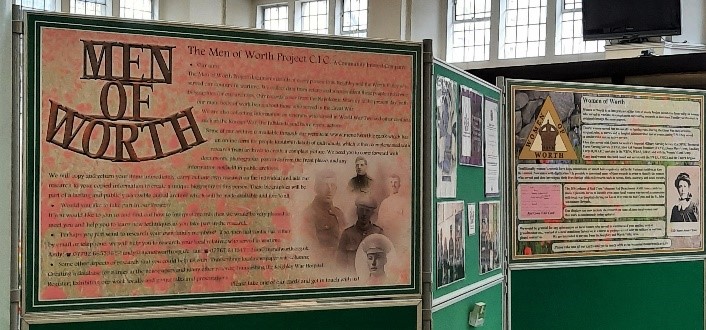
As ever, the Queen’s Award winning Men of Worth volunteer project, that is at the forefront of digital archiving, reported movingly of families seeing photographs of grandparents who had served in the wars for the very first time.
The Patients’ Register was on display from Keighley’s War Hospital at Morton and volunteers have been busily transcribing and digitising their fragile pages. Please come into the library to see the book and further information on this project on Keighley Library’s ground floor. andy@menofworth.org.uk
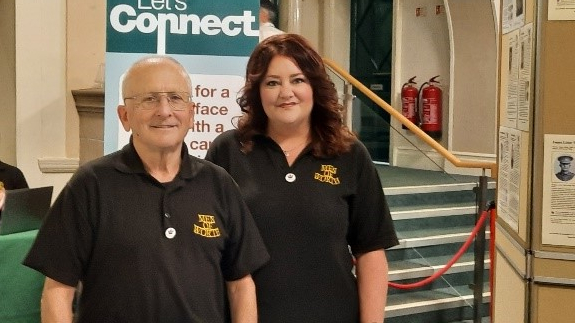
Andy Wade and Ian Walkden of MoW reported a great turnout and were busy for most of the day. Their volunteers have now been researching service women in the wars for some time and there were some interesting biographies on display, with an appeal for any further details of women in Keighley and the Worth Valley area who served. We hope to write further pieces on the Men of Worth and about some new projects that they are pursuing in October as we come up to Remembrance Day. Thanks to their volunteers Kat Hyde and Laura Goodchild.
Ex professional footballer, Keighley’s own Mike Hellawell’s talk had received a red card before it even started by having to be suddenly sent off the Local Studies’ pitch to be relocated to the Lending library area on the ground floor due to a broken lift. Inconvenience of seating rearrangements and some noise aside, the event went very well with an audience of over 100 people who, despite the changes, managed to enjoy the afternoon. Mike’s question and answer session at the end was particularly lively as Mike had been a popular local cricket player as well as footballer and had also run his own grocery shop in Keighley. There were a lot of questions and funny banter from Mike’s contemporaries and friends in the audience that gave us a glimpse of Keighley and local society in the past.
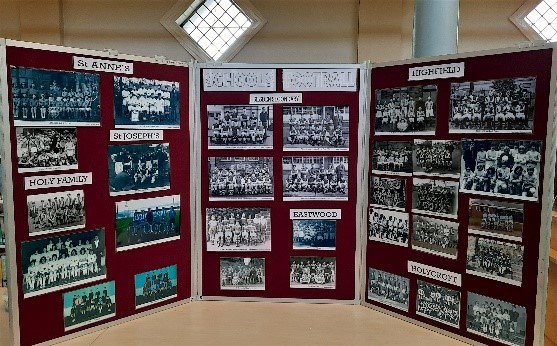
The sense of Keighley in the late 20th century was enhanced by David Kirkley’s very popular (even days after) photograph display of some local schools’ sports teams of the past and by the library’s own displays of Keighley in the 1950s, Keighley Galas in the Past and of Her Majesty Queen Elizabeth’s coronation times.
The refreshments and a Spot the Ball competition managed to raise £65 for Keighley’s Lord Mayor’s charity Dementia Keighley. Thanks must go again to the Keighley Lions for the competition prize and to Morrisons’ Supermarket for their kind donation of refreshments to the Friends of Keighley Library who manned the tea and coffee pots with their usual professional calm and efficiency. A big thank you to Julie Evans and Lynn Hibbert for that and also to Denise Wilson for collecting for Dementia Keighley. https://dementiafriendlykeighley.org.uk/
Keighley Library staff can now look forward again hopefully, to even more successful Heritage Days. Thanks to all for coming at a difficult time. Please come again next year. We shall leave you with some more thanks again to local star Mike Hellawell written in our Visitors’ Book and echoed by all the library staff.
“Really enjoyable, and a pleasure to meet a local international footballer! ‘You’ll Never Walk Alone!’” Shaun Roberts
“Great stuff from Mike about the old days. Lots of fun.” Jean Mitchell
“Fabulous talk. Very entertaining! Catherine Kelly
“In the same room as a legend.” M. Hibbert, Burnley Fan since 1962
“Let’s have lots more of these talks and bring back the music sessions, we all loved.” Mrs Prett
“A popular speaker with lots of friends in Keighley.” Ronnie
Keighley Library will be hosting Heritage Day again on Saturday 10th September after a two-year pandemic break so please come along from 10.00am.
Wharfedale & Airedale Family History Society will be on hand to help you with your family history and Keighley & District Local History Society will be exhibiting some of their photo archive collection.
The award winning Men of Worth Project will also be there to help you with any enquires and showing off their work including The Morton Banks War Hospital records project.
Volunteers have been working hard to transcribe and digitise the Patient Register from the First World War. The original War Hospital Register is archived at Keighley Library (BK39) and contains 13,214 names of servicemen who were treated there. It also contains the names of German prisoners of war who were being held locally and required treatment from time to time, notably from the influenza epidemic.
There will also be a display on the Women of Worth with compelling documentation on the roles of local women in wartime.
Come and see old photos of 1950s Keighley including school photos from David Kirkley’s collection and of Gala Days gone by.
Along with the amazing and interactive Heritage Open Day events the library has planned, there will also be a couple of rare artefacts on display to promote an exciting and forthcoming “Pink Floyd in Keighley” library exhibition.
And if that isn’t enough to tempt you at 2.00pm local footballing (legend/ star/) Mike Hellawell will be talking about his career and life growing up in 1950s Keighley. Going from playing non-league to playing top flight football for QPR, Birmingham City, Sunderland and Huddersfield Town, gaining two England Caps.
The talk is free but seating is limited so booking is advisable, contact Keighley Local Studies Library on (01535 618215).
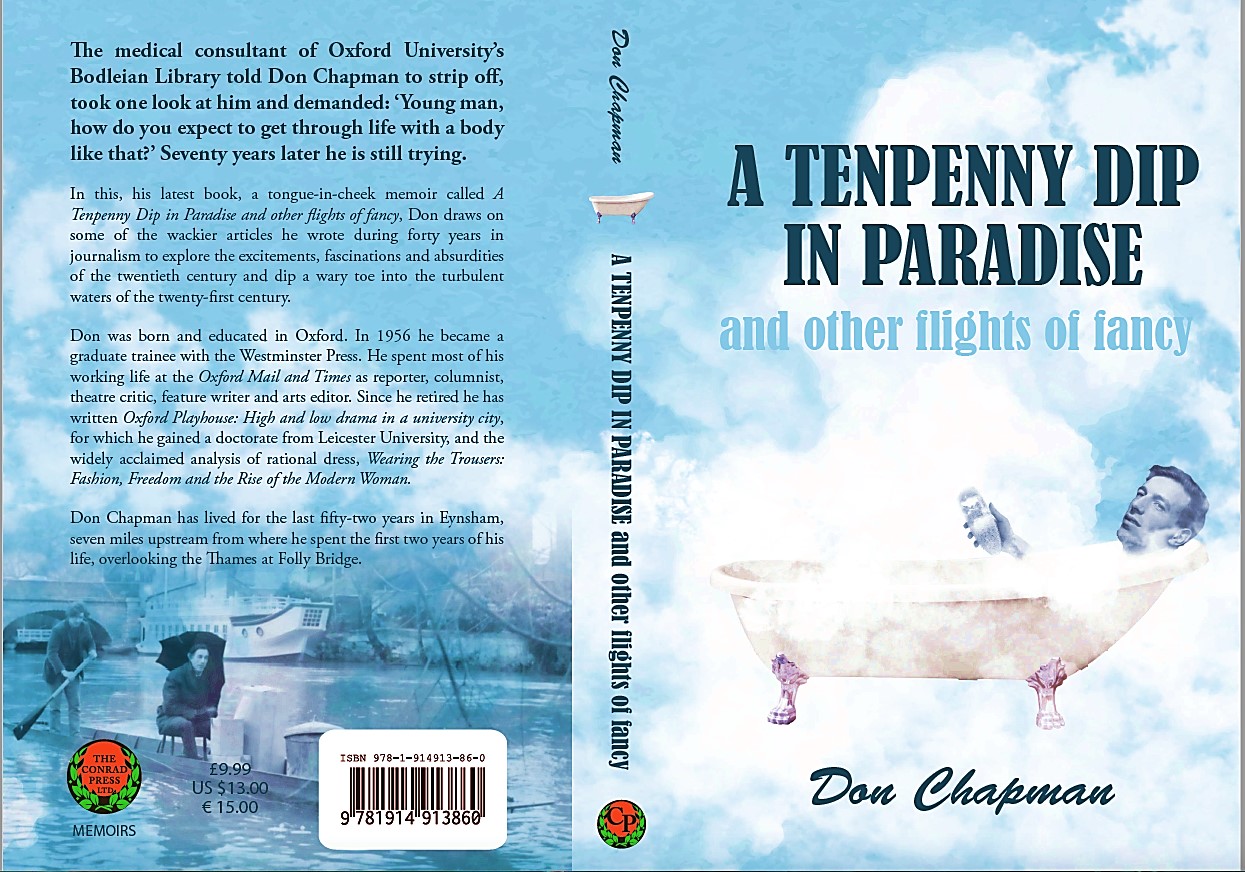
It is not that often that an enquirer of Keighley Local Studies Library on a Keighley history subject, comes ‘right back atcha’ with a casual, “I am researching an autobiographical work coming out soon” but occasionally they do. Don Chapman enquired earlier this year about Keighley baths and his new book that includes sketches of the Keighley he came to know and love, surprisingly as an in-comer from Oxford and its University, is published now and in due course will be in Keighley Library.
When he became a graduate trainee with the Bradford and District Newspaper Company in 1956, it was the landlord of his first digs in Keighley who took the tops off the bath taps. He went to the public baths down the road fearing the worst. Hence the title of his tongue in cheek memoir featuring some of the wackier articles he wrote in a 40-year career in journalism, A Tenpenny Dip in Paradise and other flights of fancy. In it, Don Chapman hopes that he has captured some of the “banter and bonhomie I shared with my colleagues at the Keighley News”, that he remembers most fondly.
Just a few of his Keighley memories are quoted here:
“I’m not sure I even knew where Keighley was when the Westminster Press told me I would be starting my career as a graduate trainee reporter there in September, 1956. Before I took up the post, I decided I’d better take a look.
I arrived by train from Oxford shortly after 2pm. The hotel at the bottom of Cavendish Street had stopped serving lunch and everywhere else was shut. It was early closing day. Eventually I stumbled on a workmen’s café and a satisfying plate of bacon and eggs, served with a large mug of Yorkshire tea, somewhere in the back-street.”
“I quickly grew to love Keighley. The flowers in the front windows of those who hadn’t got gardens. The washing in the streets between the back-to-back houses. The rich array of cakes and savouries in the bakery shop.”
“The war years and the period before them had left their mark on the town. Sooner or later, chaps I met in the pub would start rueing the privations of the 1930s Depression: an economic downturn Lord Nuffield’s Cowley car factories had protected Oxford from.
Although premier Harold Macmillan was telling people they’d never had it so good, many in Keighley were still struggling. At the Mechanics Institute Saturday night hop, on more than one occasion the manager said to me: ‘See that couple there, Don, they’re on their honeymoon!’”
The book is out now and available online and from bookshops. It will also be in Keighley Library soon.
Gina Birdsall Keighley Local Studies
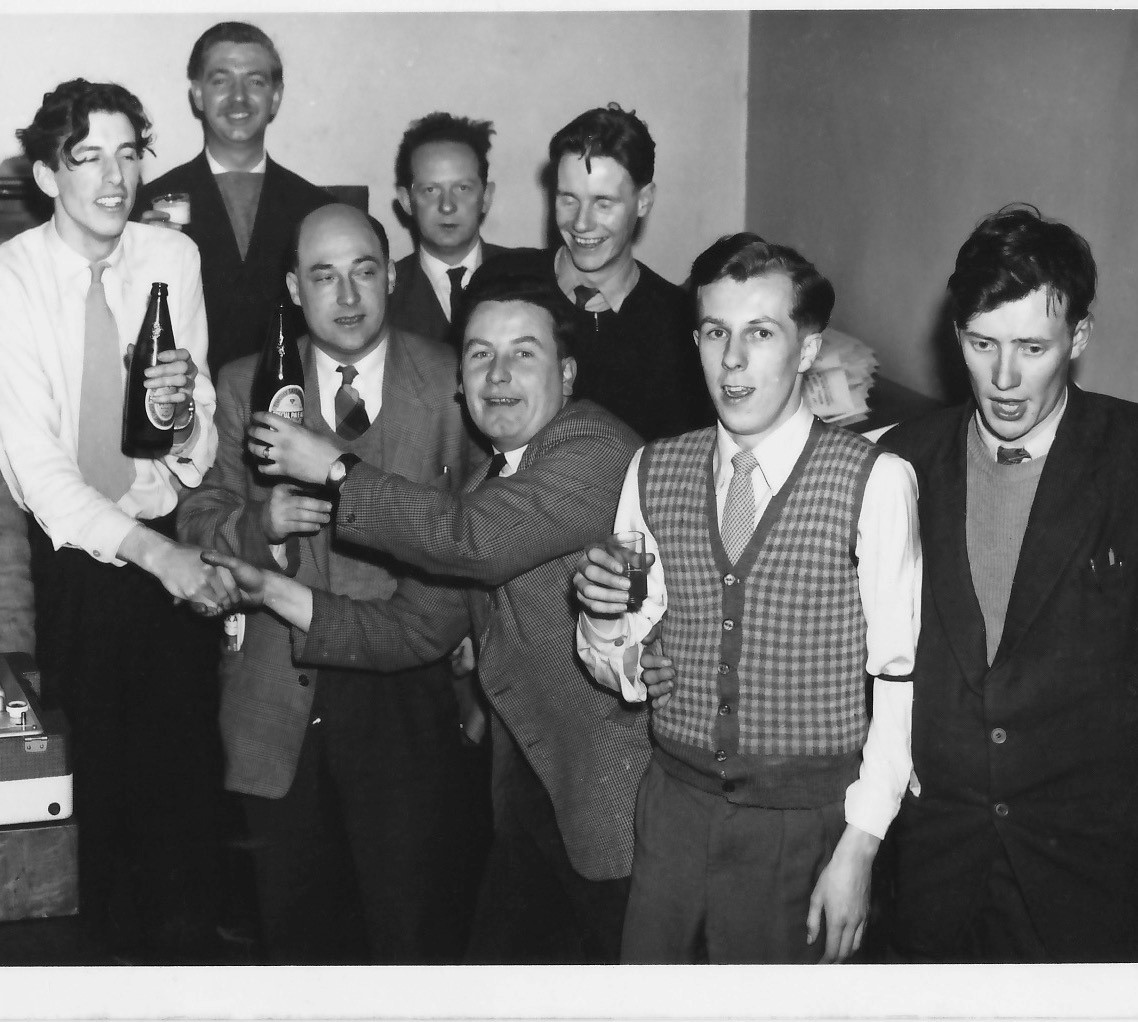
Left to right: Don Chapman (bottle of Taylor’s Yorkshire Ale in hand!), Peter Cook (Yorkshire Post), Eric Lund (Keighley News reporter), Jack Broadley, Keighley News reporters: Eric Walker, Brian Smith, David Waterhouse and holding my hand Trevor Atkins.