Book Review: Punjab to Bradford: Life Stories of Punjabi Immigrants in Bradford

Punjab to Bradford: Life Stories of Punjabi Immigrants in Bradford. By Ramindar Singh and Kashmir Singh Rajput. Privately published (ramindar.singh@ntlworld.com), 2013
204 pp.  ISBN: 978-0-907734-71-10.  £10.00.

Available at Bradford Libraries

Dr Ramindar Singh MBE

This book presents the lives of 44 Punjabi migrants who came to Bradford in the 1950s and made the city their home. With only a few pounds to their name they came here with great hopes and some with good academic qualifications. They were obliged at first, however, to take up unskilled work on the buses, in mills and foundries, finding their qualifications were not recognized in Bradford. They suffered much discrimination too, until opportunities arise where they could use their knowledge and skills more appropriately.  Local colleges, particularly Bradford Technical College, played a significant role in making this transition possible. It was good to find, too, that most of their children became well-qualified and successful in their occupations. As seen with other migrant groups, early arrivals often gave room in their homes to new arrivals, in spite of difficulties it caused. This of course had a substantial effect in promoting community cohesion. The reunion of families when wives came to join their husbands and find work themselves outside the home, must have contributed significantly towards social mobility of their families.

This book gives personal accounts of how the early Punjabi immigrants in the 1950’s coped with their frustrations, humiliations and discrimination.  After an editorial introduction explaining how the book was compiled, there follows an account of the Punjab and reasons of why migration occurred, and its process.  An account is then given of the development of the development of the Punjabi community in Bradford.  The main part of the book contains the stories of individuals who left their homes and families in the Punjab during the 1950s through 1970s to seek their fortunes in vilayat (England).  At the conclusion of these accounts there is a chapter entitled: Reflections of life through Mehfil (informal gatherings). Topics covered here are: Community spirit and mutual support; Understanding local people; Learning new work norms; Duality of conduct; Life in a male dormitory; Entertainment; Women’s position and experience; and Utopian Vilayat vanished.  Finally there is a useful Glossary of Punjabi words and phrases.

In their Conclusion, the compilers note how the Bradford that the 1950 pioneer migrants experienced is no more, and that their children and grandchildren experience a very different world. Reminiscences such as those here are important in keeping the heritage alive. Something, of course, which is true of all cultures, whether migrant (from overseas or other parts of Great Britain ) or even non-migrants. This book is a valuable contribution to Bradford’s social history.

Dr Singh is a former Bradford College lecturer, JP, and deputy chairman of the Commission of Racial Equality. He is author of The Struggle for Racial Justice: From Community Relations to Community Cohesion in the Story of Bradford 1950-2002. K.S.Rajput was a senior education officer with Bradford Council. Bob Duckett

Review reprinted from the Bradford Antiquary, 2016, courtesy of the Bradford Historical and Antiquarian Society.


Neglected Bradford Industries: Limestone & lime-burning

Bradford is famous for spinning and weaving but textile production was only one of a group of important industries which ‘Worstedopolis’ supported. Since several  are now almost forgotten by contemporary citizens I should like to draw attention to those which seem unreasonably neglected, in a series of short articles.

Limestone was a most valuable commodity. It could be cut into ashlar for building construction. It could be burned in kilns to produce quick lime which was then slaked with water. In either of these forms it could be spread on the land to ‘sweeten’ acid soils, making them more fertile. Slaked lime was also the essential ingredient of lime mortar, render and whitewash. To charge a blast furnace crushed limestone was added to coke and iron ore because it assisted in the separation of the slag waste. Some hard fossil-containing limestones which took a good polish, like Purbeck stone, were regarded as ‘marbles’ and used for decorative purposes. It is common today to employ limestone aggregate for path and road construction, but this is a relatively recent development.

Limestone consists largely of a single mineral called calcite (calcium carbonate). Immensely thick limestone strata are common near Skipton and in the Dales.  Geologists recognise many sub-types of limestone classified by age, appearance, and fossil content. Since most of the stone reaching the Bradford area was burned we need not be too concerned these complexities.

Image A

Lime quarry at Stainforth, North Yorkshire.

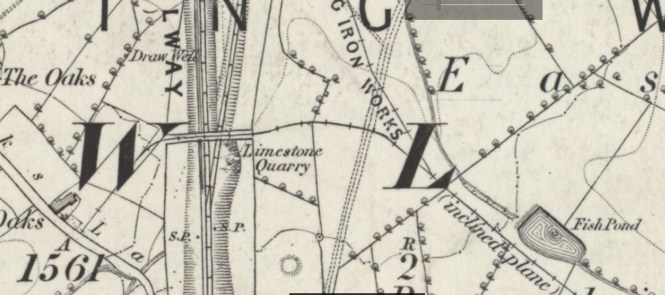
Although limestone strata do not reach the surface in the Bradford area there was nonetheless an early lime-burning industry based on the extraction of boulders from glacial moraines in the Aire and Wharfe valleys. Boulder pits were well established in Bingley by the early sevemteenth century, and three groups of pits are still marked on the first OS map of the area (1852). In 1931 the Bradford Historical & Antiquarian Society published a series of West Yorkshire Deeds which are still available in the Local Studies Library. An indenture of 1604 between Alexander Woodde of East Morton and Abraham Bynnes, with others, mentions the ‘digging of greetstones’. In 1620 Thomas Dobson of Bingley leased four closes of land to his father Michael ‘with authority to dig there for lymestones and to burn, sell and dispose of them’. Glacial erratic limestone found elsewhere was almost certainly exploited in the same way. In the nineteenth century, on at least one occasion, the digging of a railway cutting seems to have exposed similarly valuable boulders.

Image B

Lime stone quarry near Bowling Junction, and close to a mineral way to Bowling Iron Works. In this position it must represent the working of a moraine deposit (detail from 1852 OS map).

With the construction of the of the Shipley to Skipton sections of Leeds-Liverpool Canal (1773-74) plentiful supplies of limestone became available from the Skipton quarries.  The cheap movement of limestone and coal were among the original ambitions of the canal promoters. Once you had supplies of limestone you required some means of burning it. Local scholar Maggie Fleming, is currently collecting information about canal-side lime kilns, and early lime-burning from erratic boulders, particularly at Micklethwaite and Bingley. Between 1774-83 the Bradford Lime Kiln Co. had eight kilns in Bradford at a site between Broadstones and Spinkwell Lock.  There was evidently an extensive canal-side lime-burning industry since the first OS map also records kilns at, among other places: Silsden, Riddlesden, Micklethwaite, Crossflatts, Bingley (Toad Lane), Dowley Gap, and Shipley.

image C

A map of 1863 recording lime kilns near the centre of Bradford.

There were a number of lime kiln designs including some very advanced Hoffman continuous kilns like the one preserved at Stainforth, N.Yorks. Simple stone built field kilns were once common in this area. They were charged with broken stone and coal from above, with quicklime and ashes being raked out from below. The field name ‘lime-kiln close’ or ‘kiln close’ may reflect this older lime-burning industry. There are two fields in Heaton with these names, now located in Heaton Woods. Local historian Tony Woods has studied Rosse archive records from Ireland and can demonstrate that Heaton coal pits were supplying a lime-kiln, somewhere near, with fuel as long ago as 1776.

Image D

Field kiln near Grassington

If you would like to do more reading on this topic may I suggest:

J.V. Stephens et al. Geology of the country between Bradford and Skipton, HMSO, 1953, 149-151, 149. This is essential reading for geological background to any local extractive industry.

David Johnson, Limestone Industries of the Yorkshire Dales, Amberley, 2010. It is inconceivable that anyone could ask a question about limestone that this book cannot answer.

Gerald & Sheila Young, Micklethwaite: the History of a Moorland Village. The early section of this book describes has an interesting account of the exploitation of local mineral resources.

Derek Barker, Local Studies Library Volunteer

Map of the Week 25: East Bierley

I was not born in West Yorkshire which is an excuse for periodically getting lost in the urban areas south of Bradford. The most recent occasion led to my discovering a real gem, the village of East Bierley. It has an almost rural air with a village green and a well-known cricket club. It is no surprise to learn that it has been a conservation area since 1981, in recognition of ‘special architectural or historic interest’, since the village has a substantial number of lovely eighteenth and early-nineteenth century stone built properties. Admittedly East Bierley is ‘over the border’ in Kirklees but in the past it had significant coal and wool links with Bradford, and the Local Studies Library reserve map collection has a very detailed plan of the village recording both the names of fields and land-owners.

Map of the Week 025 A

A plan of East Bierley and the surrounding fields. The absence of the railway line and paucity of coal mining activity may date it to the late 1830s.

I’ve included a view of almost the entire plan and also a detail showing the village centre which should be clearer. The plan is extensively annotated in both pen and pencil. It was clearly a working copy of some type, possibly a land agent’s plan. The pattern of fields and buildings in this plan very closely resembles the first Ordnance Survey map of the area which was surveyed in 1847. So my first thought was that our plan might also represents the situation in the late 1840s. It could pre-date the OS map since it does not include the Great Northern Railway line section from Birkenshaw & Tong to Dudley Hill stations. This raises an interesting and slightly mysterious point. There is an extremely helpful website which records the lost railways of West Yorkshire:

http://www.lostrailwayswestyorkshire.co.uk/

The expert enthusiasts managing this site believe that this section of track, part of a Gildersome to Laisterdyke line, was opened in 1856 which makes its appearance on an 1852 OS map edition surprising. Possibly revised sheets of the first OS map were issued to allow for such major developments.

Map of the Week 025 B

A detail showing East Bierley properties, some of the land-owners and ‘Bell Pit Hills’.

It would be wrong to assume that the annotations are necessarily contemporary with the plan but there are some indications that this is the case. Not all the land-owners’ names are legible but I can recognise: Joseph Waterhouse, Joseph Speight, William Booth, Joseph Binns, John Woodcock, John Firth and James Verity. I have tried to identify some of these individuals in trade directories and the censuses for 1841 and 1851. It seems that East Bierley is linked to Hunsworth for recording purposes. The 1851 census indicated that by the mid-nineteenth century coal or ironstone miner was the commonest occupation in the village, and there was even a single 11 year old ‘pit boy’. The second commonest occupation was wool-comber, this being an essential part of the worsted process. Nearby Birkenshaw Mill and Wilson Mill both wove worsted cloth. There were residents employed in other textile trades such as spinners and power-loom weavers. Next in frequency were farmers and finally a grocer, a druggist, and two boot and shoe makers. Family history really deserves prolonged study, rather than the quick assessment which is all that I provide. What I can say is that Joseph Speight, William Booth, John Woodcock, John Firth and James Verity can all be identified as farmers in the 1841 census but only John Firth survives to 1851. I therefore think that it is reasonable to date the addition of the annotations to the early 1840s.

The plan maker seems to be more concerned with with the surface land ownership than the mineral resources underground. This makes it possible that the plan itself was originally drawn up as early as the 1830s before the Bowling Iron Company leased the right to mine coal in this area. Certainly by the time of the first OS map there were several working and abandoned coal mines existing within the area of the plan, also ironstone pits and a tramway taking material to Bowling Iron Works. On our plan there are just two, quite subtle, references to ‘black diamonds’. One is a ‘pit’ noted above and slightly to the left of the pinfold where stray animals were kept. The other is a field name at the top centre of the detail, in the occupation of Joseph Waterhouse. The name recorded for this is ‘Bell Pit Hills’. Bell pits are commonly encountered in accounts of early mining. In this method a short shaft was sunk down to a shallow seam and its base was then expanded as the mineral was removed, creating a bell-like profile. When unsafe, because of potential roof collapse, the bell was abandoned and a new shaft sunk nearby. Each bell was filled in turn by waste dug out of its successor. Since the exact situation underground cannot be determined from surface remains ‘shallow shaft mining’ is now the preferred term.

Map of the Week 025 C

A detail of the plan included in Derek Pickles’s unpublished work showing the pits and tramways near East Bierley at their maximum extent. The triangles are pits which, in many cases, are numbered since their names are unknown.

In his very detailed study of mineral tramways, curated by Bradford Industrial Museum, Derek Pickles recorded that ‘in 1839 the (Bowling Iron) Company leased 1200 acres of land in Toftshaw and Hunsworth from the Earl of Scarborough, and began to work pits in the area’. The Earl was at that time Lord of the Manor. It is possible then that the original plan pre-dates this event. The shallowest seam in the East Bierley area was called the Blocking Bed (or Toftshaw Bed) Coal. At nearby Toftshaw Colliery, which was open  between 1913-1950, the Blocking Bed Coal was found at 26.5m and the deeper Shertcliffe Coal seam at 87m depth. Other bore hole reports available from the British Geological Survey suggest that more usually Shertcliffe Coal was at 30m depth in this area, and was widely exploited. The fact that there were also ironstone miners and ironstone pits in East Bierley suggests that the ironstone containing Black Bed Coal seam was also being accessed about 67m below the Shertcliffe Coal. Derek Pickles recorded that the Bowling Iron Company already had shafts of 95m depth to reach the Better Bed coal but when it ‘extended its operations into Hunsworth, Toftshaw and Tong much larger and deeper pits were sunk’. The enterprise was not without risk: at one of the company’s pits in 1847 the Bradford Observer reports a firedamp (methane) explosion with one miner killed and several others burned.

Otherwise peaceful East Bierley does not seemed to have occupied contemporary newspapers over much around the time of the plan. In 1838 the community contributed delegates, and a flag, to a Chartist meeting on Hartshead Moor which was addressed by Peter Bussey and Feargus O’Connor. In 1842 James Verity, one of the landowners, together with James Binns, were sworn in as constables. The following year a Bradford branch of the Leeds to Manchester railway was being considered and in 1844, at the Lister’s Arms in Manchester Road, William Patchett won a main prize at a flower show with a dark-laced pink called ‘Lady Milner’. In 1856 John Willey, representing Hunsworth, was elected a Poor Law Guardian of the North Bierley Union. He lived at Moor House, East Bierley which you should be able to make out on the right of the larger plan. His son was Francis Willey (1st Baron Barnby) a very successful international Bradford wool merchant in the late nineteenth century.


Derek Barker, Local Studies Library volunteer

Treasure of the week no. 15: Tinners and bonnet-makers: The working classes of 1851

JND 197/23 (Please quote this number if requesting this item)

BAKER, Robert.  The Present Condition of the Working Classes. Considered in two lectures delivered before members of the Bradford Church Institute. Bradford: H. O. Mawson, C. Stansfield, J. Dale, H. B. Byles, and other Booksellers.  1851. 62 pages.

working

I recommend this substantial booklet to anyone interested in mid-nineteenth-century Bradford. The print is small and the prose dense, but it is factual (with statistical tables), wide-ranging, objective, detailed, and contemporary with the scene it describes: a sort of textbook of the times. Chapter headings are:

  • The Working Classes as a Body Considered
  • Their Hours Work – Legal and Conventional
  • Their Intellectual State
  • Their Social State
  • Their Morality
  • Strikes

But who were the working class? The author excluded ‘Domestic Servants, Labourers, and those who work in Manufacture and Mines’, but the list of those included in one of the statistical tables gives a useful picture of the ‘Labour Trades’ of old Bradford:

  • Bakers
  • Brewers
  • Butchers
  • Brick-makers
  • Bricklayers
  • Joiners
  • Masons
  • Painters
  • Sawyers
  • Plasterers
  • Blacksmiths
  • Cabinet-makers
  • Engineers
  • Iron manufacturers
  • Nail makers
  • Glass maker
  • Potters
  • Tinners
  • Wheelwrights
  • Shipbuilders
  • Coach makers
  • Curriers
  • Boot & Shoe makers
  • Tailors
  • Carters
  • Hawkers
  • Milliners & dress-makers
  • Sempsters & stresses
  • Stay-makers
  • Straw-plaiters
  • Strawboard-makers
  • Bonnet-makers

An aside it is frequently unknown how the library acquired its pamphlets, but not this one. It is stamped: British Museum Duplicate Transferred.

Stackmole

TREASURE OF THE WEEK No. 14: POLICE DUTIES IN 1848

JND 197/17 (Please quote this number if requesting this item)

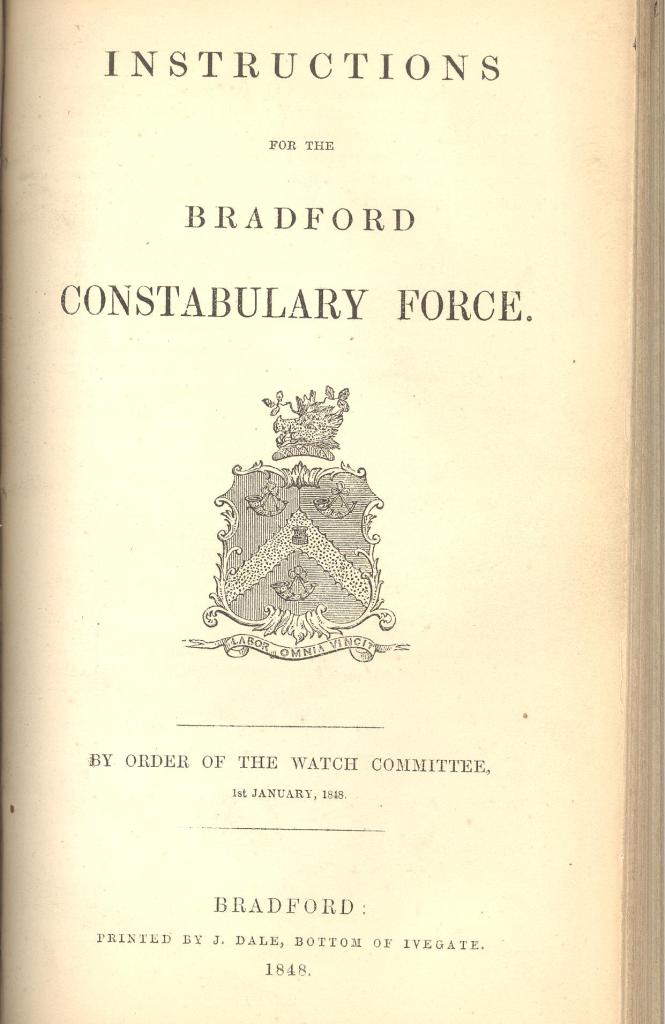
BRADFORD CONSTABULARY FORCE. Instructions for the Bradford Constabulary Force. Bradford, J. Dale, Printer. 1848. 76 pages.

jnd 197 17 001

This weighty booklet published ‘By Order of the Watch Committee’, describe the duties of the early police force in Bradford.

After describing the duties of the various ranks of the police force from Constable, through Sergeants, Detective Officers, Superintendent to Chief Constable, further details are given of these various duties. Topics covered include:

  • Felonies
  • Misdemeanours
  • Riots
  • Assaults
  • Breaches of the Peace
  • Breaking open and entering Homes
  • Arresting Offenders
  • Executing Warrants
  • Removing Articles from the Pinfold
  • Opening Sewers
  • Keeping Order in the Streets
  • Affrays and Riots at Night
  • Felonies, Robberies, etc.
  • Calling for Assistance
  • Giving Evidence

The publication includes several forms and lists, including details of The Riot Act; Names of Keepers of the Keys of Fire Engines, and Sweeping of the Streets.  In the latter all 130 streets, or parts of streets in Bradford Town are listed with how often they are to be ‘swept’ (i.e. patrolled). Most are to be swept once a week, but Hall Ings, Broadstones and Well Street are three streets which are to be swept three times weekly. There is an impressive and immaculately compiled six-page index. Under ‘A’ are:

  • Abusive Language, Constable cannot Arrest for
  • Affrays
  • Arrest, How to be made
  • Assault
    Whether a Constable may Arrest for
    When a Constable cannot Arrest for
  • Assistance, Calling for

A fascinating and detailed insight into a community developing social control.

Stackmole