Local Poets of Keighley and District: Bill O’th Hoylus End (William Wright)

In the celebrating of public events in Keighley, which town he has long made his home, or in the lampooning of Keighley’s public men, he is especially at home. No public matter there would be regarded as duly celebrated unless enshrined in the local laureate’s rhyme, no ceremony complete without his burly presence or his facile pen. He is the poet historian of the borough.

(William Wright: The Poets of Keighley, Bingley and Haworth: Chas F Forshaw (Ed) 1893)
Local Author’s collection, Keighley Local Studies Library.

William Wright

To Isaac Holden Esq. MP

Come, hand me down that rustic harp,
From off that rugged wall,
For I must sing another song
To suit the Muse’s call,
For she is bent to sing a pœan,
On this eventful year,
In praise of the philanthropist
Whom all his friends hold dear—
The Grand Old Man of Oakworth,
Beyond his eightieth year!

No flattery!  My honest Muse,
Nor yet be thou servile;
But tinkle up that harp again,
A moment to beguile.
Altho’ the bard be rude and rough,
Yet, he is ever proud
To do the mite that he can do,
And thus proclaim aloud—
The Grand Old Man of Oakworth,
Of whom we all are proud!

For base indeed were any bard
That ever sang on earth,
Did he not wish his neighbour well,
And praise his sterling worth.
Leave state affairs and office
To those of younger blood,
But I am with the patriot,
The noble, wise, and good—
The Grand Old Man of Oakworth,
The wise, the great, the good!

This worthy old philanthropist,
Whom all his neighbours greet;
Who has a smile for every one
Whom he may chance to meet—
Go to yon pleasant village,
On the margin of the moor,
And you will hear his praises sung
By all the aged poor—
The Grand Old Man of Oakworth,
A friend unto the poor!

Long may he live! and happy be,
The patriot and the sire;
And may some other harp give praise,
Whose notes will sound much higher.
His thirst for knowledge, worth, and lore—
His heart was ever there—
This worthy old philanthropist,
Beyond his eightieth year!—
The Grand Old Man of Oakworth,
Beyond his eightieth year.

See also:  BK 135 & BK361 held in the Archives @ Keighley Local Studies.

For more on Bill O’ Th Hoylus End

http://discovery.nationalarchives.gov.uk/details/rd/ea64b6b2-55a8-469c-823e-7cf6cb125fdd
http://www.haworth-village.org.uk/history/people/bill-hoylus.asp
http://www.gutenberg.org/files/29085/29085-h/29085-h.htm

And more can be learned about the subject of Bill’s poem, Sir Isaac Holden, inventor, entrepreneur and politician here, in our subscription to the Dictionary of National Biography

http://www.oxforddnb.com/view/article/13491?docPos=12

Ian Dewhirst in Keighley Library Then and Now!

Ian Dewhirst was the Reference Librarian in Keighley Library from 1967 until his retirement in 1991.  Here are images of him doing a talk in 2015 and working in the library at the start of his career in Keighley.

Ian Dewhirst 2015

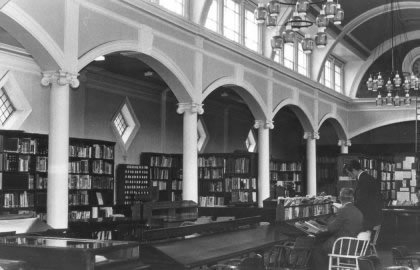
Keighley Public Library has the distinction of being the first in England substantially paid for by the Scots-born American industrialist Andrew Carnegie. The Borough council was to provide the site and adopt the Free Libraries Act. An architectural competition was held and the design of McKewan and Swann of Manchester was chosen. The design of the building was described as ‘Edwardian Free Style with Art and Craft influence which presages future 20th century developments in architecture more than it reflects 19th century eclecticism.’ (Sarr 1980)

Ian Dewhirst 1967

Where Town Meets Country

In the BBC’s ‘Countryfile’ programme of Sunday 17th May Anita Rani returned to her home turf of Bradford to explore the countryside on the edge of the city. She discovered the rural gems right on her doorstep and the journey that has been made for centuries from the urban sprawl to the fresh air of the nearby moors.

Bowling Iron WorksImages from the collection of Bradford Local Studies Library were shown in the programme including pictures of the Bowling Iron Works in 1861. The Bowling Iron Works had been established c 1780 in the southeast of Bradford. The process involved mining coal and iron ore, smelting and refining, casting and forging. By 1840 Bradford was known for having some of the most smoke-filled air in Britain, however these images also demonstrate the proximity of the local moors and countryside surrounding Bradford.

Countryfile also featured coverage of Saltaire and Baildon including Roberts Park, Shipley Glen Tramway and Baildon Moor.

80 Years of Ilkley Lido

The bathing pool opened in May 1935.  It was an immediate success and enhanced Ilkley’s reputation as an inland health and holiday resort. There were several water slides and the popular ‘wedding cake’ fountain. The diving board was of international standard.

During the second world war, the bathing pool was a popular centre during the Holiday at Home weeks.  In May 1942 it was announced ‘in order to avoid the use of fuel, the water at the bathing pool will not be heated this year.’

In 1950 when this photograph was taken the pool was open from 9am until 9pm each day and in the evening was illuminated by ‘fairy lights’.

The official opening of the Ilkley Lido this year will be on 23rd May.

Ilkley Lido

Local Studies visit the Bradford Club

Bradford Local Studies Library was represented at an event organised by the Bradford Historical and Antiquarian Society.  The event was a day-school called “Bradford In 1851” and featured guest speakers giving talks on the Bradford Poor Law, Bradford Architecture, The Census, and the Religious Census.

Showing a Map

The well attended event took place at the historic Bradford Club in Piece Hall Square (the manager even gave an impromptu short talk on the history of the Club!). Bradford Libraries stall featured an original map of the city centre from 1851, examples of Acts of Parliament relating to Bradford from the 1850s, early examples of Electoral Registers, giving details of Bradford luminaries of the time such as Titus Salt and much more.

The stall proved very popular with those attending the event, and we have already seen some of them visit the library as a result of what they saw.

Local Studies Display