Treasure of the week no. 20 – Decayed tradesmen, fags of the family & stained glass windows

JND 194/14 (Please quote this number if requesting this item)

jnd 194 14 001

BRADFORD TRADESMEN’S HOME. Lily Croft, Manningham21st Annual Report, with list of Donors and Subscribers.  Bradford: W. Byles and Sons, Printers. 24 pages plus 10 engravings, 1889.

Caring for the elderly has ever been with us. Before state pensions, the National Heath Service, and local authority Social Services, the problem concerned many of Bradford’s leading citizens. Many Benevolent Societies were established and the success of the Tradesmen’s Benevolent Society charted here, in building houses for pensioners, is an inspiring story.

‘The idea of a Home for decayed Tradesmen was suggested by the administration of the affairs of the Tradesmen’s Benevolent Institution. Very early in the history of that Charity it became painfully evident that the mere annuity was insufficient to relieve the necessities of the recipients. With the most frugal management it could barely supply the means of sustenance, so that, with respect to what is equally important for the aged and the careworn – a peaceful home – they must shift as best they could. The pensioners must either be lodgers in the poorest and most unhealthy localities, exposed to every disturbance likely to destroy that calm so necessary for man’s final preparation, or they must dwell with their married children, where there may be equal annoyance, and a sense of dependence – where the grandfather is often made the fag of the family, the grandmother the incessant nurse, – and where in bad times the first resource is to forestall the pensioner’s annuity.’

A proposal was made to erect thirty houses, to be tenanted, free of rent, rates, and taxes, by pensioners of the Tradesmen’s Benevolent Society and others, to be elected by the donors to the fund. A site for the building was purchased at Lilycroft, Manningham, plans of the houses were prepared and adopted,  and in due time the foundation stone was laid by Sir Titus Salt, who donated two thousand guineas. The thirty houses were all occupied by 1870 and during 1877 and 1878 another block of thirteen houses were erected. There was a lofty hall that could seat 300 persons, a hall that was beautifully enriched with memorials in stained glass of several departed friends of the Institution.

Stackmole

“Our Criminal Ancestors”

Do you have a criminal ancestor?

Police constable or prison officer in the family?

Victims or witnesses of crime?

Find out more about the history of crime and criminal records…

Meet leading experts and uncover the secrets of finding, interpreting and using criminal records at this FREE introductory workshop.

Wednesday 18th April – 11am– 1.15pm

Bradford Local Studies Library
Old Central Library, Princes Way, Bradford

Please contact the library to book: 01274 433688 or local.studies@bradford .gov.uk

This event has been organised by the Bradford Police Museum and supported by Bradford Local Studies Library


Map of the week: Old Frizinghall

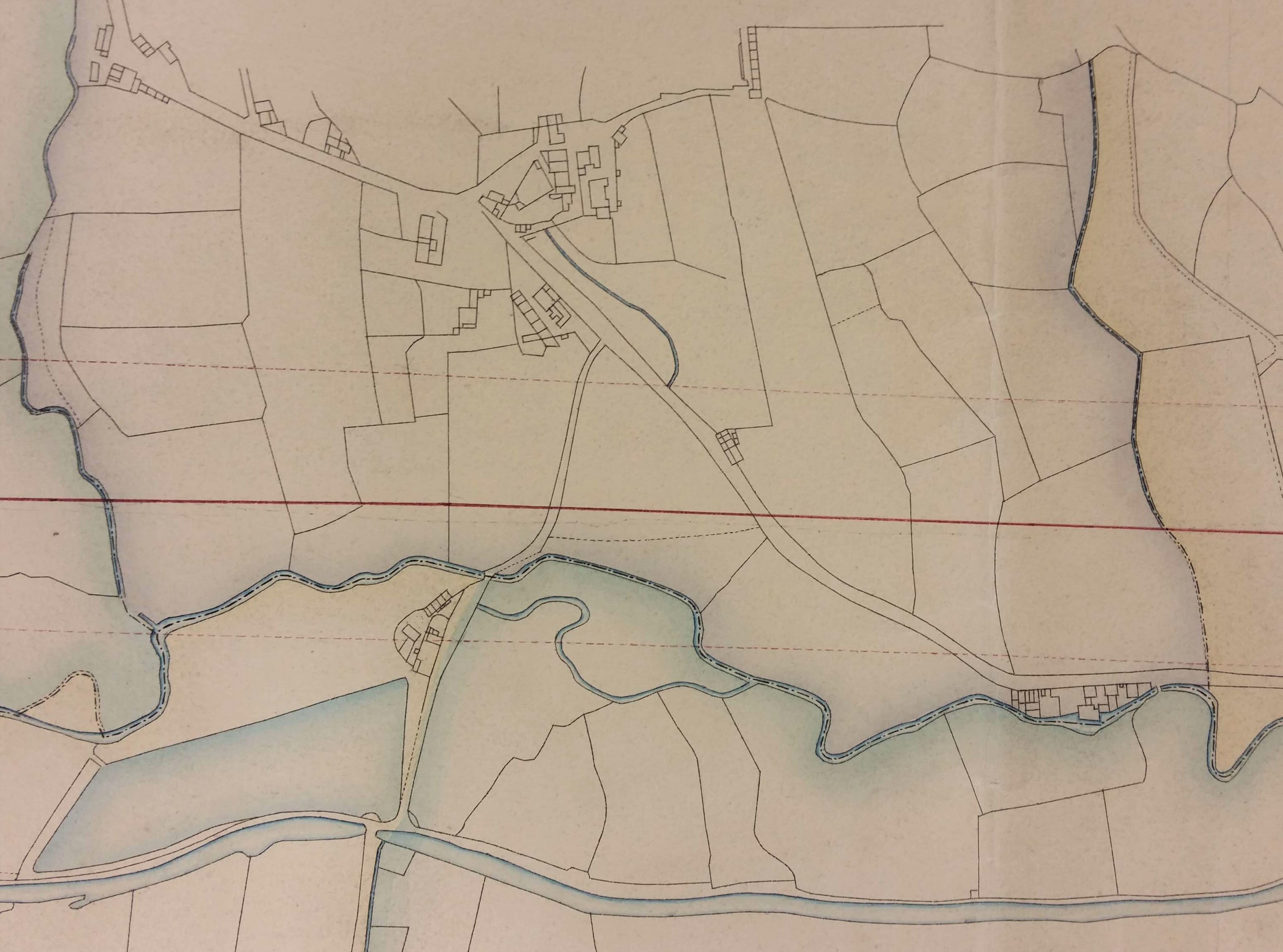
Bradford local historians are most fortunate in having the Local Studies Library and the West Yorkshire Archives (Bradford) under the same roof, each with helpful and dedicated staff. To illustrate the value of this I shall trace the history of a single building starting with the Local Studies Library reserve map collection which provides a detailed plan of the area between Bradford and Shipley. The plan is completely unlabelled but field boundaries and properties are meticulously drawn. A detail is included here which shows the canal and Bradford Beck at the bottom. A continuous line (red in the original) near the map centre must represent the railway to be opened by the Leeds & Bradford (later Midland) Railway Company in 1846. The discontinuous lines lines on either side were presumably an estimate of the land needed to be acquired by the company. The date of the map would be the early 1840s. From comparison with the first OS map of the area, surveyed a few years later, the track did follow exactly this route.

Map of the Week 029 A

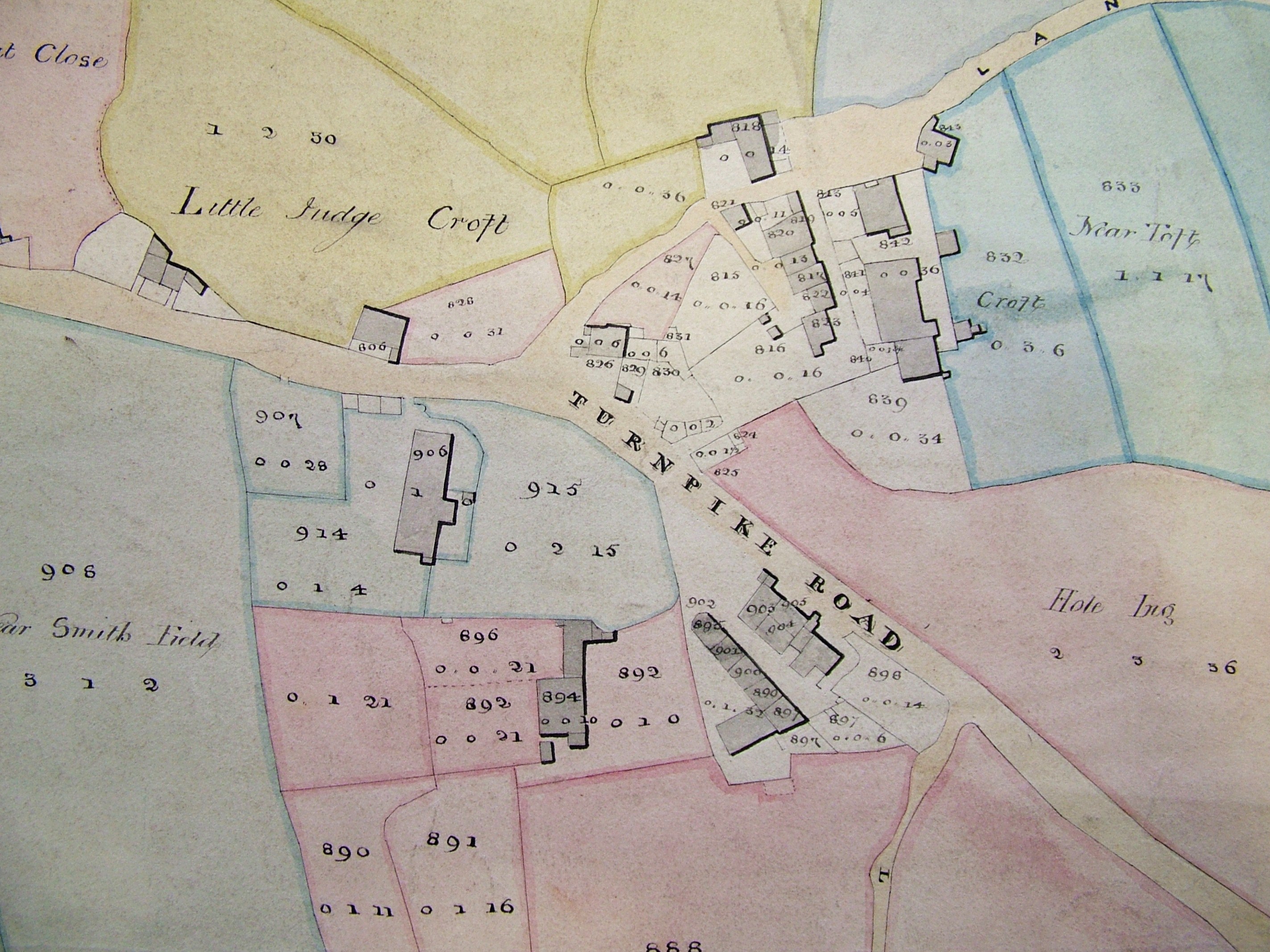
You would need to know this area very intimately to recognise the hamlet in the upper centre of the map as Frizinghall. This is now considered to be part of Heaton, which was not incorporated into the Borough of Bradford until 1882. To orientate yourself imagine you are standing in Bolton Woods: the direction of Bradford is to the left and Shipley to the right. The course of the beck has since been straightened and between it and the railway is the modern Canal Road, at roughly the position of the lower interrupted line. The thoroughfare drawn crossing the canal is Gaisby Lane. The next plan is a detail from a lovely Frizinghall map which is approximately contemporary with the first image. It is available in the LSL main collection.

Map of the Week 029 B

There was to be extensive house building over the next 50 years, probably after Frizinghall train station was opened in 1875, but many features on this map are still visible today. The three buildings in the lower third certainly still exist. The only one with public access fronts the turnpike road. This is the Black Swan public house; the triangle of land on which it sits was once called Swan Hill and is well above road level. The Black Swan must predate even this map by several centuries and is well worth a visit. From its car park the housing which looks like a laterally inverted L is also visible. The third building in the cluster is a private house then called the Old Hall.

 My personal favourite is the building in the middle of the blue coloured land opposite the ‘turn’ of turnpike; this is still easily visible from the road. Although latterly called ‘The Old Barn’ when it was a pub-restaurant, the property was known as ‘The Poplars’ for much of the twentieth century. Earlier than that it was ‘Carr Syke Farm’ or ‘Lower Carr Syke Farm’. The Carr Syke was a watercourse, the name deriving from the Norse meaning ‘the stream in the marshy ground’. In the late eighteenth century the Carr Syke Farm seems to have formed part of the estate of Benjamin Hird of Frizinghall which was sold to a Dr Joshua Walker of Leeds in 1795. The estate passed to Dr Walker’s daughter Margaret, and then by marriage to a well-known Quaker, William Leatham of Hemsworth Hall, Wakefield. I believe it was owned by his family for the next 80 years. In 1883 the property was then sold to Bradford Corporation by William Henry Leatham and others. Two years later the property was purchased from Bradford Corporation by the Clockhouse Estate who retained it well into the twentieth century. Much of this portion of the estate eventually became the location of Bradford Boys Grammar School.

If you wish to learn even more a distinguished local historian, Lillian Robinson, wrote a detailed account of Frizinghall (the place of her birth) in the years 1973-75. This work does not seem to have been published but typescript copies are available in the Library (B942 ROB). The notes on which this work is based are available in the Archives (WYB140) and are as useful as the completed work itself. Earlier still M. Blundell Heynemann had written an account for The Heaton Review in 1931. She had this to say: ‘on the right, down a paved path, is the entrance to the Poplars, the residence of Mr Wilkinson, the Clock House Estate Agent. A farm, now demolished, formerly stood facing the road and only the old barn and stables still remain. It was farmed by a Mr Greenwood who went there in 1877’. The Bradford historian Cudworth clearly mentions, without directly naming, Lower Carr Syke Farm because of its association with William Wilson who once leased it: ‘another old homestead at Frizinghall, enclosed in its own grounds, was for some time the residence of a most exemplary Quaker family, named Wilson, originally of Esholt. One of the members of this interesting family, named Willie or ‘Quaker’ Wilson (1767-1849), enjoyed a reputation throughout the entire kingdom for his many eminent qualities as a philanthropist.’  Wilson was apparently able to retire at fifty years of age (that is in 1817) with a fortune of many thousands of pounds. This he methodically gave away to the poor over the next 30 years. He died, much lamented, in November 1849, aged 82, and his remains were interred in the Friends’ burial-ground, Bradford.

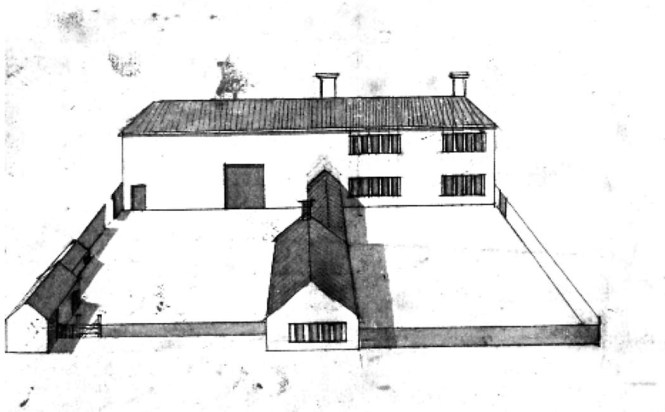
With the next two images the Archives comes into its own. Both are rotated 90° anti-clockwise from the first two. We have moved back a generation to Joshua Walker Sr. (1713-1801) who was also a Bradford Quaker, and an apothecary; he seems to have been an amateur architectural enthusiast who drew many house plans. It was his son, Dr Joshua Walker (1746-1817) physician at Leeds Infirmary, who had bought the Carr Syke estate. One of his father’s undated plans, available in the Archives, is labelled ‘Lister Patience’s Farm’; Heaton & Manningham’. The field boundary pattern fits Lower Carr Syke Farm. In this plan the present building would appear to be originally a barn which has two cottages (now missing) in front of it.

Map of the Week 029 C 

Another of Joshua Walker’s productions, WYA(B) 85D90 plan 45, is described as showing a ‘laithe house and yards’. There’s not much doubt that Lower Carr Syke Farm would have appeared very much like this when first arranged for human habitation. It is quite possible that the drawing does actually represent Lower Carr Syke Farm itself. The two cottage-like structures in the foreground could easily be those marked on the map of ‘Lister Patience’s farm’. I have not been able to trace ‘Lister Patience’, nor Patience Lister which sounds a more probable name. Can anyone help?
Map of the Week 029 D


Derek Barker, Local Studies Library volunteer

Greengates

SITUATED around three miles north of Bradford, Greengates  is unfairly known by many as no more than the busy Bradford to Harrogate and Leeds to Keighley crossroads.  Its boundaries, however, spread beyond this busy junction. The actual parish boundaries show that Greengates includes parts of the Thorpe Edge and Ravenscliffe estates and Apperley Bridge.

Map

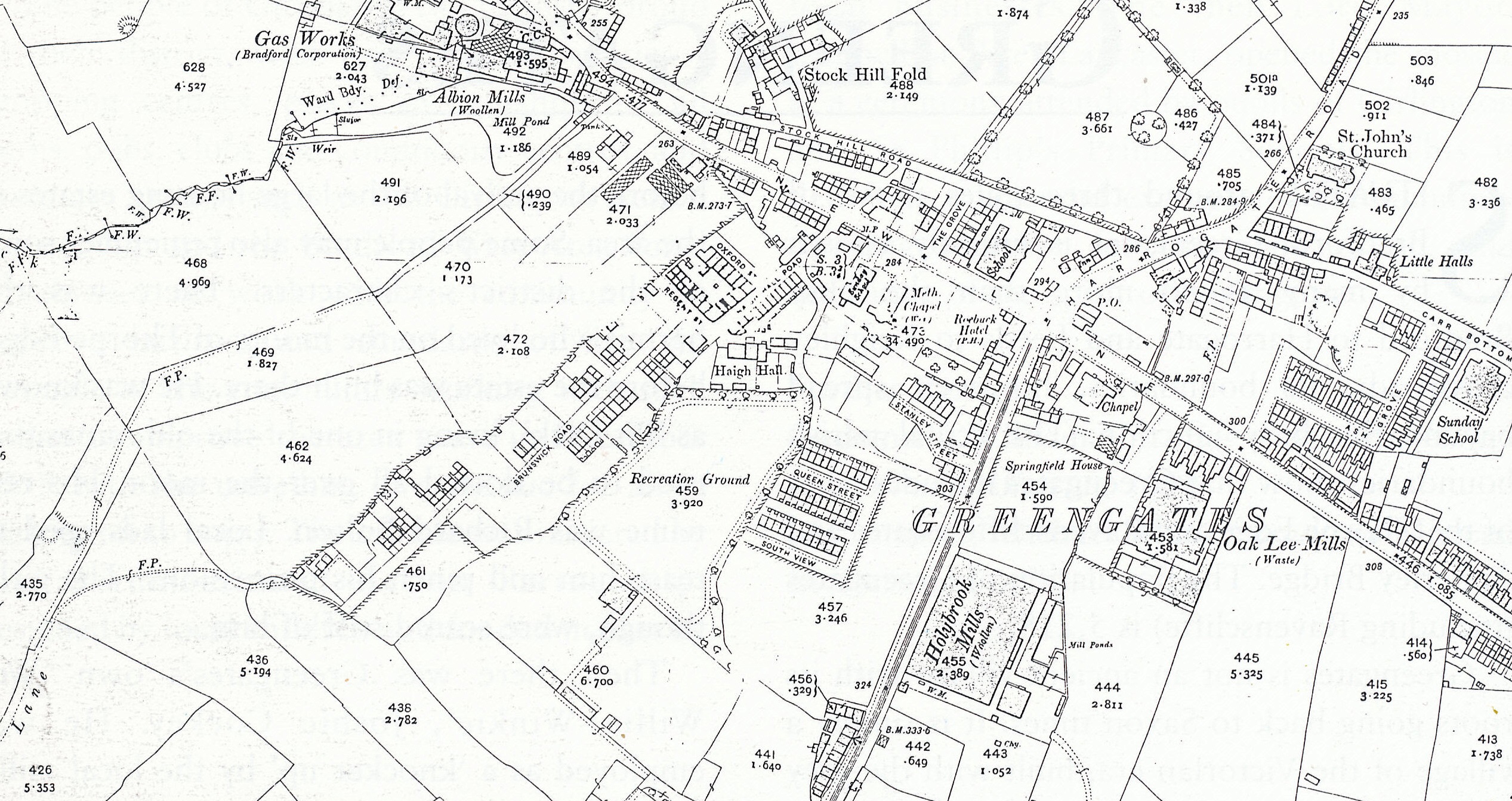
Map of Greengates, 1908


Greengates is not an ancient village with its roots going back to Saxon times. It is simply a village of the Victorian era, built with the grey Yorkshire stone of early Victorian prosperity.  In fact little of Greengates nowadays is more than 60 years old.

The village, like many others in Bradford, has now been swallowed up by the city.  However, some of the prettier and more interesting qualities of the place still exist.  Take, for example, the row of cottages in Stockhill Fold.  They were built for weavers and some date from as early as 1786.  They were renovated in 1979.  The builders and architects ensured that many of the original features were retained.   In fact, Methodist pioneer John Wesley is reputed to have stayed in one of the cottages. They are all now listed buildings.

Stockill Fold

Weavers Cottages in Stockhill Fold, 2002


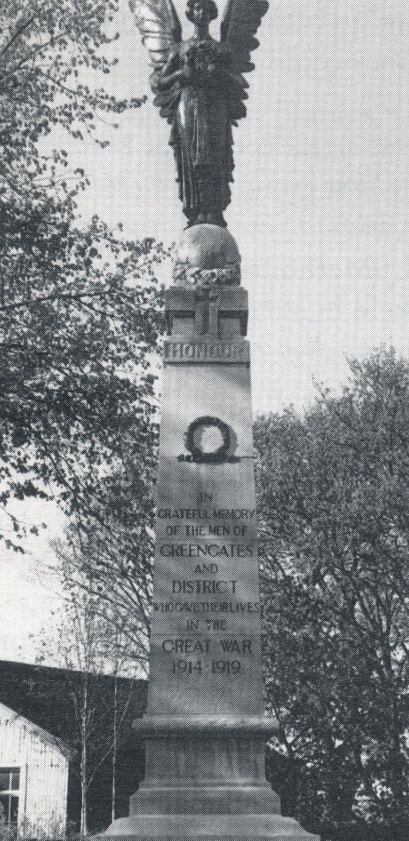
Another of the village’s most famous landmarks is its war memorial, situated at the busy crossroads. The imposing angel statue was erected in memory of the men of Greengates who died in World War One.

War Mem

War Memorial, 2002


Some older people may still remember with affection Greengates’ mills, or the acres and acres of green fields that surrounded the village before the arrival of the large housing estates in the area. Some people may also remember some of the district’s characters.  There was the hermit who lived on the moors of Thorpe Edge,  before the estate was built there.  He was known as ‘Pit Dick’, living in one of the old mines that used to be dotted all over the moor. His real name was Richard Bolton. Local lads used to tease him and pinch his possessions.  The girls, though, were scared stiff of him.

Then there was Greengates’s own ‘Wee Willie Winkie’, Joshie Cockey.  He was employed as a ‘knocker up’, by the local mill owners.  Some may remember the time when he knocked everyone up an hour early.  When he realised his mistake he had to to go back on his rounds letting folk know that they could have another hour in bed.

Greengates was a real centre for Methodism in Bradford. The first group met there in 1781, the year Wesley was supposed to have stayed in Stockhill Fold. Methodism prospered and meetings were held in a building in Haigh Hall Road. This building eventually became Greengates Library as well as a burling and mending workshop.

Today Greengates can certainly be a bottleneck.   The busy junction at its centre, known as New Line, is now under more pressure with the arrival of supermarkets and retail parks.  Next time you’re doing your weekly shop in Sainsbury’s, or travelling between Shipley and Leeds or  Bradford and Harrogate, spare a thought for what used to be a small, quiet village, with superb views over  the Aire Valley.

New Line

New Line, Greengates, in more peaceful times

Taken from The Illustrated History of Bradford’s Suburbs, 2002

Keighley Women

In Keighley Local Studies Library on Saturday 3rd March, retired librarian and celebrated local historian Ian Dewhirst MBE gave a very well received talk about notable Keighley women. The talk was well attended by the many people who had braved the icy conditions to be there.

Ian Dewhirst 2 Keighley Library

Thursday 8th March was International Women’s Day and Ian illustrated how Keighley has certainly has had its share of feisty ladies over the years.

The varied selection of ladies included Mrs Emma Groves, temperance advocate and Miss Sandra Dorne, film star. In his talk he spoke also of the late Mollie Sugden who played Mrs Slocombe in the 1970’s sit-com ‘Are You Being Served’. As mistress of the comedy double-entendre she had come a long way from her non-conformist roots at Ingrow.

Throughout history there are many forgotten personalities whose stories can be uncovered by delving into our Local Studies Library collections. The talk featured are some less well-known ladies with unusual stories such as Miss Annie Collett who kept an autograph album while visiting Keighley War Hospital in 1917-1918 and Miss Maud Marks of Keighley Salvation Army who was caught up in the fall of France in 1940.

This year is also the 100th anniversary of reforms to the voting system in 1918 where women over 30 years married to a householder or with a degree were given the vote for the first time.

Mr Dewhirst described the visit of suffragettes, Adela Pankhurst and Mary Kenney to Victoria Park on Sunday May 24th 1908 where the speeches were drowned out by the singing of popular songs. He spoke of the work of women in the First World War which had contributed greatly to their being given the vote.

The talk was accompanied by a display from Keighley Local Studies library collections which will remain in Keighley Local Studies library over the coming weeks.

Ian Dewhirst 1 Keighley Library