From the Mill to Monte Carlo: The Working-Class Englishman who Beat the Monaco Casino

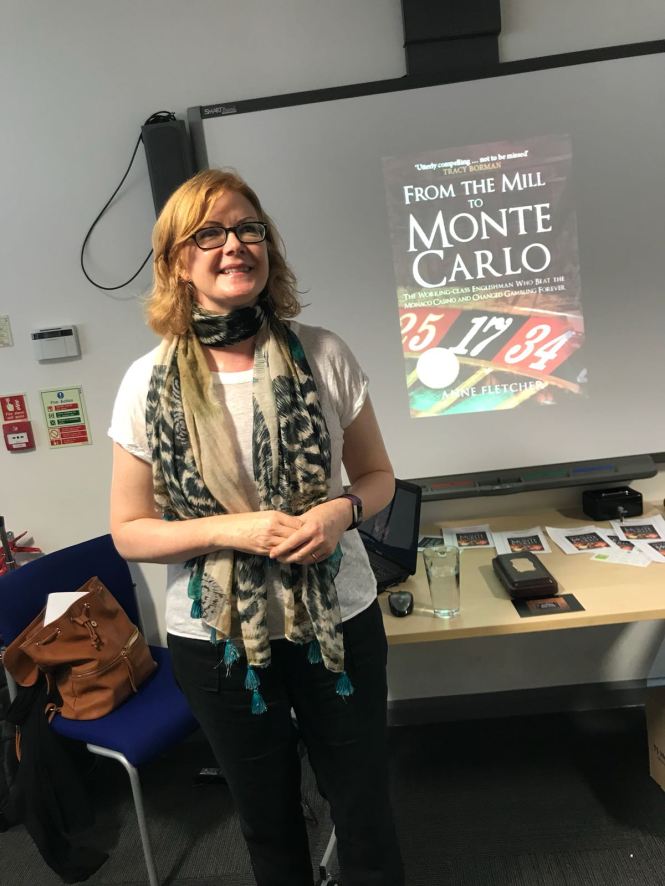
Many thanks to Anne Fletcher for sharing the wonderful story of her great-great-great uncle Joseph Hobson Jagger in her fascinating talk in Bradford Local Studies library at Bradford Festival on Saturday.

Based on her newly published book, Anne told the story of a man who went from Bradford mill worker to Monte Carlo millionaire. Amongst the men ‘who broke the bank at Monte Carlo’, Joseph Hobson Jagger is unique. He is the only one known to have devised an infallible and completely legal system to defeat the odds at roulette and win a fortune. But he was not what might be expected. He wasn’t a gentleman or an aristocrat, he wasn’t a professional gambler, he was a Yorkshire textile worker who had laboured in the Victorian mills of Bradford since childhood.

Joseph Jagger was an exceptional man who travelled nearly a thousand miles to the exclusive world of the Riviera in a time when most people lived and died within a few miles of where they were born. The trains that took him there were still new and dangerous, he did not speak French and had never left the north of England. His motivation was strong. Joseph, his wife and four children, the youngest of whom was only two, faced a situation so grave that their only escape seemed to be his desperate gamble on the roulette tables of Monte Carlo. Today Jagger’s legacy is felt in casinos worldwide and yet he is virtually unknown.

In  this true-life detective story, Anne uncovers how he was able to win a fortune, what happened to his millions and why Jagger should now be regarded as the real ‘man who broke the bank at Monte Carlo’.

‘From the Mill to Monte Carlo’
By Anne Fletcher
978-1-4456-7139-0

20180714_140915

AFMill-to-Monte-Carlo

Keighley’s Gallant Sons

Bradford Libraries's avatarBradford Libraries World War One Blog

This was a published list in the Bradford Daily Telegraph of all the Keighley men who volunteered in the early part of the war, before the introduction of the Military Service Act.

A copy is available to view in Keighley Local Studies Library, but can also be viewed here:

Keighley’s Gallant Sons

View original post

‘From the Mill to Monte Carlo’. A talk by Anne Fletcher

Come and meet Anne Fletcher on Saturday 14th July at 12pm on the first floor of City Library, Bradford, and then come and join her for a free talk and chat at 2pm in Bradford Local Studies Library, Margaret McMillan Tower (side entrance).

This is the story of the man from Bradford who beat the casino. Anne Fletcher is his great-great-great niece and in this true-life detective story she uncovers how he was able to win a fortune, what happened to his millions and why Jagger should now be regarded as the real ‘man who broke the bank at Monte Carlo’.

Free event, all welcome

Mill-to-Monte-Carlo


Treasure of the Week no. 21. The Low Moor Iron Works – what poetry!

Low Moor Iron Works: a poem. By John Nicholson. 1829 (1856 reprint).

JND 187/1 (Please quote this number if requesting this item.)

Tres 21 John Nicholson

Image reproduced from ‘Poets of Keighley, Bingley, Haworth and District’ by Charles F Forshaw.

In common with other writers of the early nineteenth century, John Nicholson (1790-1843), ‘The Bard of Airedale’ found romance in the achievements of industry.  The coal-fired flares of the iron works at Low Moor were compared to the smoking volcanoes of Etna and Strombolo. Beyond romance though, were the utilitarian products that issued

When first the shapeless sable Ore
Is laid in heaps around Low Moor,
The roaring Blast, the quiv’ring Flame,
Give to the mass another name;
White as the Sun the Metal runs,
For Horse Shoe Nails, or thund’ring Guns;
The trembling hair-spring of a Watch,
An Anchor, or a Cottage latch –
Most implements the Farmers have,
And those of Steamers on the wave
The Tailor’s Needle, or the Shell
The levell’d once where Princes dwell;
The Engine, Boiler, Cobler’s awl,
The Carronade, the pond’rous ball;
The place where Steam first moved his wings,
The Nails in Beggars’ Shoes and Kings’;
The Anchor’s Chain, the Fisher’s Hook,
The Sword – the Hatchet – and the Crook,
The sounding Anvil, all the blades,
The cause of many thousand trades;
No pen can write, no mind can soar
To tell the Wonders of Low Moor.

The importance of the Low Moor Iron Works in the manufacture of weapons is noted:

Throughout the world thy heavy Guns are known:
From the Pacific to the Indian shore,
Nations have heard their dread tremendous roar.

And at the Woolwich arsenal:

There Pyramids of balls for battle form’d,
By which each fortress of our foes is storm’d,
The bursting bombs of every size are there,
To guard the land Britannia holds so dear.

But now

Silent the Cannon, peaceful all the host;

In particular, and prophetically, the coming of the railways is noted: the days of the Courier, the Pilot, and the Duke of Leeds, stage coaches all, are ending:

Ye panting horses, smoking on the road,
Mark’d with the whip, and struggling with your load;
Your race of cruelties will soon be done,
The mail without you soon will swiftly run.

Summing up, Nicholson tells how Low Moor helped make Bradford:

What millions sterling have been made,
What tens of thousands have been paid,
What thousands here has genius fed,
Since the first blast has rear’d its head,
Crown’d with flame that dar’d on high,
And cheer’d the midnight cloudy sky.
But for Low Moor, old Bradford Town,
Had never like a City grown.

This poem was first published in 1829 and reprinted in 1856 by J Dobson of the Market Place, Bingley.

Nicholson started his working life in the mills but aged 32 moved to Harden Beck and became an established poet. After success with works such as Airedale in Ancient Times and The Siege of Bradford, he tried his luck in London, but soon returned to Bingley. In the 1841 Census, John (aged 50) and his wife Martha (45) were living with their eight children, aged 6 through to Ann (22) and Sarah (20), both worsted warpers, and Thomas (20), a wool sorter. John Nicholson was drowned while trying to cross the River Aire on stepping stones on a stormy night.
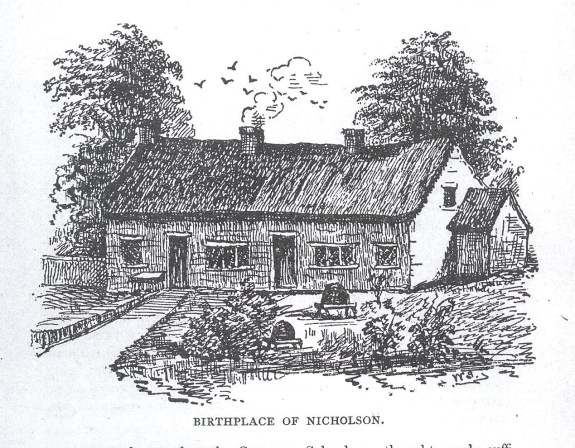
Tres21 birthplace of Nicholson

Image reproduced from ‘Poets of Keighley, Bingley, Haworth and District’ by Charles F Forshaw.

The Low Moor Iron Works have long since gone, but the recent re-opening of Low Moor station would surely have pleased ‘The Bard of Airedale’!

Stackmole

Small Town Saturday Night

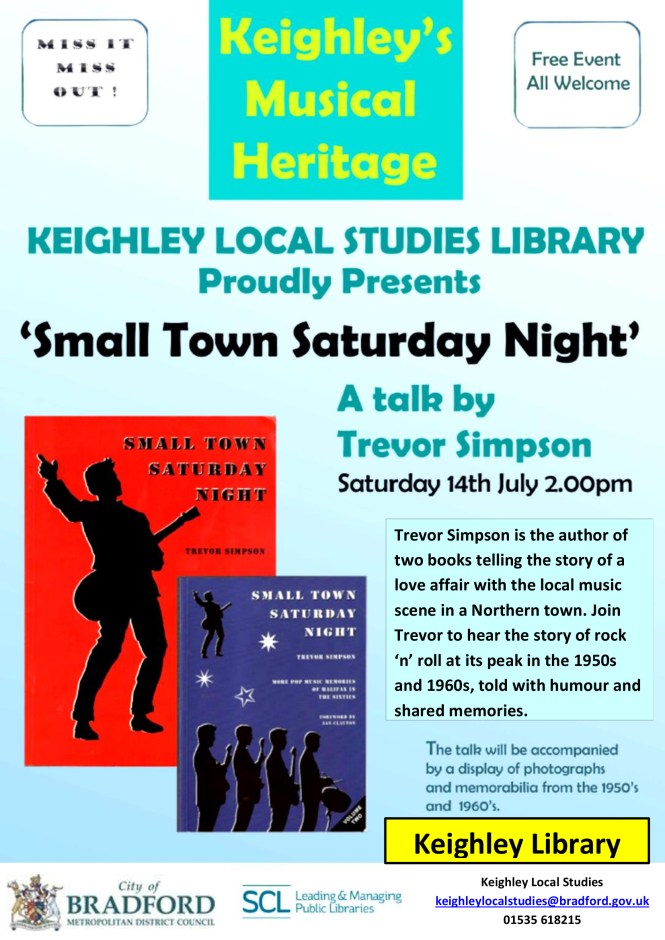
Trevor Simpson is the author of two books telling the story of a love affair with the local music scene in a Northern town.  Join Trevor to hear the story of rock n’roll at its peak in the 1950’s and 1960’s, told with humour and shared memories.

The talk will be accompanied by a display of photos and memorabilia from the 50’s and 60’s.

Free event, all welcome.

For more details contact Keighley Local Studies Library:
keighleylocalstudies@bradford.gov.uk
01535 618215

Trevor-simpson-Blog-edition