Map of the week: Boldshay Hall Estate, Barkerend

Fig 031 A


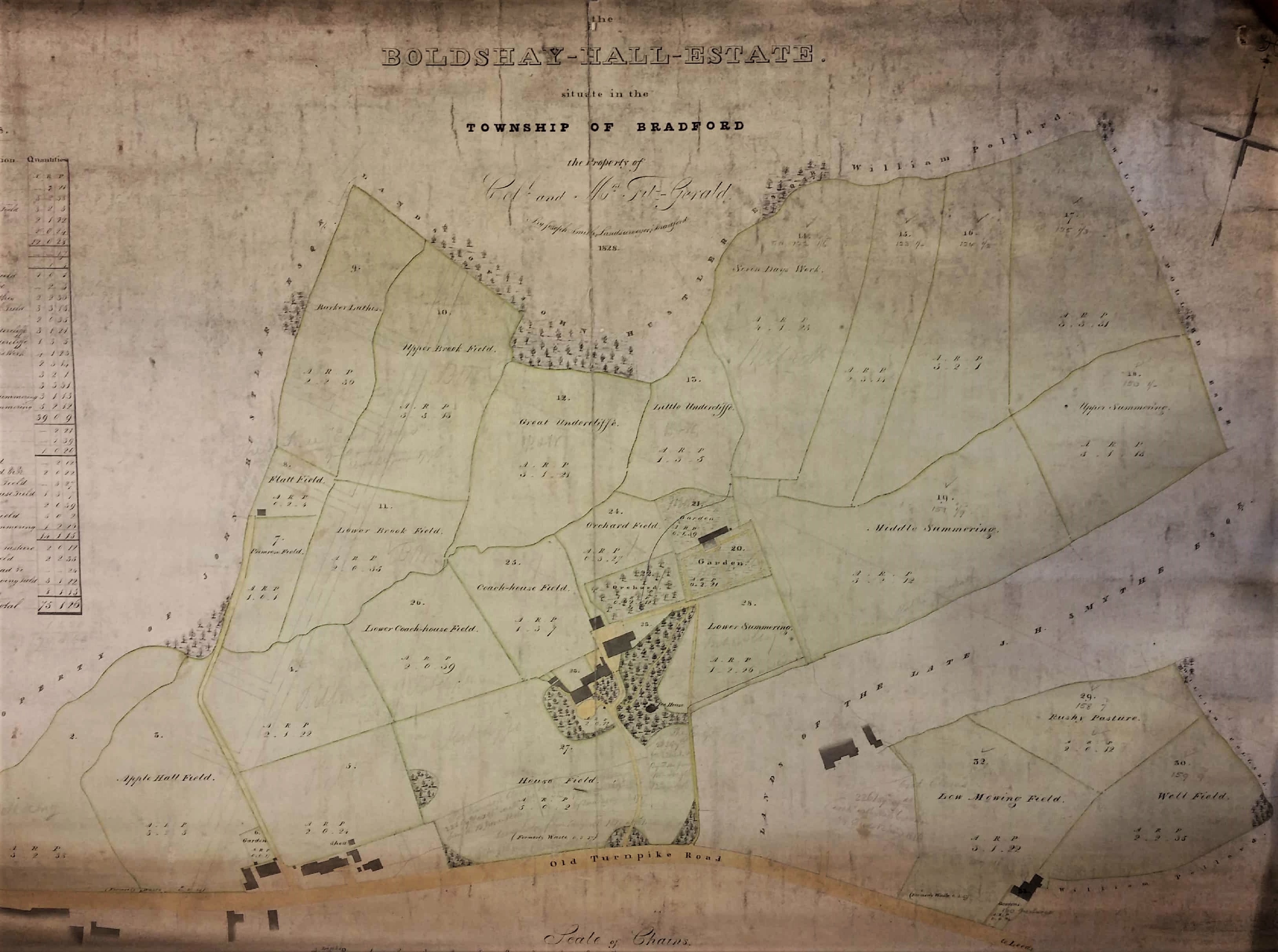
It is always an exciting moment when an important two hundred year old map, which does not appear to represent a copy of one already in the publicly accessible collection, turns up among the Local Studies Library’s reserve material.  The title of this map indicates that it produced for Colonel Thomas George Fitzgerald, who was a large landowner in Bradford until his death in the mid-nineteenth century. Local Studies has plans of his holdings elsewhere in the city, but no other copy of this plan of Boldshay Hall as far as I can see. The West Yorkshire Archives also has many documents relating to the estate.

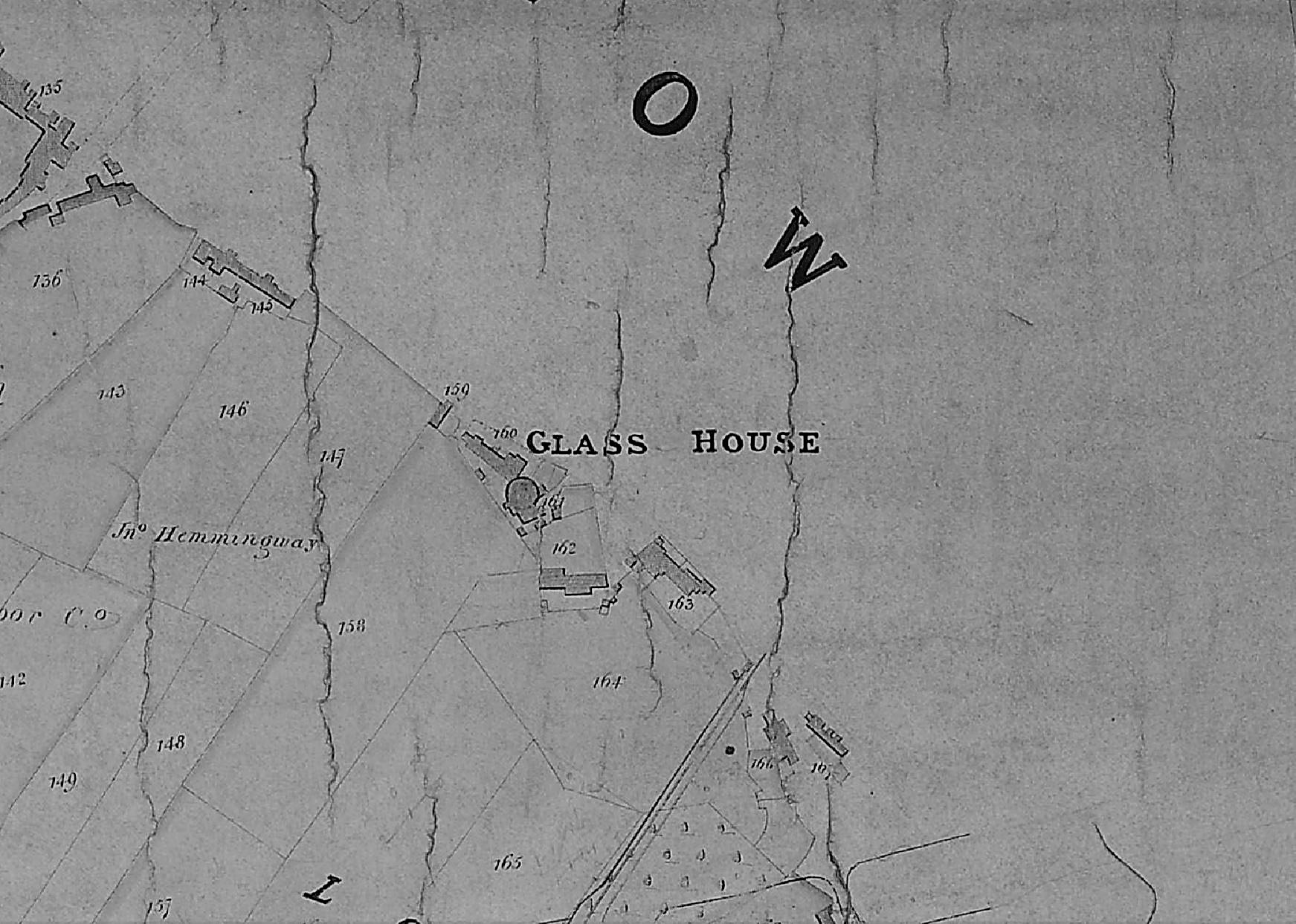
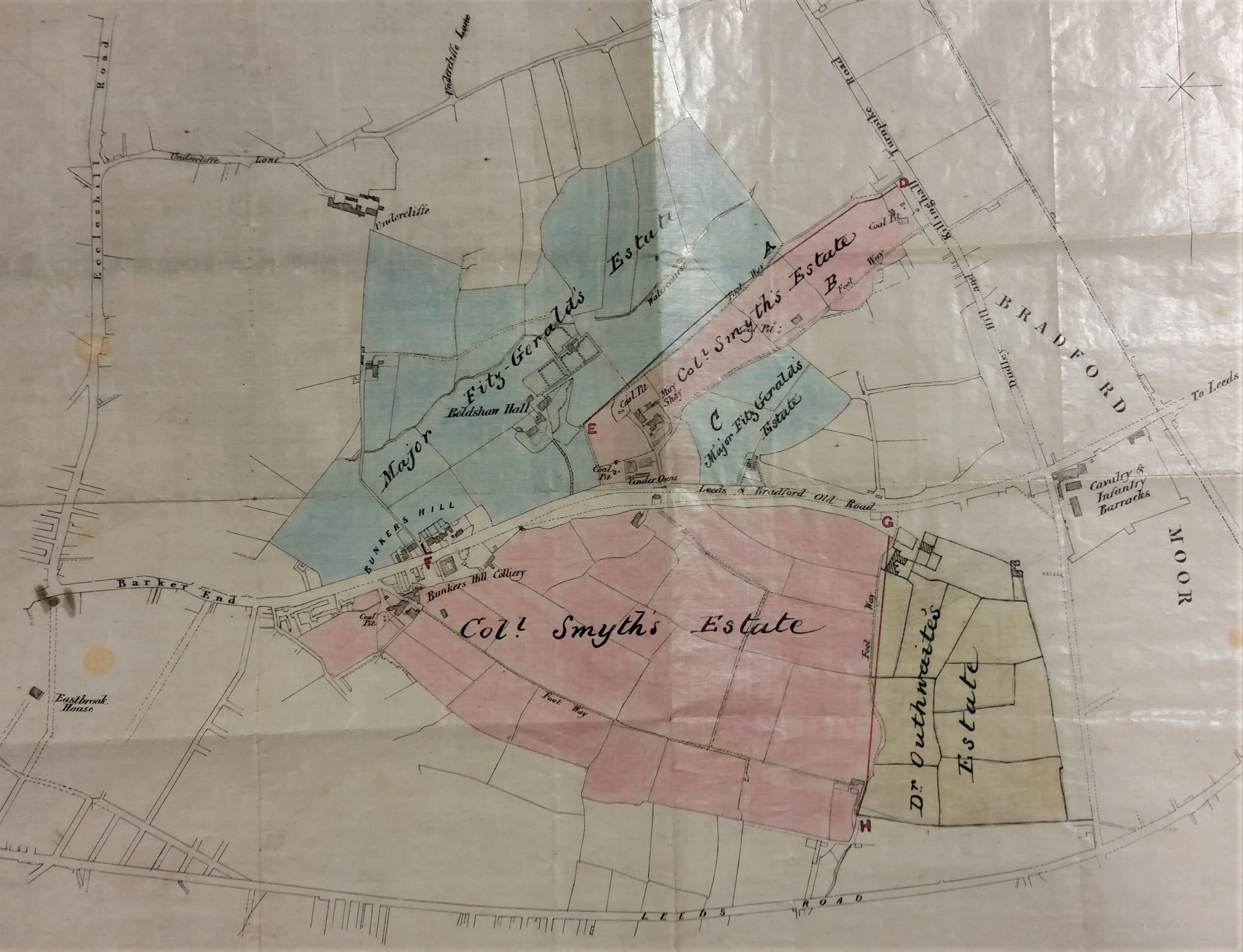
Physically the map is a tinted, rolled, estate plan but it is dusty, in poor condition, and needed some repair before it could be handled safely. It was found in a group that seem to have come from Bradford Council. The next map was a post-war plan of Bradford’s twinned city Mönchengladbach, more recent by about 140 years! The unnamed building you can see a little south east of Boldshay is Miry Shay (or Miryshay) an older seventeenth century house. This has long been demolished but in the early nineteenth century had been the property of JH (John Henry) Smyth MP (1780-1822) whose family had owned it, and the Bradford Soke Mill, for generations. Smyth had died before the map was surveyed, and hence is referred to as ‘late’. The West Yorkshire Archives have a good deal of information about the Smyth family too. By the time of the 1852 Ordnance Survey map there was a large colliery just south of Miry Shay called Bunkers Hill. The land ownership in this area is made clearer by a second, later, LSL map which also illustrates that the name Bunkers Hill was in fact applied to a series of collieries along Barkerend Road.  The ‘Col. Smyth’ in this map is John George Smyth (1815-1869) MP for York and Colonel of the 2nd West Yorkshire Militia who lived at Heath Hall, Wakefield. His land holdings north of Barkerend Road are now a substantial part of Bradford Moor Golf Club.


Fig 031 B

The original Boldshay Hall Estate plan is dated 1828 and was drawn by Joseph Smith, of whom I will say more later. Boldshay Hall itself was built circa 1740 and at this early period was associated with the name of Samuel Hemingway and his son Henry Hemingway, who were both lawyers. The estate itself is presumed to be far older. Remarkably the hall still exists on Byron Street, surrounded by Victorian housing, and is Grade II listed. The gardens, fields, and coal mines which once enclosed it have long ago vanished completely.

As you would expect some previous owners of this historic building are described by William Scruton in Pen & Pencil Buildings of Old Bradford, and of course by William Cudworth. The estate passed to the Lister family of Horton Hall since Samuel Lister’s sister, Elizabeth Lister, had married Henry Hemingway. Their daughter, and Samuel Lister’s niece, Mary Hemingway married a Dr James Crowther MD of Leeds. After the death of Samuel Lister, and his second wife, Dr and Mrs Crowther inherited all the Lister estates and in due course their own daughter Elizabeth Crowther (1788-1838) became the Mrs Fitzgerald of the map’s title. Colonel Fitzgerald is Thomas George Fitzgerald, of Turlough, Ireland (1778-1850) who in 1819 had taken Elizabeth Crowther as his second wife at St George’s Hanover Square. Fitzgerald’s first wife also had a strong Bradford connection. Ten years earlier, in 1809 at St Peter’s, he had married Delia (1780-1817), daughter of Joshua Field, of Heaton Hall, and sister of John Wilmer Field. Two daughters died young but they had one son who took over their Irish estates. I should really like to know how Colonel Fitzgerald kept meeting Bradford heiresses and winning their hearts.

Fig 031 D

The hall itself is the large building in the centre of the group. I assume the rest are stables, farm buildings and coach houses; note the presence of an ice house. The agent for the estate, and other Fitzgerald properties, was Joseph Smith. Joseph Smith must have surveyed this map. He was succeeded by his son George Belk Smith who had designed the Bradford – Eccleshill turnpike in 1826. There are pencil annotations which are hard to read but seem, at least in part, to be records of the years in which certain parcels of land were acquired for the estate. I would like to know how long the Fitzgeralds lived at Boldshay Hall. After the death of Colonel Fitzgerald the estate passed to his son Major Henry Thomas George Fitzgerald (1820-1890) who had been born and baptised in Bradford but probably didn’t live here; his address is usually given at Maperton House, Somerset, which the Fitzgeralds also owned. Baines directory of 1822 confirms that Colonel Fitzgerald was in residence at that date but by the time Fitzgerald died in 1850 the Leeds Mercury recorded that he was ‘formerly of Boldshay Hall’. The 1828 map itself includes a list of tenants with their holdings, but nobody is leasing the hall where presumably, six years after the directory was published, the family still lived. It would appear likely that Colonel and Mrs Fitzgerald moved to Maperton House in the late 1820s. Could the resultant need for records of their local land holdings have been the reason that the map was originally created?

Interestingly around this time Boldshay Gardens became a place of public resort. The fact that they were no longer open for this purpose was formally announced in the Leeds Mercury in 1839. As I have mentioned before I am not a family historian and I am slightly puzzled by exactly who lived at Boldshay Hall after the Fitzgeralds. One of the map’s listed tenants is James Cousen. A man of this name is a partner in Rawson, Cousen & Co who were coal masters. This company owned the various Bunkers Hill collieries by the 1830s. His son, another James, (of Cousen, Thackrey & Co, stone-merchants of the canal basin) was given the address of ‘Boldshay’ in the press announcement issued when he died in 1830.  Possibly Boldshay Hall was subdivided since a local merchant named John Mann (1808-1845) was also giving Boldshay as his address by 1834. According to the Bradford Observer the same man won a prize for his lettuce at the Bradford Grand Floral & Horticultural Society in 1841. John Mann died in 1845 at the early age of 37. Probably James Cousen and John Mann were related. One family historian gives James Cousen’s second wife the name of Elizabeth Mann.  James Cousen senior still lived at the hall when he died at the age of 83 in 1844. I have also seen James Cousen’s name linked with Miry Shay although the only contemporary resident of this house I am certain of from press announcements is a Joseph Dalby, farmer, who died there in 1834.

The 1841 census makes the situation slightly clearer. At Boldshay Hall live John Mann (30) and wife Anne (who was to survive him by fifty years), two children and four servants. Andrew Newell, a gardener, lives at Boldshay Gardens. Miry Shay is more complicated. James Cousen, coal merchant, and his wife Elizabeth are certainly resident, but so also are a collection of coal miners, agricultural labourers, worsted weavers. and assorted descendants of the Dalbys. Understandably I have a personal weakness for Barkerend so exploring this map has been a real pleasure even if I have not found all the answers.

Derek Barker, Local Studies Library Volunteer
Local Studies Facebook Page

access app application apps

Photo by Pixabay on Pexels.com

The Local Studies Service now have our own Facebook page. So if you are on Facebook and are interested in local history, news and events, why not give us a like and follow the page.

https://www.facebook.com/BradfordLocalStudies/

New Local Studies Newsletter

news-530220_960_720We are starting a new Local Studies Newsletter.  This will contain local history news and events as well as many interesting snippets about the whole district.

If you are interested then please sign up here:

https://public.govdelivery.com/accounts/UKBMD/subscriber/new?topic_id=UKBMD_124


Treasure of the week no. 22. A terrible calamity in 1882

A Terrible Calamity in Bradford: being the entire story from beginning to end, of the Fall of Ripley’s Mill Chimney on Thursday, Dec. 28th, 1882, along with All the Particulars, List of Killed, Accounts of Startling and Extraordinary Escapes, etc. Published by Willie Reynolds.

JND 187/11 (Please quote this number when requesting this item.)

tc

1882 was, the author claims, a disastrous and eventful year:

From its very commencement it was a year ever to be remembered by poor and rich alike, if such events as the useless Egyptian war, outrageous practices and barbarous murders in Ireland, destructive fires in all parts of England, colliery accidents, and calamities of all kinds by land and sea could make it so.

In Bradford the year ended in the collapse of the chimney at Ripley’s Mill in Spring Street off the Manchester Road, at a few minutes past eight on Thursday morning, killing 53 people and seriously injuring 50. The mill was used for spinning and top making and was occupied by several companies. The chimney was said to weigh over 4,000 tons and was 255 feet high. It had been built over twenty years earlier but was never regarded as being quite safe. A week before its fall, pieces of lime and stone had fallen from it. After slight repairs, the architect passed it as being safe. But high winds, incessant rain, frost and heavy falls of snow followed. The gigantic stack collapsed at a point a few feet above the ground.

This modest leaflet of sixteen pages gives an account of the collapse, details of prior warnings and graphic eye witness reports. A list of those killed is given with their ages and we note that many children were killed. The youngest were 8-year-old Susan Woodhead, 9-year-old Emma Pearson, and Edgar North, Arthur Smith and Lydia Lightowler, all 12.

The pamphlet is of interest, not just for the details of the tragedy, but for how it was published. No author is given but we assume it was the publisher. It was priced at One Penny and “The proceeds from the sale of this work is intended for the ‘relief’ fund for the sufferers by the accident.” It was to be “had by all News Agents and News Lads”. One imagines that Willie Reynolds took it upon himself to interview participants, research background, write up the story – and well-written it is – print (probably out of his own pocket), then do the rounds of local newsagents, recruit an army of news lads, then collect and distribute the income, all within a short space of time. That was no mean achievement. No Facebook, Twitter or Internet in 1882!

Stackmole

Emily Jane Brontë – 200th year celebrations of her birth

The years of Brontë anniversary celebrations continue in to 2018 with the 200th anniversary of Emily Jane Brontë’s birth on 30th July 1818. Emily is probably the most controversial sister of the three to survive into adulthood and be published. Whereas Charlotte’s and Anne’s characters and influences are more clearly defined and documented by themselves and their contemporaries, still little is known of Emily’s inner life and full and true character, despite gleanings from her sisters’ observations and their associates. Wuthering Heights, Emily’s only published novel, similarly continues to confound and disturb readers and literary critics alike, while her poetry is much admired and reflects the truest love of Haworth’s moorland and its natural world.

This year will see some wonderful celebrations of Emily’s life and works in film, music, talks, tours and moorland walks, including the launch of the Brontë Stones, a unique celebration of the Brontë’s legacy. Check out  the Brontë Society, and Parsonage Museum’s fabulous events and workshops will continue throughout the year, please see:  www.bronte.org.uk/whats-on

brontedisplay


Nowhere can compete with the Brontë Society Collections, Museum and Parsonage Library in Haworth  but Keighley Local Studies Library is proud to be Bradford Council’s repository for a very important collection of books, articles and news cuttings, including a small archive on the Brontës and Haworth in general. In these anniversary years, the Library is adding to this with newly published works reflecting contemporary scholarship and the latest research, with book stock for both reference and for loan. (Please see list of new books below) We also have a new fact sheet on Emily Brontë and this accompanies the full booklet about the Brontë collection and other leaflets celebrating the Brontë family and their contacts in the local area, please see:

www.bradford.gov.uk/libraries/local-and-family-history to download  free copies  or better still, call into Keighley Library to pick up a copy and see the collection for yourself. The library is open daily from 9am until 7pm and on Saturdays 9 am-5 pm, closed Sundays.

Telephone: 01535 618215; email: keighleylocalstudies@bradford.gov.uk

Emily Bronte New Books