Keighley Roll of Honour 1914-1918

Bradford Libraries's avatarBradford Libraries World War One Blog

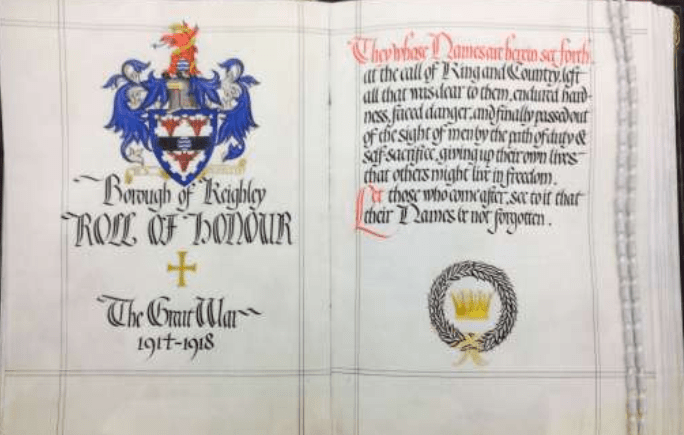
As we reach this particular poignant Remembrance Sunday on the 11th November, marking one hundred years since the First World War armistice,   we would like to share some information on the Keighley Roll of Honour for 1914-1918.

The Keighley Roll is a magnificent manuscript and situated in Keighley Library, upstairs in the Local Studies Department. The pages are turned on a regular basis but if you wish to look at a particular name staff are happy to turn the pages for you.

More information about the Keighley Roll of Honour

View original post

BRANWELL BRONTË’S PUBLISHED POEMS

Branwell was the second best poet in the Brontë family and some of his poems are worth studying in their own right.
(Tom Winnifrith in The Poems of Patrick Branwell Brontë)
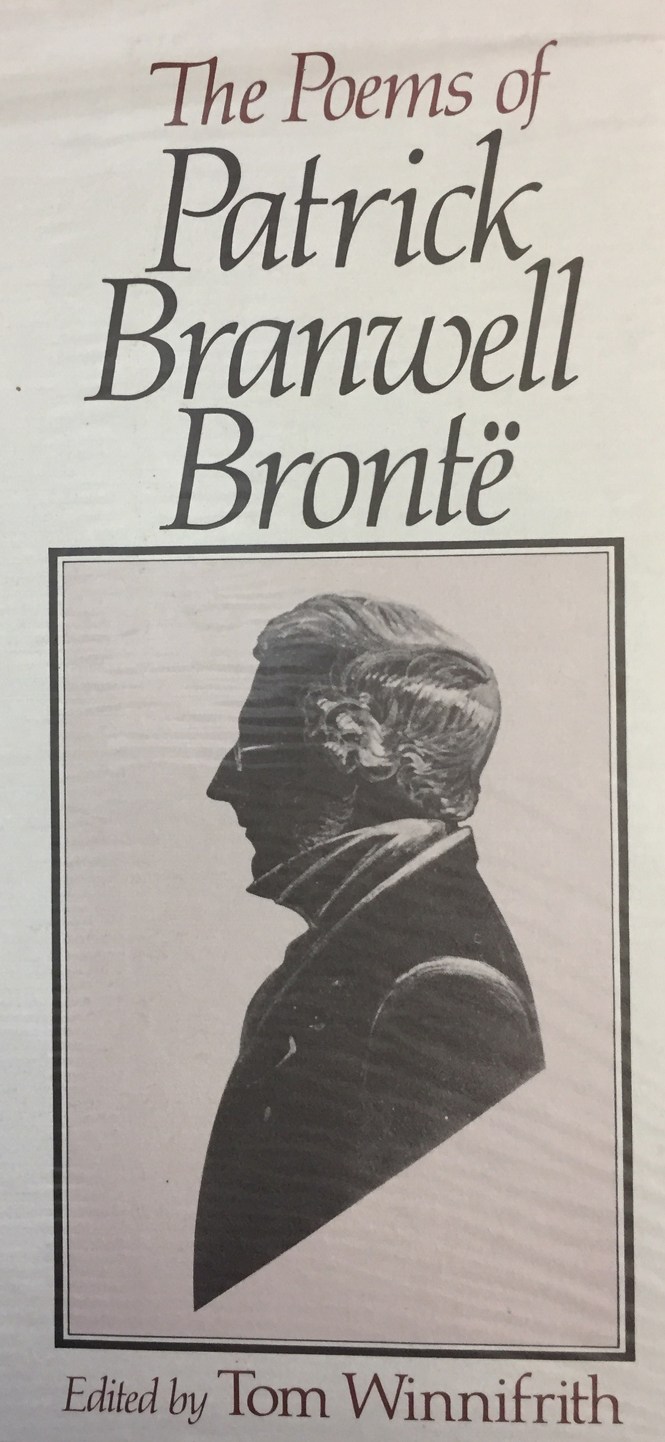
Winnifrith

The year 2017 was the bi-centenary of the birth of local lad, Branwell Brontë, born Thornton 26th June 1817. It was also the year that Routledge published the three-volume complete literary works of Branwell Brontë, which the Library purchased for Keighley’s Brontë Collection.

Like his sisters, Branwell Brontë wanted to be a published writer and thanks to the local newspapers, he succeeded. Indeed, Branwell was a published poet five years before his sisters published their book of poems in 1846 and their first novels a year later. In all, eighteen of Branwell’s poems are known to be published in his lifetime (1817-48), the last just six months before the publication of Jane Eyre in October 1847, and six published a second time in other newspapers. “Given that his sisters’ 1846 volume of poems sold only two copies in its first year, it is safe to say that Branwell’s poems enjoyed significantly wider readership.” (Neufeldt, v.3., p. xx)

All Branwell’s poems were published pseudonymously under the name ‘Northangerland’ except one, which was just signed ‘PBB’. Thus at no time did Branwell’s name appear in print. Why this is so remains a mystery. What is also a mystery is whether his sisters knew of his success. Getting poems published in local newspapers was no easy achievement at that time. There was great competition between newspapers and it is to Branwell’s credit that not only was his work accepted, but also reprinted in rival newspapers.

It has taken a long time for the full extent of Branwell’s poetic success to be realised. In Winnifrith’s edition of Branwell’s poems published in 1983, he wrote that the poem ‘The Afghan War’ was “the only composition of Branwell’s which is known to have been printed during his lifetime.” (p.140). Yet only fourteen years later, Professor Neufeldt, in the US edition of The Works of Patrick Branwell Brontë 1837-1848 (the Routledge edition noted above is a UK reprint) noted twenty-six publications.* More remarkable was the re-discovery, reported in 1999 by Professor Neufeldt, in the Halifax Guardian for October 1847, of an outstanding piece of art criticism on the illustrator Thomas Bewick by … ‘Northangerland’! This, plus Branwell’s success as a published poet, not to mention the mass of his hitherto unpublished writings now made accessible, has caused scholars to modify the hitherto largely negative view many had of Branwell.

With the acquisition of his complete works by the Library, we can now read for ourselves Branwell’s writings, published and unpublished. Listed below are his published poems (together with the page numbers in Volume 3 of Neufeldt’s edition).

‘Heaven and Earth’   Halifax Guardian, 5 June 1841 (p. 335)

‘On the Melbourne Ministry’   Halifax Guardian, 14 August 1841 (p. 340)

Sonnet I: ‘On Landseer’s Painting’   Bradford Herald, 28 April 1842 (p. 365)

Sonnet II: ‘On the callousness produced by cares’   Bradford Herald, 5 May 1842

also Halifax Guardian 7 May 1842 (p. 366)

‘The Affghan War’   Leeds Intelligencer, 7 May 1843 (p. 367)

Sonnet III: ‘On Peaceful Death and Painful Life’   Bradford Herald, 12 May 1842

also Halifax Guardian 14 May 1842 (p. 369)

‘Caroline’s Prayer – On the change from childhood to womanhood’   Bradford Herald, 2 June 1842

also Halifax Guardian 4 June 1842 (p. 370)

Song: ‘Should Life’s first feeling be forgot’   Bradford Herald, 9 June 1842

also Halifax Guardian, 11 June 1842 (p. 371)

‘An Epicurean’s Song’   Bradford Herald, 7 July 1842

also Halifax Guardian, 9 July 1842 (p. 372)

‘On Caroline’   Bradford Herald, 12 July 1842

also Halifax Guardian, 14  July 1842 (p.374)

‘Noah’s Warning over Methuselah’s Grave’   Bradford Herald, 25 August 1842 (p. 375)

‘On Landseer’s Picture: The Shepherd’s Chief Mourner ‘ A Dog Watching alone by his master’s grave’   Yorkshire Gazette, 10 May 1845 (p. 407) Revision of Sonnet 1, above.

‘Black Comb’   Yorkshire Gazette, 10 May 1845 (p. 408)

‘The Emigrant – Two Sonnets’   Yorkshire Gazette, 7 June 1845 (p.406)

‘Real Rest’   Halifax Guardian, 8 November 1845 (p.471)

‘Penmaenmawr’   Halifax Guardian, 20 December 1845 (p. 473)

‘Letter from a Father on Earth to his Child in her grave,   Halifax Guardian, 18 April 1846 (pp. 479-80)

‘Speak Kindly’   Halifax Guardian 19 September 1846 (p. 512) The authorship of this poem is disputed.

‘The End of All’   Halifax Guardian, 5 June 1847 (pp. 504-508)

Also: ‘Thomas Bewick’ [Prose review article] Halifax Guardian, I October 1842 (pp.397-400)

Branwell died in Haworth on 24th September, 1848, aged 31.
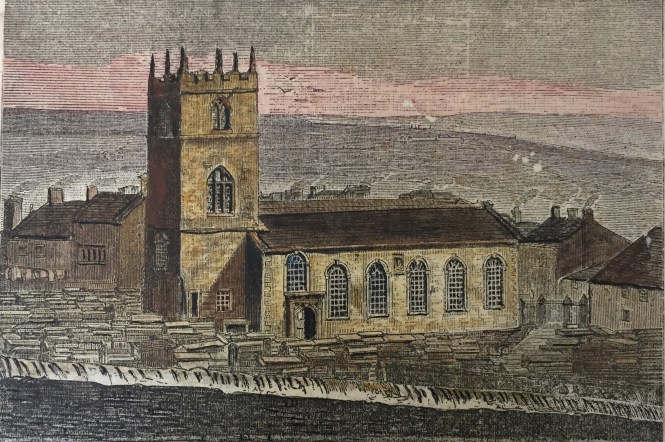
Haworth Church (Before it was rebuilt)

While no great claim can be made for the excellence of Branwell’s poems, they are no worse than many others that were published in the newspapers of the time, and some were considerably better. They range from comments on the political events of the day such as the introduction of the self-adhesive postage stamps and the First Afghan War, to the heartbreak of child deaths – a frequent occurrence in the Haworth of Branwell’s time.

Branwell’s habit of using a pseudonym once caused Library staff a problem when an Australian professor wanted photocopies from the newspapers themselves. She gave us precise references and we managed to find the poems in the Halifax Guardian, Yorkshire Gazette and Leeds Intelligencer, but annoyingly, not in the Bradford Herald, which the library did not have.  A request to the British Library Newspaper Library was returned ‘No Trace’ despite being given the correct dates and page numbers. The reason? We gave the poet as ‘Patrick Branwell Brontë’, whereas the poet’s name in the paper was … ‘Northangerland’!

Bob Duckett

*Neufeldt states that there were 26 publications, though I can find only 24. BD

Selection of Bronte books inKeighley Local Studies Library

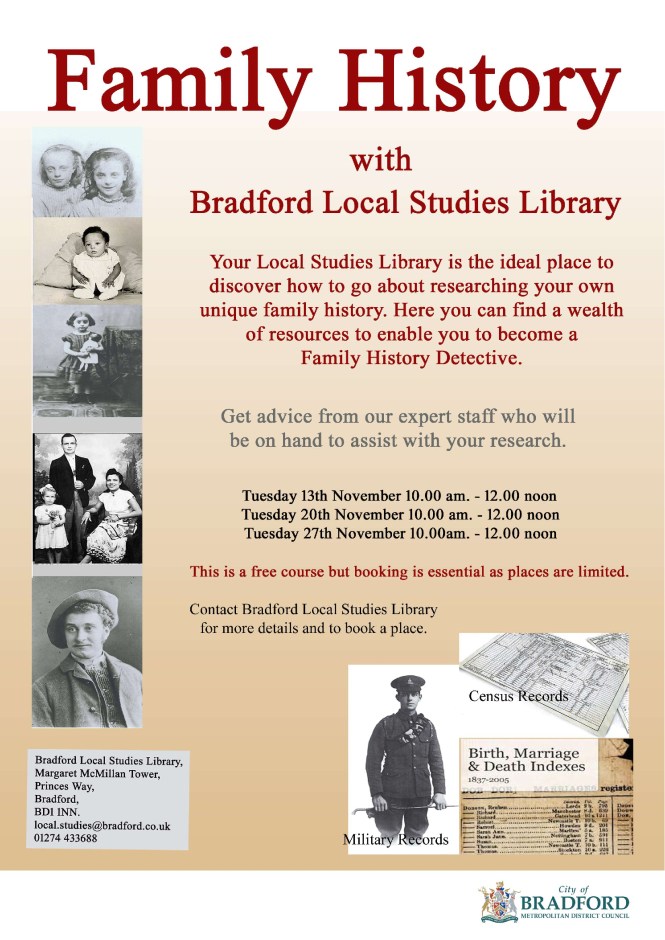
Family History with Bradford Local Studies Library

Your Local Studies Library is the ideal place to discover how to go about researching
your own unique family history. Here you can find a wealth of resources to enable you to become a Family History Detective.

Get advice from our expert staff who will be on hand to assist with your research:

Tuesday 13th November 10.00 am. – 12.00 noon
Tuesday 20th November 10.00 am. – 12.00 noon
Tuesday 27th November 10.00am. – 12.00 noon

This is a free course but booking is essential as places are limited.

Contact Bradford Local Studies Library for more information or to book a place.

Bradford Local Studies Library,
Margaret McMillan Tower,
Princes Way, Bradford, BDI INN.

local.studies@bradford.co.uk
01274 433688

Bradford-Family-History-2018

Neglected Bradford Industries: Copperas

Bradford is famous for spinning and weaving but textile production was only one of a group of important industries which ‘Worstedopolis’ supported. Since several  are now almost forgotten by contemporary citizens I should like to draw attention to those which seem unreasonably neglected, in a series of short articles.

  I would be delighted if any reader has ever heard of copperas, let alone that it had once been produced close to the city of Bradford.  Copperas is nothing whatever to do with the element copper, but is an old name for ‘green vitriol’ or iron II sulphate heptahydrate. Copperas was used in the manufacture of iron gall ink, leather tanning, and a very early process for the production of sulphuric acid. Copperas, like alum, was also important as a mordant in cloth dyeing processes. For centuries both these chemicals were papal monopolies. The monopoly was eventually broken and in the early post-medieval period the production of alum, on the North Yorkshire coast, and copperas, at several sites round the country, marked the origin of the domestic chemical industry. The industry flourished and the UK became the world’s biggest copperas producer.

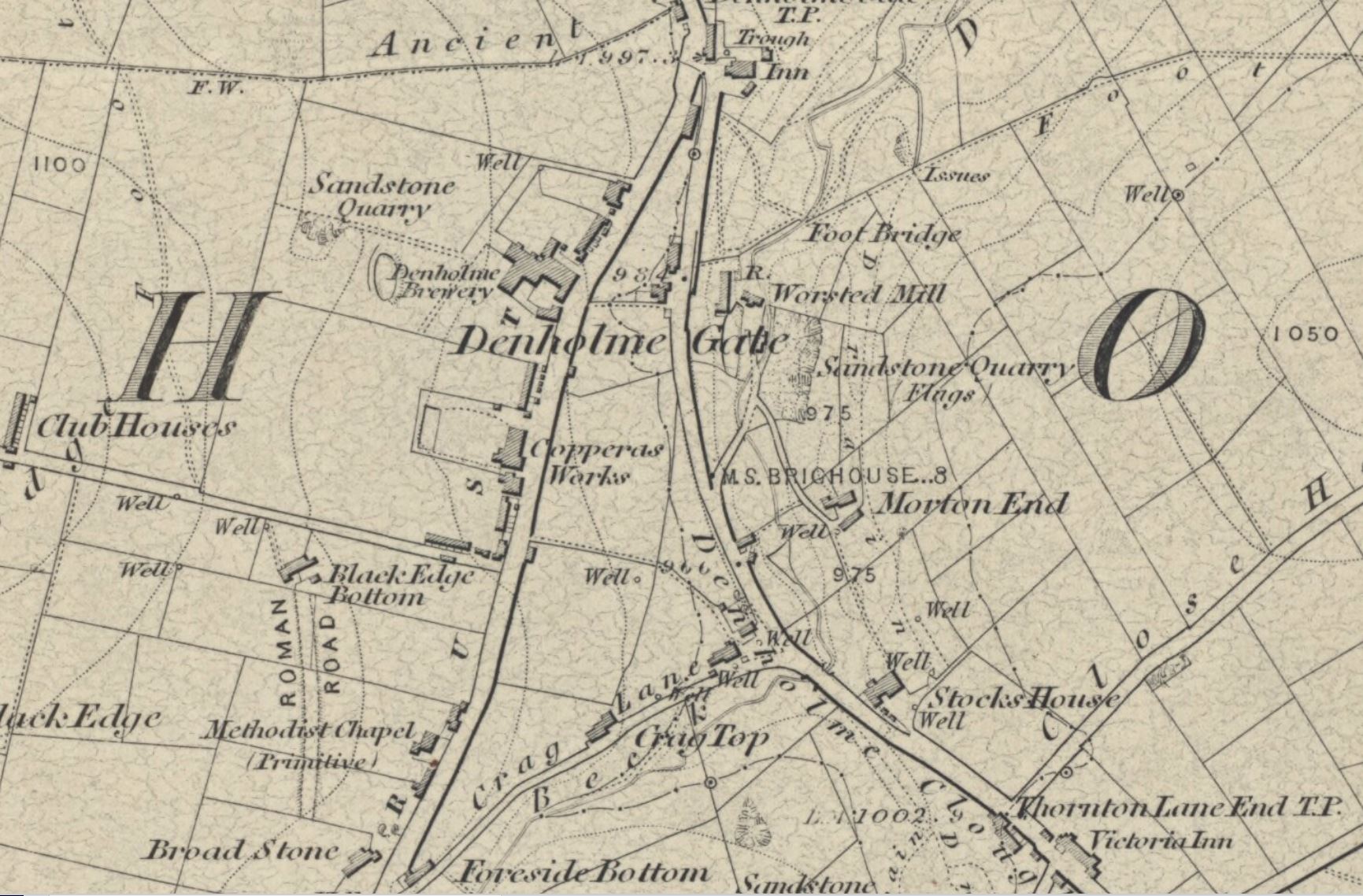
At various times production works existed in several places, this being indicated by name evidence: Copperas Hill in Liverpool, Copperas Road in Colchester, Copperas Point in Chichester Harbour, Copperas House Terrace in Todmorden, and Copperas Bay on the Stour estuary in Essex. The technique adopted  was similar at the various sites. Some years ago I was surprised to learn from historian Jean Brown, of the Thornton Antiquarian Society, that Denhome had been a centre of this industry. From trade directory evidence it is clear that, between 1822-1854, copperas was being made at not only there but at Hunslet, Birstall, Huddersfield, Elland, Southowram and Todmoden as well as in the cities of Manchester and Liverpool. Nineteenth century historian William Cudworth, writing about Denholme, recorded that an extensive coal seam was then being worked by Messrs. Townend of Cullingworth and that in parts of this Hard Bed coal ‘quantities of iron pyrites were to be found’. Cudworth stated that the process of converting iron pyrites, or pyrite, into sulphuric acid was carried on along the line of the coal seam’s outcrop. He omitted to say that two copperas works, Field Head and Denholme Gate, were associated with a family called Horsfall.


08 Plan Image

Essentially the Copperas process was the slow oxidation of iron (II) sulphide, obtained as the mineral pyrite, using atmospheric oxygen and rain water to form iron (II) sulphate heptahydrate, that is copperas. Essential to the process was, of course, access to a plentiful supply of pyrite. Pyrite nodules (‘brass lumps’) are found in the Coal Measures in Cumbria and West Yorkshire. At Denholme the producers obtained the nodules and placed them in ‘beds’ lined with clay. They were then left to weather for up to six years. Towards the end of this time they began to produce a large quantity of liquor, a dilute solution of hydrated ferrous sulphate and sulphuric acid, which was pumped into a lead boiler positioned over a furnace. Quantities of additional scrap iron were added to increase the final yield. As the liquor was reduced by evaporation more liquor was added. When it was  sufficiently concentrated the liquor was tapped off into a cooling tank. As the solution cooled the copperas crystallised in the tank. Crystals were collected, heated to melting point, and poured into moulds; finally the resulting cakes were packed into barrels for transport.

Why did the industry survive in Denholme? The most important property of copperas for nineteenth century textile manufacturers in Bradford must have been that it ‘saddened’ and ‘fixed’ wool dyes. Because it prevented the colour from washing out or fading, copperas became an essential part of the black dyeing process, especially for woollen cloth in conjunction with log-wood imported from South America. We known that cheap coal and pyrite nodules could be obtained with minimum transport costs and I imagine that once the plant had been set up there were little additional capital costs.

The cheap manufacture of vitriol, in Bradford and elsewhere, by the lead chamber process inevitably killed off the copperas industry. Once you can make sulphuric acid cheaply and in bulk you can make copperas more quickly by reacting the dilute sulphuric acid with scrap iron fragments and evaporating the result. The discovery, by Sir William Henry Perkin in 1856, of aniline dyes which did not require mordants were to make copperas largely redundant in dyeing in any case. Elsewhere copperas works were adapted to produce other industrial chemicals but this did not happen at Denholme in its rather rural location. Nevertheless at one time this community was a small but significant centre of Britain’s chemical industry. By 1888, at the very latest, all production had ceased.

If this topic interests you do read the following paper which includes Jean Brown’s meticulous family history studies:

D.J.Barker & Jean K Brown, Bradford’s Forgotten Industry: Copperas Manufacture in Denholme, Bradford Antiquary, (2015) 3rd series, 19, 25-38.

Derek Barker, Local Studies Library Volunteer.

Book Review: Bradford in 50 Buildings. By George Sheeran

Bradford in 50 Buildings. By George Sheeran. Amberley Publishing, 2017. 96 pp. ISBN: 978-1-4456-6848-2 (print); 978-1-4456-6849-9 (ebook). £14.99.

George Sheeran book

Available from Bradford Libraries

George Sheeran should be known to all students of Bradford history, and probably is. A steady stream of books, articles and talks, not to mention his work at Bradford University’s Pennine Studies Centre, all testify to his long involvement in this area.1

Bradford in 50 Buildings explores the history of Bradford through a selection of its buildings, not just the better-known iconic public ones, but from all social levels and cultures. Yes, City Hall, the Cathedral, Wool Exchange and the Alhambra Theatre are here, but so are mills, schools, churches, mosques and terrace houses. The focus of the book is more on illustrating the diverse history of Bradford through its buildings than a straightforward architectural narrative. The buildings are all present today: this is Bradford as we see it now. History is all around us. We are looking at it, but what do we see?

The book features just over a hundred coloured photographs of high quality interspersed with prose commentary highlighting the architectural features and giving historical background of the fifty selected buildings. There is a succinct introduction giving context and background to Bradford’s history and a delightfully clear map showing where the buildings are.

Here we have Cotton Weavers’ Cottages in Little Horton Green (testament to the cotton industry), cottages in Dracup Street, Great Horton (characteristic of Bradford’s early nineteenth century industrial development) and mill workers’ terraces in Gathorne Street; on the educational front we have Feversham Street School (built in 1873, with a discussion of the advent of Board Schools), Bradford College (with both the original 1883 building and the striking multi-coloured façade of the new Hockney Building) and Dixon’s Trinity Academy (a 1994 example of post-modernism); industrial buildings include Manningham Mills, Canon Mill and Mitchell Brothers (Bowling Old Lane), while the Midland Hotel, Yorkshire Penny Bank and the red brick Prudential building in Sunbridge Road are other examples of commercial buildings; Churches and mosques are well represented, plus the Hindu Temple in Leeds Road and the Bradford Reform Synagogue in Bowland Street. Council flats (Longlands), large houses (e.g. Bolling Hall), public buildings (e.g. Cartwright Hall, St George’s Hall) and a public house (Shoulder of Mutton, Kirkgate) are some of the other types of building in the author’s selection.

Not all the buildings selected are beauties. High Point, the former Yorkshire Building Society tower in Westgate is ‘the city’s outstanding piece of brutalist architecture … Its walls of corrugated concrete provide a texture … that gives the building more the feel of a piece of urban sculpture’  (plus note on the rise of building societies), the Margaret Macmillan Tower (with a note on Stanley Wardley’s plan to modernise the city and provide a trouble free flow of traffic); and the old  GPO Telephone Exchange (superficially a boring modern cube – but is a much under-rated style of the 1930s ‘stripped classicism’). Yet the author is quick to point out unusual features which will encourage us to take a second look. Thus, ‘ … the Margaret Macmillan Tower … seems just another tower block at first sight, but look again. It rests on a rustic base of slate and rises clad in Portland Stone as a chaste block overlooking the city centre. The stanchions (the vertical members) are also clad in slate producing a fine counterpoint to the Portland stone.’ Indeed, with informed architectural analysis to guide us, together with an equally informed historical background, we see Bradford with new eyes. A wide variety of eras, styles and innovative features are covered. Students of architecture will value these accounts.

Omissions? Of course there are. Magistrates Courts? Transport Interchange? Paper Hall? The Bradford Club? Bradford has far too rich an architectural heritage to be limited to a mere fifty. Maybe the author could be persuaded to do another fifity!

Sheeran wears his learning lightly: we are in the hands of an experienced and knowledgeable teacher. We are not swamped in technical terms yet learn a lot. One grouse I have is that the Contents listing omits the page numbers to the fifty listed buildings, so that I was for ever hunting for page numbers using the entry numbers!         There is no index, though the contents page is detailed.

Two final points. ‘It may seem strange in a book about the architectural riches of a city to show a derelict industrial site, but this one is important for two [historical] reasons.’ (p. 57) The site is that of the Providence and Thompson Mill sites just up from the Alhambra Theatre and the reasons are given, which lead on the second point: ‘This is a sensitive site given its historical provenance. Recent fires in derelict mill buildings and resulting demolitions provoke debate about the future development of the area, and invidious decisions that will need to be taken.’ (p. 58) ‘Let us not make the mistakes of the past.’ pleads the author. Amen to that!

Enjoyable and informative. Essential reading for Bradford city planners and their favoured architects!

(Bob Duckett)

1 Books such as Brass Castles: An Illustrated Guide to the City’s Heritage (1993); The Victorian Houses of Bradford (1990); The Buildings of Bradford: An Illustrated Architectural History (2005); Good Houses Built of Stone: The Houses and People of Leeds/Bradford 1600-1800 (1986); The Mosque in the City: Bradford and its Islamic Architecture (2015).