Temporary Closure of Keighley Local Studies Library

Keighley Local Studies Library will close for a week from Monday 26th November for Collections Week.

The Keighley Lending Library will remain open.

The week’s closure will enable work to be carried out on a section of the large collection of Local Authority material with the aim of increasing convenience of user access and ensuring that these unique items are stored in the best way possible for future preservation.

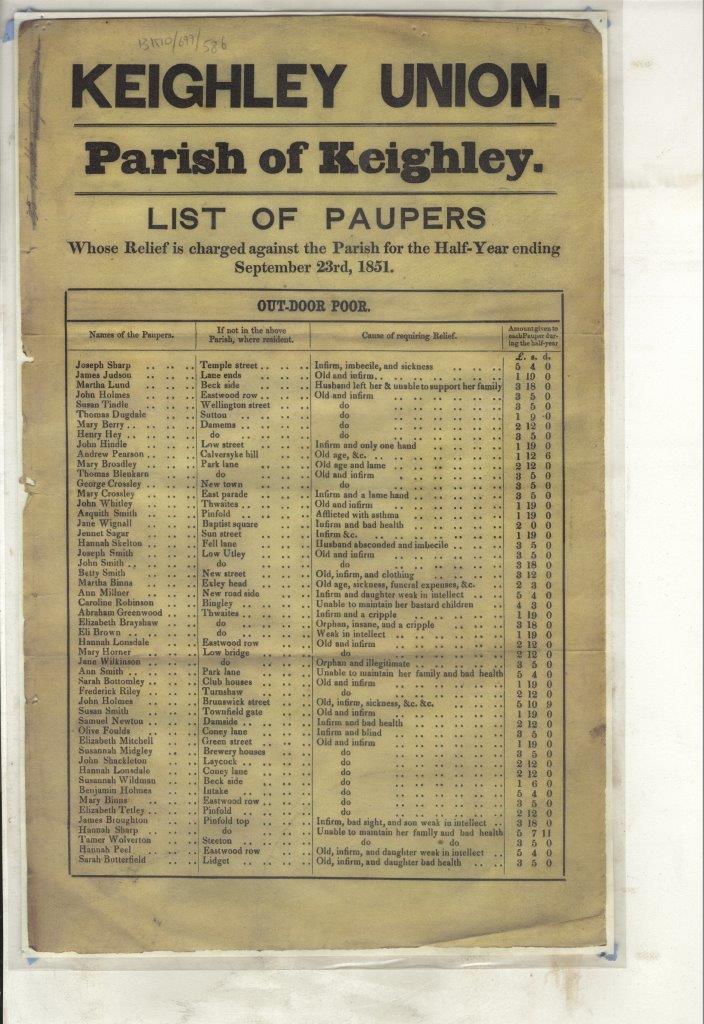
This collection which originated in Keighley Town Hall consists mainly of rate books from local Urban District Councils and Townships including Morton, Oakworth,  Oxenhope, Haworth and of course Keighley.

The collection also includes UDC committee minutes, account books and various administrative records.

The earlier records date from 1820 and many of the items are a unique source of information representing the early and middle part of the 19th century for the area.

As records of people and places for the central period of the industrial revolution, these archives are used by a wide range of researchers. They provide an important source of local, social and economic historical information.

UDC committee minutes are also popularly used for the history of villages and their pattern of development.

Local Authority archives are a valued source of information for present day conservation area assessment reports and restoration projects such as Keighley’s North Parade and Royal Arcade.

Rate books are also becoming increasingly requested records of research due to the continuing and growing popularity of family history and house history. They give information on the owner/occupier of the property and in some cases,  a description and details of size.

A selection of items from the Local Authority archives will be on display when the Local Studies Library reopens on Monday 3rd December..


Keighley Roll of Honour 1914-1918

Bradford Libraries's avatarBradford Libraries World War One Blog

As we reach this particular poignant Remembrance Sunday on the 11th November, marking one hundred years since the First World War armistice,   we would like to share some information on the Keighley Roll of Honour for 1914-1918.

The Keighley Roll is a magnificent manuscript and situated in Keighley Library, upstairs in the Local Studies Department. The pages are turned on a regular basis but if you wish to look at a particular name staff are happy to turn the pages for you.

More information about the Keighley Roll of Honour

View original post

Family History with Bradford Local Studies Library

Your Local Studies Library is the ideal place to discover how to go about researching
your own unique family history. Here you can find a wealth of resources to enable you to become a Family History Detective.

Get advice from our expert staff who will be on hand to assist with your research:

Tuesday 13th November 10.00 am. – 12.00 noon
Tuesday 20th November 10.00 am. – 12.00 noon
Tuesday 27th November 10.00am. – 12.00 noon

This is a free course but booking is essential as places are limited.

Contact Bradford Local Studies Library for more information or to book a place.

Bradford Local Studies Library,
Margaret McMillan Tower,
Princes Way, Bradford, BDI INN.

local.studies@bradford.co.uk
01274 433688

Bradford-Family-History-2018

Book Review: Bradford in 50 Buildings. By George Sheeran

Bradford in 50 Buildings. By George Sheeran. Amberley Publishing, 2017. 96 pp. ISBN: 978-1-4456-6848-2 (print); 978-1-4456-6849-9 (ebook). £14.99.

George Sheeran book

Available from Bradford Libraries

George Sheeran should be known to all students of Bradford history, and probably is. A steady stream of books, articles and talks, not to mention his work at Bradford University’s Pennine Studies Centre, all testify to his long involvement in this area.1

Bradford in 50 Buildings explores the history of Bradford through a selection of its buildings, not just the better-known iconic public ones, but from all social levels and cultures. Yes, City Hall, the Cathedral, Wool Exchange and the Alhambra Theatre are here, but so are mills, schools, churches, mosques and terrace houses. The focus of the book is more on illustrating the diverse history of Bradford through its buildings than a straightforward architectural narrative. The buildings are all present today: this is Bradford as we see it now. History is all around us. We are looking at it, but what do we see?

The book features just over a hundred coloured photographs of high quality interspersed with prose commentary highlighting the architectural features and giving historical background of the fifty selected buildings. There is a succinct introduction giving context and background to Bradford’s history and a delightfully clear map showing where the buildings are.

Here we have Cotton Weavers’ Cottages in Little Horton Green (testament to the cotton industry), cottages in Dracup Street, Great Horton (characteristic of Bradford’s early nineteenth century industrial development) and mill workers’ terraces in Gathorne Street; on the educational front we have Feversham Street School (built in 1873, with a discussion of the advent of Board Schools), Bradford College (with both the original 1883 building and the striking multi-coloured façade of the new Hockney Building) and Dixon’s Trinity Academy (a 1994 example of post-modernism); industrial buildings include Manningham Mills, Canon Mill and Mitchell Brothers (Bowling Old Lane), while the Midland Hotel, Yorkshire Penny Bank and the red brick Prudential building in Sunbridge Road are other examples of commercial buildings; Churches and mosques are well represented, plus the Hindu Temple in Leeds Road and the Bradford Reform Synagogue in Bowland Street. Council flats (Longlands), large houses (e.g. Bolling Hall), public buildings (e.g. Cartwright Hall, St George’s Hall) and a public house (Shoulder of Mutton, Kirkgate) are some of the other types of building in the author’s selection.

Not all the buildings selected are beauties. High Point, the former Yorkshire Building Society tower in Westgate is ‘the city’s outstanding piece of brutalist architecture … Its walls of corrugated concrete provide a texture … that gives the building more the feel of a piece of urban sculpture’  (plus note on the rise of building societies), the Margaret Macmillan Tower (with a note on Stanley Wardley’s plan to modernise the city and provide a trouble free flow of traffic); and the old  GPO Telephone Exchange (superficially a boring modern cube – but is a much under-rated style of the 1930s ‘stripped classicism’). Yet the author is quick to point out unusual features which will encourage us to take a second look. Thus, ‘ … the Margaret Macmillan Tower … seems just another tower block at first sight, but look again. It rests on a rustic base of slate and rises clad in Portland Stone as a chaste block overlooking the city centre. The stanchions (the vertical members) are also clad in slate producing a fine counterpoint to the Portland stone.’ Indeed, with informed architectural analysis to guide us, together with an equally informed historical background, we see Bradford with new eyes. A wide variety of eras, styles and innovative features are covered. Students of architecture will value these accounts.

Omissions? Of course there are. Magistrates Courts? Transport Interchange? Paper Hall? The Bradford Club? Bradford has far too rich an architectural heritage to be limited to a mere fifty. Maybe the author could be persuaded to do another fifity!

Sheeran wears his learning lightly: we are in the hands of an experienced and knowledgeable teacher. We are not swamped in technical terms yet learn a lot. One grouse I have is that the Contents listing omits the page numbers to the fifty listed buildings, so that I was for ever hunting for page numbers using the entry numbers!         There is no index, though the contents page is detailed.

Two final points. ‘It may seem strange in a book about the architectural riches of a city to show a derelict industrial site, but this one is important for two [historical] reasons.’ (p. 57) The site is that of the Providence and Thompson Mill sites just up from the Alhambra Theatre and the reasons are given, which lead on the second point: ‘This is a sensitive site given its historical provenance. Recent fires in derelict mill buildings and resulting demolitions provoke debate about the future development of the area, and invidious decisions that will need to be taken.’ (p. 58) ‘Let us not make the mistakes of the past.’ pleads the author. Amen to that!

Enjoyable and informative. Essential reading for Bradford city planners and their favoured architects!

(Bob Duckett)

1 Books such as Brass Castles: An Illustrated Guide to the City’s Heritage (1993); The Victorian Houses of Bradford (1990); The Buildings of Bradford: An Illustrated Architectural History (2005); Good Houses Built of Stone: The Houses and People of Leeds/Bradford 1600-1800 (1986); The Mosque in the City: Bradford and its Islamic Architecture (2015).