I was not born in West Yorkshire which is an excuse for periodically getting lost in the urban areas south of Bradford. The most recent occasion led to my discovering a real gem, the village of East Bierley. It has an almost rural air with a village green and a well-known cricket club. It is no surprise to learn that it has been a conservation area since 1981, in recognition of ‘special architectural or historic interest’, since the village has a substantial number of lovely eighteenth and early-nineteenth century stone built properties. Admittedly East Bierley is ‘over the border’ in Kirklees but in the past it had significant coal and wool links with Bradford, and the Local Studies Library reserve map collection has a very detailed plan of the village recording both the names of fields and land-owners.

A plan of East Bierley and the surrounding fields. The absence of the railway line and paucity of coal mining activity may date it to the late 1830s.
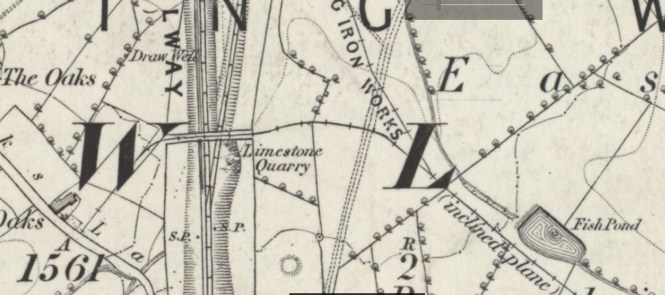
I’ve included a view of almost the entire plan and also a detail showing the village centre which should be clearer. The plan is extensively annotated in both pen and pencil. It was clearly a working copy of some type, possibly a land agent’s plan. The pattern of fields and buildings in this plan very closely resembles the first Ordnance Survey map of the area which was surveyed in 1847. So my first thought was that our plan might also represents the situation in the late 1840s. It could pre-date the OS map since it does not include the Great Northern Railway line section from Birkenshaw & Tong to Dudley Hill stations. This raises an interesting and slightly mysterious point. There is an extremely helpful website which records the lost railways of West Yorkshire:
http://www.lostrailwayswestyorkshire.co.uk/
The expert enthusiasts managing this site believe that this section of track, part of a Gildersome to Laisterdyke line, was opened in 1856 which makes its appearance on an 1852 OS map edition surprising. Possibly revised sheets of the first OS map were issued to allow for such major developments.

A detail showing East Bierley properties, some of the land-owners and ‘Bell Pit Hills’.
It would be wrong to assume that the annotations are necessarily contemporary with the plan but there are some indications that this is the case. Not all the land-owners’ names are legible but I can recognise: Joseph Waterhouse, Joseph Speight, William Booth, Joseph Binns, John Woodcock, John Firth and James Verity. I have tried to identify some of these individuals in trade directories and the censuses for 1841 and 1851. It seems that East Bierley is linked to Hunsworth for recording purposes. The 1851 census indicated that by the mid-nineteenth century coal or ironstone miner was the commonest occupation in the village, and there was even a single 11 year old ‘pit boy’. The second commonest occupation was wool-comber, this being an essential part of the worsted process. Nearby Birkenshaw Mill and Wilson Mill both wove worsted cloth. There were residents employed in other textile trades such as spinners and power-loom weavers. Next in frequency were farmers and finally a grocer, a druggist, and two boot and shoe makers. Family history really deserves prolonged study, rather than the quick assessment which is all that I provide. What I can say is that Joseph Speight, William Booth, John Woodcock, John Firth and James Verity can all be identified as farmers in the 1841 census but only John Firth survives to 1851. I therefore think that it is reasonable to date the addition of the annotations to the early 1840s.
The plan maker seems to be more concerned with with the surface land ownership than the mineral resources underground. This makes it possible that the plan itself was originally drawn up as early as the 1830s before the Bowling Iron Company leased the right to mine coal in this area. Certainly by the time of the first OS map there were several working and abandoned coal mines existing within the area of the plan, also ironstone pits and a tramway taking material to Bowling Iron Works. On our plan there are just two, quite subtle, references to ‘black diamonds’. One is a ‘pit’ noted above and slightly to the left of the pinfold where stray animals were kept. The other is a field name at the top centre of the detail, in the occupation of Joseph Waterhouse. The name recorded for this is ‘Bell Pit Hills’. Bell pits are commonly encountered in accounts of early mining. In this method a short shaft was sunk down to a shallow seam and its base was then expanded as the mineral was removed, creating a bell-like profile. When unsafe, because of potential roof collapse, the bell was abandoned and a new shaft sunk nearby. Each bell was filled in turn by waste dug out of its successor. Since the exact situation underground cannot be determined from surface remains ‘shallow shaft mining’ is now the preferred term.

A detail of the plan included in Derek Pickles’s unpublished work showing the pits and tramways near East Bierley at their maximum extent. The triangles are pits which, in many cases, are numbered since their names are unknown.
In his very detailed study of mineral tramways, curated by Bradford Industrial Museum, Derek Pickles recorded that ‘in 1839 the (Bowling Iron) Company leased 1200 acres of land in Toftshaw and Hunsworth from the Earl of Scarborough, and began to work pits in the area’. The Earl was at that time Lord of the Manor. It is possible then that the original plan pre-dates this event. The shallowest seam in the East Bierley area was called the Blocking Bed (or Toftshaw Bed) Coal. At nearby Toftshaw Colliery, which was open between 1913-1950, the Blocking Bed Coal was found at 26.5m and the deeper Shertcliffe Coal seam at 87m depth. Other bore hole reports available from the British Geological Survey suggest that more usually Shertcliffe Coal was at 30m depth in this area, and was widely exploited. The fact that there were also ironstone miners and ironstone pits in East Bierley suggests that the ironstone containing Black Bed Coal seam was also being accessed about 67m below the Shertcliffe Coal. Derek Pickles recorded that the Bowling Iron Company already had shafts of 95m depth to reach the Better Bed coal but when it ‘extended its operations into Hunsworth, Toftshaw and Tong much larger and deeper pits were sunk’. The enterprise was not without risk: at one of the company’s pits in 1847 the Bradford Observer reports a firedamp (methane) explosion with one miner killed and several others burned.
Otherwise peaceful East Bierley does not seemed to have occupied contemporary newspapers over much around the time of the plan. In 1838 the community contributed delegates, and a flag, to a Chartist meeting on Hartshead Moor which was addressed by Peter Bussey and Feargus O’Connor. In 1842 James Verity, one of the landowners, together with James Binns, were sworn in as constables. The following year a Bradford branch of the Leeds to Manchester railway was being considered and in 1844, at the Lister’s Arms in Manchester Road, William Patchett won a main prize at a flower show with a dark-laced pink called ‘Lady Milner’. In 1856 John Willey, representing Hunsworth, was elected a Poor Law Guardian of the North Bierley Union. He lived at Moor House, East Bierley which you should be able to make out on the right of the larger plan. His son was Francis Willey (1st Baron Barnby) a very successful international Bradford wool merchant in the late nineteenth century.
Derek Barker, Local Studies Library volunteer