Lord Asa Briggs of Lewes , born and schooled in Keighley: 07 May 1921 – 15 March 2016

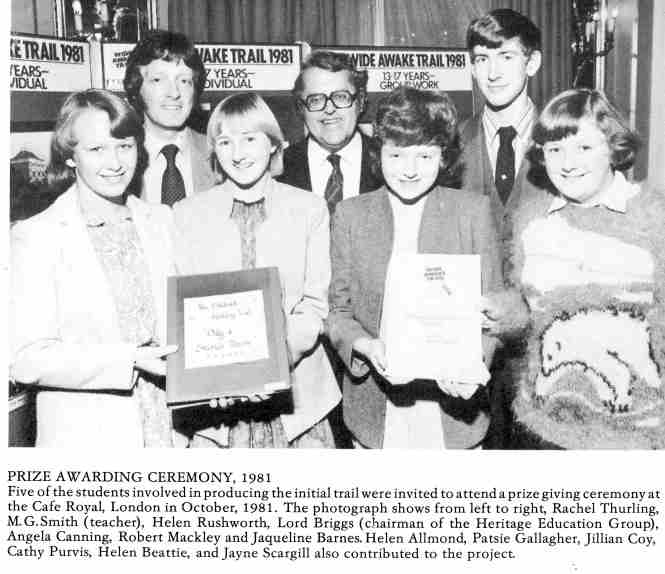
Lord Briggs Prize Award Ceremony 19811mb

Image taken from the book ‘Oakbank History Trail’ © Maurice G. Smith

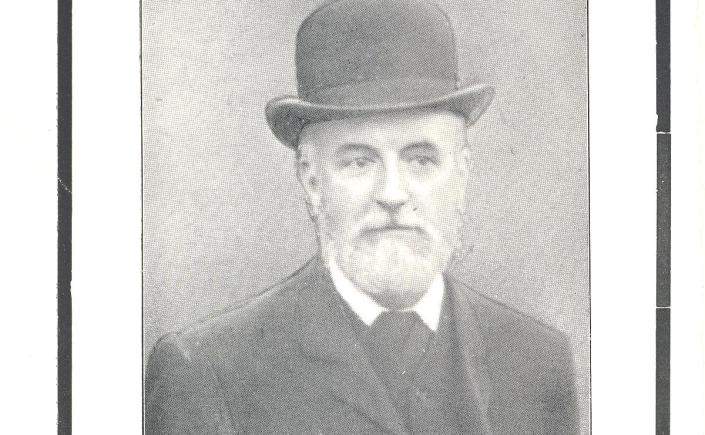
Keighley Boys’ Grammar School produced not one, but two, great historians in the early part of the twentieth century. Both were to have an impact on the study and philosophy of history and were to become amongst the most prominent historians of their day, their names were Asa Briggs and Herbert Butterfield (1900-1979). This blog concentrates on Lord Asa Briggs who sadly died last year and in whose honour the Historical Association have kindly donated a collection of books to Keighley Library, where the young Asa Briggs loved to study.

Keighley Library view c19291mb.jpg

Asa Briggs, historian and public servant, was born in Keighley 7th May 1921. He was the son of William Walter Briggs, a skilled engineer and a good pianist. His mother, Jane, was the daughter of a greengrocer, who, prior to the depression, had been part of a small farming family in Yorkshire.

Asa initially attended Eastwood council school, followed by the school, said to have had the most influence on his development and future studies, the Keighley Boys’ Grammar School, adjacent to the old Mechanics’ Institute in North Street and opposite this library.  He used this Carnegie public library, regularly. This is where he first learned to browse. Here too, amongst the newspapers in the reading room, and the large collection of books from the Philip Snowden collection that specialised in social economic and political interests,  Briggs says that he studied the politics that he would later introduce to his own version of social history, (Special Relationships, Frontline Books , 2012, p.9).

Keighley Library Reading Room

Boys studying in reading room 1mb

Briggs enjoyed his school days at Keighley, especially his English and drama lessons with Kenneth Preston, of whom he speaks as the ablest of teachers. He seems to have made the most of his time there, becoming a school prefect and a member of a variety of societies including the Literary and Debating Society, the Stamp Society and the “Thirty- Three” Society. Despite a general love of history, Briggs in fact wanted to become a writer and, during this time at school, wrote poetry and various society reports for The Keighlian, the school magazine. However, another revered mentor at the school, the headmaster Neville Hind, did not favour the further study of English and encouraged students to pursue other subjects and to also try for his old Cambridge College, Sidney Sussex. Briggs was to adhere to this advice, so following in the footsteps of Herbert Butterfield from Oxenhope. By this time Herbert Butterfield was also lecturing at Cambridge. In 1944, Butterfield was elected Professor of Modern History, later Regius Professor and Vice Chancellor of Cambridge University from 1959-1961. He was knighted in 1968. On arrival at Cambridge, Brigg attended his lectures which influenced the young historian, (Special Relationships, Frontline Books, 2012 p.5).

In 1937, with war imminent, Briggs was accepted as a scholar by Sidney Sussex College, Cambridge at the very young age of 16. In Special Relationships, the tutor, James Passant, is quoted as saying, “You’re only a baby, Briggs – but since we are sure there is going to be a war, we would like you to complete your degree before you are called up for military service,”( p.68).

Briggs went on to achieve first class honours in History Tripos Parts 1 and 2. He also graduated from the London School of Economics before his call-up to the Army. He was posted to Bletchley Park as a cryptographer under Frank Adcock. He worked mainly on signals traffic from the Mediterranean using Alan Turing’s proto-computers (Bombes). These allowed them to read enemy signals. He also helped to dupe the Germans into thinking D-Day would not be carried out in Normandy. A full account of his life at Bletchley is given in the acclaimed book Secret Days Code-breaking in Bletchley Park (Frontline Books, 2011), available for loan in Bradford Libraries.

He left Bletchley for Oxford in 1944 where he became Fellow of Worcester College and his academic career began in earnest. His main areas of interest were the social and cultural history of the 19th and 20th centuries and the history of broadcasting in Britain. The following list is taken from the University of Sussex site: http://www.sussex.ac.uk

  • 1944-1955 Fellow of Worcester College, Oxford
  • 1950-1955 University Reader in Recent Social and Economic History, Oxford
  • 1953-1955 Faculty Fellow of Nuffield College, Oxford
  • 1953-1954 Member of the Institute for Advanced Studies, Princeton, New Jersey, United States
  • 1954-1967 Deputy President, President of the Workers’ Education Association
  • 1955-1961 Professor of Modern History, co-Head of the History Dept., Leeds University
  • 1961-1967 Professor of History, Dean of the School of Social Studies, Pro-Vice- Chancellor, University of Sussex
  • 1967-1976 Vice-Chancellor, University of Sussex
  • 1976-1991 Provost of Worcester College, Oxford
  • 1978-1994 Chancellor of the Open University
  • 1988 A founder, first chair of the Commonwealth of Learning

Asa Briggs was also active in a very large number of societies:

  • President of  Haworth’s  own  Brontë Society and also of the following:
  • Social History Society
  • William Morris Society
  • Victorian Society
  • Ephemera Society
  • British Association for Local History
  • Association of Research Associations

He also served on a variety of committees:

  • member of the University Grants Committee
  • governor of the British Film Institute,
  • a trustee of the Glyndebourne Arts Trust, the International Broadcasting Institute, the Heritage Education Group  and the Civic Trust
  • chairman of the Standing Conference for the Study of Local History, the European Institute of Education, the governors and trustees of the Brighton Pavilion, and the Advisory Board for Redundant Churches.

Briggs also undertook several public appointments: most notably chairing a committee on the future of nursing, which in 1972 recommended improvements in nurses’ pay and conditions and an overhaul of nurses’ training that were later accepted by the Conservative government.

To quote Tam Dalyell in the Independent, Wednesday, 16th  March 2016,

“…his output in the written word, and in broadcasts and lectures, was awesome. It is doubtful whether Briggs ever spent a truly idle moment in his life.”

In fact, following his 90th birthday, he completed 3 books including Loose Ends and Extras in 2014.

Asa Briggs always kept in touch with Keighley and regarded himself as a “Lawkholme Laner”, (Keighley News 1930s Special, 16 February 1996). He was brought up in Emily Street, just off Lawkholme Lane.

Emily St Keighley1mb

In 1962,  he became the first vice-president of the newly formed Friends of Cliffe Castle. He attended Old Keighlian reunions, and followed the developments of his old school. Keighley Boys’ Grammar School had been renamed Keighley School in 1964, when it became a County school, and it became known as Oakbank Grammar School in 1967. In 1982, Asa Briggs wrote the Foreward of the prize- winning, The Oakbank History Trail, published to commemorate the official opening of the new Oakbank school buildings. He had already attended the prize-giving ceremony in 1981 in London, as Chairman of the Heritage Education Group hosting the ceremony.

In 2015, Keighley Library was contacted regarding Lord Briggs’ time at Keighley Boys’ Grammar school and regarding the first poem that he ever had published, which was in the school magazine, the Keighlian’s December issue 1936, part of our own archive collection. The Complete Poems of Asa  Briggs, was subsequently published in 2016 and it was a real privilege for Keighley Library staff to play even a minor role in this last published work of one of Keighley’s greatest sons.

Lord Briggs died at Lewes 15th March 2016, leaving his wife, also an historian, whom he married in 1955, (then Susan Banwell), four children and 14 grandchildren, to whom this last book is dedicated.

Gina Birdsall, November 2017
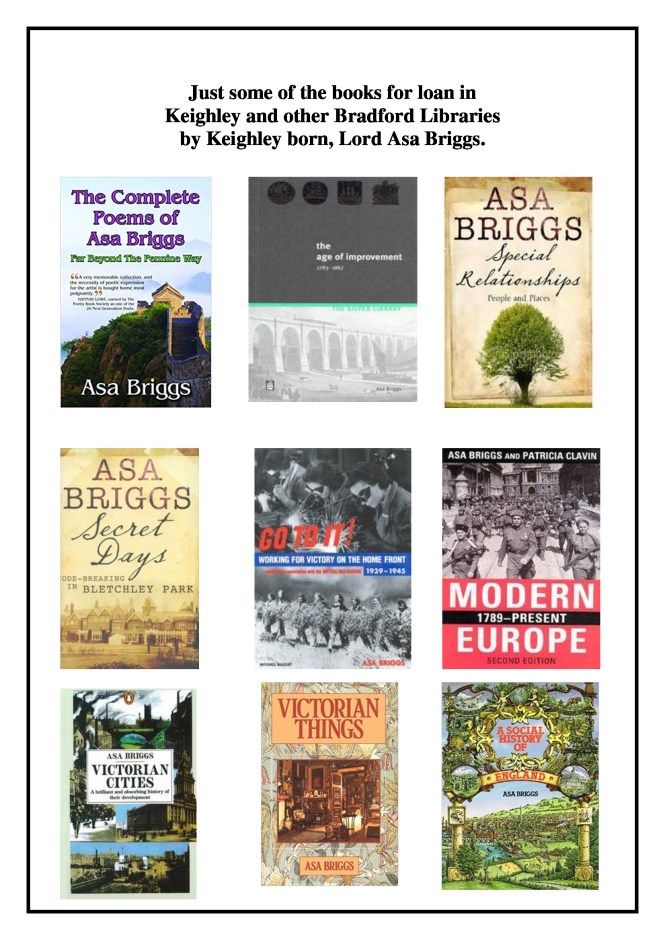
Asa-Briggs_-books-for-loan

Books about Professor Asa Briggs donated to Keighley Local Studies Library

A presentation of books about the late Professor Briggs has been made to Keighley Local Studies Library by the Historical Association.

The books were presented by Professor Tony Badger, President of the Historical Association, to Maggie Pedley, Head of Libraries, Museums and Galleries on Wednesday 29 November.

Also present at the event were Dr Trevor James, Editor of ‘The Historian’ journal and historian, Philip Johnston.

Asa Briggs was one of Keighley’s foremost citizens. He became a well-known and remarkable historian who inspired others through his research, teaching and writing.

At Keighley Library, the young Asa developed his skills to become such an influential social historian.

In his book ‘Special Relationships’ he traces his love of history back to his days in Keighley. He said of Keighley Library ‘It was there that I first studied the politics that I was to introduce into my own version of social history.’

​It is fitting that these books will be added to the archives and made available for the benefit of future researchers and historians.

There is a display of books and local information about Asa Briggs in the Local Studies library on the first floor that will remain up over the next 3 weeks.


Map of the Week 027: What was going on in Great Horton?

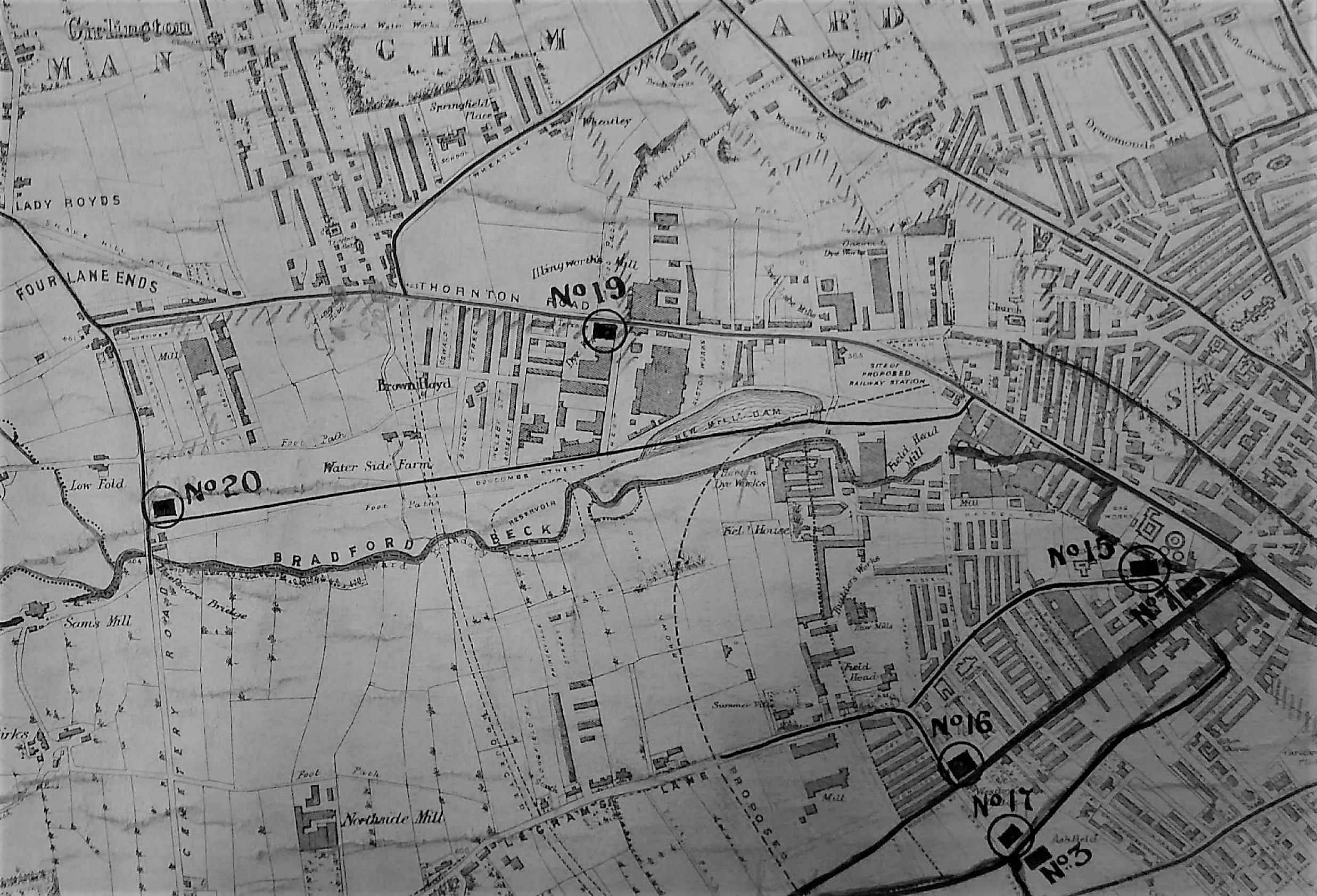
If you are reading this article you probably find maps and plans as interesting as I do. You will certainly understand how easy it is to get distracted, while writing a brief report, by trying to identify all the recorded features and resolve some of the inevitable puzzles. The first image is a detail of a map in the reserve collection which is in poor condition. The parent map is the one produced of the Borough of Bradford in 1873 by Walker & Virr, which is especially valuable since it falls evenly between the two first Ordnance Survey maps of the 1850s and 1890s. The twenty years that preceeded the Walker & Virr map brought huge changes to Horton. In 1850 the community had been surrounded by many coal and ironstone pits, both functioning and disused. Tramways conveyed their products to the Low Moor Ironworks for conversion into best Yorkshire wrought iron. By the 1870s the seams were exhausted, the pits were closed, and there had been considerable housing development.

Map of the Week 027 A

A map detail showing Great Horton watercourses and main sewers

This map was in a group that evidently came to the Local Studies Library from the city’s Surveyors and Engineers Department. Its purpose is clearly recorded, this being to record Bradford’s main sewerage system and to show storm overflows. The main sewers collected both foul water and surface water. During a rainstorm they could become completely filled. Under those circumstances the plan was for the excess to flow into alternative sewers and ultimately watercourses like the Bradford Beck; not a pretty thought. The positions of the storm overflows are more easily displayed in a second map detail.

Map of the Week 027 B

A detail from the same map showing sewers in the area between Thornton Road and Legrams Lane

The Borough Surveyor (B.Walker) employed this map. It was clearly being used for at least a decade after its first publication since pencil annotations are dated for the years 1881-83. Having dated the map and identified its use I thought that there were three features of particular interest: the Old Mill, Bracken Hall, and the brick works.

The longer watercourse in the first image is the Horton Beck which provided the water for the Old Mill. A little further down stream, out of sight, was a second corn mill called the New Mill. I assume that the Old Mill started life as a manorial watermill, like Bowling Mill or the Bradford Soke Mill. William Cudworth records that in the nineteenth century the Lord of the Manor of Horton was Sir Watts Horton and then, after his death, his son in law Captain Charles Horton Rhyss. His property came up for sale in 1858 when William Cousen of Cross Lane Mill purchased the lordship. The Old Mill, its farm, and the water rights went to Samuel Dracup a noted textile engineer. He, it appears, eventually converted Old Mill to be a textile mill. I am more interested in an earlier tenant of Old Mill recorded in the Ibbetson’s 1845 Bradford directory, John Beanland. He was the son of Joseph Beanland who was a corn miller and colliery proprietor at Beanland’s Collieries, Fairweather Green. Cudworth says he belonged to a Heaton family. There was certainly a James Beanland (1768-1852), of Firth Carr, Heaton who exploited coal in Frizinghall.

Cudworth describes the impressive looking Bracken Hall as being of a fairly recent origin. I’m sure Cudworth is correct since the Hall is not present on the 1852 OS map of the area. It was inhabited by William Ramsden who was the owner, with his brother John, of Cliffe Mill. This was a Horton worsted mill which can be seen in the centre left of the first map. Bracken Hall was described as being ‘surrounded by a thriving plantation’ which is certainly the appearance that this map records. In the 1881 census William Bracken (54) and his wife Sarah (57) were living at the Hall rather modestly, with only a cook and a housemaid. I am not sure when the house was demolished. It certainly survived into the twentieth century but is missing from the 1930s OS maps. Before the construction of the Hall there were fields and a pre-existing farmhouse which I assume is the small building called Bracken Hill on the OS 1852 map. The land was owned by Mrs Ann Giles who possessed much property in Great Horton including Haycliffe Hill and Southfield Lane with the fields in between. The means by which she acquired her estate was quite complicated. Hannah Gilpin Sharp (1743-1823) of Horton Hall bequeathed her mansion, with all her land in Bradford, to her nephew, Captain Thomas Gilpin and his male heirs, and in ‘default of issue’ to her niece Ann Kitchen. Captain Gilpin, after enjoying the estates for only three years, died at Madeira in the year 1826 without ever having been married. So Ann Kitchen came into the property. In 1828 she married a clerk in Somerset House, as her second husband. Cudworth records him as Edward Giles, but I believe that Edmund is the correct name and the couple were united at St Pancras Old Church. Here their son, another Edmund, was baptised the following year. Ann Giles lived in Tavistock Place but her husband died in 1832 leaving his infant son as heir to the Horton estates. At the age of 25 this son Edmund eventually went to Australia, being enamoured of sea life, but only lived three days after landing in the colony. In 1839 an Act had been passed for disposing of the Giles estate at Horton, owing to the great increase of buildings in the immediate vicinity. Land belonging to ‘Mrs Giles’ are common on maps of Bradford and Horton. In the 1851 census she and Edmund were staying with her daughter by her first marriage, Ann Haines, who was ultimately to inherit her estate.

It seems that I may have fallen at the final hurdle since I cannot identify the owner of the brickworks. In the 1880s Great Horton had no less than three brickworks: Beldon Road, Haycliffe Road and this mapped works in the High Street. The Beldon Road works was owned by the Bradford Brick & Tile Company in the years 1875-1927. The Haycliffe Road works were linked in 1871 with an E.Hopkinson (Wm. Holdsworth manager) and in the years 1875-1883 William Holdsworth seems to be the owner himself. The High Street brick-works was the earliest but its existence may have been brief since it is attested only by maps of 1873 and 1882. It does not feature in the libraries’s stock of Trade Directories. One possibility is that it belonged to Robert Bown ‘coal merchant and brickmaker’ whose bankrupcy was reported in the Bradford Observer in March 1864. Twenty thousand bricks from the ‘Horton yard’ were to be auctioned. A coal merchant of that name lived in Little Horton in the 1861 census. Even if this is true who kept the building going for at least another ten years?

If you would like to learn more about historic Horton I can recommend:

www.bradford.gov.uk/media/2373/greathortonconservationareaassessment.pdf

Derek Barker, Local Studies Library Volunteer.

Treasure of the Week no. 17: Morning Dress at Bradford College: A Scientific Conversazione

JND233/5 (Please quote this number if requesting this item)

BRADFORD SCIENTIFIC ASSOCIATION.  Annual Conversazione held in the Technical College on March 7th & 8th, 1901. Programme and Handbook of Exhibits, Demonstrations, etc.  Bradford: H. Gaskarth, Printer. 25 pages.

From this Programme and Handbook, printed on thick paper with a (faded) maroon cover with gold lettering, we gain an insight into Bradford Technical College (now just ‘Bradford College’) putting on a show for the public. And some show it was too! Here, at the turn of the century, we sense a vibrant and confident Bradford.

On the Thursday evening there was a ‘conversazione’, a cultural celebration. The Opening Address was given by the President of the Bradford Scientific Association, Mr E. Naylor, there were songs and a violin solo, and two Lecturettes, one on Glacial Geology (with lantern slides) and the other on Colour Photography (illustrated by a photochromescopic lantern). On the following evening there were four songs (‘I was dreaming’, ‘The Sailor’s Grave’, ‘The River of Years’, and ‘Songs of Araby’) and two Lecturettes, one on Faraday’s Electro-Magnetic Discoveries, and the other on Aresenical Poisoning.

Throughout the two days there were Demonstrations, which included:

  •             Machines for testing the strength of concrete
  •             Collotype Printing,

Spectroscopes

  •             Action of dyes on flowers
  •             Preparation of glucose from starch using sulphuric acid
  •             The recovery of ammonia from Ammonical Liquor, and
  •             The Manufacture of Copperas (used in the purification of Bradford sewage)


There was a Children’s Corner where there were Experiments with Gyroscope and Soap Bubbles, and other eye-catching activities. Among the many Microscope shows were the magnifications of insects’ eyes, frog skin and the foot of a spider.

Permanent Exhibits were displayed in the subjects of Astronomy, Botony, Chemistry, Engineering, Ethnology, Geology, Photography, Physiology, Textiles, Zoology.

The Conversaziones were held in the evenings and the programme notes that ‘Morning Dress was to be worn’. Morning Dress is not something seen at Bradford College these days! Nor photochromescopic lanterns for that matter! But as an insight into the development of science in Bradford at the beginning of the twentieth century, this programme is hugely impressive.

Stackmole

Exhibition in Keighley Library ‘Battle of Third Ypres and Passchendaele’ by ‘Men of Worth project’

Bradford Libraries's avatarBradford Libraries World War One Blog

The Third Battle of Ypres and later Passchendaele, were fought in 1917 and ran from July 31 to November 10. This was the third time this area had been fought over during the war. It would be fought over on two more occasions before the war ended.

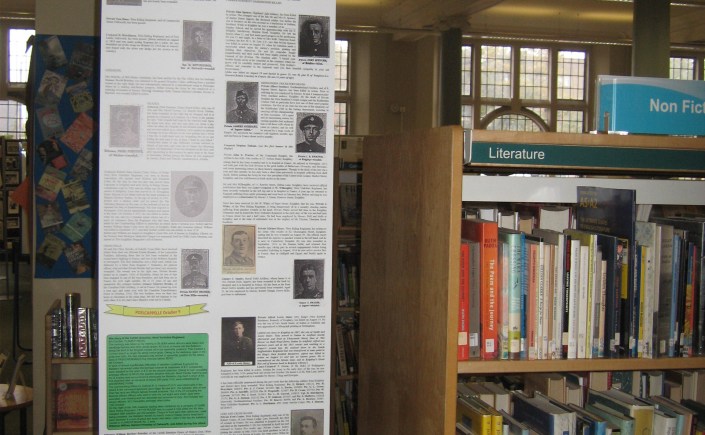
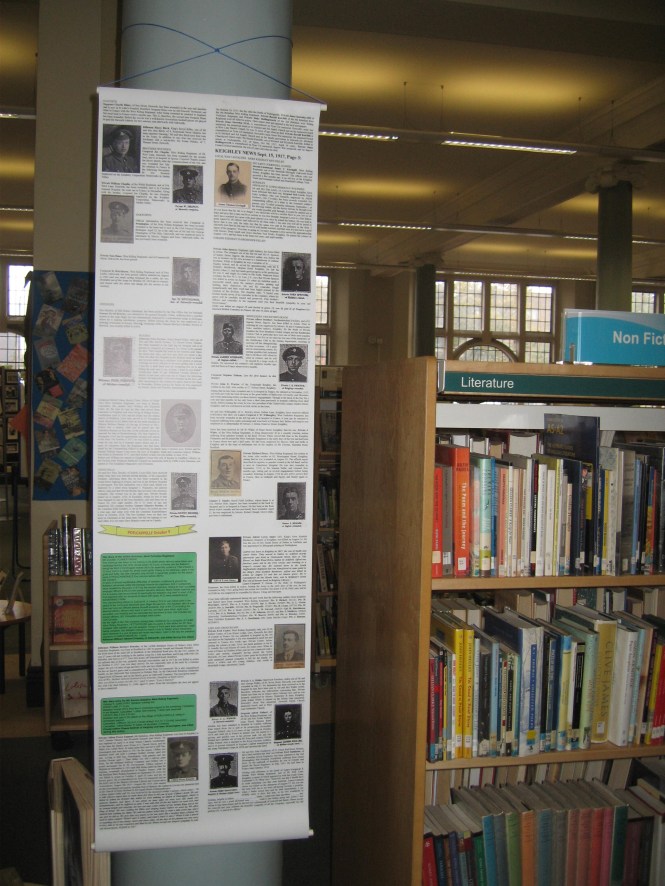
This exhibition has details of the battles in this ‘offensive’ which was a major push to take the Passchendaele ridge where the village was before winter set in. The exhibition takes the form of 10 hanging banners on the library pillars.

One of the many panels currently on display One of the panels

Andy Wade from Men of Worth project said: ‘In this exhibition we show columns from the Keighley News of the day about local men serving in these battles and what was happening to them, interspersed with War Diary transcripts and images of the men, the battle conditions and other material we have found during our research. Please take…

View original post 55 more words