Small Town Saturday Night

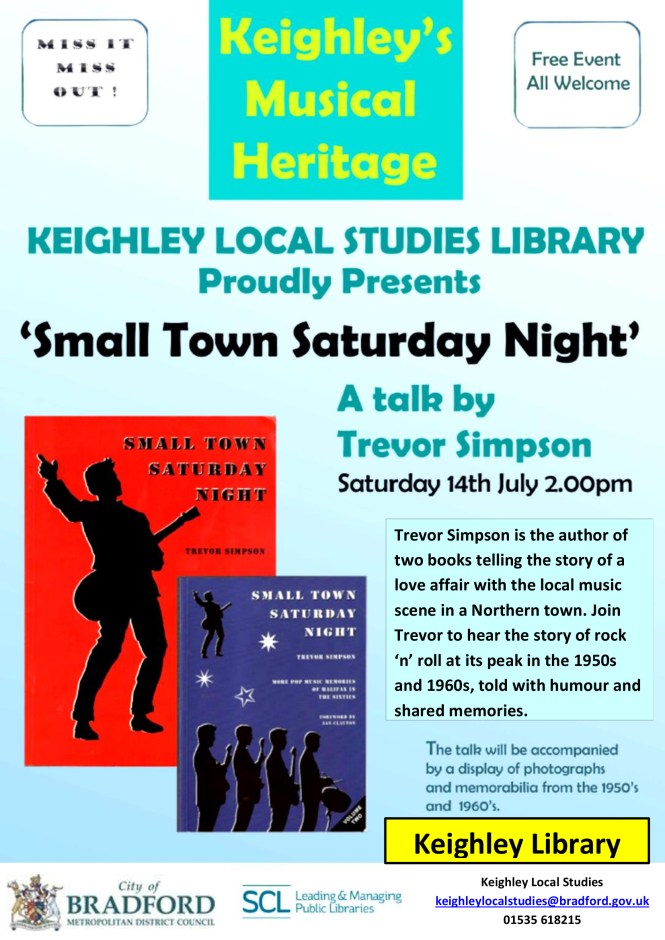
Trevor Simpson is the author of two books telling the story of a love affair with the local music scene in a Northern town.  Join Trevor to hear the story of rock n’roll at its peak in the 1950’s and 1960’s, told with humour and shared memories.

The talk will be accompanied by a display of photos and memorabilia from the 50’s and 60’s.

Free event, all welcome.

For more details contact Keighley Local Studies Library:
keighleylocalstudies@bradford.gov.uk
01535 618215

Trevor-simpson-Blog-edition

Keighley’s Musical Heritage at its finest!

A sunshine summer day in the city could not be better celebrated than with upbeat rock ‘n’ roll bands,  superb singers, and a locally famous comedic host – Keighley Library had it all. The atmosphere was buzzing with a capacity crowd of over 200 pop fans, over 800 visitors to the library on the day (Saturday 9th June) and £213 raised for the charity St Martin’s House by the brave staff manning the very busy refreshment area.

The afternoon kicked off with an introduction to the 1950s like no other by local historian and former Reference Librarian of Keighley Library, Mr Ian Dewhirst MBE. He spoke of how rock ‘n’ roll music seemed to have passed him by in a flurry of 2 years of National Service and helping in his dad’s shop. He said, “The only song I liked was Peggy Sue by Buddy Holly, but he died and that was that!” After hearing the Doveston Brothers, however, Ian acknowledged that he must have absorbed more of this burgeoning pop culture because he did indeed recognise many of the songs. Ian’s continued funny and informative account of the fifties and sixties did not lack spice as he spoke of having to help in a newsagent’s with a top shelf collection. He mentioned no names but said that he was surprised at the identity of some of the local customers.  Not surprisingly, all this racey activity led to a request for information about sex from Ian, the teenager, when he and his dad were riding tandem through the countryside. His dad didn’t fall off the bike but apparently went very quiet and after a couple more miles said simply, “Both the man and the woman have to agree, Son,” which brought the house down.

The Doveston Brothers was just one of two of Keighley’s finest bands of this era. They had formerly played twice at the London Palladium and though they had not played for 45 years, their winning professionalism shone through with a brilliant set of 60s covers. Brian Eldee’s voice is still superb and the audience was treated to Everly Brothers’ favourites as well as more rock ‘n’ roll songs. As a special treat for Janet Mawson, who organised this event, Brian sang John Denver’s, Leaving on a Jet Plane. Later, it was hard to get her feet back on the ground to chat to people about her revamped exhibition on the 1960s but she had to manage it.  With even more unique photographs, music reports and personal anecdotes from local band members, Janet was in great demand all day to answer questions and introduce people.

The Doveston Brothers were beyond popular and set the bar super high for the next band, fast becoming seasoned Keighley library stars – The Presidents, but as we know from last year’s event, they could not possibly disappoint. Their playing was fab with the expected nifty guitar work and Bruce’s acclaimed harmonica.  Linda Russell’s voice soared into pop and ballad perfection to match Brian Eldee’s earlier performance. Both the bands added interest and humour between songs with conversation and funny anecdotes to further enrich the value of this fantastic first class, free entertainment.

Local children were not missed out in this poptastic extravaganza and Saturday Rhymetime became Jamba Samba with little ones, ears fully protected, enjoying Samba drumming with an expert in the art. “Happy” does not describe the expression on some of the children’s faces as they got to make an exceptional musical noise in one of the quieter places in the centre of Keighley. Complements about the event are still coming in.

It’s an underestimation to say that everyone had a great time on Saturday 9th June, many people have filled in the Visitors’ books to the effect that it was another event that brought back many happy memories and was a wonderful musical and social occasion for the local community, especially for many in the audience whose youthful years were represented in the music and the exhibition.  I am sure Ian Dewhirst would agree, that this is local social history at its finest because it is momentarily giving real life to the books, photographs and archives in our keeping. As we have already found out, this in turn enhances their usage and local interest in the subject. It’s certainly something that Keighley Local Studies is very proud to deliver on.

Now, that’s not all folks because the  locally acclaimed and revamped 60’s exhibition will run until September when a brand new display will be launched, assembled by hard working volunteer, Malcolm Hanson with Music of the 70s. A local historian, writer and former local band member of this decade himself, he has inside knowledge of the local music scene but is still collecting memorabilia from bands and fans.  Malcolm can be contacted for this at the following:

Email: Malcolm.b.hanson@gmail.com or call Malcolm on 01756 798730

This exhibition will be accompanied with more live music, this time from the 1970s to celebrate Heritage Day on Saturday 15th September 2018.

The next Keighley Musical Heritage event in Keighley Local Studies Library is: “Small Town Saturday Night”, A talk by Trevor Simpson on Saturday 14th July 2.00 pm. Trevor Simpson is the author of two books telling the story of a love affair with the local music scene in a northern town.  It is a story of rock ‘n’ roll at its peak in the 1950s and 1960s told with humour and shared memories. The talk will be accompanied with photographs and memorabilia from those decades. Don’t miss it!

Gina Birdsall, Keighley Local Studies

This slideshow requires JavaScript.

Local History on Borrow Box

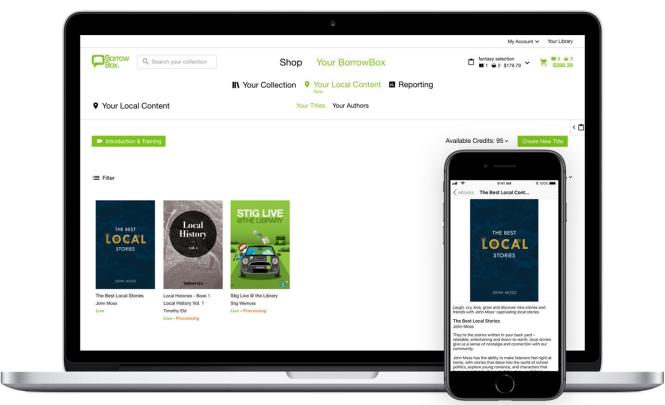
Bradford Libraries eBook service, Borrow Box, have introduced an exciting new feature.

We can now upload our own local content as eBook titles to BorrowBox and make them available for our members to borrow.

For example, we can upload stories or poetry by local authors, local historical documents or library information.

Library members will be able to enjoy the full eBook reader functionality in the BorrowBox app for our local content.  Both ePub and PDF documents are supported.

If you have anything that you would like to showcase to Bradford Libraries customers, then why not get in touch and see if you can get your work on our eBook platform.

For more information contact peter.walker@bradford.gov.ukbblocal

Visit to the Brotherton Galleries, Leeds University Library

On Monday, 21 May, a small group of FOBALs (Friends of Bradford Archives and Local Studies) and library staff were very fortunate indeed and saw the Brotherton Library at Leeds University and the archives of the Special Collections.  Wow! The library is a Grade II listed Beaux-Arts building, opened in 1936. The reading room was apparently modelled on the British Museum reading-room, in the round, but “just that little bit bigger”, our tour guide said with a twinkle in her eye. It has some Art Deco fittings including a large central light that is impressively lowered when the large surrounding windows fail to supply sufficient illumination, it’s almost Orwellian.  The actual collections are equally admirable, containing rare medieval gems, such as an illuminated medieval rolled manuscript on the history of the world in Anglo-French. Local materials include Brontë manuscripts and surprisingly, Bradford and Keighley mill records as well Independent Labour Party minutes from Bradford in 1893. Our excellent guide, Laura Wilson, Galleries, Learning and Assistant Engagement Manager (GLEAM) for the Special Collections at the Brotherton was appointed to enhance public access and promote the collections to the wider public and has already seen a great improvement in visitor figures since 2016.

This slideshow requires JavaScript.

Images from Opening Souvenir Booklet,  6th  1936, from the Brigg collection (BK10), Keighley Local Studies Library.

The Library owes its outstanding library of books and manuscripts to Lord Brotherton of Wakefield (1856-1930) and subsequently his family. Edward Allen Brotherton was actually born in Manchester. He left school at 15, worked in a hardware store and also a chemical laboratory and in the evening studied chemistry at Owens College, Manchester. He obtained a post in a chemical works in Wakefield and, by 1878, had become a partner in the firm of Dyson Bros. and Brotherton,  manufacturers of ammonium sulphate and based in Wakefield.  By 1902, it had become the largest private chemical company in the country as Brotherton & Co.  Edward Brotherton was mayor of Wakefield (1902-3) and Leeds (1913-14) and sat as MP for Wakefield as a coalition Unionist, from 1902 -1910, 1918-1922. He made a number of large donations to the University of Leeds, including the funding for a new library for which he laid the foundation stone in 1930, and at which, he announced the donation of his book and manuscript collection. Brotherton’s bibliographic interests began in 1922 through his niece by marriage, Dorothy Una Ratcliffe, Yorkshire poet (1887-1967). The present collection continues to be supported by his family and consists of some 35,000 books, 400 manuscripts, 4000 deeds and 30,000 letters and it continues to grow.

The Special Collections department has undergone a major refurbishment with top of the range, interactive and illuminating display cases to showcase this wonderful collection outside the constraints of the archive search room. There is a Treasures gallery to display, for example, Shakespeare’s First Folio or the miniature story books of the Brontës and a second gallery space with 2 exhibition changes each year, exploring a range of collection themes. This also represents a  renewed commitment to the original aims of Lord Brotherton to give everyone equal access to the beauty and knowledge to be found in the study of local and national heritage collections. The collection’s greatest strength is in English literature from the 17th century to the present but there are also mediaeval manuscript books of hours, early books in maths and science, papers of the transvestite adventurer the Chevalier d’Eon and of the regicide Henry Marten, as well as the Liddle collection of first-hand accounts of WW1 and WW2 experiences and a West Riding textiles and business collection, the Quaker archive collection and Feminist Archive North. The Brotherton also holds a Russian archive collection of papers of Russian émigrés to the West, since the 1917 Revolution, and papers of British people living and working in Russia before the Revolution. The current exhibitions looks at the culture of Romany Gypsies: Rights and Romance: Representing Gypsy Lives, items on the Great War and Cooks and their Books. There is also a case displaying samples of the library’s collection of manuscripts of Branwell Brontë that includes letters, pen and ink drawings and Angrian manuscripts.

Amongst the local materials that were brought out especially for our visit was a WW1 hospital register from Becket Park war hospital that contained photographs, names of patients, their injuries and even a column in their own hand on what they would like to do to the Kaiser which made for interesting reading – amongst some rather gory suggestions, one soldier wrote that he should simply be handed over to the women of England! Interestingly, the collection of textile records includes those of Bradford and Keighley mills, we were shown records of Bankcroft Mill, Oxenhope detailing conditions at the mill. The online catalogue for special collections of the Brotherton Library is searchable and you can get a fair idea of holdings by looking under location of individual mill or business, though the catalogue is still not yet fully comprehensive. Access to archives for study is by a period of notice and appointment, with careful handling on receipt in the search room.

Last of all we had a quick look in the Stanley and Audrey Burton Gallery in the same building that holds regular displays from the University Art collection and is also free to access, including works by Walter Sickert, Stanley Spencer and Jacob Epstein.

Although we were naturally impressed by the quality of the archives and their display and presentation to the public, we were also confident that our records held throughout Bradford libraries’ and museums’ collections and, from our particular point of view,  Keighley Local Studies Library archives, were in many ways their equal in terms of important local heritage. Keighley Library alone has its own collection of local textile mill records and local author manuscripts, including published works by Dorothy Una Ratcliffe. It also has a very fine WW1 collection, the locally renowned mill owning and philanthropist Brigg family records, an early 20th century poster collection, the Lord and Lady Snowden library and the important Brontë Library. In the future it is hoped that though space for more elaborate displays is at a premium, Keighley Library will be able to provide digital access to its records to reach an even wider audience.

The visit to the Brotherton Library was a memorable one, very informative and really enjoyable and for all of us I think, one that will be repeated in the future outside work.  Our thanks must go to our colleagues who generously covered that afternoon for us, to FOBALS (Friends of Bradford Archives and Local Studies) who organised this visit and to the staff at the Brotherton, especially Laura Wilson for her lively tour and expertise.

For further details, please check out the following:

https://library.leeds.ac.uk/special-collections

https://archiveshub.jisc.ac.uk/contributors/universityofleeds.html

www.bradford.gov.uk/libraries/library-services-online/digital-library/ for the Oxford English Dictionary entry for Lord Brotherton, including photograph

www.thoresby.org.uk  and http://femalewarpoets.blogspot.co.uk for Dorothy Una Ratcliffe

www.bradford.gov.uk/libraries/local-and-family-history/archives-and-collections-available-in-our-libraries

www.bradford.gov.uk/arts-and-culture/museums-and-galleries/museums-and-art-galleries/

 

Map of the week: A track into history

I’m not really a railway enthusiast so I must start with an apology to those readers who are, and say that I would welcome your guidance. I don’t find the early history of Bradford’s rail links an easy topic since the companies involved seem to change their names, and move the location of their stations, quite frequently. Naturally the creation of early railway lines generated maps and plans, many of which have survived. Even here I have a problem since tracks appear on maps which are notionally of an earlier date. Despite these difficulties I want to describe the early lines entering Bradford from the south because of  the interesting light they shed on the city’s industrial past.

Map of the Week 30 A

The first image is a detail from the 1852 Ordnance Survey map. It shows Bowling junction, although this is not named. Two, seemingly single, rail tracks, are mapped. The first is the Lancashire and Yorkshire Railway line which connected Halifax to Bradford, and its terminus Drake Street (later Exchange) Station which opened in 1850. The second line moving off to the right went from Bowling junction to Leeds, via Laisterdyke, and was opened a few years later in 1854. It was operated by the same company and, I presume, allowed trains to travel from Leeds to Halifax direct, by-passing Bradford completely. The track no longer exists but the line is visible on aerial photographs.

I am interested that at the junction a ‘limestone quarry’ is mapped. Limestone strata do not reach the surface in the city area but there was nonetheless an early lime-burning industry based on the extraction of boulders from glacial moraines in the Aire valley. Boulder pits were certainly established in Bingley by the early seventeenth century. It looks as if glacial erratic limestone boulders were found elsewhere, being exploited in the same way. In this case the digging of a railway cutting presumably exposed the valuable mineral. Plausibly these boulders were taken to the nearby Bowling Iron Company where crushed lime was used as a flux in iron smelting. Slightly further north is Spring Wood. The name has almost certainly nothing whatever to do with a water supply. ‘Spring’ was applied to a tree that had been cut off at ground level for coppicing. So Spring Wood was presumably an area of old coppice woodland. William Cudworth records that there was once also a Springwood Coal Pit, but the wood itself soon disappears from maps.

Map of the Week 30 B

The next plan is from the Local Studies Library reserve collection. If you imagine it turned 90º  clockwise it is clearly the same view as before. You can easily identify the two railway tracks and also the Bowling Dye works. The name of the company involved here is West Riding Union Railway. As I understand it this title was only employed for a brief period around 1845-47. This and other evidence suggests that this map is a few years earlier than that of the OS map we have examined. This map shows the Bowling Iron Company colliery tramway very clearly. This took coal to the Bowling Depot on Queens Street where I assume it was available to local merchants. The Bowling Dye Works and the Bowling New Dye House were both parts of the Ripley family enterprises (Edward Ripley & Co). What are obviously missing are the large reservoir and dye pits which are such a prominent feature in the OS map. When were these created? The Bradford Observer reports a large sale of land in this area, including that piece accommodating the Dye Works, in 1850. The vendor isn’t stated but might well be the Bowling Iron Company. Probably the dye works boss, the famous Sir Wm. Henry Ripley, purchased land at this time to allow for the expansion of his business and the assurance of adequate soft water supplies, which included a reservoir. Cudworth records a 100 acre purchase by the Ripley company and also states that a contractor called Samuel Pearson constructed reservoirs for Bowling Dye Works and Bowling Iron Works at a date ‘early in the fifties’. We shall hear more of Samuel Pearson shortly. Marked on this map are marked a variety of planned new streets. Were these streets ever constructed? Presumably not. After 1863-64 Ripleyville, consisting of 200 houses with schools, was constructed by Sir Henry but the alignment of these streets on the 1887 borough map looks quite different.

Map of the Week 30 C

This third map shows an area slightly further north. There have been additional train track developments. The Great Northern Railway had opened its service to Leeds from Adolphus Street station in 1854 but the rival Midland Railway service, via Shipley, ended at a station more convenient to the town centre depriving GNR of customers. In consequence, around 1867, a track loop was constructed connecting the GNR line to the L&Y track at Mill Lane junction and allowing passengers from Leeds access to Exchange Station. Nearby St Dunstan’s passenger transfer station was also opened. The loop is clearly visible on the map north of Ripleyville. In describing the work involved in taking the GNR railway line from the Exchange Station towards Leeds, Horace Hird (Bradford in History, 1968) again mentions the activities of Samuel Pearson & Son who took over responsibility for the material excavated from the necessary cutting. The cutting spoil created a ‘great mound’ and for 15 years 60 men were employed making drain pipes, chimney pots and bricks from this material. Their Broomfield brick works is clearly indicated on the map above the loop. The line seen curving away to the left edge of the map, opposite the brick works, services a series of coal drops which are still visible, in a ruinous state, off Mill Lane today.

Samuel Pearson was a Cleckheaton brick-maker who founded a contracting dynasty. His contracting business started in Silver Street, off Tabbs Lane, Scholes, in 1856. By 1860-63 Messrs. S. Pearson & Son were established at the Broomfield Works, Mill Lane (near St Dunstan’s) for the manufacture of building bricks, sanitary tubes and terracotta goods. The works can be identified on the 1871 map of Bradford but closed shortly before the 1887 map was published, the ‘spoil bank’ being exhausted. The site is described as a ‘disused brick-works’ by the time of the 1895 OS map. Within a generation Pearson’s had became an international contractor and was particularly associated with Mexico during the dictatorship of Porfirio Diaz. Canals, railways and oil were among the company’s many interests. After being created a baronet Samuel Pearson’s grandson, Weetman Pearson, became the first Viscount Cowdray in 1917. The family seat became Cowdray House and park, near Midhurst in West Sussex.

map-of-the-week-30-d.jpg

For the final plan I return to the LSL Reserve Collection. Essentially it shows the same area as the last. The plan is undated but the railway companies have their pre-nationalisation names, so it is earlier than 1948. Wakefield Road is referred to as the A650 and local historian Maggie Fleming suggests that this nomenclature makes the plan later than 1920. St Dunstan’s Station is still present, and in fact had another thirty years of life before closing in 1952. The site of Broomfield brick works is blank, and is today a car park. The purpose of this plan seems to have been to show the course of a new road joining Bolling Road to Upper Castle Street. This is another thoroughfare that was never constructed.


Derek Barker, Local Studies Library Volunteer