‘The Origins of Soccer in Bradford’

‘The Origins of Soccer in Bradford’

A talk by Rob Grillo with an introduction by John Dewhirst

Bradford Local Studies Library,
Margaret McMillan Tower (side entrance), Princes Way,
BD1 1NN

Saturday 8 June
10.30am-12.00 noon

FREE
All welcome

For further details and to book a place please contact Bradford Local Studies Library on 01274 433688 or email: local.studies@bradford.gov.uk

During the second half of the nineteenth century Bradford established a proud reputation as a leading centre of sport and was known for the enthusiasm and prowess of its sports clubs. Bradford City and Bradford (Park Avenue) football clubs need no introduction, but over the years there have been a myriad of amateur football teams that have strived to better themselves.

Rob Grillo is the author of several sporting histories. His most recent book ‘Late to the Game’ covers the early years of association football in Bradford.

late to the game book cover 3

He will speak about his research findings; the early teams and league and cup competitions in the city as well as the early pioneers of the sport. He will also explain how the growth of soccer in the West Riding in the early years was affected by the region’s professional rugby league clubs.

John Dewhirst is well known for his interest in the history of Bradford sport in particular football and Bradford City AFC. He was co-founder of the City Gent fanzine and has authored several books in the BantamsPast series.

Come along and meet these two experts. Hear about the remarkable story of Bradford’s sporting history and there will be the opportunity to ask questions after the talk.

There will be a display to accompany the event which will remain in the Local Studies library until the end of June.

team photo 2the art of dribbling 4


Taking the stories of workhouse records to a wider audience

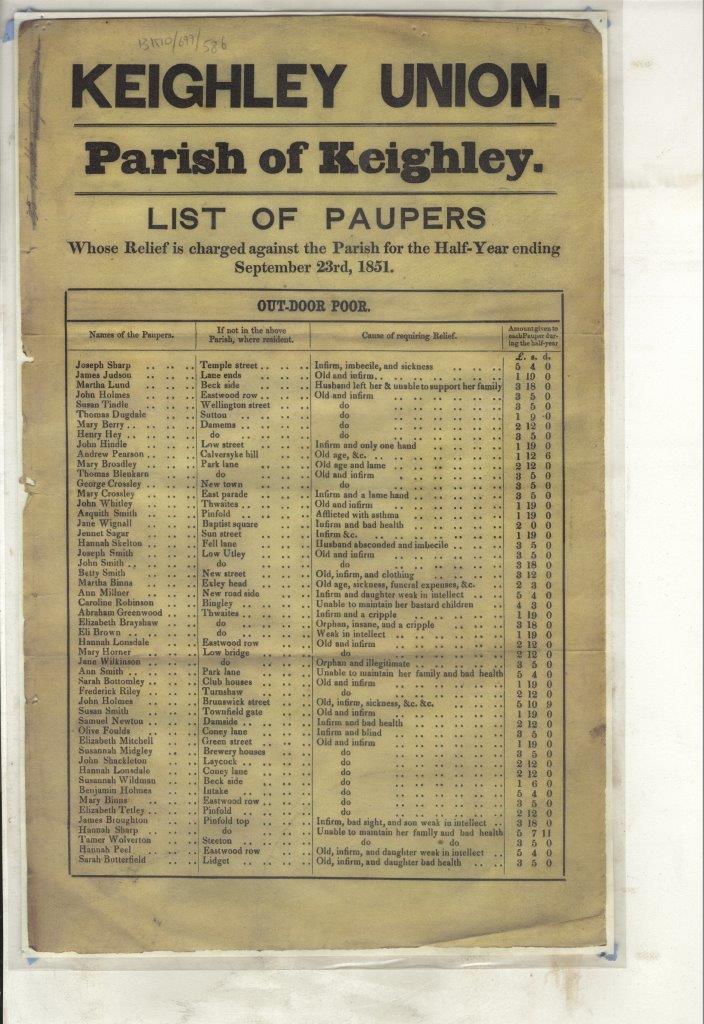
Thank you to Sylvia Valentine for contributing the following article about using the workhouse records held in Keighley Local Studies Library Archives.

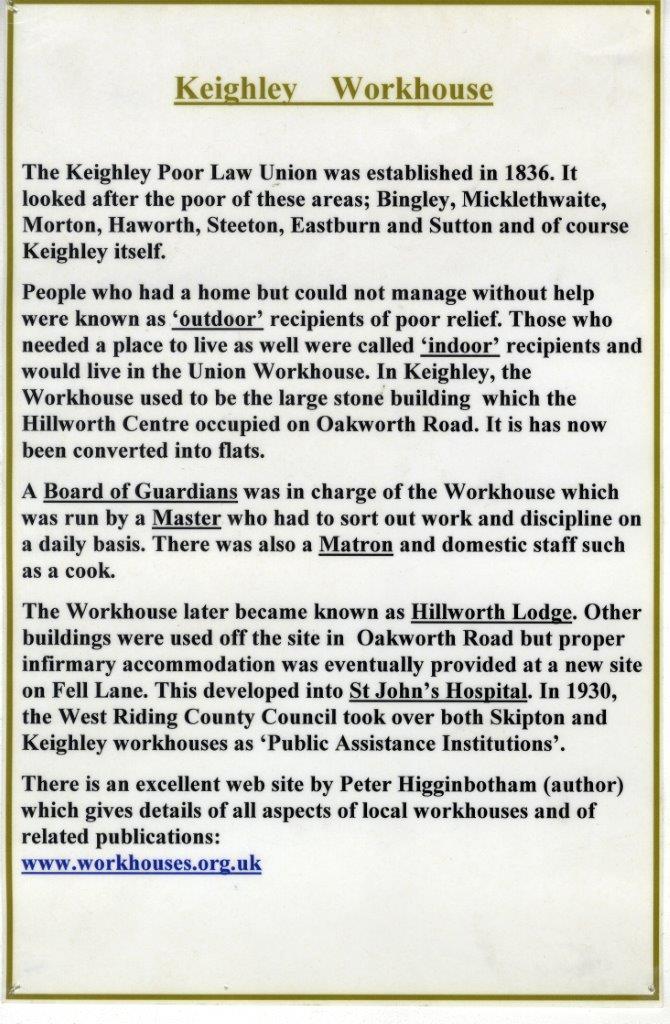
I am a professional family historian and spend time researching in archives as I help people trace their ancestors and their stories.  This brings me into contact with a wide range of source material, including the various records held in Keighley Local Studies Library.  Amongst the amazing collection of records are a variety of records of Keighley Union and the North Bierley Union, perhaps better known as records of the workhouse.

Minute books of committee meetings might not strike many people as being very exciting, however, over the years I have found a number of fascinating stories about various people who came into contact with the workhouse, either as employees, suppliers, Guardians and of course the inmates. It has been my pleasure in recent years to talk about these stories and the wonderful record collections at various family history events both in England and Canada. When giving my talks, my aim is to encourage other family historians to find for themselves the stories of their own ancestors who might have a “workhouse connection”. The stories I have been able to research make wonderful examples of what can be done with just a few lines from a committee meeting minute book, and hopefully are a source of inspiration to others.

Sylvia Valentine
Recover Your Roots

Collections Week at Keighley Local Studies

Keighley Local Studies Library will close from Monday 3rd of June 2019 for Collections Week.

The week’s closure will enable work to be carried out on a section of the large collection of Local Authority material with the aim of increasing convenience of user access and ensuring that these unique items are stored in the best way for future preservation.

A selection of items from the Local Authority archives will be on display when the Local Studies Library reopens on Monday 10th of June

Apologies for any inconvenience caused during this period.

From Charles Lubelski, author of Pride, Passion and Printing

Pride-Passion-and-Printing-cover-26-10-18

Although I was apprenticed and trained in Leeds as a compositor in the printing trade, like many of my peers, I was always interested in the legendary Bradford printing company Percy Lund Humphries. This was where the great Penrose Annual was printed and published. Each edition had fascinating articles about new technologies, new typefaces, articles about typographers and designers and new devices and machines which promised so much in the ever expanding world of the printing industry. And this remarkable printing company was based in the great city of Bradford.

Therefore, I suppose it is not surprising that when Professor Caroline Archer of Birmingham City University suggested that I write a book about PLH — I had no hesitation in accepting this invitation. It was to be a labour of love. Having spent all my working life in the printing industry I quickly realised that PLH was not the norm – it was the exception. Their philosophy was absolute quality and accuracy in every detail – the company was built on pride and passion – hence the title of my book: Pride, Passion and Printing.

For one hundred years Percy Lund Humphries was one of the world’s great printing establishments. The management and the craftsmen and craftswomen worked as a team for a common purpose – it was always quality first and financial gain second, perhaps an uncommon concept in current times.

I have tried to address social, economic, political, technical and artistic issues from an historic point of view supported where possible by illustrations. Technology and artistic endeavour are ever changing; both significantly affect in one way or another political ideas and economics of society. I leave it for others to explore this observation.

I am delighted that Bradford City Libraries have been displaying a number of the books printed by PLH. Bradfordians of today will get inspiration from this display and perhaps be encouraged to take their city forward with new ideas and new industries.

I personally would like to see a revival of design, typography, and the visual arts. PLH once produced the most beautiful art books – could this great city emulate its past masters?

What brick?

I spend a great deal of time studying maps, and writing about maps. Many people feel I should get out more: so here is the result of a Bradford history outdoor trip. Most readers will know Infirmary Field, a green space which begins at the junction of Westgate and Lumb Lane, and which for many years was the location of Bradford Infirmary. The Infirmary was already present in the first OS map of the area (c.1852) but was relocated between the 1932 and 1938 OS maps. At the rear of the site is a snicket connecting Westgate and Lumb Lane.  There has been much modern housing redevelopment in this area but the snicket may have started life as the back lane of Queens Street which, together with Kings Street, was once a terrace that ran parallel to it.

The perimeter wall separating Infirmary Field from this snicket is basically constructed of sandstone masonry, but has evidently been patched or repaired on many occasions and with many materials. A piece of rather sloppy brick-laying placed three bricks on their long edges to reveal the brick mark [P&S] placed in a rather whimsically shaped depression, or frog.

What brick Fig 1

They look like late Victorian machine-moulded bricks, although I have never seen any other examples of exactly this type, among the hundreds of Bradford bricks I have examined. Could the resources of the Local Studies Library be used to identify the original maker of these bricks? Sadly there is no ‘Bradford Brick Book’ in which you may identify individual brick marks, but there are a large collection of Victorian trade directories in which you can investigate local brick manufacturers. Brick works and kilns are marked on the LSL’s extensive collection of maps, and there are also newspaper advertisements and census reports.

Essentially I was looking for a maker who generated the initials P & S, where previous experience teaches me that ‘& S’ was likely (but not certain) to represent ‘and sons’. There seemed to be three possibilities. The least likely were Parkinson and Spencer, a Halifax company making refractory bricks and fireclay items, who survived well into the 20th century. They did not seem likely to have made Victorian house bricks which penetrated as far as Bradford.

William Pickard & Sons operated at Wellington Street, Laisterdyke and they appear in many trade directories: 1867, 1872, 1875-1880, 1881, 1883 and 1887-88. In the 1883 Directory, for example, they are listed as ‘William Pickard, builder, stone merchant and brick-maker’ and the works (probably called Wellington Works) could have had a 25 year existence. But there is a known mark [WP & S] which would fit this manufacturer better than the puzzle brick, so consequently they are only my second choice.

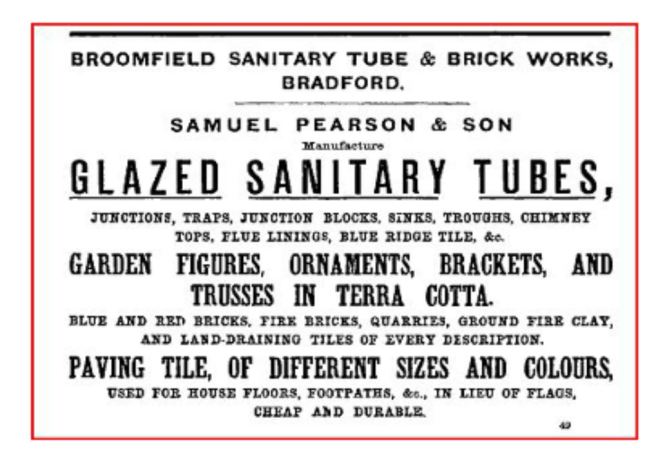
The most likely candidate seems to be the firm of Pearson & Son. Samuel Pearson was a Cleckheaton brick-maker who founded a contracting dynasty. His first contracting works was in Silver Street (off Tabbs Lane) in Scholes around 1856.
What brick Fig 2

His largely forgotten works in Bradford, which he probably acquired from a man called William Poulter, was known as the Broomfield Clay works and later Broomfield Sanitary Tube & Brick Works. In describing the work involved in taking the GNR railway line from Exchange Station towards Leeds in 1866 Horace Hird (Bradford in History, 1968) mentions the activities of Pearson & Son who took over responsibility for the clay excavated from a cutting. They created a ‘great mound’, and for 15 years 60 men were employed making drain pipes, chimney pots and bricks from this mound. One of their brick marks (which I have only seen in a damaged state) is [PEARSON & SON][BRADFORD] but [P&S] could easily have been an earlier alternative. Examination of the Heaton Local Board accounts for 1877 shows that Samuel Pearson & Son were supplying 15” ceramic pipes ‘to be delivered at the Turf Tavern’. Their works can be also identified on the 1871 map of Bradford, but apparently closed in 1885 when a ‘spoil bank’ was exhausted. The site is described as a ‘disused brick-works’ by the time of the 1895 OS map, and Pearson & Sons are not recorded in an 1898 trade directory. In the 1881 census Samuel Pearson is described as a retired brick-maker, born in Scholes, and living in Greenside. He evidently died in 1884 (worth £20,000) at the Elms, Scholes Road.

By the time of his retirement Pearson’s were already undertaking contracts in many major industrial cities. Samuel Pearson’s son was called George Pearson but the firm’s success was largely due to the energy of his grandson, Weetman Pearson (1856-1927), to whom Samuel transferred all his personal holdings. Weetman may have started as a brick manufacturer but the company he managed evolved into the great firm of Samuel Pearson & Sons which considered brick, tile and sanitary-ware making as only a very minor part of their activities. The firm undertook many contracts for the British Government and within a generation it became an international contractor. It was particularly associated with Mexico under the presidency of Porfirio Diaz. Canals, railways, and oil were among the company’s many interests. Weetman Pearson was eventually created the first Viscount Cowdray and died in 1927.  The company still exists as Pearson plc but has widely diversified its interests into the media, which is a very long way from a Bradford snicket.

Derek Barker, Local Studies Library Volunteer