Keighley’s Neglected Poet: a talk by Ian Dewhirst MBE

To celebrate National Poetry Day on October 6th, well-known author and historian Ian Dewhirst MBE will be giving a talk ‘Gordon Bottomley, Keighley’s neglected poet and playwright’ in Keighley Local Studies library.

Born in Keighley in 1874, Gordon Bottomley was an important figure in the poetry movement before and during the First World War and one of the most influential literary figures to have been born in Keighley.

Over the years, Mr Dewhirst has made a special study of Gordon Bottomley, for whom he has a great deal of admiration, and we are fortunate that this renowned raconteur has agreed to share his knowledge in this unique talk to be held at Keighley Library.

The talk starts at 11.00am. Admission is free and all are welcome.

gordon-bottomley-keighley-poet


Gordon Bottomley (1874-1948)
Keighley’s poet, writer, playwright, art collector

Gordon Bottomley is one of the most important literary figures to have been born in Keighley.  Despite the limitations he faced in society due to illness, his cultural reach extended into the national arts scene including drama, poetry and fine art.  As well as honorary degrees, Bottomley was a Fellow and Benson medallist of the Royal Society of Literature and Vice-president of the British Drama League.  In 1994, a blue plaque, similar to those for famous London landmarks, was put up to mark the site of his birth in Keighley.

Born in 1874, the only child of Alfred Bottomley, a Keighley accountant and his wife Maria, a Scot, he was initially educated by his mother. He then attended the Keighley Trade and Grammar School, part of the Mechanics’ Institute building which later became Keighley Boys’ Grammar School. Gordon Bottomley credits the school as a major influence on his literary development and Keighley Library holds the records of the school which reveal to some extent the kind of education and facilities available.

At the age of 16, he became a junior clerk at the Craven Bank in Keighley. In 1891 he was transferred to the Bradford branch but ill health (haemorrhaging of the lungs) left him an invalid for long periods of time. When he was 18 years old, the family moved to Cartmel area on the Cumbria-Lancashire border. Bottomley stayed in the area for the rest of his life, moving to The Sheiling, in Silverdale near Carnforth in 1914 with his wife Emily. Here they entertained friends such as Paul Nash, the artist, and Edward Thomas, the poet, and his correspondence with both these influential men has since been published.

Gordon Bottomley began writing poetry in earnest in the 1890s and became a leading figure in the Georgian Poetry movement before, and during, WW1. He had seven collections of poetry published and his works appeared in anthologies of the time.
He was also a playwright, mainly of one-act verse plays and he also championed the experimental theatre of the 1930s. He loved art, and became a dedicated collector. Greatly influenced by William Morris and the Pre-Raphaelites, he acquired a nationally important collection which also included the work of influential contemporary artists such as Paul Nash, Stanley Spencer, William Nicholson and Bradford’s own Sir William Rothenstein.  In 1949, he left over 600 paintings, drawings and prints to the Tullie House Museum and Art Gallery in Carlisle. Details of his collection are available in archive BK60.

gordon-bottomley

Keighley Local Studies Library Resources

Gordon Bottomley’s works are out of print now but Keighley Library has an important collection of his publications, photographs and published and original correspondence housed in the Library’s Yorkshire Authors’ Collection and in the archive.

The library also holds news cuttings and biographical articles, including some written by local historian and former Keighley Reference Librarian, Ian Dewhirst MBE.

A leaflet has also been produced outlining Gordon Bottomley’s life, works and original archive resources stored in Keighley Local Studies Library.

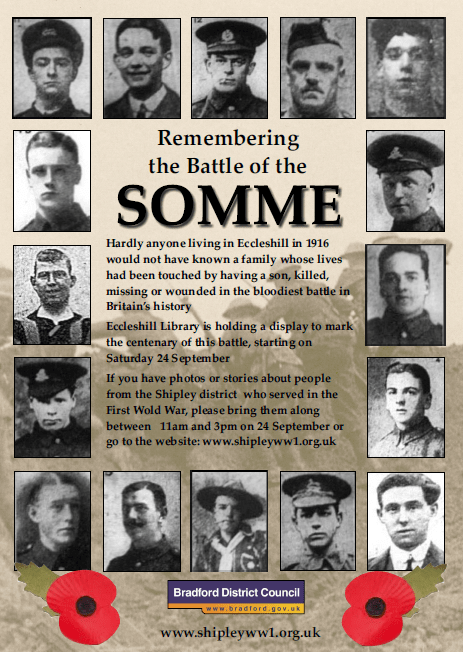
100 years since The Somme remembered at Eccleshill Library

Bradford Libraries's avatarBradford Libraries World War One Blog

The next in the series of free events will take place in Eccleshill library.

Richard Coomber from the www.shipleyww1.org organisation will be at the library on Saturday 24th September between 11.00am and 3.00pm  with a database of local men who served in the First World War. Anyone who has photos or stories of family involved in WW1 is encouraged to bring them along on the day.

The event will launch a display in Eccleshill library commemorating the local men who were killed, missing or wounded in the Somme.

The display will run from 24th September – 8th October. It will include coverage of the First World War from the Shipley Times and Express from 1914-18. The research has been collated by www.shipleyww1.org.uk

somme

View original post

Family History Courses Starting Soon!

Courses run by Bradford College will be starting soon at Bradford Local Studies Library and Keighley Local Studies Library including blogging and websites for all.

Wednesdays 10.00am-12noon for 11 weeks starting 21st September at Bradford.

Tuesdays 10.00am-12noon starting 20th September or Thursdays 10am-12noon for 11 weeks starting 22nd September at Keighley.

Researching family history can be a rewarding and exciting experience and these events can help to guide people to the unique resources they need to investigate the past and provide a fantastic opportunity to learn new skills.

The fee for an 11 week course is £75.00 including an administration fee of £15. Concessions may apply. Contact Bradford College on 01274 436300 for more details or Bradford Local Studies Library or Keighley Local Studies Library to book a place.

fh

Heritage Open Day, Keighley Local Studies Library

On 10th September as part of the Heritage Open Days Festival, Keighley Local Studies Library will be host to a variety of local societies and groups and will be exhibiting some of the treasures from their archives and collections.

This is a great opportunity not only to see some of the hidden gems of the Keighley archives, but also to meet local groups, see displays and exhibitions on the history of the local area, and to get help with your family tree and research.

It is also an chance to bring along your own stories, memorabilia and pictures to help celebrate the rich and diverse history and heritage of the Keighley District.

Amongst the groups exhibiting will be Keighley and District Local and Family History Societies, The Airedale Writers Circle, Silsden Local History Society, Oxenhope historians and local authors.  

The event will feature the exhibition from Men of Worth about the men of Keighley and District in the Battle of the Somme and Keighley’s Military Hospital along with a showing of the film ‘The Battle of The Somme’.

This is a free ‘drop in’ event and will run from 10.30am until 4.00pm. All are welcome.

KeiHeritage

Map of the week: a century of Bradford Hailstones

As I work on the reserve map collection the same local land-owners appear regularly. Examples are: Rev. Godfrey Wright, Mrs Giles and Miss Dawson. Godfrey Wright owned a great deal of property around Bradford, but seemingly lived near Doncaster. ‘Mrs Giles’ was clearly a member of a family who owned much of Horton, and she sold the land on which the Bradford workhouse (later St Luke’s Hospital) was built. ‘Miss Dawson’ was probably Eliza Dawson, grand-daughter of Joseph Dawson, partner in the Low Moor Iron Company. The name of Samuel Hailstone also occurs regularly. His importance to Bradford, and his fame as a Yorkshire naturalist, will ensure that his memory stays green.

Samuel Hailstone (1768-1851) was that rare combination, a lawyer and a botanist. His brother John Hailstone MA FRS took holy orders and became a professor of geology at Cambridge. Samuel himself was born in Hoxton, London but his family soon moved to York. In time he became articled to John Hardy, a Bradford solicitor, and Hardy & Hailstone eventually became partners. John Hardy was elected an MP and was the father of another politician Gathorne Gathorne-Hardy who was created Earl of Cranbrook. I understand that Samuel and John Hardy were the moving spirits behind the 1803 Bradford Improvement Act. More than forty years before Bradford became a borough this act established commissioners with a variety of local government powers such as street cleaning, lighting, and water provision.

Samuel continued to practise as a solicitor and was later in partnership with the Thomas Mason who became a director of the Bolling Iron Company and lived at Bolling Hall (see the previous map). Samuel Hailstone was the classic example of a wealthy and highly successful professional man. His politics were Liberal and, slightly unusually for non-conformist Bradford, he was an Anglican. He purchased the Bolton House estate although he never resided there. I get the impression that Yorkshire botany and geology were Samuel’s main interests. A collection of more than 2000 plant specimens was passed to the Yorkshire Museum on his death. But despite these studies he was active in issues affecting his chosen town. He helped found the Bradford Literary & Philosophical Society and also the Mechanics Institute. He served as a major in the Bradford Volunteer Infantry and was clerk to the Trustees of the Leeds and Halifax Turnpike Road.

This brings us to the maps. In Samuel Hailstone 1837 he offered for sale the land between Croft Street & Bridge Street. A small portion of a very large sale plan is illustrated here.

Map of the Week 011A

A second map shows land further south which is also divided into lots. This map is stylistically very similar and shows Samuel’s place of business and house. What is now called Croft Street took its name from Croft House, in Bowling Lane (now Manchester Road) which was was where Samuel lived in his early years.

Map of the Week 011B

In 1808, quite late in life, Samuel married Ann Jones, the daughter of a Bradford surgeon, and the couple had several children.  Samuel died at Horton Hall, Bradford in 1851. In his census return for that year he indicates that he is living alone, except for a house-keeper and five servants.

The Hailstones were a very high achieving family. One son, Samuel jnr., was also a noted amateur naturalist and a collector of crustacea. He pre-deceased his father in 1841. There were two surviving sons, Rev John Hailstone (1810-1871), the vicar of Bottisham, Cambridgeshire, and Edward Hailstone FSA (1818-1890). Edward took over the Bradford legal practice but is famous for a huge assembly of books and documents relating to Yorkshire history, especially those of the Sharp family who were the previous owners of Horton Hall. This was the project of his retirement when he lived at Walton Hall, near Wakefield. At his death the collection was left to the archives of York Minster where it can still be consulted today.

Derek Barker, Local Studies Library Volunteer