Map of the week: Manningham village

It can be very difficult to orient yourself correctly when examining an old map. Map-makers often did not identify the direction of north and a building that would have provided an obvious fixed point, such as the parish church in the centre of Bradford, may not be drawn. The names of roadways may not be given, or if they are included they may differ from those known today. A plan of Manningham from the reserve collection exemplifies such difficulties.

The first image constitutes about half the original map which is annotated ‘late Miss Booth’s property, Manningham’. The crucial fact is that the road labelled as Lilly Croft Lane is now called Heaton Road. This thoroughfare leads from Bradford to Heaton, as the map indicates, in a direction that is a few degrees west of due north. Today there is another Lilycroft Lane, which is the road entrance leaving Heaton Road to the left. The block at the top left of the plan is a row of cottages, no longer existing, which were in front of the first Manningham Mill. This mill was rebuilt by Samuel Cunliffe Lister in 1873 after a disastrous fire. The mill building itself, which would have permitted instant positional recognition, is not drawn.

Moving east we cross the property of E.C.L. Kaye. He was Samuel Cunliffe Lister’s brother who retired early and took no part in the commercial life of Bradford. The field patterns here resemble closely those of the first OS map of the area; this was surveyed in 1847-50 and so provides an approximate date for our map. Skinner Lane in Manningham village has kept its name and the property outlines that are drawn again resemble those of the the first OS map. The road leaving the village to the east, and reappearing on the second image, is Dewhirst Lane.

map-of-the-week-014-b

In the first OS map this is called Duce Lane. I assume that Dewhirst is formally correct but that ‘Duce’ was a contraction by which it was generally known. Today it is Oak Lane. Whatever its name the lane ends at property belonging to Thomas & Isaac Rhodes. Here it joins Esp Lane, often called Hesp Lane, which evolved into North Park Road when the land  surrounding Manningham Hall was developed as a public open space (Lister Park) after 1870. Where you may just be able to make out the words ‘to Bradford’, at the bottom right of the image, is approximately the position of the beautiful Manningham Park gates. The road shown here links to Manningham Lane – Keighley Road, which is not drawn.

So, who was the late Miss Booth? As so often Cudworth provides the answer. He writes: (Skinner Lane) ‘was formerly the only outlet from Manningham to Duce Lane (now Oak Lane) which obtained its name from one Dewhirst (locally pronounced Duce) having long been resident there. In one square house, which is still standing in Skinner Lane, lived Jonas Booth with his maiden sister Catherine. Booth was one of the old race of stuff-makers, his warehouse being in the rear of his house. He died in 1837 bequeathing his property to his sister, who died the following year.’ Our map therefore presumably dates from 1838-39.

Derek Barker, Local Studies Library Volunteer
Bradford in its Hey Day – A day school

On Saturday 15th October, Bradford Historical and Antiquarian Society, in partnership with Bradford Local Studies Library ran a day-school entitled “Bradford In Its Hey Day – The Late Nineteenth Century”.

This was a very well attended event at the Bradford Club in Piece Hall Yard. Speakers included George Sheeran (A New Generation – Bradford Architects and Architecture 1880 – 1914), David Pearson (Railways In Bradford), Alan Hall (Notable Bradfordians) and George Ingle (The Textile Trade In Bradford). During the lunch break, attendees were also offered the chance to join a short tour of the historic Bradford Club.

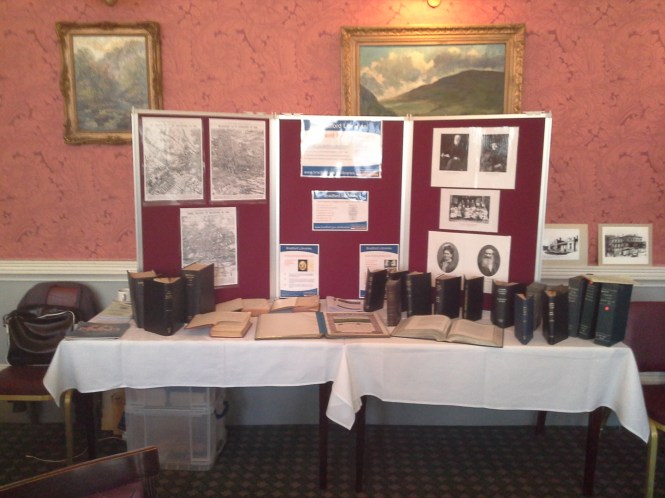
The Local Studies Library provided a stall highlighting many items of our stock relating to the period, including Trade Directories, maps and illustrations and a selection of bound volumes of material originally published by associations and institutions active in Bradford during the latter part of the nineteenth century.

20120516_023624

The stall attracted a good number of people during the day, many of whom were unaware of the resources the Library holds. We hope to see many of these people visiting us in the coming weeks following up on the research questions they were asking at the event.

All in all this was a very successful, enjoyable day all round.

Bradford Artist Geoff Latz

The Battle of Verdun

This poignant piece of artwork which is on show now at Bradford Local Studies Library, depicts a trench scene from The Battle of Verdun in France. It has been created by Geoff Latz who is a Bradford based artist.

Geoff is an ‘Upscaling’ artist and creates artwork mainly from unwanted or reclaimed materials. He works predominantly in various metals, i.e. copper, steel, wire etc, but uses whatever materials are necessary to create his work, as is the case with this particular piece. He has a passion for history and takes much inspiration from this when creating his work. He likes to make things that have an educational value, to inspire people of all ages, to catch the imagination and tell a story. You can see more of his work at http://www.latzart.com.

Earlier this year he created this piece of artwork to commemorate the First World War, which depicts a trench scene from The Battle of Verdun in France. This was longest single battle of WW1, fought between the French and German armies from 21th Feb to 18th Dec 1916. It was nick-named “The Meat Grinder” as it was so bloody and resulted in a magnitude of casualties and deaths, an accurate figure of which will probably never be known.  The impact of the battle on the French Army was a primary reason for the British starting the Battle of the Somme in July 1916, in an effort to take German pressure off the French at Verdun.

The artwork is set in a box display frame approx L85cm x H52cm x D15cm, with a toughened glass front and LED lights. It is a mixed media piece, painted in acrylics. The detailed scene has been created using various materials including stones, twigs, sand, metal and wire. The sandbags are made from jute shopping bag handles, the cenataph from glass & granite tiles and the crosses from matchsticks. The soldiers are made from copper wire, one has been shot. The numbers at the top right corner signify the estimated total casualties and deaths as a result of this battle, at the time of Geoff’s research.

The Battle of Verdun is on loan to Bradford Local Studies Library at the Margaret McMillan Tower building until Friday, October 21. It will then be going on a tour of libraries in the district. Next it will go on display at Bradford’s City Library in City Park until November 4 when it will move out to the district to go on show at Keighley Local Studies Library, coinciding with a screening of the Imperial War Museum’s film The Battle of The Somme on November 19 by the Men of Worth project.

verdun-2

Map of the week: Leeds Road and Market Street

This current example of a map from the Local Studies Library’s reserve collection is taken from a sepia plan which shows the eastern part of Bradford some years before it became a borough. Firstly it would help if we could establish a date. It is far earlier than the first OS map of 1849. The ‘new road’, running diagonally across the centre of the map, later became known as Leeds Road. This dates the map to later than c.1825-30 during which years this new turnpike to Leeds was constructed by the Leeds & Halifax Turnpike Trust. The pattern created by the other ‘new roads’ portrayed also exists on the Bradford plan of 1830, so we are probably looking at a map from the late 1820s.

leeds-rd

A coal staithe is a place adjacent to a highway from which merchants can collect a supply for subsequent delivery to their customers. The staithe here is marked J.S. & Co. Clearly this represents John Sturges (or Sturgess) & Co. which was the company that operated Bowling Iron Works. There were two original partners of this name, father and son, but they were presumably dead by the time this map was created. The ‘new rail road’ drawn is in fact a mineral carrying tramway bringing coal in trucks to the Eastbrook staithe, by rope haulage, from the iron works. Bowling Iron Company owned and operated many collieries and ironstone mines. The trucks may have been returned filled with limestone, needed for iron smelting, which would have arrived at the nearby canal basin from the quarries at Skipton. The tramway was closed in 1846 and the area is marked as an ‘old staithe’ in the first OS map of the area.

Let us look at some other roads. Wakefield Road, Bridge Street, and Hall Ings are in their present positions. ‘Dead Lane’ has subsequently been renamed Vicar Lane. Leeds Old Road is now Barkerend Road. As far as I can tell the numbered areas represent fields. Trees are growing west of the first section of Leeds Road and a rather larger wood is mapped there in the 1800 Bradford plan. There is second coal staithe (or stay) at the junction of Well Street and Hall Ings. This is evidently operated by J.J. & Co. whom I cannot identify. At the opposite end of Wells Street is another ‘new street’ which had been in existence for some years and has evolved into Market Street. Behind this is a rather sketchily drawn Bradford Beck. The surveyor of the map was evidently interested in the owners of property between Market Street and the beck and has added some names. You probably won’t be able to read these names, and in fact they are not easily legible even on the original map. As far as I can make out, reading from top to bottom, the names are: Green, Cowling or Crossley, Bradford, Wilkinson, Bank, Armytage, L Lumb, and Hustler.

There are directories listing Bradford business in 1822 and 1834. Plausible identification of most of these names in Market Street can be made from these directories although it is impossible to be sure.

  • Thomas Green, grocer and tea dealer 1834
  • David Crossley, attorney 1834
  • Bradford – uncertain
  • James Wilkinson, cabinet maker 1822
  • Thomas Jowett Wilkinson, cabinet maker 1834
  • Bradford Commercial Bank Co. 1834
  • Samuel Armitage, plumber & glazier 1834
  • John Lumb, straw hat maker 1822
  • Ann Lumb, pawn broker 1822
  • Thomas Lumb, pawn broker 1834

The name Hustler is more difficult. The famous Quaker wool-stapler and canal promoter, John Hustler, had died 1790. I believe he left two daughters. The fact that Market Street boasted two wool-stapler partnerships carrying his surname cannot, surely, be a coincidence. The two partnerships were Hustler & Blackburn and Hustler & Seebohm and I have confirmed the existence of both in other sources. I know that the Seebohms were another Bradford Quaker family. Can anyone fill me in on the exact relationships?

Derek Barker, Local Studies Library Volunteer

Keighley’s Ian Dewhirst

Keighley’s Ian Dewhirst …

A Pennine legend in his own lifetime – man on a train.

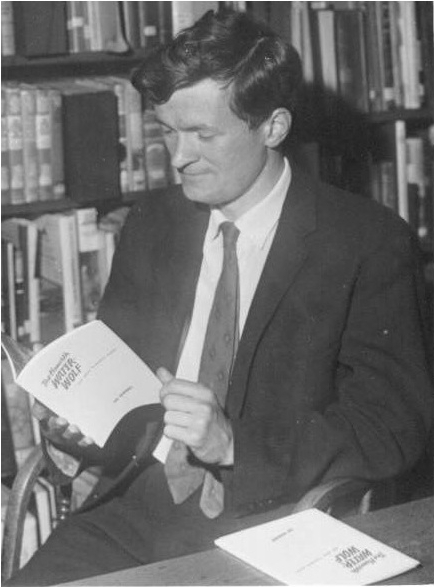
For a scholar who never wanted to become a teacher, Ian Dewhirst MBE has proved to be one of the most memorable on the subject of local history. Informative, enthusiastic and entertaining, his talks are renowned and what’s more his scholarship and wit stay in the memory with a lingering delight – and so we are taught.

However, Ian Dewhirst, native of Keighley and pupil of Keighley Boys’ Grammar School, did not know what he wanted to become when he eventually graduated from the University of Manchester in 1958, with Honours in English. He was instead, directed towards librarianship by the National Service he undertook shortly following his graduation. Having already worked part-time for a mere 6 weeks in Keighley Public Library, the Army decided to make him a sergeant-instructor in the Royal Army Educational Corps and put him in charge of an army library at Deepcut on the Surrey/Hampshire border. He was Garrison Librarian no less, serving military personnel and families as well as civilians. Ian must have enjoyed the work, because he joined the library service in Keighley when he left the Army in 1960.

… and you see, here is where the other part of the legend begins, for Bradford Library Services’ staff and Yorkshire customers alike, that of  Ian Dewhirst, the helpful, enthusiastic and enviably knowledgeable Reference Librarian who, in 2016, still bestrides Keighley Librarianship like a colossus. I can’t count the number of times I have been eagerly asked if Ian Dewhirst, the Librarian, is available and uncomfortably witnessed the looks of disappointment when I told them he was not and, I have to admit, that when new to both Keighley town and library, I did weary of yet another common comment, “Ian Dewhirst would have known…”, when I didn’t know, followed by that look of   bewildered frustration when I also commented that Ian had long been retired. This was then followed by drooping shoulders, heavy sighs and knowing nods, from myself included. Where was this giant, this legend? I soon met the man and many times since have made a beeline for him myself to ask for advice, pointers or just plain “Help!” Always he has been patient, generous spirited, knowledgeable and yes, encouraging. If the Beatles had known of this guru, they would have written a different album, and maybe sported some book based fashions as well.

Ian puts his local history knowledge down to his ultimate employment as Reference Librarian in Keighley Library which had a growing local history collection, but also the fact that it dovetailed with his own love and enthusiasm for that subject. The one benefited the other. In the last 50 years, he has also made between 80-200 appearances a year all over the country, speaking about Keighley and Yorkshire history and literature, always with learned references to the wider national historical context and his wit and humour have even outclassed the likes of Jeremy Beadle when at the height of national popularity. Locally, he is affectionately known as Mr Keighley and has even seen his name on the side of a Northern Rail 158 diesel travelling the Airedale line and throughout the North for 4 years. Ian has written books, journal and newspaper articles and continues to write for the Keighley News with his informative Down Memory Lane slot and regularly appears on radio. For some time, he also appeared on ITV’s The Dales Diary, covering topics from Yorkshire history.

Ian has seen many changes in the library service over the years. He says that he worked during a “Golden Age” of librarianship when education was more essentially and enthusiastically library centred and book stock based and he has witnessed important developments brought about by the publication of controversial works such as Lady Chatterley, but the biggest change that still shocks him is that of the Internet and the proliferation of those machines in libraries.  He still counts himself fortunate in that during his career, he was able to continue working, as he puts it, as basically, “…an Edwardian Reference Librarian“, but, probably because Ian continues not to be on Facebook and because we can’t get him by email, we continue to benefit from the comforting and inspiring presence in the flesh of this Keighley Library champion and for now, hurray for that!  Happy 80th year, Ian, and long may you continue to be a shining light on the actual pages of local history, Keighley’s in particular.

Gina Birdsall, Keighley Library

ian-dewhirst

Ian Dewhirst in 1967