Battle of the Somme: historical film showing in Keighley Local Studies library

Bradford Libraries's avatarBradford Libraries World War One Blog

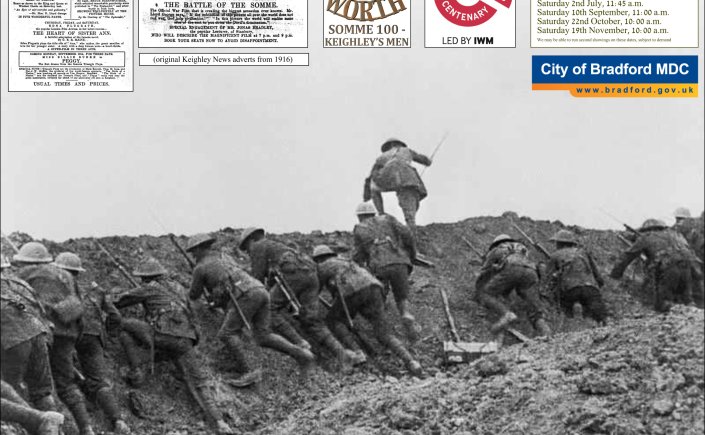
There will be a final opportunity to see the extraordinary and moving film ‘The Battle of the Somme’ in Keighley Local Studies library on Saturday November 19th at 10.00am before the DVD is returned to the Imperial War Museum.

The Battle of the Somme documentary was seen by millions of people across the world in 1916. At that time, film was a relatively young media. However, the government realised the power of film in controlling the war news. The film was released on 21st August 1916 by the War Office. This was a ground breaking British documentary film now accepted to be an early example of film propaganda, as well as a historical record of the battle.

On September 11th 1916, the film was first shown in Keighley. For the audience to see images of the war as it was happening, unfolding on the screen was a…

View original post 262 more words

Ilkley and Armistice Day

Extract from ‘ Ilkley and the Great War’ by Caroline Brown and Mark Hunnebell; Amberley, 2014

At 11.00am on November 11th 1918 church bells rang across Europe. The fighting was over but life would never be the same again. Millions had died around the world and those who returned home had the hard task of making sense of the horrors they had survived and the adjustment back to civilian life.

The Ilkley howitzer brigade brought the guns into action for the last time on November 10th at 2.00pm at Quevy-le-Grand unaware that the last day of the war was so close. A E Gee recorded the events of the morning of 11th November:

‘A mounted staff-officer in a big hurry, passing by with wild news of the Armistice, was thought by many to be a spy; but the Major fired with his own hands a single farewell round at top range at 9am – the safety cap being left on the shell to prevent accidents at the other end of its journey and it began to be realised that all was about over bar the shouting. Shortly came instructions that the Armistice at 11 o’clock was official; and the men stood about as this moment approached almost expecting some sign from Heaven. This came from the heavens at a quarter to eleven in the form of a dozen German shells into the village in front – with the safety caps off. Other Batteries concealed in hedgerows and banks all about could be heard firing their parting shots also…

While most of the world went mad to celebrate the Armistice, it is noteworthy that the men who had most immediate occasion had least opportunity for celebration. Though the fact of the Armistice was known, it was certainly not fully assimilated at first, and the momentum of routine and discipline carried the Battery through the next few days without any changes to indicate that its raison d’etre had vanished and that this body of men which had worked for years as a single compact unit to a single end was about to split up into 200 distinct and separate individuals, striving after their two hundred private ends…

On November 11th 1918, a pointed salient formed the British Front at Valenciennes. The West Riding Artillery was at the apex of this salient being the most advanced Divisional Artillery, and D245 Battery prides itself that, so far as can be ascertained, no British Battery of Artillery was nearer to Germany when the war ended than itself.’

In Ilkley, at 11am Mr Dobson displayed the news on a blackboard outside his newsagent and tobacconist shop on Brook Street with the addendum ‘official’. In a short time the streets became very lively. ‘The Ilkley Gazette’ reported:

There were flags of all kinds and streamers too, not a single street being noticed without some evidence of jubilation. Many of the flags had done duty on other occasions of rejoicing than the present, and the ‘Welcome Home’ that one bore in large letters will still more fittingly serve to welcome our local warriors spared to return.’

Wounded soldiers at the Ilkley Military Hospitals, taking possession of a tradesman’s cart, rode round the town in ‘merry mood’. Later, a larger group which included soldiers and sailors at home on leave, broke into the Volunteer Bugle Band room in Bridge lane, and secured a number of drums and one or two bugles. To the accompaniment of these they paraded around the town. In the afternoon they were joined by some of the Volunteer buglers, and paid a visit to Addingham, with one of the wounded soldiers dressed up to represent Britannia. The ‘Ilkley Gazette’ described events

With such a holiday spirit in evidence, a good deal of the business of the town was suspended at mid-day, and a number of the shops closed. The Parish Church bells were rung both at noon and in the evening, and the Volunteer Bugle Band continued to peregrinate the town in the evening after the wounded soldiers were obliged to be indoors. The youngsters had the time of their lives, and although the National Schools continued to open in the afternoon, there were many absentees. As night closed in upon the scene fireworks began to be let off in all parts of the town. The pyrotechnic display in Brook Street was of a character never before attempted; nor would it have been allowed. D.O.R.A. and the Police were not to be met with in authority, and squibs, crackers, rockets, maroons and Roman candles mingled together in blazes of light and noise for several hours .The thanksgiving services held at the Parish Church and St Margaret’s Church were very well attended.’

The signing of the armistice which gave way to relief and rejoicing was tinged with great sadness at the loss of life. ‘The Ilkley Gazette’ editorial summed up the situation:

‘ The curtain has finally rung down on the greatest and most terrible war in the world’s history. The glad tidings were everywhere hailed by the Allies with the greatest enthusiasm; indeed more than was to be expected, with the knowledge of the desolation the war has caused and the sorrow it has brought into so many lives. If there was momentary forgetfulness of this on the part of any, it was to be forgiven; for how could the majority of people keep in check their feelings of thankfulness on such a day. Yet not all rejoiced in boisterous and hilarious fashion, for a much deeper and more sober thankfulness was shown by some in attendance at the thanksgiving services held throughout the length and breadth of the land.’
ilkley-war-096

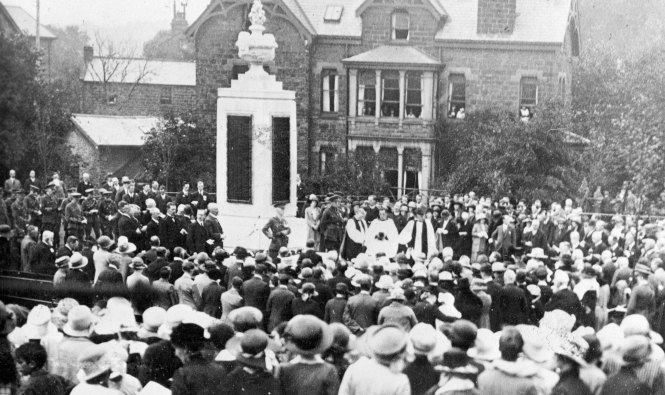
Crowds at the unveiling and dedication of the Ilkley War memorial, July 1922. (Image Ilkley Library)

ilkley-war-095

The procession to the unveiling and dedication of the Ilkley War memorial proceeds along the top of Brook Street towards The Grove. (Image courtesy of Sally Gunton)

 

National Poetry Day the Dewhirst Way!

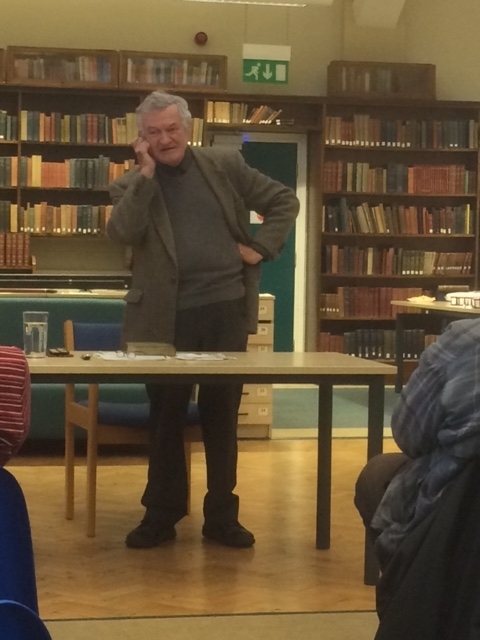
A talk by Ian Dewhirst is always something to look forward to and, given Ian’s keen interest and admiration for Keighley’s Gordon Bottomley, writer, poet, playwright, art collector, I was particularly eager to hear this one. I was not disappointed.

id2

Ian outlined Gordon Bottomley’s early life in Keighley and how local theatre trips with his gran, access to good libraries and his time at Keighley Boys’ Grammar School had all, Bottomley acknowledged, ultimately influenced his playwriting and poetry. Ian also noted the origins of Keighley Library’s unique archive collection of his original correspondence, deposited by Mrs Philip Lamb, a relative from Harrogate. You might have thought that a talk about a man so troubled by poor health would reflect some slow progress but Bottomley did travel at times and he certainly mingled in intellectually energetic company. Ian apprised us of his literary and artistic connections including Edward Thomas, renowned poet, John Masefield, Poet Laureate and Paul Nash, the famous artist. He also spoke of his influence in the Georgian Poetry Movement during the early 20th century, which included Rupert Brook and Siegfried Sassoon and significantly marks the major change in poetry from the romantic to the harsher realism of modern poetry, following the impact of WW1.

This talk could also have become one of simple name dropping of the artists and literati of the time but Ian Dewhirst MBE was never going to be so dull. The talk was well rounded, peppered with amusing anecdotes and brought to life the cultural times in which Gordon Bottomley lived, as well as Bottomley’s intelligent, witty and lively personality which so successfully managed to overshadow very serious ill health.

id

Nevertheless, a talk from Ian would not be complete without a relevant but hilarious personal story at the expense of Ian himself. This came in his very funny account of his attempts to get a clearer view of the much admired The Sheiling. From 1914, this was Bottomley’s home with his wife, Emily, in Silverdale, near Carnforth. Quite a few of the great and good visited the Bottomleys here and so there are some fine descriptions of a beautiful house and woodland surroundings, a “magic wood” even. Inspired by these descriptions, Ian had, on a few rambles, attempted to get a better view of the house over the limestone rise and one wet, windy day, romantically determined to get that view at last. Manfully he scaled the rocks, only to find himself suddenly wet nose to pane with the kitchen window. As he put it, soggy and bedraggled, he knew the washing powder of the latest occupants but still had no better idea of the building.

Everyone enjoyed the talk, from the local lady who wrote poetry herself to a member of Keighley’s Film Club who commented that it was inspiring to hear “the expert” speak on an entirely new topic, never tackled before in depth, and he looked forward, as I do, to repeats in the future. Radio Leeds, who had interviewed Ian before the talk, made plans for not one but two features on this national day of celebration.

Indeed, it was a great pleasure post talk, to once again marvel at this comparatively small town of Keighley which has made such a contribution to the nurturing of national and international cultural and artistic influences, not only Gordon Bottomley but the Brontës, Alexander Smith, pioneer of the pictorial movement in photography, and the late Lord Asa Briggs, renowned historian, to mention a few, and all this whilst standing in one of the earliest of the famous Carnegie public libraries. GRAND!

Gina Birdsall

The History of Whitakers Chocolatiers

whit2

The next in the series of talks in Keighley Local Studies library organised by the Keighley & District Family History Society will be on Monday 7th November.

The talk by John Whitaker will  feature the history of Whitakers Chocolatiers (there will be samples!)

The meeting opens at 7pm before the speaker begins at 7.30pm and will finish at 9pm. Please use the side entrance to the library on Albert Street.

All are welcome. There is a fee of £2.50 for non-members.

From Parks to Pavilions

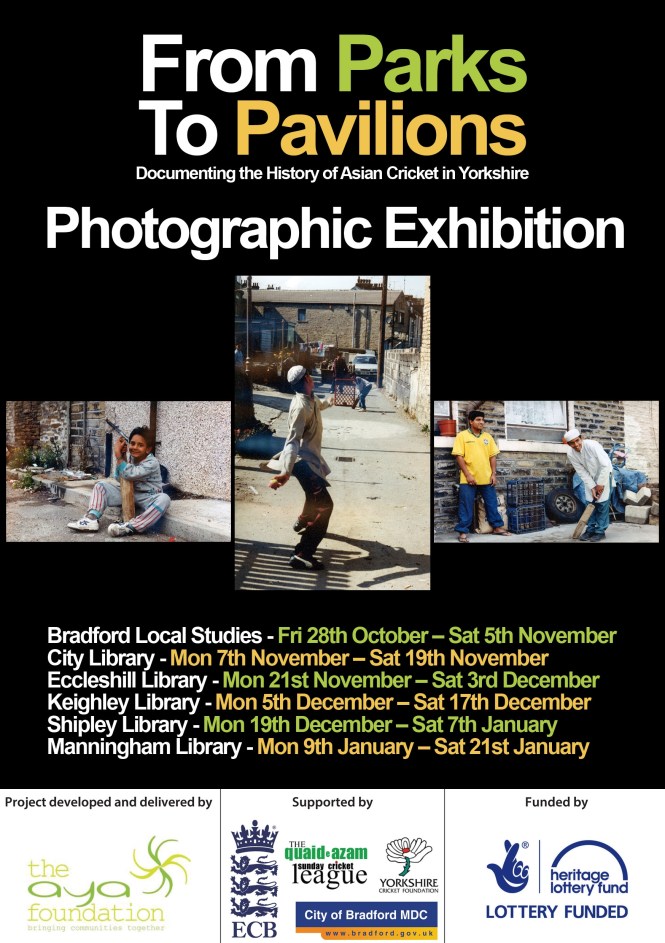
A photography exhibition illustrating the grass roots beginnings of Asian cricket in Yorkshire will be touring Bradford libraries over the coming weeks.

p2p

The exhibition contains photographs, taken by cricket enthusiast Mohanlal Mistry, of back-street cricket being played in West Yorkshire in the early 1990s. The exhibition has been displayed at Headlingley Cricket Ground for the one day international between England and Pakistan and at the Oval for the 2016 Asian Cricket Awards. This will be the first time that the exhibition is open to the public and free to visit.

It is part of the From Parks to Pavilions project which is documenting the history of Asian cricket in Yorkshire. The project was developed by the AYA Foundation, a community organisation specialising in promoting minority heritage, arts and culture, with support of Bradford Local Studies Libraries, the Yorkshire Cricket Foundation, the England and Wales Cricket Boards (ECB), and funded by the Heritage Lottery Fund.

This slideshow requires JavaScript.

Mobeen Butt, the curator of the exhibition and Project Lead of the From Parks to Pavilions project said: “The photographs perfectly capture how young Asians played cricket in the 1970s, ‘80s and ‘90s. They didn’t play on cricket grounds, in practice nets or even in parks – they played wherever they could, and that meant playing in alleyways, carparks and wastelands. They played with milk crates, traffic cones and crisp boxes for wickets and would carve out a bat from pieces of broken floor board or fence”.

The project aims to collect material and record interviews from members of one of the oldest Asian led cricket leagues in Britain, the Bradford based Quaid-e-Azam Sunday Cricket League.

As part of the project, the young people visited Bradford Local Studies library to find out about the oral history collection, the newspaper files and cricket memorabilia.

Maria Hussain, one of the young people working on the From Parks to Pavilions project said: “This exhibition is only a small part of our project. We’ve been to visit archives and museums. We’ve been to Lords, and we’ve been taught how to conduct oral history interviews and been on photography workshops. We will be producing a radio and video documentary and putting everything on YouTube for everyone to see!”

Councillor Sarah Ferriby, Bradford Council’s Executive Member for Environment, Sport and Culture, said: “It’s important to record the rich history of our South Asian communities participating in one of our great national sports. Cricket is still close to the hearts of local people and is a significant factor in community cohesion. We’re pleased to see the Heritage Lottery Fund get behind this as we have an enormous passion for sport across the Yorkshire region and it is a great unifier.”

To keep updated with the project visit: www.fromparkstopavilions.org.uk, follow @Parks2Pavilions on Twitter or join the ‘From Parks to Pavilions’ Facebook group.

All are welcome to take a look as it tours libraries in the coming weeks.

The exhibition will be in:

Bradford Local Studies Library from Fri 28th October – Sat 5th November
City Library from Mon 7th November – Sat 19th November
Eccleshill Library from Mon 21st November – Sat 3rd December
Keighley Library from Mon 5th December – Sat 17th December
Shipley Library from Mon 19th December – Sat 7th January
Manningham Library from Mon 9th January – Sat 21st January