Discover the woman who owned the first ‘Dalton Mill’ and fought off intimidation; another who championed the first children’s allowance, now Family Credit; why a female councillor resigned from the Labour Party in 1947; who stood up to Lord Reith as one of the first woman members of the BBC Board; which Keighley lass wrote The Feminist Movement – way before the 1970s -and more anecdotes along the way.
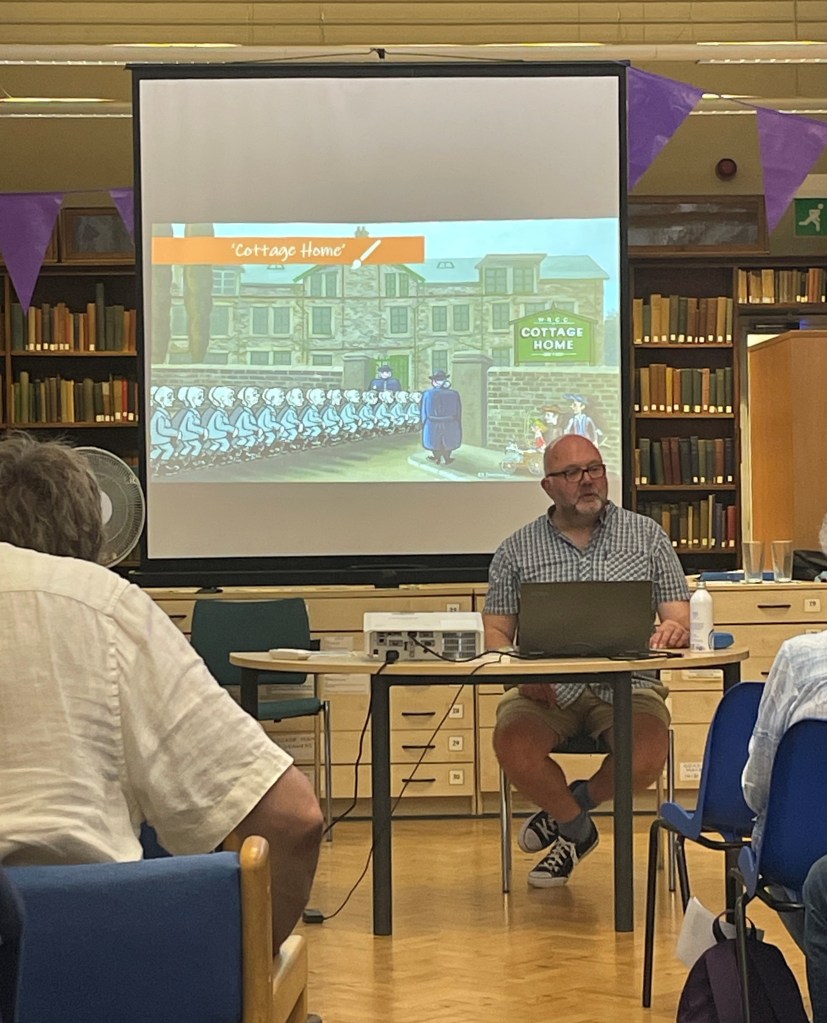
Join writer/historian Irene Lofthouse as she shares stories about some of the lesser-known women of Keighley, their achievements and legacies that still resound today. Then visit the exhibition of portraits by local artist #SophiePowell.
It is true that local history is only a second behind national current affairs. Given today’s volatile political climate and workers’ unrest, an examination of early 20th century history, is not the antiquated process that the notion of progress might lead us to hope for in 2023.
Keighley Library holds a small but important collection of ILP records (BK11) and also the Snowden collection that includes the libraries of early ILP members: Lord Philip Snowden and his wife, Lady Ethel Snowden, so we thought that we would look into these important and still very relevant local connections for this anniversary year.
The national Independent Labour Party was led by Keir Hardie who became its first chairman and had its inaugural meeting in Bradford at Laycocks’ Temperance Hotel, Albion Court, off Kirkgate on 13 January, 1893. Its foundations were rooted in the turmoil in the Bradford textile trade which was facing competition from France and rising foreign tariffs on British goods. This had led to greater local competition and an intensification of machine led production with pressure to produce more by fewer workers for the same wages. The Manningham Mills strikes of 1890 and 1891 saw powerful links forged between the ILP and local trade unions that the Liberal and Tory parties had failed to make. However, most importantly from an historical perspective, the ILP’s critical eye, focused as it was on established politics in such challenging times for lower paid workers, helped to lay the foundations for the growth of the “working class” affiliation with the less radical Labour Party that was emerging under Ramsay MacDonald and ultimately that party’s much greater political success in replacing the Liberal and Tory norm at both local and national levels of government.
In Bradford today, the founding meeting of the ILP is still marked by the large mural on the north side of Leeds Road near the city centre on the wall of the Priestley Theatre in Little Germany.
The ILP in Keighley
Keighley is joined with Bradford in its reputation as being part of the heartland of Labour politics at the Party’s time of emergence. In fact, in the 1890s, Keighley had one of the largest ILP branches in the country.Nevertheless, it seems that the politically dominant Liberal elite in Keighley was able to deter the political success of the ILP in the town.
The 1880s-1890s were full of discontent for working men and women in Yorkshire but despite this, the established party of choice, the Liberal party, still won elections – the largest single group on the Borough Council from 1882-1908. Furthermore, in spite of early electoral successes by 1900, consisting of four ILP town councillors and three School board members (both including Philip Snowden), ILP representation on the Council declined so that from 1904 to 1912 there were no Keighley town councillors for the ILP.
One argument could be that the successful influence and patronage within other areas of the town’s community life: employment, culture, education, religion and temperance were such, that voters could not ultimately be persuaded to embrace the ILP’s more radical politics. Liberal leaders such as Sir Isaac Holden, Sir John Brigg and Sir Swire Smith had brought much success to Keighley, both as employers in successful and expanding industry but also socially and culturally. They were instrumental in the establishment and success of the Mechanics’ Institute, its popular and nationally successful technical education for young working men and women and also the establishment of a Carnegie Public Library for all in 1904. Keighley’s sizeable Irish population also backed the Liberals at a crucial time in Keighley because of the staunch Liberal Home Rule policy. It is also worth remembering that the ILP in Keighley had fewer funds than either Bradford’s ILP branch or Keighley’s Tory and Liberal parties that relied less on the coffers of lower paid workers. One more point is that voting was still restricted to women who were ratepayers and heads of the household and that excluded many potential radical votes from single working women, paid little within poor working conditions, many in the textile trade. Lady Ethel Snowden was to do much to support women’s suffrage and Philip Snowden also became a champion of this cause.
Another argument might run that as a smaller town than Bradford, there was perhaps less room for independent opposition in such an economically, socially and culturally interconnected town. The Liberal elite were employers, sometimes landlords and held good standing within Keighley’s Non-conformist and temperance led community. Minority radicals would have had to have the mesmerising charisma of John Wesley to pull in supporters who would be going against the grain of such family and communal loyalties. Keighley, as a small town, also appears to have had some class fluidity for the educated and skilled working men. David James, former Bradford District Archivist and Labour historian, points out that some Chartist sympathisers had also been able to do well and gain influence within various organisations in Keighley and that this had also subsequently somewhat clipped their radical wings, (David James, “Local Politics and the Independent Labour Party in Keighley” in Keith Leybourn and David James (eds), The Rising Sun of Socialism 1991), p.106.
However, despite the ultimate failure of an early political conquest in Keighley, the influence of the ILP, as in Bradford, was still a pervasive one. It endured and promoted an alternative political option to Liberalism and Toryism in frustrating times for those working people, particularly with skill and education, and it offered a means of publicly active criticism, not least through its growing relations with developing trade unions. Finally, and again in the words of David James, above all, “…it sowed the seeds of a successful independent working-class political party, though it was the Labour Party that was to reap the harvest.” (ibid., p.118).
Lord Philip Snowden, Chancellor of the Exchequer for the first Labour Government
Although he never became Keighley’s MP, it was in Keighley that Philip Snowden was to cut his political teeth.
Born in Cowling in 1864 to cotton and worsted weavers from Ickornshaw, his parents were staunch Methodists and members of the Temperance society. It was an upbringing that was to shape his later political career.
“I was brought up in this radical atmosphere it was then that I imbedded the political and social principals which I have held ever since”
Philip was one of three children but unlike his two elder sisters, due to the shrewd saving of his father, he did not enter the local mill to work at the aged 10. Instead, Philip who was a bright child stayed on at school and attended the newly established board school from 1874, becoming a pupil teacher in 1877.
His interest in politics started when his family was forced to move to Nelson on the closure of Cowlings mill in 1879.Taking up a job as a clerk in an insurance office in Burnley. His early leaning however, were to favour the Radical Liberal ideals of his father.
In 1886 he won a competition to join the civil service and started to work as excise man. Over the next few years he travelled the country working in Liverpool, the Orkneys and Aberdeen. However, his civil service career was cut short when in 1889 whilst at Plymouth he sustained a back injury that that left him paralysed. He returned home to Ikornshaw to be nursed by his widowed mother and over the next few years he learned to walk again but walked with a stick for the rest of his life.
Whilst convalescing he put his frustrations into reading and began to read widely on the subject of socialism. Between 1892-1995 his leaning went from the Radical Liberal to moving over to the Socialism of the Independent Labour Party.
His contribution to local politic in Keighley was a significant one, he joined the Keighley ILP in 1895 only a few years after its formation and he became editor of the Keighley Labour Union Journal in 1898. By 1899 he was a Labour councillor and School Board member. His journalistic abilities along with his fine oratory skills made him popular figure and he drew large crowds to his speeches. At the Labour Church and he went on to tour the nation giving talks on socialism.
Philip was now making a name for himself with in the Labour moment, one of the big four alongside Keir Hardie, Ramsey MacDonald and Bruce Glasier. He served as chairman of the National Administrative Council of the ILP.
The early 1900s saw his gradual withdrawal from the Keighley political scene and his attentions tuned first towards Leeds and then west to the Lancashire. Local politics had shown its limitations, and he became of the belief that real social change could only be achieved through entry to parliament. His attempt to stand as the ILP candidate in Keighley in 1895 had been thwarted by lack of funds. He did not give up and after two failed attempts at Blackburn in 1900 and in Wakefield 1902, he was eventually elected as Labour MP for Blackburn in 1906.
It was also around this time that he met Ethel Annakin a young school teacher, feminist and socialist. Like minded and both ambitious for their political causes they married in Otley in 1905, against his mother’s wishes. A leading suffragist it was Ethel that was to convert her husband to the cause. He was also becoming a recognised expert on economic issues and advised David Lloyd George on his 1909 peoples budget.
The couple were travelling when war broke out and they found themselves on the other side of the Atlantic. Snowden’s opposition to the Fist World War was contrary to the Labour Party’s patriotic support and he found himself once again aligned with the left and the anti-war ILP. Such views were against the grain at the time, saw him defeated at the next general election in 1918.
In 1922 he was elected as the Labour MP for Colne Valley. Only two years late in 1924 the first Labour Government was formed, and he was appointed Chancellor of the Exchequer under Ramsey MacDonald. He went on to reprise his role as Chancellor in 1929 as part of the second Labour government.
It was when he continued as chancellor 1931 under the National Government that he met with controversy. After he introduced a budget that had been rejected by the previous labour cabinet, he was expelled from the Labour party.
Struggling with ill health he did not stand in 1931 instead he given a peerage. They became viscount and Viscountess Snowden of Ikornshaw. Philip turned to journalism in later years, but he suffered from increasing ill health and died on 15th May 1937.
The town had obviously made an impact on her husband for it was to Keighley library that Lady Ethel Snowden gave his 3,000 strong collection of books along with his writing desk. Her books joined those of her husbands on her death in 1951.
Santa came early to Keighley Library bringing the precious gift of Live Music on Friday night, 2nd December. A growing atmosphere of happy anticipation and pure joy filled the room as first John Drury and then the Haleys took to the library floor to thunderous applause – and we are not joking here or being Charles Dickensy just for the season. The gigs at Keighley Library, that pay for themselves incidentally, have become so popular locally that tickets sell out literally within hours. Glastonbury eat your heart out!
It is a truth universally recognised that listening to music improves mood and promotes feelings of wellbeing. Music shared combats loneliness and creates a sense of community spirit. In the words of the legendary John Denver, “no matter what language we speak, what colour we are, the form of our politics or the expression of our love and our faith, music proves: we are the same.”
This month’s gig was no exception as regular library borrowers, friends, family, fans and first time library visitors queued for a big slice of communal wellbeing and musical magic. A performance of this scale and calibre to be held, for the very first time in the evening, added to the Christmassy getaway feel that, for some local people this year, could well be limited to this library experience and the books borrowed to escape into over the holiday.
John Drury is a singer songwriter from a London-Irish background who now hails from Oxenhope. His songs have been described as ‘poetry with music on top’. He writes about the little as well as the big things in life, and believes deeply that ‘we are all in this together’. Friday night though was all about the cover versions with a couple of his own compositions thrown in for good measure. He proved to be the ideal ‘support’ act and from the off had the audience in the palm of his hand, clapping and singing along, troubles of the outside world forgotten for the time being!
What to say about the Haley Sisters? The sisters were born and raised in the village of Harden near Bingley and from a very early age they followed in their parents’ footsteps. The siblings have appeared alongside many respected artists since launching their professional career back in 1989, Freddy Fender, George Hamilton 1V, Raul Malo, Nathan Carter and Daniel O’Donnell. On 28th May 2017, they performed to a sell-out audience at the London Palladium and in April 2018 they were the opening act for the first of its kind, the Roy Orbison ‘In Dreams Hologram Arena tour’.
Becky and Jo-Ann are now award winning vocalists who could easily sell out the Grand Ole Opry in good old Nashville, Tennessee. Think a female version of the Everly Brothers with a magical natural blend of vocal harmonies with Becky on rhythm guitar and Jo-Ann on bass. The third member of the group is Becky’s husband, songwriter and steel guitarist, Brian ’Smithy’ Smith. Brian has worked on many recording sessions in Nashville including Crystal Gayle’s ‘Three Good Reasons’ album.
Proving that music really is in the genes, we were also treated to a song or two from 80-year-old Pa, Tony Haley, who taught us how to yodel with a rousing version of the Frank Ifield classic which earned him a standing ovation led by our very own Town Council Mayor.
Our other guests included Trevor Simpson and his wife Denise. Trevor is a former FA Premier League and international football referee, the author of two bestselling music books ‘Small Town, Saturday Night’ and a walking encyclopaedia on anything to do with Elvis.
Regular library customers still discuss gigs of years’ past and this will no doubt be one of them in the future. We will now let the music do the talking, see for yourself below and rock on 2023!
Mission: to follow closely in the footsteps of the Brontë family
Location: Keighley town centre…? Keighley town centre
Time Lord: Nancy Garrs, servant to the Brontës. To regenerate later into Irene Lofthouse, popular local guide and author for all things history in the Bradford District
Information provider: Keighley Library Town Trails, first episode Brontë Footsteps in Keighley
Mode of travel: definitely legs not telephone boxes
On Saturday 3rd December, for the first time in history, an intrepid group of literary searchers set off on the Brontë Footsteps Trail around Keighley, led by Nancy Garrs, former Brontë servant. Their mission was to discover the Keighley people, places and buildings that had formerly provided the Brontës with entertainments, tuition, publications and national cultural updates in the development of science and the arts. This was a first and all the information was gathered together from many secondary and primary sources held at Keighley’s own Carnegie Public Library.
The Trail was launched with an introduction by library staff and authors, Angela Speight and Gina Birdsall, who outlined why Keighley’s 19th/20th century’s rich history and rapid economic growth and burgeoning cultural development was to become the subject of a series of published Trails set in the town centre. They also noted the large numbers of connections between Keighley and the Brontës that authors have made in biographies and histories of the family that led to the creation of this, the very first town trail, and the first full recognition of Keighley’s contribution to the formative development of the Brontës in the 1820s and 1830s. Furthermore, all these references in books and articles and published diaries of the Brontës are to be found in Keighley Library’s own Brontë Library collection. The trail walk followed and we all, some of us it seems for the first time, really looked at Keighley town places and buildings.
Nancy must have had a lenient day of chores because she was full of energy and enthusiasm and brought some of her own extensive knowledge to the walk regarding the Brontës, their lives and times. It was a very entertaining trail through history and Nancy really did rival the best of the best of Dr Whos.
Nancy Garrs (Irene Lofthouse)
Temple Street Buildings Devonshire Arms Buildings on Church Green
However, the library tardis and a warm space eventually beckoned and we returned for tea and cake and a look at some of the library’s wonderful books and archives that make up the unique history of Keighley in relation to the Brontës, including the Brontë Library that is now the largest in the country outside that of Haworth Parsonage. Angela and Gina had also provided a more detailed fact/source sheet and bibliography for those who wanted to do further research.
We would like to thank all who joined us on the trail, Irene Lofthouse for her wonderful tour on the day, Steven Wood and Eddie Kelly, local historians who contributed their knowledge and expertise to the trail research. Finally, we would like to thank Dionne Hood, Bradford Libraries’ Development Officer for Reading and Stock, and Create Connect Make (especial thanks to Jean McEwan) for their wonderful support and offer to publish this cultural first in Keighley.
Here’s what Ann Dinsdale (Principal Curator, Brontë Parsonage) and Sharon Wright (journalist and author of TheMother of the Brontës thought about the trail booklet:
“The Brontë Trail not only flags up the wonderful resources available at Keighley Local Studies Archive, it shines a light on all the forgotten corners of Keighley which are associated with the Brontës’ lives. It allows you to follow in their footsteps around the town and includes details which are usually missing in biographies of the famous family.” (Ann Dinsdale, Principal Curator, Brontë Parsonage)
“The Brontë Trail is a long-overdue guide to the family’s forgotten local links. The authors have mined important and exciting knowledge from the local history goldmine at Keighley Library.” Journalist and Brontë biographer Sharon Wright.
Some Feedback for the new Brontë Trail
“That was such an interesting walk. I thought I knew quite a bit, but I learnt a lot as we walked. Thank you.”
“What a refreshing way to find out about the Brontës. Really enjoyed the presentation, and the leaflet with pictures is great to be able to retrace the steps.”
“I shall be able to impress my family with what I’ve learnt, and I’ll be going to visit the places on the map we didn’t get to.”
“Thank you for the walk, and discussion about the routes the Brontës used to come from Haworth. I’ve been trying to work out what Charlotte meant in a letter she wrote, and this has been really helpful.”
“Setts or cobbles? What did Brontës call them? Enjoyed the walk, and it created questions I’d not thought about. I hope there’ll be more walks like this.”
“Thank you for a fantastic walk and talk at the weekend about the Brontës in Keighley. It was so informative and really brought the research you’ve done to life. Congratulations to everyone involved in all of the process.”
“What a wonderful walk-talk- and exhibition – full of colour, humour and life and history. Congratulations to our guide.”
“Just enjoyed the Brontë Town Trail – wonderful! Thanks to Irene (Nancy Garrs) for such a spirited and lively tour. Thanks to Gina and Angela for such an interesting and informative booklet!”
For those of you interested in Nancy Garrs herself please follow these links:
Keighley Local Studies Library staff are very pleased to announce the launch of the very first Brontë Trail around Keighley. It’s now published and will be available in the library from Saturday 3rd December after the launch at 10am. All welcome.
You too can follow in the footsteps of these literary greats as they catch up with friends, tuition, lectures, shopping, book borrowing, publishing, travel stops and entertainments. We shall have a range of photographs, books and archives out in the library for those wanting to follow the trail in more depth.
The Trail will also be taken out onto the streets of Keighley after the launch by the local historian and very popular guide, Irene Lofthouse, who will be dressed in the guise of Nancy de Garrs (Nancy Garrs), nursemaid and cook to the young Brontë children for 8 years. There are only 15 places available for the actual trail so please telephone 01535 618215 to book your place.
The day will also hold other Create Connect Make activities as well as the regular children’s story time at 11am. There will be Learn to Crochet with CCM Making and Crafting group in the meeting room, first floor, a special story time at 2pm with Catrina Farnell, bookmaking/collage drop in all day in the library with CCM’s wonderful Jean McEwan and a Christmas crafts drop in.
Please come and join us for this Christmas feast of activity.