Local Library Collections and the Camera in Local History. A Celebration for Local History Month

Over the last couple of years Elizabeth Edwards, Professor Emerita of Photographic History at De Montfort University in Leicester, and until recently Andrew W, Mellon Visiting Professor at the V&A Research Institute, London, has been making periodic academic study visits to Keighley Local Studies Library. Elizabeth is the author of the ground-breaking study, The Camera as Historian, and generally hopes to raise awareness of library photographic collections that she feels have been much neglected in academic and heritage circles. Elizabeth generously offered to write a blog for us and in so doing, gives us a brief but fascinating insight into these valuable collections, their regional and national importance, and the vital role played by libraries in the development of local history.

The Camera as Historian

Survey Volumes

Among the local studies treasures in Keighley Public Library is a set of 6 bound volumes of photographs. That they are little known is the result of the almost total neglect of the photographic holdings in local studies libraries more generally, despite the distinguished social historian Raphael Samuel referring to them as the lifeblood of local histories. Certainly, many local historians have used the photographs productively in their work. But to really appreciate what is at stake, we have to think about the photographs collectively, as an assemblage, which came into being with a clear purpose, and with work to do in civic society.

This is where the 6 volumes come in. While they are just part of a larger collection of historical photographs in the Library, they represent a cornerstone, both as a collection and more especially as a purpose. They are described from the outset as a ‘photographic survey’ – as embossed on the spines of the volumes. They were donated to the new Library in 1911. However, their genesis was a couple of years earlier, in 1909, when Keighley Photographic Association formed a sub-committee to undertake a photographic survey.

They were inspired, according to an article in the Keighley News, by Birmingham MP Sir Benjamin Stone who was a keen amateur photographer. In 1897 he founded the National Photographic Record Association to which he hoped that local photographers and photographic societies would contribute, creating a national record of ancient buildings, folk customs and so forth. Stone seems to have been something of a thorn in the flesh of the photographic world with his pronouncements on how photographs should look and what they should do. He hated forms such as pictorialism (as practised by Keighley’s famous photographer of the early 20th century Alex Keighley) which he, Stone, referred to as ‘fuzzigraphs.’ So while many surveys give lip-service to Stone, most went their own way, working and thinking locally, bringing local knowledge and networks to bear on their production.  For all the razmataz, Sir Benjamin’s national association failed because he tried to turn into a national centralised archive, something that was profoundly local, tied to local desires and local civic and civil society.

Photo Album

Writing about the photographic survey movement, which emerged in the 1890s, has tended to characterise it as nostalgic, ruralist, conservative – anxious about the loss of the ‘old ways’. In 2012 I published a book The Camera as Historian which argued against this position. Instead I suggested that the surveys were driven not so much by a sense of loss, but one of local dynamism, and a fear not of a direct fading away, but of a future that had no sense of its past. These sentiments resonate through Keighley’s survey photographs, recording as they do, civic and national events from wars to elections and charity events, street scenes, the demise of horse-drawn trams, the advent of electric trams, the modernisation of factory plant, slum clearance, everyday life and much else. They also copied older photographs, many of which map civic society in the modern town – the postmasters (and one postmistress), the chiefs of the local constabulary, the medical officers, and local teachers – people who made up the infrastructure of the town. Consequently, Keighley’s survey is concerned not with the quaint and picturesque, but with the changing face of a modern industrial town.

Photo Album

Unfortunately, I didn’t know of the Keighley survey when I finished the manuscript for that book about 15 years ago. If I had it would only have reinforced my argument. Because it really stresses the ways in which local identities were being played out. Yes, one can make arguments about who was doing the photographing (the expense of photography meant that most photographers came from the broad middle classes) but it would be a mistake to narrowly define them and reduce them to that. They were photographing in the contexts of a broadly liberal, non-conformist, philanthropic environment, where photographic skills in relation to survey were seen as a contribution to the civic and civil body. The photographs in the albums trace the presences and life experiences of a multitude of Keighley citizens and their families if one cares to look – and think. It has the feeling of a collective being.

Scrapbook

The Library itself is an important player here. It was seen as the proper place for the survey albums, which were added to until about 1936. And Keighley is not alone here. A good many of the surveys were donated to public libraries or in some cases, such as Norwich or Dundee, were the result of a direct collaborative relationship, commission even, between public libraries and photographic clubs. I have become so interested in the role of public libraries in the development of local history, and more broadly, in a sense of local identity and local particularities, that they have now become part of my current book project. This explores the role of photography in an increasing, yet dispersed, sense of the past, which is manifested through everything from picture postcards, illustrated guidebooks, or the management of ancient monuments (the extensive visual presence of Kirkstall Abbey in west Yorkshire narratives is a good example here), to family albums, and even cigarette cards – and a multitude of photographic places in-between.  And Keighley will most definitely be playing a major role in that argument.

Elizabeth Edwards

****************************************************************

Elizabeth Edwards has generously donated her book, The Camera as Historian, Amateur Photographers and Historical Imagination, 1885-1918, (Duke University Press, 2012) and it will shortly be available for reference in Keighley Local Studies library.

Some publications by Elizabeth Edwards

Photographs and the Practice of History: a short primer. (London: Bloomsbury, 2022)

What Photographs Do: the making and remaking of museum culturesed. E. Edwards and E. Ravilious. (London: UCL Press, 2022) available as open access free download: https://www.uclpress.co.uk/products/192312

Raw Histories: Photographs, Anthropology and Museums (Oxford: Berg, 2001)

Anthropology and Photography: A long history of knowledge and affect (Taylor & Frances Online, 30 Nov. 2015)

Photography, Anthropology and History: Expanding the Frame, ed. C. Morton and E. Edwards (Aldershot: Ashgate, 2009)

Sensible Objects: Colonialism, Museums and Material Culture, ed. Chris Gosden, Ruth B. Phillips, E. Edwards (Oxford: Berg:Routledge, 2006)

Keighley Local Studies Team

Crime Fiction and Reality

How do you write a prison based novel when you have never been inside yourself?

How do you help prisoners to aim for better lives when they come out of prison?

How do you research local history for novels set in previous decades?

Which prisoner covered himself in butter to fight, and delay his slippery arrest, after his football team lost a game?

These are just a few of the questions that were answered during the course of last Saturday afternoon with our two brilliant local authors and speakers – Frances Brody and Veronica Bird OBE.

You may know of the acclaimed author Frances Brody, as she is very well known for her very popular Kate Shackleton mysteries, some set in Yorkshire, including Haworth and Saltaire but you may not have heard of Veronica Bird OBE who was the first female governor of HMP Armley in Leeds and of her aptly named autobiography, Veronica’s Bird.

This dynamic duo who met through Frances’s research into her new series of novels, the Brackerley Prison mysteries, thoroughly informed and entertained their large audience. As well as the writing of her novels and her characters, Frances also spoke about local history research and the use of news cuttings in libraries including the valuable collection in Keighley Local Studies. She also included notes on the craft of creative writing and very helpfully to budding authors in the audience, gave some really good advice on making a start at writing a story or novel, overcoming writers’ block and on how to find interesting minor stories to set within the main plot.

Veronica spoke about her deprived upbringing and subsequent hard won career in some of Britain’s most challenging prisons. She also highlighted the lack of literacy amongst at least 50% of prisoners with consequential feelings of hopelessness and sadly an increased chance of re-offending on release. Both Veronica and Frances support the Shannon Trust that helps with learning to read and improve other basic skills so that prisoners, “can pursue wider opportunities and thrive in the community”. Veronica also told us some amusing stories of what can happen when the occasional slip-up in prison guard vigilance occurs such as the attempted sale of prison knickers at a local market stall. Never destined to be a best seller, however, not one pair was sold.

Veronica, now retired but still working with prison inmates, also works for various charities including Ukrainian refugees, and was awarded her OBE for her charitable works. On Saturday, both speakers raised funds for their chosen charities and Frances Brody very kindly donated to Bradford Libraries two large print versions of her novels, including A Murder Inside (the first prison based novel), as well as an audio version of A Mansion for Murder, her latest Kate Shackleton mystery.

We thank them both for a great afternoon of information, education and entertainment and thank Alice and Felicity, the volunteers who so efficiently supervised refreshments.

Keighley Local Studies Team

David Kirkley, Keighley’s gentlemanly historian

It was with great sadness that staff at Keighley Library heard of the recent death of David Kirkley. David had not only become a major contributor to Heritage Days and Keighley local history but also a friend to the library staff.

Photo from Keighley News

David was the other half of the Schools’ Heritage Group, together with Jan Rotheram. This was set up a few years ago and ever since, their wonderful photograph collection has provided a source of displays for Heritage Days and other events held in Keighley Library, in particular the Local Studies Library on the first floor. These displays always won a brilliant reception from locals, as families and friends pointed out their old school selves or others they recognised and reminisced about the “best days” of their lives. In 2022, David had put on another great display for us of local school sport photographs to accompany a talk on Keighley and football in the 1950s by Mike Halliwell.

Local Schools Display

Before Covid, David came at least once a week to Local Studies for a catch up with other locals, equally enthusiastic about Keighley’s history and we learned a lot from them and their projects in our turn.  David supported this historic library in both word and deed and was amongst the first to support the wonderful musical heritage events. We, the staff, always enjoyed chatting to him, he was a knowledgeable, reliable, kind and helpful gentleman and we shall all miss him very much indeed. We are not surprised that in other areas of his life such as the Cougars’ rugby club, he was held in such high regard, a local legend indeed.

Keighley Local Studies staff.

International Women’s Week in Keighley Local Studies Library

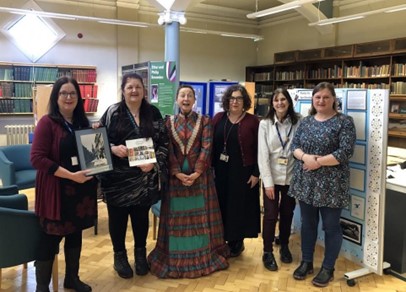
International Women’s Week in Keighley Local Studies Library was celebrated with another popular talk by Irene Lofthouse in full costume. Over 50 people ignored any remaining difficulties of ice and snow to hear about some of the inspirational women of Keighley at the turn of the century.

Margaret Winteringham (first British born female MP in Parliament, child and family welfare campaigner); Rachel Leach (early Dalton mill owner and business woman); Lady Ethel Snowden (campaigner, speaker for women’s rights, ILP member, BBC Board of Governors); Frances Smith (mill worker, councillor, champion of child welfare and public health and first woman director of the Co-op Society Ltd); Margaret Pickles (a Keighley Guardian, a member of the Keighley Union Relief Committee who championed better conditions for the poor and taking children’s upbringing outside the workhouse environment) were just some of the women brought vividly to life by this entertaining actor-historian Irene Lofthouse, who, we are proud to say, does much of her research here in Keighley using our renowned Local Studies’ collection. Our holdings include the Lady Ethel Snowden Library, Down Memory Lane articles by the late Dr Ian Dewhirst MBE, news cuttings, local histories and archives, including a large collection of resources on local mills and their owners. Please see our leaflet guides on this site.

Women in Publishing

Keighley Local Studies also put on a display about women in publishing with reference to an excellent online article on the British Library website by Dr Margaretta Jolly, Professor of Cultural Studies at the University of Sussex. This examines the progress made by women in the world of publishing, alongside women’s suffrage and rights’ movements that inspired publications such as the Spare Rib magazine and the establishment of Virago press whose archive is now held at the British Library. The article also notes the emergence of greater diversity in the industry to be inclusive of the working class and also minority ethnic representation with a look at Margaret Busby OBE Hon. FRSL, the youngest and first black woman director of a publishing company. There is plenty online about Margaret Busby who is a patron of Independent Black Publishers and was appointed Chair of Judges for the Booker Prize in 2020. Her latest book New Daughters of Africa (ISBN: 9780241997000), an international anthology of writing by women of African descent, is available from Bradford Libraries.

There is a great reading list attached to this article but check out the following sites for more information:

https://www.bl.uk/womens-rights/articles/print-purpose-and-profit-women-in-publishing

https://www.bl.uk/20th-century-literature/articles/feminist-literature-puncturing-the-spectacle

https://www.blackheroesfoundation.org/people/margaret-busby/

https://www.theguardian.com/society/2020/oct/22/margaret-busby-the-uks-first-black-female-publisher-everyone-assumed-i-was-there-to-make-the-tea

We also featured the emergence in Bradford of two female Asian publishers at Bradford based Fox & Windmill, Habiba Desai and Sara Razzaq.

This is the first independent book publishing company for British South Asian writers, established in 2021. Their inspiring collection of short stories and poetry from British South Asian writers, Into the Wilds, bridges the gap in the publishing industry for writers from a different background.

https://foxandwindmill.co.uk/

Cover of Into the Wilds

Women in the Printing Industry


The printing industry itself was also covered with reference to another article about women’s experiences in the printing industry today but also the first woman to have her own printing press and to employ and to train the first young women in the industry, Emily Faithfull (1835-1895). Emily, a vicar’s daughter, trained as a printer and typesetter and launched the Victoria Press in London in 1860. Its aim was to promote women’s rights to skilled and decently paid employment. The Press printed The English Woman’s Journal, considered the first British feminist periodical, edited by activist-poet Bessie Rayner Parkes. Emily was appointed publisher-in-ordinary to Queen Victoria in 1862. The full article can be read at the following site:

https://www.printweek.com/briefing/article/women-at-work-the-push-for-gender-diversity-in-print

Keighley Local Studies also holds a small selection of 19th century broadsides (single sheets of commentary, song or poetry) and previously has collaborated with Piston, Pen & Press an AHRC-funded project that aimed to “understand how industrial workers in Scotland and the North of England, from the 1840s to the 1910s, engaged with literary culture through writing, reading and participation in wider cultural activities”. Check out their web site for more information please:

https://www.pistonpenandpress.org/

It just goes to show that inspirational women are everywhere, should be celebrated and their struggles and achievements recorded. We are pleased that Bradford Libraries and Archives on their bookshelves, displays and in their Local Studies’ departments can share in their journey past, present and future.

Gina Birdsall, Local Studies & Archives Assistant