
Keighley’s Neglected Poet: a talk by Ian Dewhirst MBE

To celebrate National Poetry Day on October 6th, well-known author and historian Ian Dewhirst MBE will be giving a talk ‘Gordon Bottomley, Keighley’s neglected poet and playwright’ in Keighley Local Studies library.

Born in Keighley in 1874, Gordon Bottomley was an important figure in the poetry movement before and during the First World War and one of the most influential literary figures to have been born in Keighley.

Over the years, Mr Dewhirst has made a special study of Gordon Bottomley, for whom he has a great deal of admiration, and we are fortunate that this renowned raconteur has agreed to share his knowledge in this unique talk to be held at Keighley Library.

The talk starts at 11.00am. Admission is free and all are welcome.

gordon-bottomley-keighley-poet


Gordon Bottomley (1874-1948)
Keighley’s poet, writer, playwright, art collector

Gordon Bottomley is one of the most important literary figures to have been born in Keighley.  Despite the limitations he faced in society due to illness, his cultural reach extended into the national arts scene including drama, poetry and fine art.  As well as honorary degrees, Bottomley was a Fellow and Benson medallist of the Royal Society of Literature and Vice-president of the British Drama League.  In 1994, a blue plaque, similar to those for famous London landmarks, was put up to mark the site of his birth in Keighley.

Born in 1874, the only child of Alfred Bottomley, a Keighley accountant and his wife Maria, a Scot, he was initially educated by his mother. He then attended the Keighley Trade and Grammar School, part of the Mechanics’ Institute building which later became Keighley Boys’ Grammar School. Gordon Bottomley credits the school as a major influence on his literary development and Keighley Library holds the records of the school which reveal to some extent the kind of education and facilities available.

At the age of 16, he became a junior clerk at the Craven Bank in Keighley. In 1891 he was transferred to the Bradford branch but ill health (haemorrhaging of the lungs) left him an invalid for long periods of time. When he was 18 years old, the family moved to Cartmel area on the Cumbria-Lancashire border. Bottomley stayed in the area for the rest of his life, moving to The Sheiling, in Silverdale near Carnforth in 1914 with his wife Emily. Here they entertained friends such as Paul Nash, the artist, and Edward Thomas, the poet, and his correspondence with both these influential men has since been published.

Gordon Bottomley began writing poetry in earnest in the 1890s and became a leading figure in the Georgian Poetry movement before, and during, WW1. He had seven collections of poetry published and his works appeared in anthologies of the time.
He was also a playwright, mainly of one-act verse plays and he also championed the experimental theatre of the 1930s. He loved art, and became a dedicated collector. Greatly influenced by William Morris and the Pre-Raphaelites, he acquired a nationally important collection which also included the work of influential contemporary artists such as Paul Nash, Stanley Spencer, William Nicholson and Bradford’s own Sir William Rothenstein.  In 1949, he left over 600 paintings, drawings and prints to the Tullie House Museum and Art Gallery in Carlisle. Details of his collection are available in archive BK60.

gordon-bottomley

Keighley Local Studies Library Resources

Gordon Bottomley’s works are out of print now but Keighley Library has an important collection of his publications, photographs and published and original correspondence housed in the Library’s Yorkshire Authors’ Collection and in the archive.

The library also holds news cuttings and biographical articles, including some written by local historian and former Keighley Reference Librarian, Ian Dewhirst MBE.

A leaflet has also been produced outlining Gordon Bottomley’s life, works and original archive resources stored in Keighley Local Studies Library.

Humbert Wolfe, Bradford Poet

On 5th December the sculptured head of Humbert Wolfe, Bradford poet, was presented to City Library by Anthony Padgett, Sculptor. The sculpture was unveiled by the Lord Mayor of Bradford, Councillor Joanne Dodds, with a reading of Humbert’s poems by poet Stephen O’Connor.

hw

Humbert’s poem ‘Requiem’, published in 1927 is often read at Remembrance events.

Requiem: The Soldier

Down some cold field in a world outspoken
the young men are walking together, slim and tall,
and though they laugh to one another, silence is not broken;
there is no sound however clear they call.

They are speaking together of what they loved in vain here,
but the air is too thin to carry the things they say.
They were young and golden, but they came on pain here,
and their youth is age now, their gold is grey.

Yet their hearts are not changed, and they cry to one another,
‘What have they done with the lives we laid aside?
Are they young with our youth, gold with our gold, my brother?
Do they smile in the face of death, because we died?’

Down some cold field in a world uncharted
the young seek each other with questioning eyes.
They question each other, the young, the golden hearted,
of the world that they were robbed of in their quiet paradise.

I do not ask God’s purpose. He gave me the sword,
and though merely to wield it is itself the lie
against the light, at the bidding of my Lord,
where all the rest bear witness, I’ll deny.
And I remember Peter’s high reward,
and say of soldiers, when I hear cocks cry,
‘As your dear lives (’twas all you might afford)
you laid aside, I lay my sainthood by.’
There are in heaven other archangels,
bright friends of God, who build where Michael destroys,
in music, or in beauty, lute players.
I wield the sword; and though I ask nought else
of God, I pray to Him: ‘But these were boys,
and died. Be gentle, God, to soldiers.’

Bradford Local Studies library has an extensive collection of books and news cuttings by this best selling poet.

  • London sonnets (1920)
  • The Unknown Goddess (1925) poems
  • Humoresque (1926)
  • News of the Devil (1926) poems
  • Requiem (1927) poems
  • Cursory Rhymes (1927) poems
  • Others Abide (1927)
  • Dialogues and monologues (1928) criticism
  • This Blind Rose (1928) poems
  • Troy (1928) Faber & GwyerAriel poems
  • The Uncelestial City (1930)
  • George Moore (1931)
  • Snow (1931) poems
  • Signpost to poetry (1931)
  • Now a stranger (1933) autobiography
  • Portraits by inference (1934)
  • X at Oberammergau : A poem (1935) drama
  • The Pilgrim’s Way (1936)
  • The Upward Anguish (1938) autobiography
  • Out of Great Tribulation (1939) poems
  • Kensington Gardens in War-Time (1940) poems
  • Catalogue of printed books: the library of the late Humbert Wolfe (Sotheby)
  • Harlequin in Whitehall: a life of Humbert Wolfe by Philip Baggeley

Burley Poet is Celebrated

There is currently an exhibition in Burley library featuring Alfred J Brown, 1894-1969, walker, writer, passionate Yorkshireman and Burley resident as part of the Burley Festival.

Alfred John Brown was a Bradford businessman living in Burley who began writing prose and poetry while recovering from illness during the First World War. He was one of the most popular authors of guide books to walking in the Yorkshire Dales between the 1920’s and the 1950’s. His works include ‘Tramping in Yorkshire’, ‘Striding through Yorkshire’, ‘Poems and Songs’ and ‘Broad Acres’ as well as ‘Four Boon Fellows’ about a 100 mile weekend walk one Easter weekend from Barnard Castle to Ilkley.

His headstone is inscribed with words from one of his poems Dales in Paradise: “There must be Dales in Paradise, which you and I will find.”

Another of his poems ‘Emily Bronte’s Grave’ is reproduced here.’

Emily Bronte’s Grave

She is not buried here
Beneath this tomb;
Death could not pinion her
In such small room.

This is too strait a place
For her wild blood,
Only the dust of her
Rests by this Rood.

Look for the soul of her
On the high Moor,
Where the wind wails for her
And the clouds low’r.

There where the curlews cry
List for her voice!
Cage-free and glad – at last
Hear her rejoice!

The display will be on until mid-September.

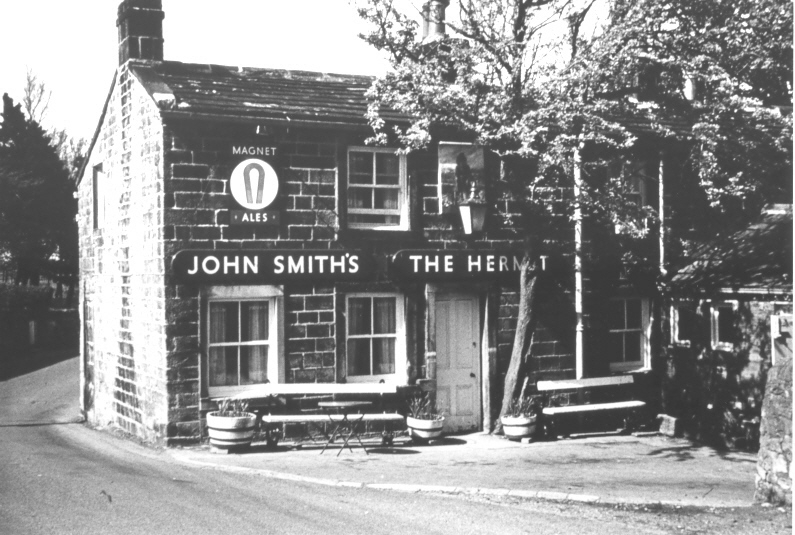
Hermit Inn

One of his favourite pubs was the Hermit at Burley Woodhead where on occasions he met J B Priestley.