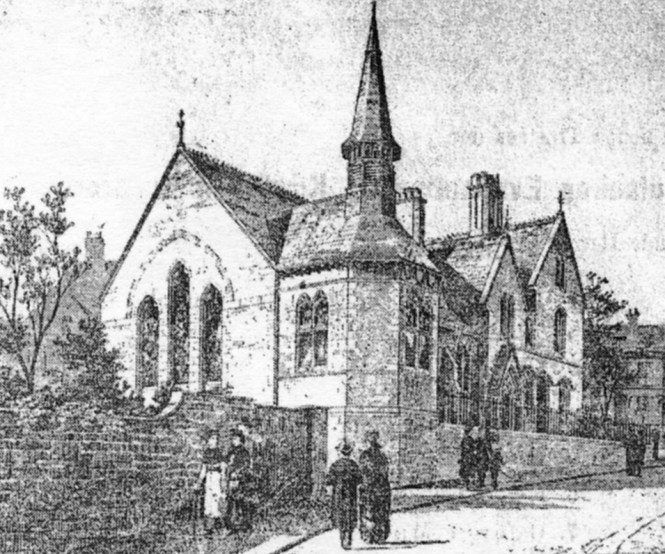
TREASURE OF THE WEEK. No. 11 DEUTSCHE EVANGELISCHE KIRCH

THE GERMAN EVANGELICAL CHURCH. 1881. 8 pages.

 JND 245/7 (Please quote this number if requesting this item.)

German Church2.1

This slim leaflet is a report on the origin of the German Evangelical Church in Bradford and, in particular, the progress of the fund to build a permanent place of worship.

‘The origin of the German Evangelical Church in Bradford is soon told. The town contains a large resident German population, of which a considerable number have brought or inherited from their native country the attachment to the Evangelical faith. No special and suitable provision for their spiritual wants had been made until 1876, when a Church Mission was held in the town, which, at the suggestion of the Rev. Vincent J. Ryan, was extended to the German inhabitants. The Rev. J.S.G. Krönig, of Hull preached to them in their own language. A committee was formed, who carried on divine service, with the help chiefly of Moravian ministers of the neighbourhood of Bradford, till in November, 1876, they received a pastor from Germany.’

A Grand Bazaar was held in 1879, the purpose of which was to raise funds to build a church for the German population of Bradford. The impressive list of the many members of the German nobility who gave patronage to the bazaar reminds us how different pre-war imperial Germany was:

His Royal Highness The Grand Duke of Hesse
Her Royal Highness the Grand Duchess Sophie of Weimar
Her Imperial Highness the Crown Princess of Germany and Princess Royal of England
Her Highness Princess Marie of Scwarzburg-Sondershausen
Countess Maria zu Münster
His Excellency Count zu Münster

Local celebrities were also much in evidence, including:

Sir Henry and Lady Ripley
Rt Hon W E Forster
Lord Frederick Cavendish
The Lord Bishop of Ripon
Mrs Julius Delius

Not forgetting the Band of the 103rd Royal Bombay Fusiliers!

The Bazaar made £422 1s. 7d., and with donations of £903.55 and promises of £1100, plus another £300, “some £2500 was made. This left £1500 more needed.” The Church was built and still stands, on the corner of Great Horton Road and Chester Street. Hundreds of university and college students pass the Church every day, most of whom will barely notice it. Currently it is home to the Delius Arts & Cultural Centre and Artwork Creative Communities. In addition to presenting a picture of Germany before the First World War, this ‘Treasure from the Stacks’ is also a reminder that the establishment of religious centres for immigrant cultures in Bradford is nothing new.

Stackmole

Map of the Week: A View from the Bridge

The Queens Road bridge, which carries the traffic from Manningham over Canal Road towards Bolton, Eccleshill and Idle, was in place when the 1889 OS map of the area was surveyed. The Local Studies Library reserve collection has a map from 1880 which seems to have been part of the preparatory planning for this structure. Early users, descending from Manningham, would have seen on their right the railway line and Valley Road coming from Bradford, very much as now. To their left, approximately where a stone reclamation site is now located, was Manningham Station. This pre-dated the bridge and was, in the years 1868-1965, the first stop out of Bradford on the Midland Railway (later LMS) line. Manningham and Frizinghall stations were closed, well within living memory, by Dr Beeching. Subsequently Frizinghall station has been reopened.

The three maps included in this article, though all undated, are clearly from the mid-twentieth century.  Their relatively late origin has one great advantage inasmuch as their interpretation can be supported with photography.

The first map shows the situation on the city side of the bridge. To display the annotations correctly it has to be displayed with the city centre to the left of the map which doesn’t feel right to me. Valley Road should be running across the top of the plan but is not drawn. The canal is evidently ‘disused’ which places our plan quite certainly after 1922. The arrangement of the buildings resembles the 1930s OS maps quite closely, so that is a probable date.

Map of the Week 021 A

The curved building that is aligned on Station Road, unnamed in this map, is a wool-combing mill. The blue waterway is the Bradford Beck and the idea behind the map, which is not explained, may have been to show how the beck could be culverted and taken under Canal Road at a time when a new sewer was being constructed. The six circles, and the ancillary buildings between them, represent the Bradford Gas Works. You can see this arrangement clearly in an image on the Britain From Above website:

Valley Road Gas Works

Strangely the 1936 OS map does not name the Gas Works but does indicate that it was served by a network of railway lines which presumably distributed coal, arriving on trucks from the Midland Railway, to the coke ovens.

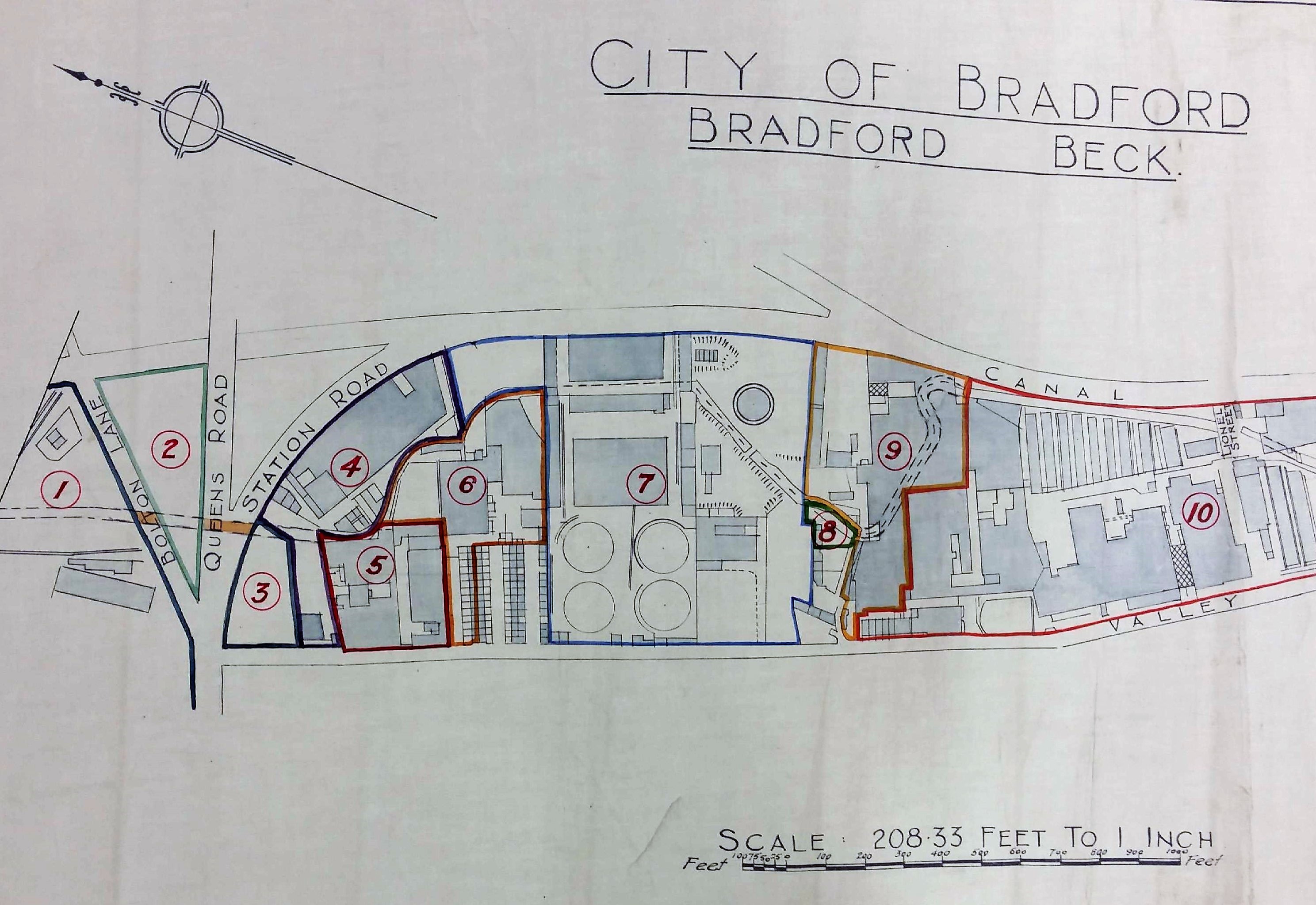
The second plan shows the same area but is orientated more naturally.

Map of the Week 021 B

The map is undated but in the list below the railway is identified as London Midland & Scottish so it clearly pre-dates nationalisation in 1948.  It is stamped ‘SG Wardley, City surveyor & engineer’.  I believe Wardley was in post around 1946-1960s.  Readers who have known Bradford longer than me will have their own views about whether the major city plan that he espoused produced bloom or blight. The great advantage of the second map is that land occupiers are clearly identified:

1 London Midland & Scottish Railway Company

2 Bradford Corporation

3 Bradford Corporation Street Drainage & Works

4 Bradford Woolcombers Mutual Association Ltd

5 Beck Properties Ltd

6 J F Raspin Ltd

7 The Bradford Corporation, Gas Committee

8 Wm. Whitaker & Co Ltd

9 R Clough & Co Ltd

10 The Bradford Corporation, Electricity Committee

Contemporary trade directories reveal that Raspin’s and Clough’s were both firms of commission wool-combers. The well-known Wm. Whitaker & Co Ltd were brewers until the 1920s but by the 1950s were bottlers and wine & spirit merchants. Unfortunately my limited research cannot place them securely in this position nor explain why they needed such a small patch of land. Can anybody help? Between Raspin’s mill and the Gas Works were three long-vanished roads: Hopwood St, Valley St and Valley Row. Small portions of the Bradford Beck are shown and the relationship of Canal Road with Valley Road is much clearer than in the first map. Towards the end of the 1930s gas production was abandoned at the Valley Road works which became exclusively a distribution centre. Production continued at Birks Hall works, Laisterdyke, eventually the largest in Yorkshire.

The final building on this map is the Valley Road Electricity Generating Station. I understand that its chimney was taller than the famous example at Manningham Mills. Its wooden-construction cooling towers were known as Davenport Towers. The works consumed millions of gallons of water, and hundreds of tons of coal, weekly. It had been built in 1896 and extended in 1939 and again in 1947.

In the Local Studies collection we have a plan of the whole Power Station of which the third map is a detail. The map is annotated ‘Electricity works, Canal Road’. The British Electricity Authority (Yorkshire Division) is recorded as the operator. I believe that this body was only in existence between 1948-55. The station was finally demolished in the mid-1970s.

Map of the Week 021 C


Derek Barker, Local Studies Library volunteer.

A Bradford Childhood 1944-1955

About three years ago I decided to write a family history and made a valiant effort to fit the pieces together for my children; but, as time went on, I found I was increasingly inserting my own memories and the whole thing was beginning to take the shape of a memoir instead.

I discovered a need to place myself in the centre of the writing because some kind of half understood force was requiring me to write in a particular way about my own memories; but I was still able to use the documentary information I possessed to provide a historical context. It is as accurate an account as I can deliver. It should give a reasonable idea of what times were like for a small boy in Bradford just after the war and, although personal to me, might very well arouse complementary memories in those of my own generation who lived in Bradford as children at more or less the same time. If it has any historical value at all, it may even be of interest to later generations who will have no memory of this time but may be interested in exploring the flavour of those days which, although possibly dominated by drab austerity for adults were, in fact, for ‘us kids’, times of joy, adventure, colour, excitement, exploration, emotional richness and hope.

I was born in a nursing home somewhere in Bradford Moor in early 1944 and spent the first seven or eight years of my life with my parents and, later, my younger sister, in a terraced house on Evelyn Avenue in Thornbury. Some of my earliest memories are my clearest. This is one of the ways I remember my mother:

She was a talented singer who had been encouraged by her schoolteachers to enter competitions and to join the children’s pantomime chorus run by the local impresario Francis Laidler. For several seasons she had been a ‘Sunbeam’ at the Alhambra Theatre in Bradford and had sung and danced in front of capacity audiences; but now she sat alone, beside me, her hands smelling faintly of chopped vegetables, singing softly, as I lay in my little bed, half asleep, half awake, drifting towards oblivion.

 Lulla lulla lulla lulla bye bye
Does you want the stars to play with
Or the moon to run away with?
They’ll come if you don’t cry.

Lulla lulla lulla lulla bye bye
In your mammy’s arms be creepin’
And soon you’ll be a-sleeping
Lulla lulla lulla lulla bye.

Out towards Fagley Woods?

And my father, who I loved very much, but who could seem rather frightening at times:

After leaving school and beginning work in a textile company, my father had won a scholarship from the Bradford Chamber of Commerce that allowed him to travel in Germany for a few months. He won this opportunity because, after starting work, he had studied hard at night school to become fluent in the language, even though he had never been to Germany. By the time he returned, he was bi-lingual, which is why Army Intelligence later became interested in him when he ‘joined up’ just after the war started. He was drafted into field security, acting mainly as an interpreter helping to interrogate captured German officers, suspected Nazi collaborators and spies.

2

Life in the back streets was rich and varied. The alley at the back of our house saw a procession of colourful visitors over the years and was the main focus of our games and social lives. Here is one regular visitor I remember:

I was fascinated by the rag and bone man’s cry that pierced the air above the rumbling of his cart’s wooden wheels as it progressed over the stone and cinder surface of the alley. My friends and I sat on our garden wall in silence watching the grimy faced driver pass by clicking his tongue at his scrawny pony as it pushed against the creaking leather bindings between the shafts, its hooves clopping and slithering over the stones as it made its way to the end of the terrace. A stringy, mop-headed boy sat on the back of the cart staring at us from amongst the worn out army great coats, pots, pans and bits of old stove already collected. Occasionally, a pinafore-and-turban clad housewife would appear at her back garden gate and the boy would jump to the ground and collect an old washtub or bag of clothes to put with the other items on the cart in exchange for a couple of shillings or a few balloons.

Transport during my early boyhood didn’t involve a family car; that came a little later. I found Bradford’s public transport, especially the trams, a constant form of fascination and excitement:

Swaying tramcars, cream and brown, rattled on their iron rails along the main Leeds Road at the top of our street, clanging, rumbling and sparking beneath a dull yellow sky. They were intriguing, exciting, slightly frightening and wonderful fun to travel in. I was therefore sad to see one day workmen dig up the cobble bedded tram rails and replace them with smooth asphalt for the new, usurping trolley buses that immediately began to creep along the road on big fat rubber tyres, wheezing from stop to stop and swishing in the rain backwards and forwards between Bradford’s sooty outskirts and its monumental city centre.

Last day of trams on Church Bank July 23 1949

Last day of trams on Church Bank ©Bradford Libraries

The Saturday morning cinema matinee was an exciting source of information about other worlds (especially America) as well as tremendous entertainment:

With our two pennies entrance fee clutched in our hands we boarded the bus amidst shrieking and shouting and the clanging of studded boots on the stairs accompanied by the thump of fists against flesh as some kids settled quarrels on the way to their seats. We found somewhere to sit and rubbed the condensation off the windows to see out onto the black shiny-wet roads and the slate roofed sooty buildings. We passed shops and chapels, a garage, a long terrace of houses, dusty privet hedges, an old factory and several pubs. When we got to Stanningley we would all leave the bus in a continuous stream and join other lines of kids from other buses and make our way into the cinema. The whole place smelled of cleaning fluid, stale tobacco smoke, bubble-gum and farts.

I spent many long summer evenings caddying for my father on Phoenix Park Golf Course:

I liked it best when we got to the lower end of the course where the main railway line between Leeds and Bradford ran adjacent to one of the fairways. There was a level crossing near the tee-off and, when we got there, if I heard the clanging bell warning of a train’s approach, I would run to climb onto a wooden bar half way up the wobbling gate waiting, fascinated, looking for the first signs of the train down the line.

The little black dot would grow larger and larger and my excitement would mount on discovering it was an express. The smoke billowed out of the funnel; the steam driven thrusts of the piston and the wailing of the whistle drew closer and closer. Then, suddenly, with a soft woofing explosion of hot air, it was upon me and I could smell the oil and feel the heat of the fire from the cab as the engine roared past, screaming and rocking and rhythmically racing along the iron rails. I would lose myself in the enveloping noise, hanging grimly on to the gate, refusing to get down, my eyelids forming slits against the onslaught of sparks and soot, my hair blowing about my head and the slipstream tugging at my vibrating innards.

In my next blog entry I’ll say something about our move to Eccleshill, but to be going on with, I’ll share a few situations with you that I didn’t put in my memoir to see if any other memories are jogged. Some that we might all remember include:

Queuing along the inside of a magnificently decorated grotto at Brown Muffs (or was it Busby’s?) to see Santa Claus.

Busby's Main Store Manningham Lane 19541

©Bradford Libraries

Eating pie and peas in the high backed settles at ‘Pie Tom’s’ in the Kirkgate Market.
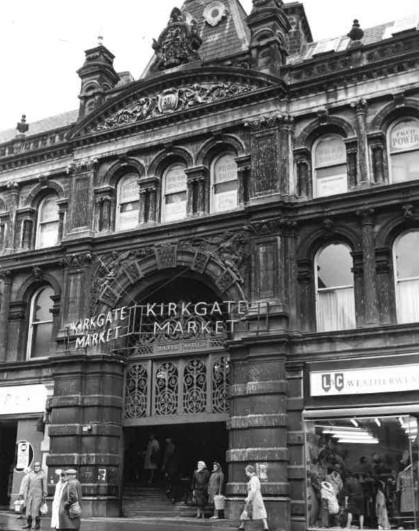
Kirgate entrance1

© Bradford Libraries


Sitting in the burgundy plush seats at the Alhambra waiting to see (amongst others) Norman Evans (over the garden wall) and Margery Manners (principal boy)……………. I remember very well seeing Wilfred Pickles play Buttons there with half a dozen or so live ponies on the stage. This means I almost certainly saw a young June Whitfield playing opposite him as Cinderella.

Anybody recognise any of this? I’ll try to think of a few more next time.

In the meantime, my memoir is on the library shelves, I believe, if you want to take a look.

Bob Nichol

3


Map of the Week: Bolton Woods

These two sections from a Bradford Local Studies Library map are part of a sale plan of the Bolton Hall Estate dating from 1882. Among other things it advertises the availability of building land and stone quarries. The right side of image 1 joins the left of image 2. The map as a whole marks a transitional stage between rural and industrialised phases in the district. Some woodland remains but quarries are in action, roads are being laid out, and houses have been built. Frizinghall mill is drawn although this and its reservoir no longer exist. The Bradford canal spur has also gone now, although the canal bridges remain. The railway line already existed in 1882 and it would appear that the extension of Canal Road to Shipley is being suggested.

Map of the Week 020 AMap of the Week 020 B

I have to admit that I am not sure of the precise boundaries of Bolton Woods. It is to your right as you travel up Canal Road from Bradford to Shipley although the very high ground is occupied by the much more ancient townships of Bolton, Idle, and Wrose. The designation ‘Bolton Woods’  appears on the 1851 OS map but is probably naming the woodland only. I think we can be certain that Bolton Woods was neither an old community, nor a planned one: it ‘just growed’. William Cudworth treats the area as part of Bolton township and two more recent authors have developed his account:

        A History of Bolton in Bradford-Dale: RC Allan (ed), 1927, p.107.

        The Story of Bolton Woods and St Laurence’s Church : Mary Lister, 1980.

Both these books are available in the Local Studies Library although the second is kept in the stacks and will have to be fetched by a member of staff. Mary Lister (1922-85) was a noted local historian who was ex-President of the Bradford Historical & Antiquarian Society, and taught at Hanson School. As a further source of information I am indebted to Tony Woods for the unpublished findings of his study into the district’s coal mining.

There is general agreement then that the history of Bolton Woods is quite recent. Before 200 years ago the district was simply noted for fields and a magnificent woodland. There were no roads, only trails through the trees. Peat could be cut there for fuel and the was some question of whether the inhabitants of Bolton had the right of turbary on land lying about Bolton Old Hall. In 1624 Bolton Manor became the property of Thomas Walker. The Old Manor House was soon demolished and Bolton Old Hall erected a short distance away. The Stanhopes of Eccleshill bought the Bolton Hall Estate from Thomas Walker in 1648. Bolton Woods was one of the many districts of Bradford where coal extraction may well have had medieval roots. In 1699 Cudworth describes various freeholders entering into an agreement to extract coal. Coal features again in a 1746 lease: near Hollins Close John Whitaker leased land for £6-10s with a condition of the lease being an undertaking to remove the coal-pit hill when it was dispensed with. By 1750 land around Bolton Grange Field was apparently much broken up by attempting to get coals through trenches or ‘Day-holes’.

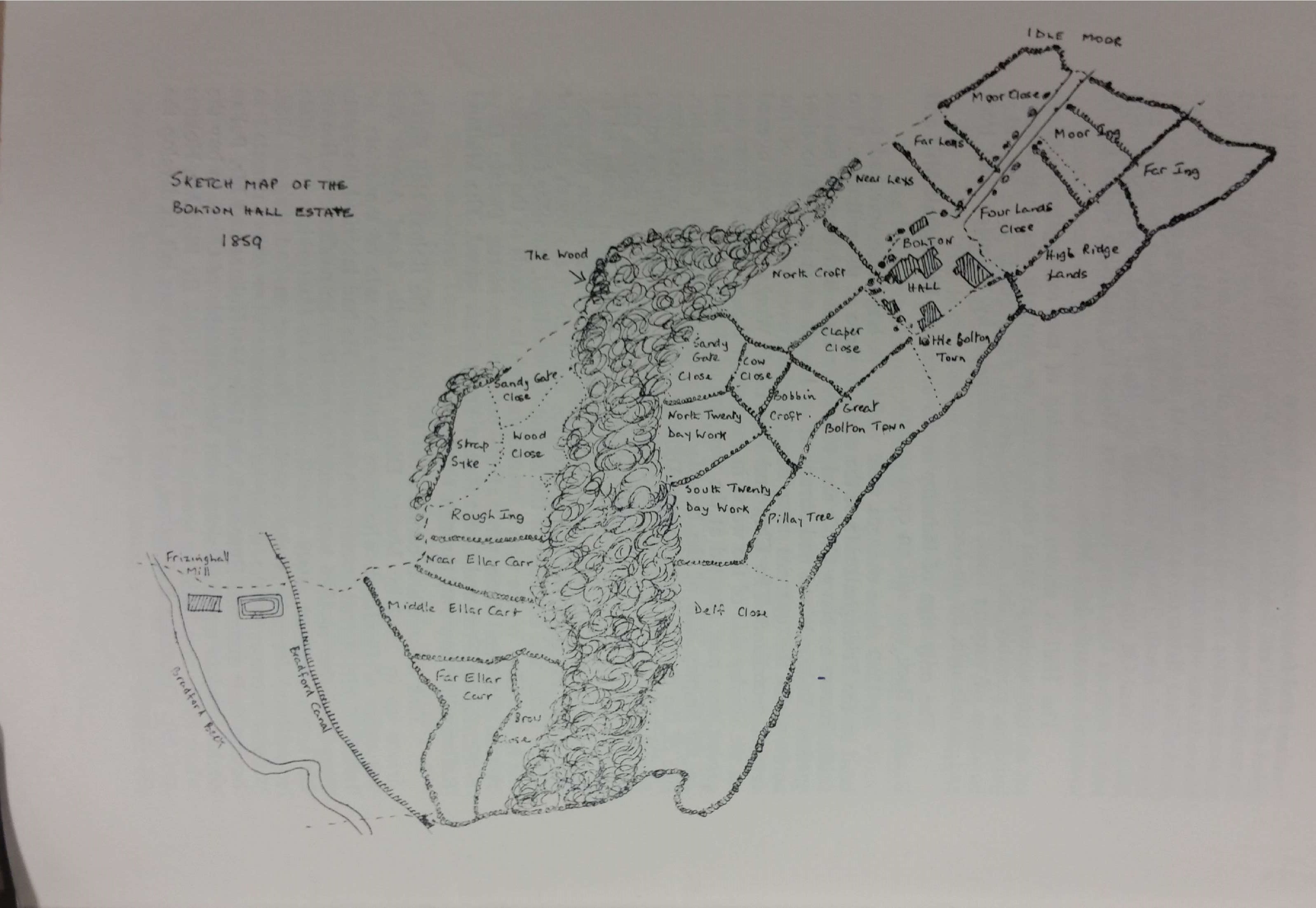
An Enclosure Act operated at Bolton Woods in 1819, and in 1825 Bolton Road was constructed.  By 1840 Walter Scott-Stanhope had inherited the estate and then sold it to his cousin Richard Watson of Springwood, Manchester. Watson’s Scottish bailiff equipped the farm and, according to Cudworth, by his efforts made it one of the best in the district. At first he grew wheat but later suggested that building stone might be more profitably extracted. The first modern quarry in Bolton Woods was opened by John Holmes and Thomas Dawson in 1853. In the later nineteenth century more organised extraction of the Hard & Soft Bed coal seams was undertaken in Bolton Woods. Shafts and ‘old shafts’ are present on early OS maps but no named collieries are indicated. In the late 1850s there seem to have been two companies: Handforth & Co, and Messrs Brogden & Co. Their enterprise was  known as Bolton Wood Colliery which had been leased by Richard Watson. It was under Navy Croft, Far Ellar Carr, Mid Ellar Carr, Nr Ellar Carr, Rough Ing, and part of the Woods.

You can identify these fields on the lovely sketch map Mary Lister drew for her publication. It shows the same area as the sale plan but is 25 years earlier and has a slight different orientation. Essentially it shows the land on which the village was later developed. The field name ‘Delf Close’ suggests that stone extraction pre-dated the nineteenth century; delph being a local name for quarry.

Map of the Week 020 C

Messrs Brogden was perhaps a partnership of miners extracting coal but their enterprise was dissolved by mutual consent (Bradford Observer, 18 June 1859). The majority of the men involved could not write but the literate James Brogden had been underground steward at Bunker Hill Colliery on Barkerend Road. A well-known Bradford brick-maker, Edward Gittins, is also involved at Bolton Brick Works in 1861 although I don’t know in what capacity. E. Handforth & Co. are listed as fire-brick and sanitary tube makers two years later in a single trade directory (1863). Elsewhere Handforth is listed as a ‘colliery owner and fire-brick manufacturer’. It is probable that the company bought up Bolton Wood Colliery and added a Firebrick works. In 1865 E. Handforth & Co were advertising in the Leeds Mercury for a firebrick moulder at Frizinghall, near Shipley. They seem to have sold up in 1867. The only product I can attest is a firebrick marked [..FORTH & CO BOLTON WOOD]. The extraction of coal was not always easy. Mr Woodhead of Eccleshill Potteries operated a mine in a field facing Home Farm in Hodgson Fold. It was worked by a horse-gin but failed due to flooding. In her book Lister mentions that a Bolton ‘Clay and Firebrick Works’, existed on the Shipley side of the Woods in a piece of land known as ‘Rough Ing’. When it closed it was replaced by Bolton Woods Shed (Woolcombers) which you can see on the first plan.

The ground now covered by village part of Bolton Woods was a part of the Bolton Old Hall estate purchased from Alfred Barton by three men called Holmes, Pullen & Constable as a building speculation for £11,000. John Pullen subsequently sold off Bolton Woods in small lots. Wilkinson Shann built first row of houses in Shann St. During this period the quarries were progressively developed and attracted workers to the area. The light yellow stone was purchased by Leeds for paving slabs and was used for buildings such as Manchester Town Hall and the Bradford Eye & Ear Hospital. In 1870 the construction of the defecation works at Frizinghall created additional employment opportunities and at the same time JT Riddiough opened a saw mill. In 1871  a highly influential man, Harry Stockdale, came to Bolton Woods from Long Preston. He was a builder and brick-maker and with George Lang he constructed Bolton Hall Road. In 1874 he was elected a councillor and was influential in the building of Bolton Woods first school. In a Yorkshire Directory for 1875 one entry for Shipley reads:  ‘Harry Stockdale, Bolton Woods Brick & Tile Works’. In the same year Mr H Stockdale was prosecuted for smoke nuisance from his brick kiln. Did he buy the premises of Handforth & Co? Strangely on 17 August 1878, the Leeds Mercury recorded that he appeared in court summoned by Bradford Corporation for the sum of £63.10s: this being the unpaid cost of sanitary works at his properties at Livingstone Road. Apparently he flew into a temper in the court, but was reprimanded and ordered to pay. Something unpleasant had clearly happened to a celebrated Bolton Woods resident. He died early in 1881. In the years before 1914 brick-making took place near the present children’s playground. There were also two rather rarer forms of industrial activity: a factory making glass marbles for Codd bottles and the Guana Fertilizer Works. The last coal-mining in Bolton Woods was in 1923 when Slater Bros worked a large day-hole in the hillside to north-west of Hodgson Fold. Apparently they had access to a 3 feet thick seam of poor quality coal but their colliery was soon abandoned. In 1956 Bolton Woods farm was finally sold for housing.

Derek Barker, Local Studies Library Volunteer

International Women’s Day

Wednesday 8th March is International Women’s Day and today we feature two ‘Women of Conviction’ active in local historical reforms: Frances Smith and Margaret McMillan.

Frances Smith was the first woman to winboth a municipal council election in Keighley and sit on the town’s Industrial Co-operative Society in the 1940’s and 50’s. One of her roles was chair of the council’s maternity and child welfare committee..

Margaret McMillan worked in deprived areas of Bradford in the 1890’s and agitated for reforms to improve the health of young children.

Frances Smith

Frances Maddocks was born at Hope St, Pennington, Leigh, Lancashire on the 1st August 1891. One of five children her father Edwin was a coal miner and her mother a silk winder. Her father premature death at the age of 44 from TB had a lasting effect on Frances. The family had to become resourceful. Aged only 9 Frances and her siblings sold fruit to the queues of people outside the local theatre and her mother took in boarders. Frances first job was as a Silk weaver and it was through seeking work in this industry that she moved to Keighley some time before the First World War.

In 1915 she married local man Harry Smith an iron Moulder and they went on to have one son Edwin in 1916. It is no longer possible to find out what stirred Frances’s involvement into the Co-operative moment or Local Politics but by 1943 she was actively involved in the movement and became the 1st woman to be elected to the board of directors of the Keighley Co-operative Society Ltd.

But Frances involvement in local issues did not stop there. By 1945 she had been working for the labour party for some years. Frances had forged a friendship with Ivor Thomas who in July 1945 took up his seat as Labour MP for Keighley on the labour parties winning of the general election. With his support, Frances was invited to stand as candidate for the 1945 municipal election. In November 1945 Frances won her seat with the biggest majority of the day. She signed the declaration book on 2nd of November 1945, and made history again by becoming the first woman to win a contested municipal election.

Frances wins the North east Ward Seat Municipal Election

For more information on Frances Smith see the full article ‘A Woman of Conviction: Councillor Mrs Frances Smith, First Lady of Keighley by Frances Gilbert and Angela Speight, published in Bradford Antiquary (2012) Volume 16 available at Bradford and Keighley Local Studies Library.

Margaret McMillan

Working in deprived districts of Bradford and Deptford, Margaret McMillan agitated for reforms to improve the health of young children, wrote several books on nursery education and pioneered a play-centred approach.She was born in New York in 1860. Her parents, were from Inverness but had emigrated to the United States in 1840. When she was four, an epidemic of Scarlet fever killed her father and sister. Mrs. McMillan returned to Scotland with her daughters Margaret and Rachel, where both attended the Inverness High School. Margaret went on to study Psychology and Physiology, followed by Languages and Music in Germany.

By 1888 both sisters had become active in local politics.In 1889, Rachel and Margaret helped the workers during the London Dock Strike. In 1892 they moved to Bradford. There they joined the Fabian Society, the Labour Church, the Social Democratic Federation and the Independent Labour Party.

With Bradford’s school medical officer, Dr. James Kerr, Margaret carried out the first medical inspection of elementary school children in Britain. They published a report and began a campaign for local authorities to install bathrooms, improve ventilation and supply free school meals for children, after seeing the success of Bradford Cinderella Club providing a warm meal to underprivileged children.

Their experiences in Bradford were to shape their later work in Deptford.

For further reading about Margaret and Rachel McMillan we have a good selection of books in Local Studies, please see the list below:

Select reading list of Margaret McMillan books in Bradford Local Studies Library

 Margaret Macmillan: portrait of a pioneer by Bradburn, Elizabeth. Routledge (1989), 9780415012546

All children are mine: inaugural Margaret McMillan lecture by Greenwood, Arthur London U.P (1952)

Margaret McMillan in Bradford, with reminiscences: fourth Margaret McMillan lecture by Lord, Miriam. London U.P (1957)

Our children: Margaret McMillan and the open air nursery school by Lord, Miriam. Lund Humphries

Margaret Mcmillan the childrens champion by Lowndes. Museum P (1960)

Margaret Mcmillan:founder of the open air nursery school by Margaret McMillan Memorial Fund

Camp school by McMillan, Margaret. George Allen & Unwin (1917)

Margaret McMillan: ‘I learn, to succour the helpless’ by Moriarty, Viv. Nottingham Educational Heritage (1998) 9781900219136

The young child and the life of today: third Margaret McMillan lecture by Niblett, William Roy. London U.P (1956)

Margaret McMillan, 1860-1931: reminiscences by Rachel McMillan College Association

Social and political change in England: Margaret McMillan and the battle for the slum child by Rees, Rosemary. Longman Resources Unit (1986) 9780582173637

Childhood, culture and class in Britain: Margaret McMillan, 1860-1931 by Steedman, Carolyn. Virago (1990) 9781853811234

Margaret McMillan: prophet and pioneer: second Margaret McMillan lecture by Stevinson, Emma.