TREASURE OF THE WEEK No. 12 “TAKE THE SAFEST PATH, FOR I AM FOLLOWING YOU

JND 193/21 (Please quote this number if requesting this item)

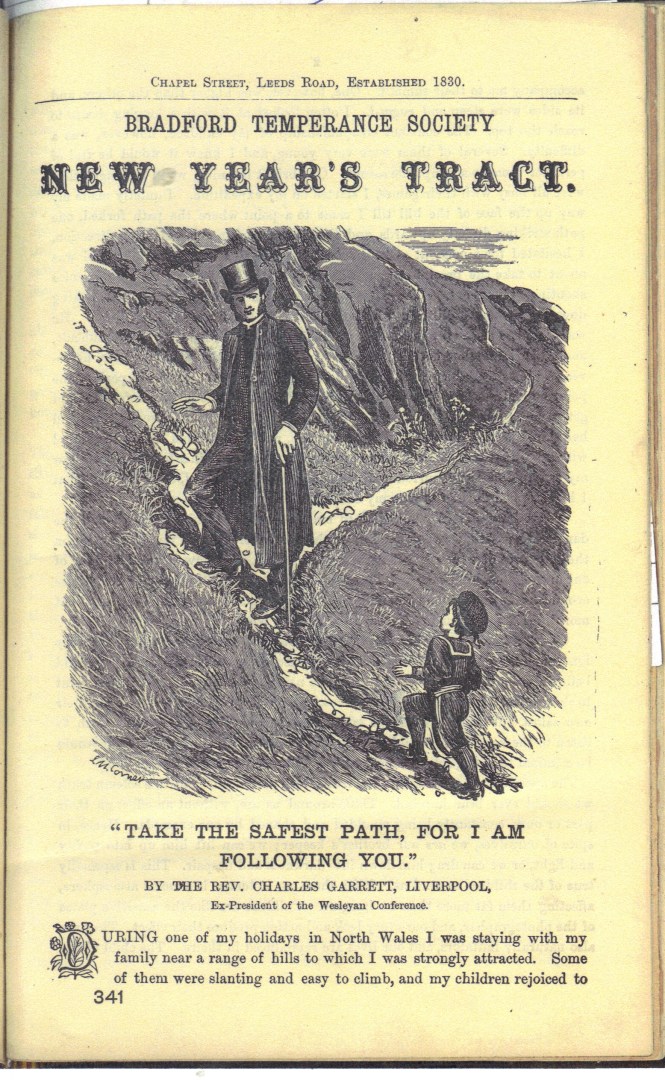
GARRETT, Rev. Charles. “Take the Safest Path, for I am following you”. Bradford Temperance Society New Year’s Tract.
Scottish Temperance League Monthly Pictorial Tract. 1881? 4 pages.

08-10-2016 17 33 34.JPG

“I beseech the readers to realize the tremendous power which they possess and to resolve by God’s help to tread the path of abstinence, if for no other reason, because the children are following them.”

The Temperance movement was huge in late Victorian Britain. The striking illustration on the front page of this tract was inspired by a holiday in North Wales taken by the author of this tract, the Rev. Charles Garrett of Liverpool, ex-President of the Wesleyan Conference.  Although it may be hard to resist the temptation to drink alcohol, like climbing a mountain, it should be done for the sake of our children, and others, who are following you.  And of course, to take the ‘safest path’.

This New Year’s tract was, as we now say, syndicated.  Presumably the Bradford Temperance Society subscribed to copies of the Monthly Pictorial Tracts produced by the Scottish Temperance League, and then sent to its members.

Stackmole

National Dementia Awareness Week: Memory Boxes

14th-20th May is National Dementia Awareness Week as the Alzheimer’s Society asks people to unite against dementia, to raise awareness and to offer help and understanding.

Memories, first hand recollections and experiences of people are extremely important and valuable to us all and thoughtful and engaging use of reminiscence when used well can be especially effective for those with dementia.

With this in mind we have refreshed and updated the Memory Boxes available to borrow from the Local Studies library.

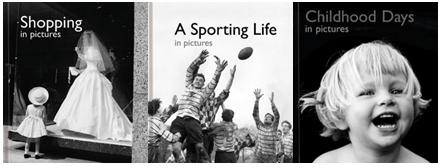
The packs contain a selection of multi-sensory objects, pictures and memorabilia plus a beautifully illustrated book which reflects the topic.

We all like an occasional trip down Memory Lane and reminiscence can be great fun for everyone involved, as well as being an important activity that affirms our sense of identity.  These Memory Boxes can stimulate arts, history and memory groups. They can be used in a variety of settings including social and community groups, day centres and residential homes.

Our boxes include a book in the series of ‘Pictures to Share’ books designed for people with dementia. These books can help and encourage communication and discussion when shared with carers, provide a calming activity for the person to do alone, and promote a feeling of worth and well-being.

memory books

Pictures to Share books are based on a variety of general themes. They include a wide selection of powerful, colourful and attractive images and texts.

For more details please see our leaflet here:

Memory boxes for reminiscence

Bradford Libraries would like to thank the ‘The Memory Bank’ forum for creating the original concept and sourcing artefacts which form the basis of these collections.

A Bradford Childhood 1944-1955 – Part 3

Our move from Thornbury to Eccleshill inevitably involved enrolment at a new school:

Wellington Road Junior School was about a mile away from where we lived, and I walked there and back, lunchtimes included, every school day until I was eleven.
It was stone built with slate roofs and mullioned windows, some of them gothic in shape and set high in the walls. There was a bell tower near the head teacher’s office and this had an inscription in the stone that indicated it was an original Board School built in 1880.

I had several teachers in the earlier part of my stay there, but for my last two years leading up to the 11 plus I was very much under the permanent influence of Miss Davis, probably the most senior teacher in the school other than the head. She was highly respected, strict, methodical, skilled and sensible.

She was probably in her fifties when I knew her. She was of average height, quite slim, had a longish face and wore her greying hair swept into a bun at the back of her head. Like my mother, she put on a little make up and powder. Everything about her was sensible and controlled. She wore long, sensible woollen or worsted skirts, often some kind of herringbone or plaid, and a smart woollen twin set or blouse and cardigan and low-heeled shoes. She occasionally chose to wear some simple jewellery: a brooch, or a modest string of pearls, but no rings.

She read to us a lot in the afternoons. She would let us engage in simple handicrafts while she read, the boys often crocheting long chains of wool via the holes in old cotton bobbins. One afternoon she involuntarily revealed the softer side of herself when reading a sad passage from ‘Uncle Tom’s Cabin’:

We were all listening and knitting or crocheting when we suddenly realised the narrative had stopped. When we looked up we saw that Miss Davis was attempting to say the words, but no sound was coming out, and that tears were streaming down her face. Eventually she stopped attempting to read and began to sob, her shoulders heaving and her face beginning to contort. Two girls stood up and walked down the stepped aisle and made awkward attempts to comfort her. The rest of us looked on in stunned silence.

She recovered and eventually carried on reading, but the incident always stayed in my mind and often in later years made me think about the power of art and the mysteries of the human soul.

My father was determined I should go to grammar school but some of the coaching he organised for me at home didn’t always bring happy results:

One evening I became so upset and frustrated, I threw the pen down on my exercise book and swore, saying I would never do any more, ever. The action produced an explosion of ink from the pen resulting in a huge blue-black arc on the wallpaper of the adjacent wall complete with drips and runs flowing downwards from the ceiling to the skirting board. There was silence apart from my mother’s tears, and then she attacked my father verbally and I was forgotten in the midst of their bickering.

By the time of the examination itself I had IQ tests coming out of my ears and I had more or less forgotten it was even going to happen:

There was no warning given before the day that we were to begin our 11+ examinations. I remember walking, as usual, along the Harrogate Road to school on a blustery spring morning happily fascinated by straining trees, glinting puddles and ragged crows flung about in the sky, unaware something serious was about to happen. Only when required to file through long rows of quiet, sombre desks that had appeared overnight in the main hall outside our classroom did I realise that the long anticipated day had arrived. Miss Davis took the register and had a few discreet words about it being the first day of the dreaded 11+, how we should not be flustered by the event and should approach the whole thing with confidence. We entered the hall, took our places where our names were written on a card on a desk, together with a number, and then, when prompted, began to read the instructions, fill in our individual details, and answer the questions.

Taking the 11 plus was the last significant thing I did in Bradford. After that, we moved across the Pennines to Cheshire and my Yorkshire citizenship was ended. Except that it wasn’t, of course, because it never leaves you no matter where you go or how old you become. Yorkshire remains my spiritual home even though I am no longer a resident. My childhood experience in Bradford was enormously important to me and I suppose that is why I felt impelled to write about it. I was just turned seventy when I started to write and I didn’t want to lose the memory and, more importantly, I wanted to share it with my children and anybody else who might be interested to read it.

If you take the whole piece out to read, I hope you enjoy it and that it might either remind you of your own early life or give a reasonably accurate account of life as it was lived by a little boy in Bradford immediately after the Second World War.

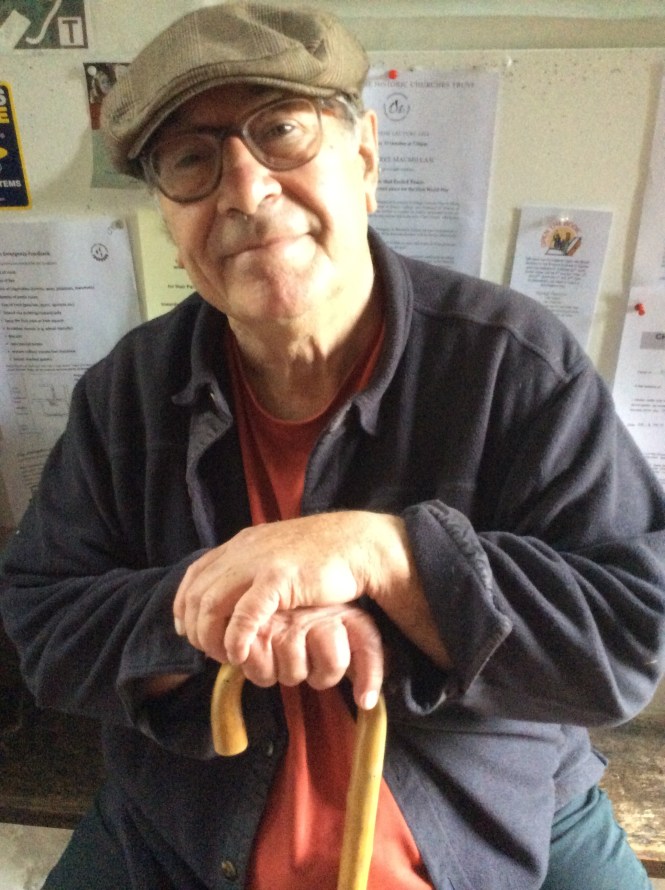
Bob Nichol

Bob Nichol


Neglected Bradford Industries: Iron-smelting

Bradford is famous for spinning and weaving but textile production was only one of a group of important industries which ‘Worstedopolis’ supported. Since several  are now almost forgotten by contemporary citizens I should like to draw attention to those which seem unreasonably neglected, in a series of short articles.

The production of copperas (iron sulphate) and glass in the Bradford area have been completely forgotten. Brick-making has escaped serious study until quite recently. It is the extent, rather than the existence, of quarrying, coal-mining and iron-smelting that has tended to pass out of memory. I shall try to provide a brief introduction to these industries and to some smaller concerns: pottery, fireclay production, lime burning and vitriol manufacture. My survey cannot be exhaustive since I know very little about soap boiling, clay pipe production, nail making or leather tanning. I hope any reader with knowledge of these activities will feel free to contribute. Although my main interest is in the history of technology I am not unaware that the successes I shall describe came at considerable human cost. In the period selected the rural poor were driven by a need for work into factories and crowded, unsanitary, housing. Some employers, like Titus Salt, were humane men but others were exploitative. Foundries, mines and vitriol works were dangerous places where often little thought was given to worker safety. Those who paid the price of progress seldom reaped its benefits.

Bradford had many advantages as an industrial centre. Building stone was relatively easy to acquire, and since the late eighteenth century there had been a vigorous brick industry. Cheap local coal was available, and could be coked to supply blast furnaces which made pig iron from locally dug ironstone. There had long been water-powered corn and textile mills but it was the introduction of steam engine power that really transformed any process that was capable of mechanisation. Cloth production was a principle beneficiary of this technology which in turn promoted the development of textile engineering in Bradford and Keighley. The town was originally a communications backwater. It was hard to move raw materials, or manufactured products, cheaply and speedily. Horse transport had been used for centuries and a network of pack-horse routes had developed throughout West Yorkshire. The construction of turnpike roads in the years 1734-1825 produced a substantial improvement in the situation. With the opening of sections of the Leeds to Liverpool canal in the 1770s, with its spur into Bradford, transport of bulk goods, especially coal and limestone, became far cheaper. Railway links were established by the 1850s.

Iron1

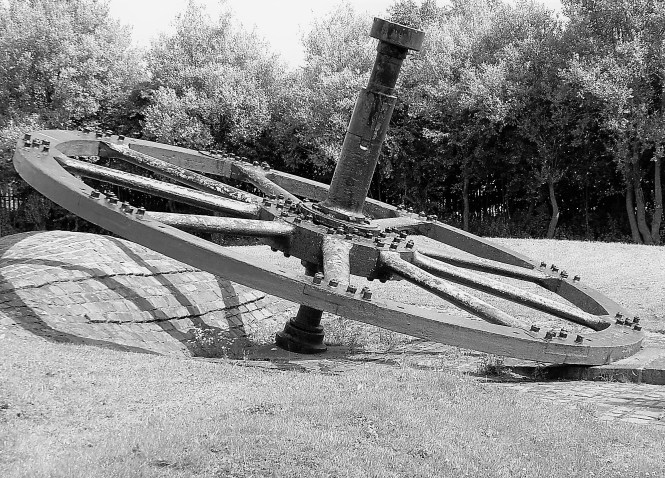
A 30.5 ton Rolling Mill flywheel presented by Alan Elsworth and preserved for display near the site of Low Moor Ironworks.

A century ago no community would be without its blacksmith but Bradford could boast a complete package of iron based technologies: ironstone mining, iron-smelting, and foundries. Historical sources, and deposits of slag, suggest that a medieval, bloomery furnace based, iron-smelting had occurred at Eldwick, Harden, Baildon, and Eccleshill, with charcoal being the fuel employed. Until their dissolution around 1539 northern Cistercian abbeys were heavily involved in iron-making but there is some documentary evidence of late Tudor smelting at Esholt and Hirst Wood, Shipley.  The origin of modern industry was the discovery in 1709, by Quaker ironmaster Abraham Darby of Coalbrookdale, that iron could be successfully smelted using coked coal. This advance took about 50 years to be widely accepted. Darby’s grandson was the creator of the famous iron bridge.

Iron2

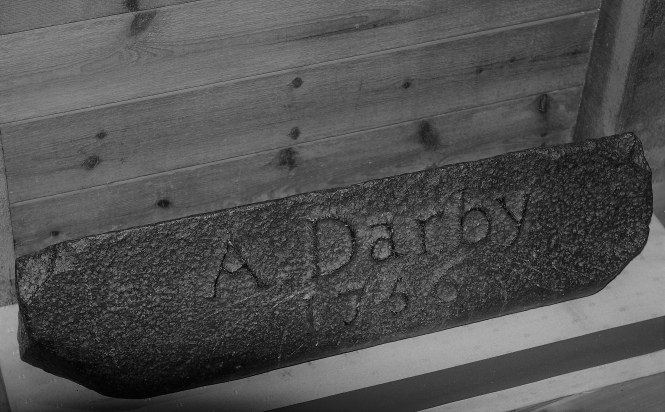
An iron pig produced by Abraham Darby in 1756, on display at Coalbrookdale Museum.

Bradford did not have the capacity to produce vast quantities of charcoal for blast furnace fuel but Darby’s discovery resulted in south Bradford’s Black Bed coal seam being mined for its rich roof deposits of ironstone. It was discovered that the deeper Better Bed coal seam was low in sulphur and phosphorus and so produced coke highly suitable for iron-smelting. The  industry was capital intensive but blast furnaces were set up at Birkenshaw (1782), Bowling (1788), Low Moor (1791) and Bierley (1810). Their products were cast iron and the ‘best wrought iron’, produced by Cort’s ‘puddling’ process. Cannon and shot were manufactured during the Napoleonic Wars. At a later date the companies did not adopt the Bessemer process to convert cast iron into steel for which Sheffield became celebrated. The furnaces are long gone but the ‘dross’ waste and some of the iron products remains. I vividly remember encountering some Low Moor cannon at Alnwick Castle. As local deposits were exhausted mineral carrying tramways transported vast amounts of coal and ironstone for miles towards the furnaces. In the 1960s a scholar called Derek Pickles studied the mineral ways supplying Bowling Iron Works. His detailed and fascinating work is curated by Bradford Industrial Museum but I know virtually nothing about him. Can anybody help me?

Iron3

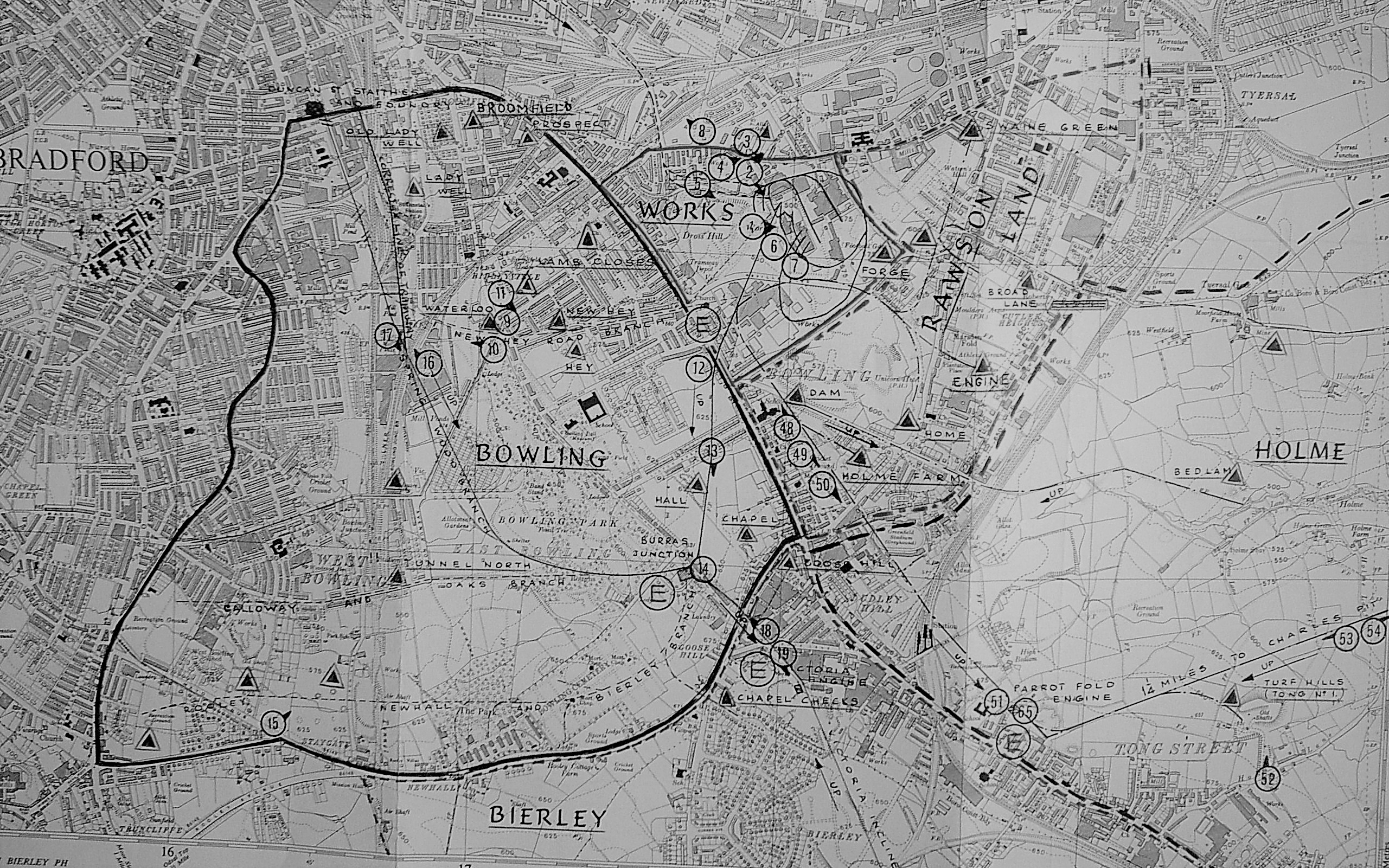
A plan from Derek Pickles’s study showing mineral ways around Bowling Iron Works (top centre). The triangles mark collieries.


If you want to undertake further background reading the Local Studies Library has copies of three useful texts:

  • RCN Thornes, West Yorkshire: A Noble Scene of Industry, WYCC (1981)
  • Gary Firth, Bradford in the Industrial Revolution, Ryburn Publishing (1990)
  • C Richardson, A Geography of Bradford, University of Bradford (1976)

Derek Barker, Local Studies Library Volunteer

A Bradford Childhood Part 2 – 1944-1955

As a family we were what would be called these days “upwardly mobile” and our move from Thornbury to Eccleshill was a modest first step up the social scale:

 When I was about eight, we moved to our new home in a sunnier, less tightly packed part of Bradford where we were more likely to play in each other’s gardens than on the local wasteland and back streets as we did at our previous address. It soon became apparent, however, that there were several forbidden places of excitement close by and I began to explore them eagerly with my new friends.

One of my early adventures involved being in a group of boys that climbed up a nearby fire escape running down the side of a local mill:

We set foot on this first metal rung and began to climb. The first few steps were easy but, as you could see straight down to the ground through the open mesh of the steps and, as the railings were also quite open and apparently fragile, the climb became more challenging with every step upwards as the ground below grew increasingly distant. We got about two thirds of the way up and were just beginning to appreciate the view over the nearby roofs and chimneys when we noticed the whole structure began to wobble. We stopped and discussed the issue, but decided to carry on and see if we could make out the roof of the Ring O’ Bells pub from the top. Then we heard a voice from way below:

‘Oi! What do you think you’re doing? Get down here now!’

Our lives became less parochial after my father bought a car:

It was about this time we started to travel out to the Dales and other parts of Yorkshire almost every weekend in our second hand black Morris Eight saloon. It was very small, but it had real leather seats and a curtain to pull down over the rear window. Mum and dad sat at the front and Pauline and I sat in the back.

I think the windscreen wipers may have been hand operated and it had to be started with a crank handle. It had black painted wire wheels and chrome plated round hubcaps with a large ‘M’ pressed into them. We all absolutely loved it. The registration plate announced we were DNW613, but we, like so many other aspiring lower middle class families of the time, gave her our own name. We decided, for reasons that now completely escape me, to call her ‘Flossie’. It was my father’s pride and joy and we were all required to put on our best clothes to take a trip in her. My mother would wear her grey suit and my father his grey flannels and the green Harris Tweed jacket with leather buttons and elbow pads that he kept for weekends. The car had two doors, narrow running boards and a spare wheel attached at the back over the small boot. My father often smoked his pipe when driving, which, combined with the smell of waxy shoe polish from my shoes, made me feel quite sick. He had special leather driving gloves with string backs and he almost always wore his flat cap. There was no radio and no heating.

ecc1

Our journeys and holidays at that time still provide me with many of my better memories:

I still miss the grass, the moors, the large skies, the limestone, the becks and brown rivers, the hills, the cry of the curlew, the bleat of the lambs, the waterfalls, the wild places, and the villages of the Dales. When I was a child I saw in Grassington a farrier shoe a carthorse and, in Reeth, a wheelwright put together an entire cartwheel, hub, spokes, metal tyre and all. I saw farmers cutting wheat with simple farm machinery and making stooks from the sheaves in the fields.

If it rained all day, we drank coffee in the car from my mother’s flask and nibbled ginger biscuits; if it was warm and sunny my sister and I would scramble up the sides of the nearest hill and look down on the tiny figures of our parents sitting by the car in their little picnic chairs, reading the paper or drinking tea. We collected stones, twigs, sheep’s wool, broken birds’ eggs, and cast-off feathers. We picked bilberries by my father’s hatful and took them home for my mother to bake in a pie. It was all very simple, very innocent, and we loved it.

ecc2

I expect all of us of a certain age remember the year of the coronation:

We had been in our new house perhaps a year when preparations for the queen’s coronation began. It was a more innocent age and everybody seemed keen to participate in the occasion as well as be an onlooker. I can’t remember much deviation from our normal lessons at school, but at home there was quite a lot of excitement and activity. All the residents did something to decorate their house. In our case, where others in the street were satisfied with bunting, my father erected in the centre of the front garden a white flagpole planted firmly in the lawn and supported by guy ropes attached to huge metal tent pegs. It reached beyond the top of the roof. For the week before the coronation, he ran the union flag up the pole every morning before leaving for work and took it down again in the early evening. At each event anybody in close proximity was expected to line up to attention on the path by the side of it (there were usually half a dozen kids, or so, and a sprinkling of adults) and salute whilst singing the national anthem at the same time. I think we may have had a special ceremony during the day when the news of the conquest of Mount Everest came through immediately before the big day on 2nd June 1953. There was not the faintest hint of irony in any of this.

When the Queen came to Bradford some time after her coronation, dozens of us went to see her as she was driven down Pullen Avenue to the roundabout by The Ring O’Bells and on into the Harrogate Road and beyond.
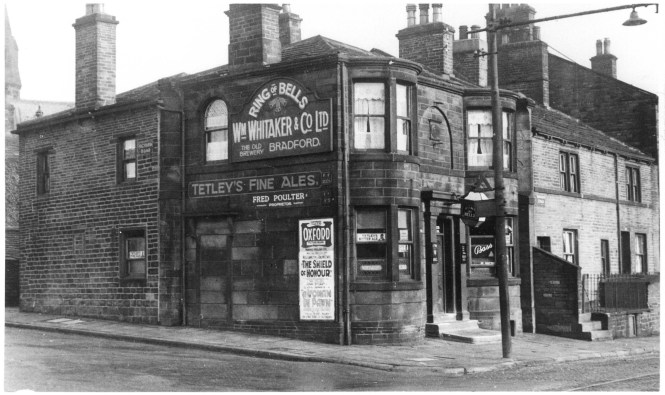
Ring o Bells Harrogate Rd, Eccleshill

The Queen’s car slowed to less than walking pace as it came close. There was a soft light within the car that caught the glimmer of her youth, the richness of her dress and the brightness of her jewels. She looked utterly beautiful; she was like a film star; glamorous and self-confident, important and revered. She passed slowly, smiling and waving, then, towards the tail end of the crowd, the chauffer kicked onto the accelerator and she was silently swept away at speed into the vastness of the Yorkshire night.

Last time I wrote about a few memories I didn’t put in my memoir and I said I’d try to think of a few more.

Does anybody remember when Leeds, Bradford Airport was simply called Yeadon Aerodrome? I remember watching De Havilland Dragon Rapides take off and land from there many times.

Perhaps you were there at the air display my family and I attended when a jet flew very low along the whole length of the runway at the same time as breaking the sound barrier, crowds of spectators being only yards away either side of it!! How’s that for Health and Safety!! I can still recreate the resulting BANG inside my head!! The jet later climbed almost vertically into the sky and disappeared into the clouds. This makes me think it was probably a prototype English Electric Lightning, but I can’t be sure.

Another memory is of walking one summer evening with my father and looking over the top of a high wall into the premises of the Jowett Motor Car Works.

Jowett Motor Manufacturer.jpg

I think they may already have been experiencing difficulties because my father said something about it and I could also see for myself nothing but rows and rows of (presumably) unsold Javelins and Jupiters filling the whole of the car park outside their factory.

Do you remember the Jowett Javelin, often referred to as the doctor’s car as it was steady and reliable and slightly upmarket? I saw quite a few out and about in Bradford when I lived there.

Jowett Javelin advertisement c1950

Next time I’ll tell you about my junior school and the teacher who prepared me for the 11+.


Bob Nichol
ecc3