Treasure of the Week no. 19: Omnibuses, Gas Stoves, ‘Horses in Stock’ and a Tripery – What the Council did in 1889

JND 194/13 (Please quote this number if requesting this item)

jnd 194 13 001

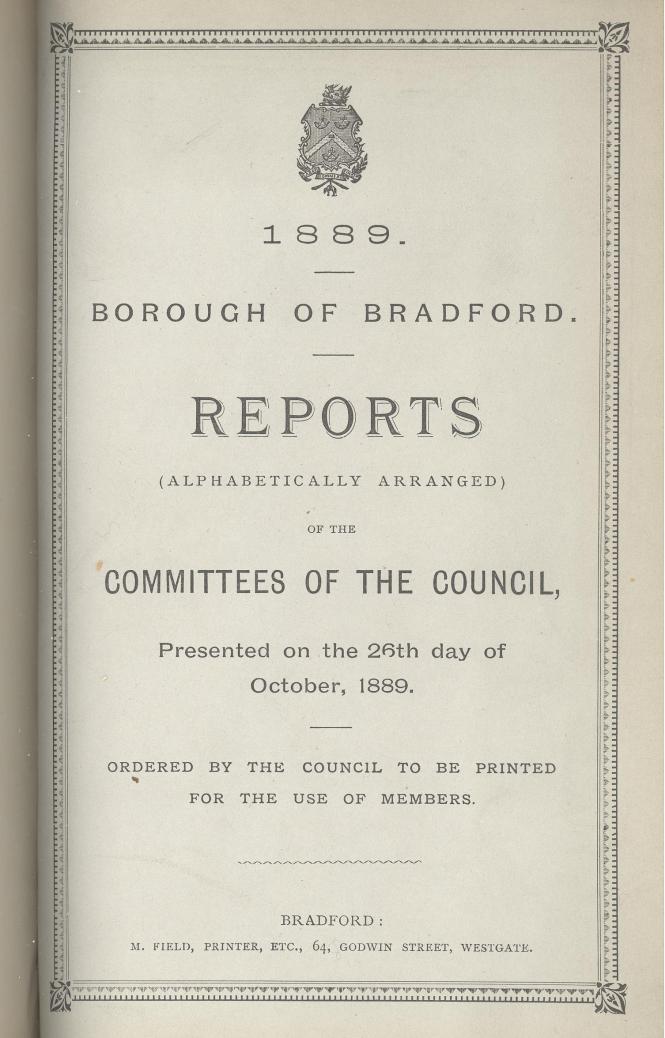
BOROUGH OF BRADFORD.   Reports of the Committees of the Council, Presented 26th, October, 1889.            Bradford: M. Field, Printer. 1889. 96 pages.

Council documents are a rich source of information. So much of what happens in a locality is due to the decisions and actions of the local authority. In 1889 Bradford covered a much smaller area than it does now – as witnessed in the second report noted below under the Finance and General Purposes Committee. Of great importance to us today was the decision to build reservoirs on the Nidd Valley, noted in the report of the Waterworks Committee. The topics listed below are only a small selection from a year’s work of the Council, much of which was routine. Committees, and some items from each, were:

Building Committee

49 new streets planned

Finance and General Purposes Committee

186 Omnibuses and 44 Tram Cars licensed

Parliamentary powers to be sought to extend Bradford to include Allerton, Heaton, Thornbury and Tyersal

Free Library and Art Museum Committee

New branch library opened in Barkerend

Gas and Electricity Supply Committee

Gas Stove Department report

Hackney Carriage and Cleansing Committee

94 notices served re smoke prevention

Markets and Fairs Committee

The ‘Tripery’ building has been successful

Parks Committee

Flowering plants and evergreens planted at Forster Square

Sanitary Committee

66,903 ashpits emptied

30 public urinals maintained

Street and Drainage Committee

Postal Telegraph wires have been laid underground in Great Horton Road

Street Improvement Committee

New and improved sight lines prescribed for Heaton Road

Tramways, Baths and Team Labour Committee

 The Cheapside and Otley Road Tramway opened

 27,470 people used the swimming, slipper and shower baths

 66 horses in stock

Waterworks Committee

New water filter approved for Thornton Moor Reservoir

Parliamentary approval to be sought to build reservoirs in the Nidd Valley


Stackmole

Neglected Bradford Industries: Vitriol (sulphuric acid) making

I expect everyone will remember dilute sulphuric acid from school chemistry, or the contents of car batteries. In the Middle Ages alchemists made the concentrated acid, vitriol, by heating crystals of hydrated iron II sulphate (green vitriol). This is a topic I will return to when I describe copperas manufacture at Denholme in a future article. In the eighteenth century vitriol was needed for manufacturing chemicals like nitric and hydrochloric acids, and in an early industrial process for making washing soda. Hydrochloric acid was the starting point for chlorine production and the gas made was in turn used in a textile bleaching process. The synthesis of important fertilisers in the nineteenth century, like ammonium sulphate and super-phosphate, required large amounts of sulphuric acid. Some of the documents relating to a Bradford works mention ‘manures’ by which name, I assume,  the artificial fertilisers were once known.

In 1746 John Roebuck (Birmingham) had adapted a process of burning sulphur with saltpetre to form sulphur trioxide, within acid-resistant chambers made of lead. Sulphur trioxide was then dissolved in water to form the vitriol. Lead was chosen for the chambers since it was the cheapest acid-resistant metal available. These large, strong and cheap receptacles produced 35-40% acid. The chemists Gay-Lussac and Glover replaced the chambers with towers, obtaining a more concentrated product. The manufacture of some dyes, and nitrocellulose, required an even more concentrated acid which could still be produced by the dry distillation of hydrated iron II sulphate.

North Brook Vitriol Works was situated between Wharf Street and Canal Road.  Vitriol and aquafortis (nitric acid) were first made there by Benjamin Rawson (1758-1844). He is believed to have been in operation by 1792 which makes the works one of Britain’s first chemical plants. In this and much else Bradford was ahead of the game. Shortly afterwards Rawson purchased the Lordship of the Manor of Bradford, a role in which he and his two daughters, Mary and Elizabeth, will be familiar to local historians. In 1838, before Rawson’s death, the works were bought by Samuel Broadbent. He lived in Northbrook House and his garden led to the canal. Additional chemicals were now sold: spirits of salts (hydrochloric acid) and ammonia.

06 Image

Mid-nineteenth century plan showing the relationship between Northbrook House, the Vitriol Works and the Canal

Northbrook House was later used as offices and one of Samuel’s daughters married George Henry Leather, a worsted spinner. Leather took over when Samuel died and after 1844 the whole plant was known as Leather’s Chemical Works, a name which was familiar to Bradfordians within living memory. Leather also sold chloride of lime as a disinfectant, which may have been needed since the smell of the works, the canal, and nearby tipped human waste, was described in the Bradford Observer as ‘abominable’. Chloride of lime (calcium hypochlorite) was made, by exposing slaked lime to gaseous chlorine in brick built chambers. One of the most interesting documents I read in the West Yorkshire Archives when researching this subject was a memorandum of 1887 to Leather’s Chemical Works from the famous fertilizer company, Jas. Fison & Sons of Thetford. An enquiry from Leather’s revealed that Fisons were using a platinum still, presumably to concentrate and purify their sulphuric acid. The still cost £5,600 and was bought from Johnson Matthey & Co of Hatton Gardens, London. This company was brought to public notice recently by the failure of its banking subsidiary, JMB, in 1984. The parent company is heavily involved in precious metals, and chemicals, today.

Samuel’s grandson Henry Burnet took over when George Leather died in 1897. By this time a new means of making the acid, the Contact Process, was becoming widely employed. I’ve found no evidence that this was adopted in Bradford. Possibly keeping the existing plant required little capital expenditure and the decision to stick with older technology was essentially a financial one. I understand that the site was still a chemical works as late as 1970. Then it was initially sold to Occidental Petroleum but Bradford Council purchased the site a year or two later and demolished the works.

There is one small puzzle. In his book The History & Topography of Bradford John James describes a bizarre incident. About 50 years before he wrote a group of gentlemen founded a Bradford Philosophical Society. One of the members, a chemist, after many experiments discovered a way of rendering oils ‘pure and transparent’ by application of a strong acid. One of the other philosophers thought he would try cleaning the working parts of the watches and clocks of the town with the same acid. As a result all the clockwork corroded. If James was being exact the date of the trials would have been 1791. The reaction between sulphuric acid and vegetable oils is quite complex but no one could call the result transparent. The acid would attack all eighteenth century known metals except lead and gold. It does seem probable that experiments were being made with the newly available cheap vitriol but please, please, do not try these at home.

If you want to explore vitriol making further I would suggest:

AE Musson (ed), Science, technology and growth in the eighteenth century, 1971.

Documents and photographs of Leather’s Chemical Company are held by West Yorkshire Archives (Bradford): 30D90.


Derek Barker, Local Studies Library Volunteer

Neglected Bradford Industries: Brick-making

Bradford is famous for spinning and weaving but textile production was only one of a group of important industries which ‘Worstedopolis’ supported. Since several  are now almost forgotten by contemporary citizens I should like to draw attention to those which seem unreasonably neglected, in a series of short articles.

Together bricks, tiles and terracotta form the ‘ceramic building materials’. This technology was introduced into Britain twice; firstly by the Romans and secondly from the Low Countries in the Middle Ages. The ruined Augustinian priory of St Botolph, Colchester (1100-1150) is a Norman building built of flint rubble and recycled Roman brick. Brick use was insignificant until the fifteenth or early sixteenth centuries when magnificent work appeared at Tattersall Castle, Lincs (1440-1450), Framlingham Castle, Suffolk (soon after 1476), and Hampton Court (1515). The first West Yorkshire brick building is believed to be Temple Newsam House, Leeds (1640-60s). The earliest Bradford brick-maker I have been told about features in the Eccleshill parish records of 1714. Later, in 1718, John Stanhope of Eccleshill wanted to build a new hall and so reached an agreement with John Brown of Nottingham who promised to ‘dig and throw sufficient clay to make 100,000 good stock bricks’. The bricks were large by modern standards, being 10 inches long, 5 inches broad, and 2.5 inches thick when burned.

Hand-moulded bricks were formed by a maker throwing a clay and water mix, of the correct plasticity, into a wooden mould. A skilled maker with a lad could produce a thousand or more bricks daily. Newly moulded green bricks were dried slowly in a hack, or shelter, and could then be successfully fired in a free-standing heap or clamp. Constructing a true kiln needed more expenditure but the firing was more controllable, resulting in a better product and fewer waste bricks. Hand-made bricks survived the spread of the latter mechanical brick presses since their manufacture required little capital. Such bricks are still available today for conservation projects.
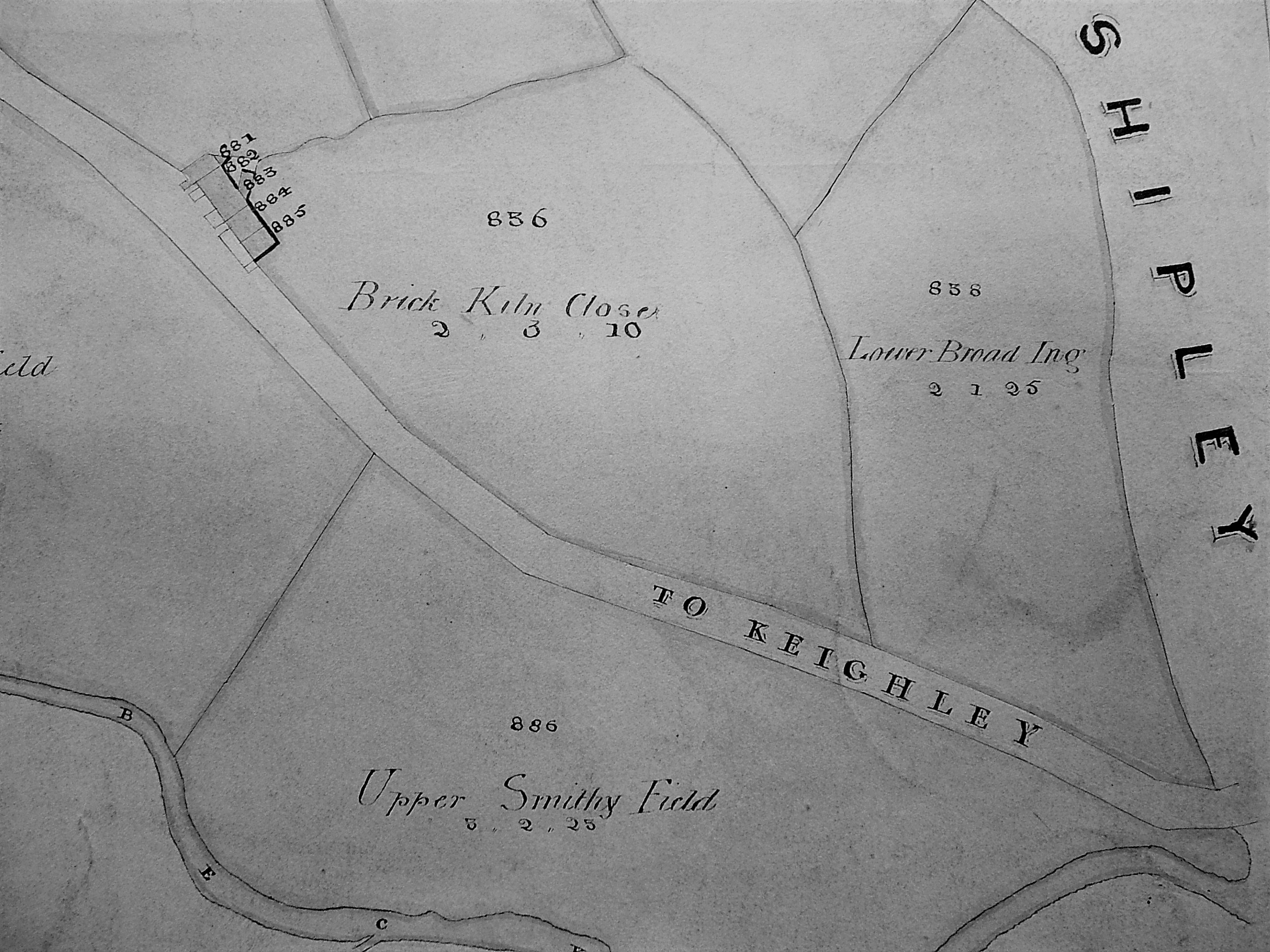
05 Image A

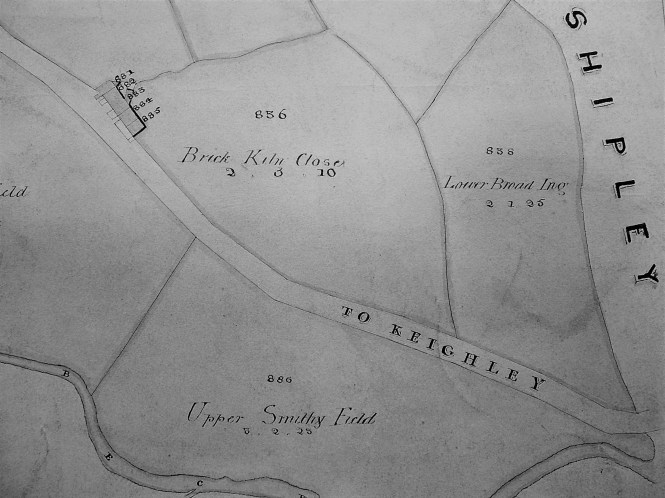
Brick-kiln close, Frizinghall. Field names with brick related elements, or buildings known as Red Hall or House, are common indicators of early brick production and use.

Local historian Tony Woods has studied the Rosse Archive records now in Ireland. He can demonstrate that Heaton coal pits were supplying a brick kiln as long ago as 1776. The field name recorded on the above map from the Local Studies Library collection confirms that there was one such kiln quite close to Heaton village, but there may have been others.  A study of early Bradford maps suggests that brick fields preceded established brick works. Evidence from elsewhere suggests that the alluvial clay in such fields was leased by owners to itinerant brick-makers who dug it and prepared it for firing into hand-moulded unmarked, or plain, bricks. There is evidence that there were such undertakings at: Fagley Lane, Bowling Back Lane, Low Moor, Frizinghall, Manningham, Leeds Road, Manchester Road, Bolton, Undercliffe, Shipley, Eccleshill and Wilsden.
05 Image B

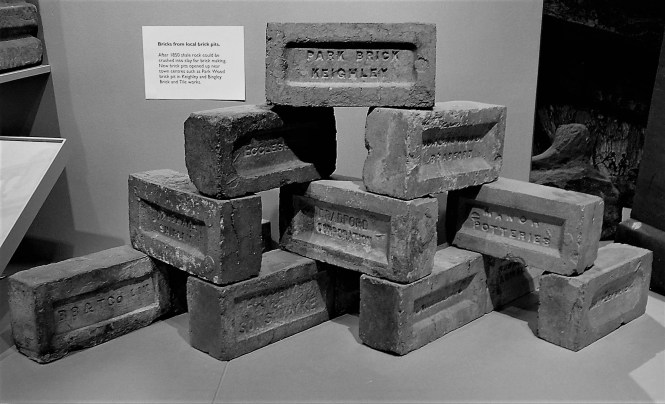
Machine pressed bricks on display at Cliffe Castle Museum, Keighley. Note the [BB&T Co Lim] marked brick at the bottom left.

By the mid-nineteenth century engineers were experimenting with ways of forming bricks mechanically. Common household bricks produced by machine pressing started to appear after 1860, and by the last decades of the century mechanical presses came to dominate production. There were small hand-operated brick presses and large steam powered machines of various patterns. Their use avoided the need to employ skilled brick-makers at a time when the demand for bricks was rapidly increasing. The new machines also produced a uniform product much loved by Victorian architects. In the Bradford area mudstones from the Coal Measures were quarried or mined, and then ground up, to supply the brick presses. The coal seams themselves provided the fuel for firing the bricks. Machine pressed bricks frequently have a depression, or frog, for receiving mortar and may be marked with the manufacturer’s name or initials. Such marks could be stamped into the brick but alternatively brass or iron plates were inserted into the brick moulds. The heads of screws that held these plates in place may also be visible in the fired brick. The interest of those of us involved with bricks was often first captured by finding a marked brick and speculating about its origin.
05 Image C

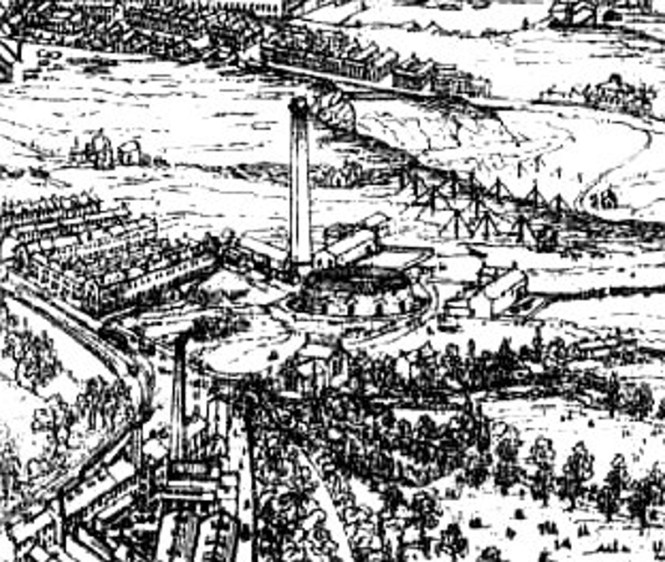
A detail from the drawing accompanying William Cudworth’s Worstedopolis. In the centre is the Hoffman kiln at Daniel Riddiough’s Airedale Road brick works.

New patterns of kiln were adopted. Circular Beehive kilns were popular for single firings. Circular or oval Hoffman kilns were kept continuously alight. Kiln gases, on their way to the chimney, were used to dry green bricks. Hoffman kilns were very economical of fuel but needed a skilled workforce. The Bradford 1856 directory records several local manufacturers: James Fairbank, an important coal merchant and brick maker, was established at the Brick Lane colliery and was ‘sinking for coal’ near the bottom of Whetley Lane. Edward Gittins had arrived from Leicester and was advertising his new patent-brick works at the junction of Wakefield Road and New Hey Road. George Stelling Hogg had come from Leeds and had established the first of his three brick making enterprises in Shipley. George Heaton had leased land from the Earl of Rosse to dig coal and make bricks at the Shipley end of Heaton Woods. As late as the 1881 census  I can only identify 204 people in the Bradford area who gave a brick related occupation to the enumerators. This number is dwarfed by coal and ironstone miners, quarrymen, and textile workers.

Research suggests that at one time or another Bradford, Shipley, Bingley and Keighley had more than 60 brick production centres, not of course all working simultaneously, together with additional imports from Halifax, Leeds and Wakefield. At first bricks were used close to the site of manufacture to minimise transport costs. Consequently the few wholly brick houses in Bradford older than a century are likely to be constructed of locally made material. Most readers will be familiar with Bradford’s stone buildings and will naturally ask the question ‘where have all the bricks gone?’  Flues from domestic fires were normally constructed of them, and many Victorian stone buildings will have an inner skin of cheaper brick with stone facings on the visible areas. When you consider the use of bricks employed for Lancashire pattern factory chimneys, or for railway bridge or tunnel linings, the number of producers does not seem excessive. In the long run the railway spelled the end for local suppliers in favour of larger, cheaper, brick producers in Peterborough or Staffordshire.

05 Image D

Trade directories are a useful source of information about the brick industry. Advertisements were common.

A popular local house-brick was produced by the Bradford Brick & Tile Company and its most common mark is [BB&T Co Lim].  This company was incorporated in January 1868. The first directors were Halifax businessmen, with the exception of Israel Thornton of East Parade, Bradford (a contractor with his fingers in many pies). At various times it operated a number of kilns: Wapping Road, Whetley Lane and Beldon Rd, Great Horton. By 1901 the Bradford Brick and Tile Company address was simply Knowsley Street, Leeds Road which seems to have been its final enterprise.

If you want to explore brick-making further I would suggest:

D J Barker, Bradford Brick-making: the mud, the men and the mysteries, Bradford Antiquary, (2010) 3rd series 14, 66-77.

The West Yorkshire Archives (Bradford) have more information on the Bradford Brick & Tile Company (10D76/3/113 Box 5). The Local Studies Library collection of trade directories are also an important source of information.

Derek Barker, Local Studies Library Volunteer

 

Treasure of the Week no. 18: Galas & Fents in Peel Park

JND 194/8 (Please quote this number if requesting this item)

jnd 194 8 c 001

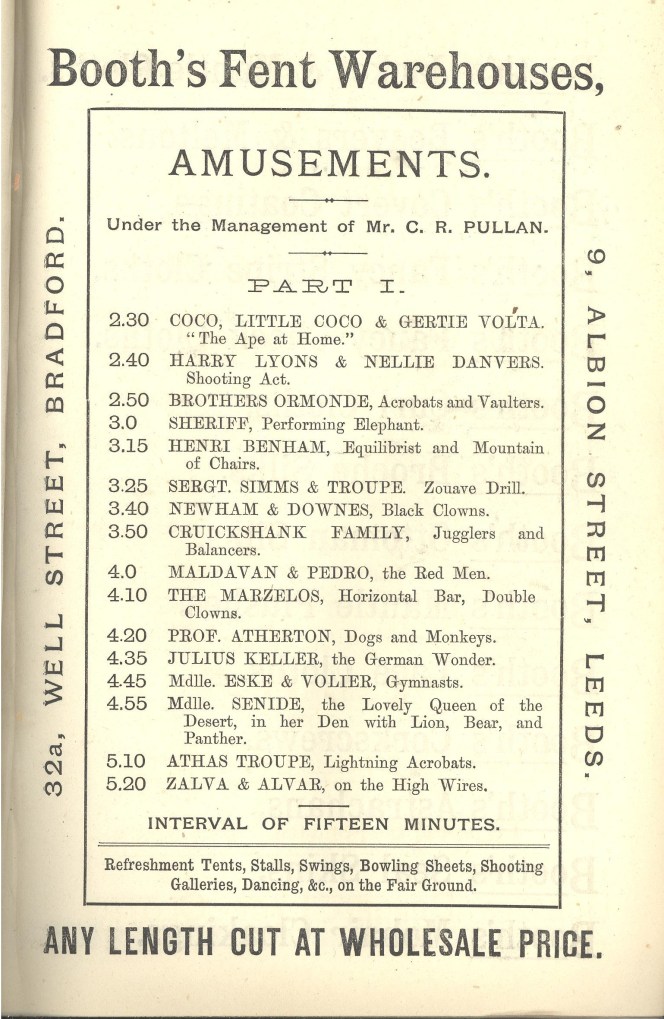
BOOTH’S FENT WAREHOUSESProgramme for the Annual West Riding Galas held in Peel Park, Bradford, Whisuntide, 1888.

Galas and Melas have been held in Peel Park for many years, but what went on in these festivals has changed greatly. In 1888 the Gala lasted two days and in the Library’s pamphlet collection we have the 16-page programme of events  sponsored by Booth’s Fent Warehouses. Fents were basically animal skins and Booth’s, whose main shops were in Well Street, Bradford and Albion Street, Leeds, made sure that people who purchased the programme for one penny could not escape knowing about their products. There were full page adverts for Booth’s Umbrellas, Booth’s Scotch Tweed, Booth’s Cheviots, Booth’s Doeskins, Booth’s Meltons, Booth’s Beaver, Booth’s Italians, Booth’s Silesias, and much else. Products long forgotten.

So much for fents. What went on at Peel Park in the spring of 1888? A lot! Amusements included:

Coco, Little Coco & Gertie Volta  – ‘The Ape at Home’

Harry Lyons & Nellie Danvers – Shooting Act

Brothers Ormonde – Acrobats and Vaulters

Sheriff – Performing Elephant

Henri Benham – Equilibrist and Mountain of Chairs

Sgt. Simms & Troup – Zouave Drill

Newham & Downes – Black Clowns

Cruikshank Family – Jugglers and Balances

Maldavan & Pedro – The Red Men

The Marzelos – Horizontal Bat, Double Clowns

Prof. Atherton – Dogs and Monkeys

Julius Keller – The German Waiter

Mademoiselle Eske & Volier – Gymnasts

Mademoiselle Senide – The Lovely Queen of the Desert, in her Den with Lion, Bear, and Panther

Zalva & Alvar – On the High Wires

There were fireworks by Professor Wells, whose displays included The Wheel of Ixion and the Revolving Fountain. There was Professor Smith with his Famous Punch & Judy Show Performing at Intervals; There was a full music programme – Six military bands, including the  2nd West York Artillery and local orchestras such as the Postmen’s Band, the Manningham Band, and the Bradford Borough Band played a wide repertoire of music.

About eight o’ clock each night, weather permitting, inventor Eric Stuart Bruce, was to personally supervise the ascent of ‘The Electrical War Balloon! For Flashing Signals at Night, As Supplied to the English and Belgian Governments’.

And, of course, there were Refreshment Tents, Stalls, Swings, Bowling Tents, Shooting Galleries, Dancing, &c., on the Fair Ground.

Imagination is required to understand what some of these activities were about. Performing animals, black clowns, and Punch & Judy would now be frowned on, but I can’t help wishing I was there, at Peel Park, in 1888, watching Zalva & Alvar on the high wires, and the Fireworks, listening to the Bands, visiting the Refreshment Tents, and waiting impatiently for the ascent of the flashing signals from The Electrical War Balloon!

Stackmole

Map of the Week 027: What was going on in Great Horton?

If you are reading this article you probably find maps and plans as interesting as I do. You will certainly understand how easy it is to get distracted, while writing a brief report, by trying to identify all the recorded features and resolve some of the inevitable puzzles. The first image is a detail of a map in the reserve collection which is in poor condition. The parent map is the one produced of the Borough of Bradford in 1873 by Walker & Virr, which is especially valuable since it falls evenly between the two first Ordnance Survey maps of the 1850s and 1890s. The twenty years that preceeded the Walker & Virr map brought huge changes to Horton. In 1850 the community had been surrounded by many coal and ironstone pits, both functioning and disused. Tramways conveyed their products to the Low Moor Ironworks for conversion into best Yorkshire wrought iron. By the 1870s the seams were exhausted, the pits were closed, and there had been considerable housing development.

Map of the Week 027 A

A map detail showing Great Horton watercourses and main sewers

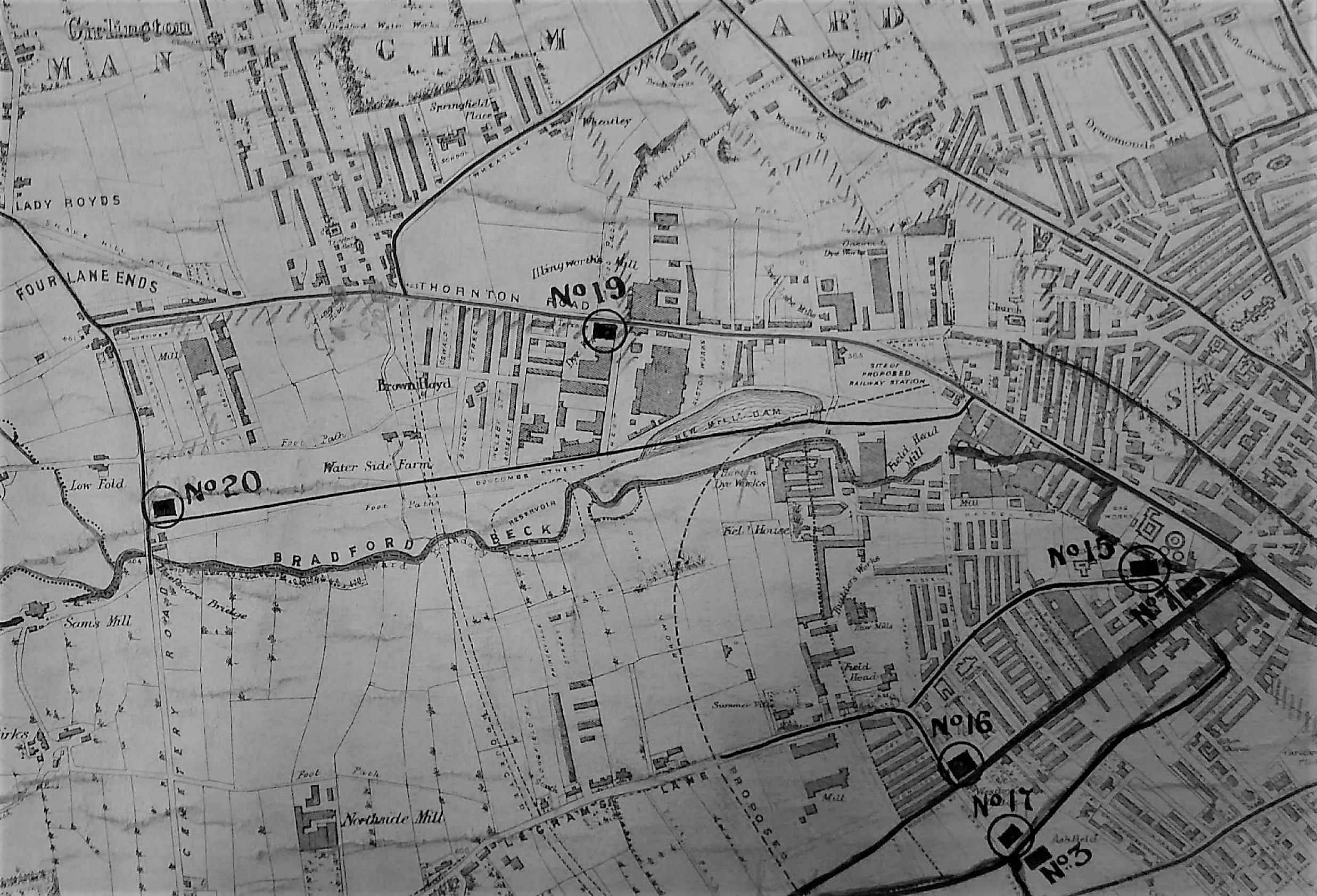
This map was in a group that evidently came to the Local Studies Library from the city’s Surveyors and Engineers Department. Its purpose is clearly recorded, this being to record Bradford’s main sewerage system and to show storm overflows. The main sewers collected both foul water and surface water. During a rainstorm they could become completely filled. Under those circumstances the plan was for the excess to flow into alternative sewers and ultimately watercourses like the Bradford Beck; not a pretty thought. The positions of the storm overflows are more easily displayed in a second map detail.

Map of the Week 027 B

A detail from the same map showing sewers in the area between Thornton Road and Legrams Lane

The Borough Surveyor (B.Walker) employed this map. It was clearly being used for at least a decade after its first publication since pencil annotations are dated for the years 1881-83. Having dated the map and identified its use I thought that there were three features of particular interest: the Old Mill, Bracken Hall, and the brick works.

The longer watercourse in the first image is the Horton Beck which provided the water for the Old Mill. A little further down stream, out of sight, was a second corn mill called the New Mill. I assume that the Old Mill started life as a manorial watermill, like Bowling Mill or the Bradford Soke Mill. William Cudworth records that in the nineteenth century the Lord of the Manor of Horton was Sir Watts Horton and then, after his death, his son in law Captain Charles Horton Rhyss. His property came up for sale in 1858 when William Cousen of Cross Lane Mill purchased the lordship. The Old Mill, its farm, and the water rights went to Samuel Dracup a noted textile engineer. He, it appears, eventually converted Old Mill to be a textile mill. I am more interested in an earlier tenant of Old Mill recorded in the Ibbetson’s 1845 Bradford directory, John Beanland. He was the son of Joseph Beanland who was a corn miller and colliery proprietor at Beanland’s Collieries, Fairweather Green. Cudworth says he belonged to a Heaton family. There was certainly a James Beanland (1768-1852), of Firth Carr, Heaton who exploited coal in Frizinghall.

Cudworth describes the impressive looking Bracken Hall as being of a fairly recent origin. I’m sure Cudworth is correct since the Hall is not present on the 1852 OS map of the area. It was inhabited by William Ramsden who was the owner, with his brother John, of Cliffe Mill. This was a Horton worsted mill which can be seen in the centre left of the first map. Bracken Hall was described as being ‘surrounded by a thriving plantation’ which is certainly the appearance that this map records. In the 1881 census William Bracken (54) and his wife Sarah (57) were living at the Hall rather modestly, with only a cook and a housemaid. I am not sure when the house was demolished. It certainly survived into the twentieth century but is missing from the 1930s OS maps. Before the construction of the Hall there were fields and a pre-existing farmhouse which I assume is the small building called Bracken Hill on the OS 1852 map. The land was owned by Mrs Ann Giles who possessed much property in Great Horton including Haycliffe Hill and Southfield Lane with the fields in between. The means by which she acquired her estate was quite complicated. Hannah Gilpin Sharp (1743-1823) of Horton Hall bequeathed her mansion, with all her land in Bradford, to her nephew, Captain Thomas Gilpin and his male heirs, and in ‘default of issue’ to her niece Ann Kitchen. Captain Gilpin, after enjoying the estates for only three years, died at Madeira in the year 1826 without ever having been married. So Ann Kitchen came into the property. In 1828 she married a clerk in Somerset House, as her second husband. Cudworth records him as Edward Giles, but I believe that Edmund is the correct name and the couple were united at St Pancras Old Church. Here their son, another Edmund, was baptised the following year. Ann Giles lived in Tavistock Place but her husband died in 1832 leaving his infant son as heir to the Horton estates. At the age of 25 this son Edmund eventually went to Australia, being enamoured of sea life, but only lived three days after landing in the colony. In 1839 an Act had been passed for disposing of the Giles estate at Horton, owing to the great increase of buildings in the immediate vicinity. Land belonging to ‘Mrs Giles’ are common on maps of Bradford and Horton. In the 1851 census she and Edmund were staying with her daughter by her first marriage, Ann Haines, who was ultimately to inherit her estate.

It seems that I may have fallen at the final hurdle since I cannot identify the owner of the brickworks. In the 1880s Great Horton had no less than three brickworks: Beldon Road, Haycliffe Road and this mapped works in the High Street. The Beldon Road works was owned by the Bradford Brick & Tile Company in the years 1875-1927. The Haycliffe Road works were linked in 1871 with an E.Hopkinson (Wm. Holdsworth manager) and in the years 1875-1883 William Holdsworth seems to be the owner himself. The High Street brick-works was the earliest but its existence may have been brief since it is attested only by maps of 1873 and 1882. It does not feature in the libraries’s stock of Trade Directories. One possibility is that it belonged to Robert Bown ‘coal merchant and brickmaker’ whose bankrupcy was reported in the Bradford Observer in March 1864. Twenty thousand bricks from the ‘Horton yard’ were to be auctioned. A coal merchant of that name lived in Little Horton in the 1861 census. Even if this is true who kept the building going for at least another ten years?

If you would like to learn more about historic Horton I can recommend:

www.bradford.gov.uk/media/2373/greathortonconservationareaassessment.pdf

Derek Barker, Local Studies Library Volunteer.