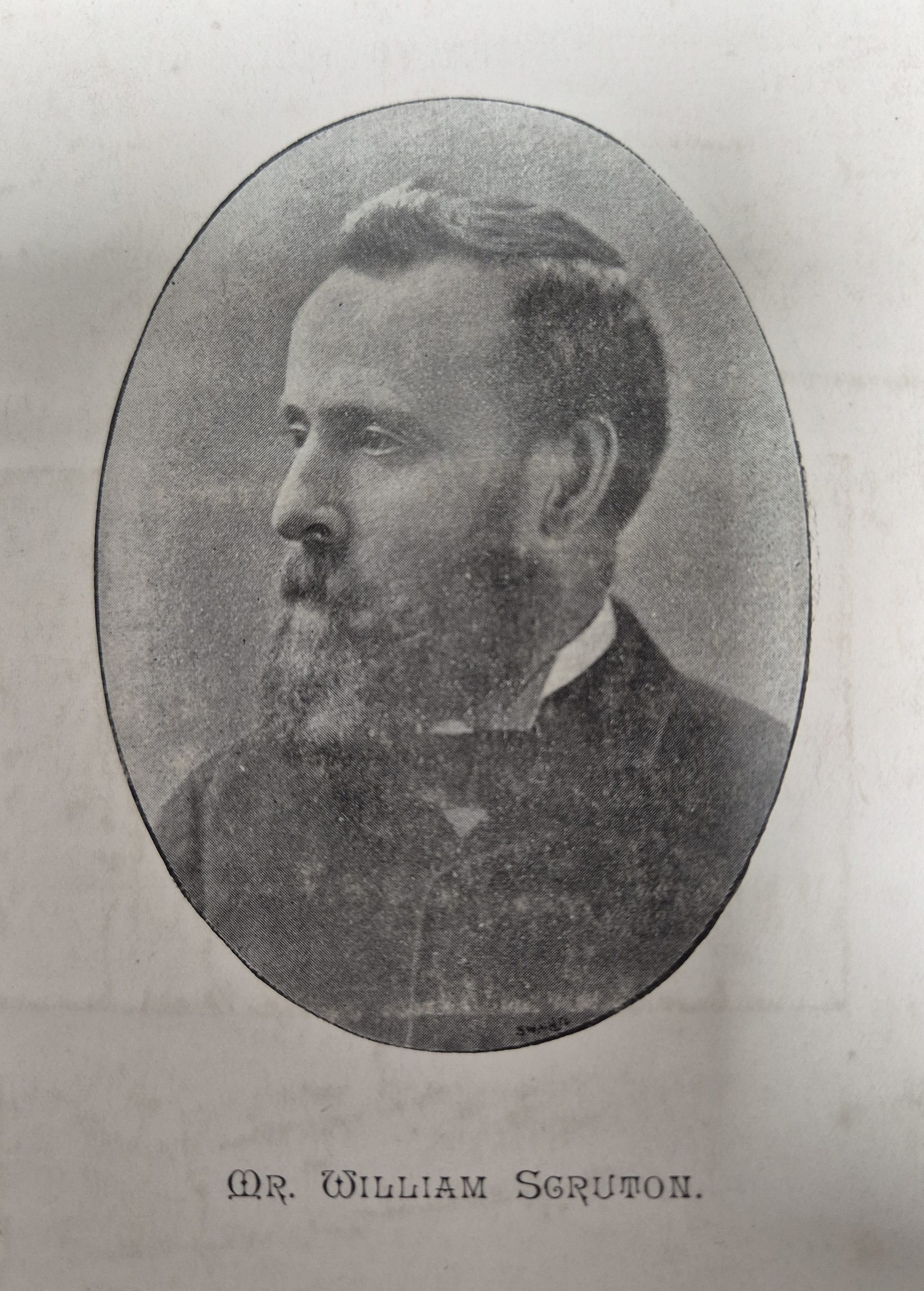
William Scruton (c. 1840–1924) was a prominent local historian, writer, and illustrator from Bradford who co-founded the Bradford Historical and Antiquarian Society in 1878, who dedicated much of his life to documenting the rapid architectural and social transformation of Bradford, West Yorkshire, during the Victorian era.
Life and Career
- Early Life: Born at Little Horton Green, Bradford, he attended a local dame’s school and evening classes at the Mechanics’ Institute.
- Profession: He worked for many years as a solicitor’s clerk in Bradford.
Writing & Illustration: A proficient illustrator and staunch Nonconformist (Moravian), he documented Victorian Bradford’s changing architecture, nooks-and-corners, and social history. He contributed regularly to the Bradford Observer and the Yorkshireman.
As an antiquarian, he was highly concerned with preserving the memory of the town before its old landmarks were demolished to make way for industrialisation and expansion into a major city. He is most famously remembered for his masterpiece, Pen & Pencil Pictures of Old Bradford, published in 1889.
Key Historical Contributions
Founder of the Bradford Historical and Antiquarian Society:
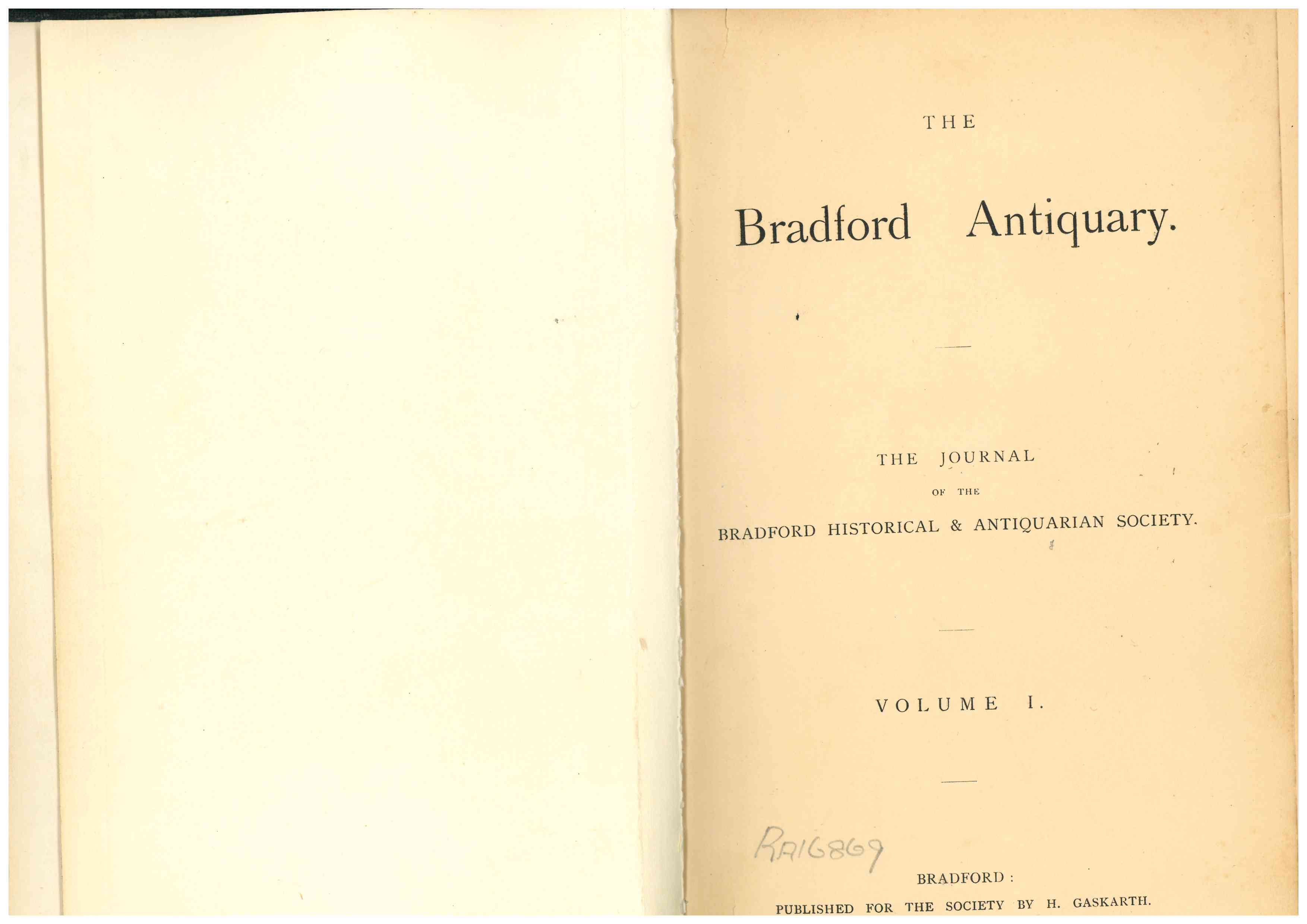
On 12 July 1878, Scruton became a founder member of the Bradford Historical and Antiquarian Society alongside fellow historians William Cudworth, T.T. Empsall, and James Horsfall Turner. He frequently wrote historical articles for the Bradford Observer and the society’s journal, The Bradford Antiquary.
The Bronte Connection: Beyond local town history, Scruton was deeply fascinated by the Brontë family who lived nearby. In 1898, he published Thornton and the Brontës, detailing the birthplace of the famous literary siblings. He even famously attempted to sketch portraits of Emily Brontë based on historical accounts and photographs.
Pen & Pencil Pictures of Old Bradford (1889)
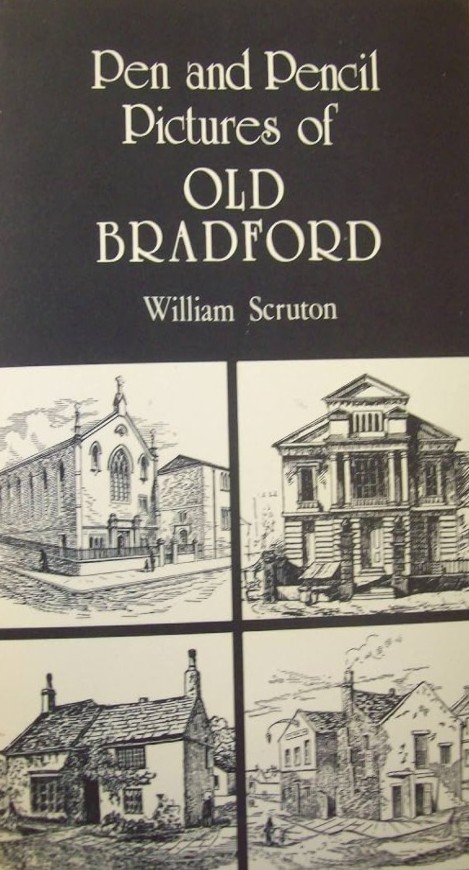
William Scruton’s artwork served as a vital visual rescue mission for Victorian Bradford, capturing the city’s architectural transition during the Industrial Revolution. As mills and terraced housing rapidly expanded, Scruton actively sketched landmarks, streets, and characters that were slated for demolition His focus, technique, and subject choices reveal a deep passion for preserving local history.
What He Framed: Subject MatterVanishing Architecture:
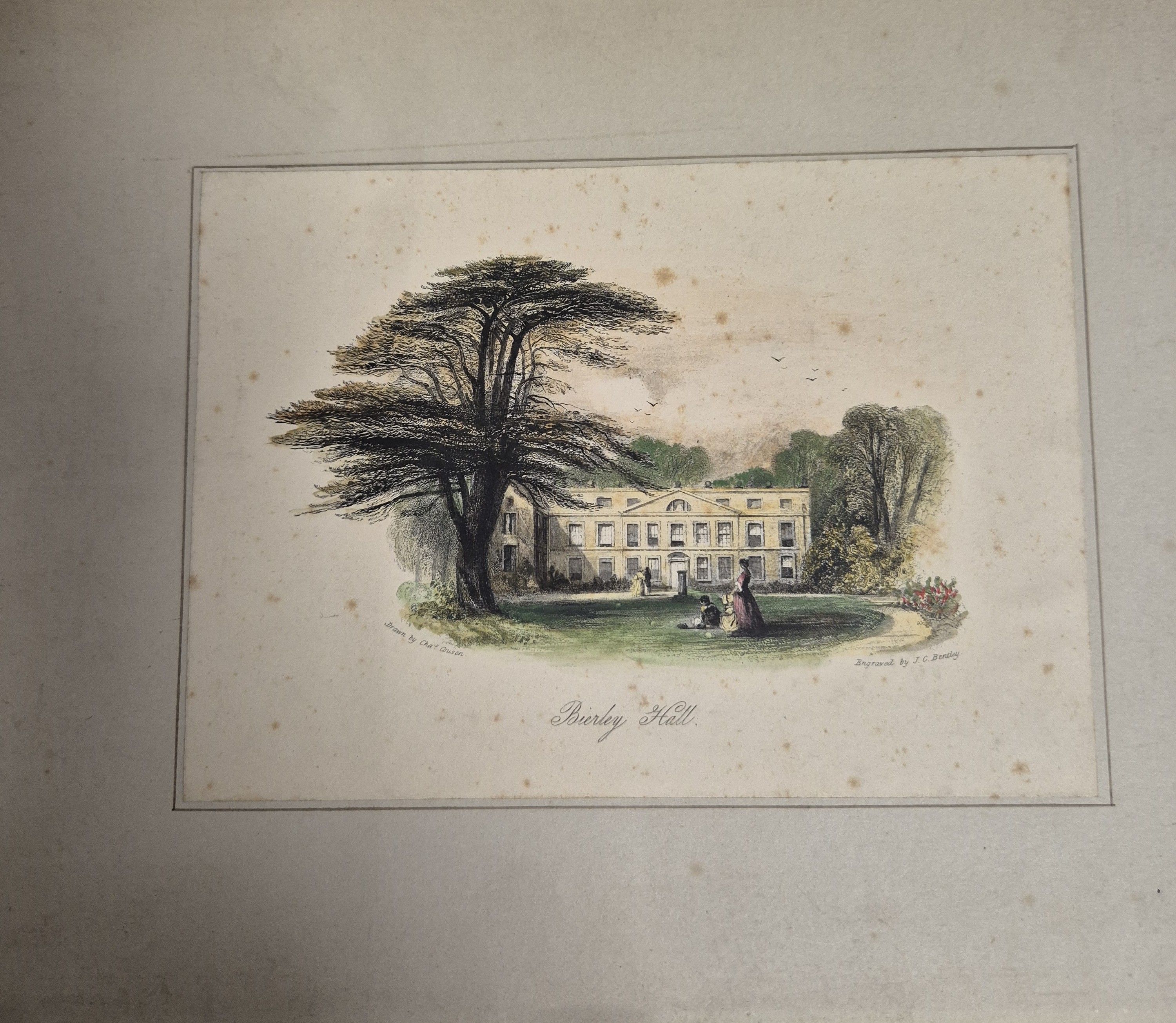
Scruton meticulously documented medieval and early modern buildings “gone forever”. His sketches featured the old Court House at the top of Westgate, the earliest town workhouse, the Old Corn Mill, and the Old Piece Hall. He also drew majestic lost mansions like Stott Hall, Manor Hall, Bierley Hall, and Horton Hall.
Street Scenes and Shops: He frequently drew daily life in bygone commercial areas like Kirkgate and Ivegate. One famous sketch captures a row of old shops in Kirkgate right before they were demolished to clear space for the Midland Hotel.
Local Personalities: Beyond buildings, Scruton drew the people who gave Bradford its character. His books feature illustrations of eccentric locals, such as Mr Tordoff (a prominent tea dealer), “Dumb John” (a quiet barber), and Judy Barrett (a famous local spice and humbug sweet seller).
The Brontë Family: Through his later work, he provided architectural illustrations of buildings tied to the Brontë family in Thornton and Haworth, alongside portrait sketches of Emily, Charlotte, and their relatives.
Artistic Technique and Style
Scruton’s illustrations were primarily pen-and-ink line drawings and detailed sketches designed specifically for woodcut or plate reproduction in print
His masterpiece, Pen and Pencil Pictures of Old Bradford (1889), remains heavily referenced by historians today because it serves as one of the few surviving visual registers of the pre-industrial town
Eye-Witness Accuracy: Most of his streetscapes were sketched directly from his own observations while walking through Bradford.
Collaborative Legacy: When a building had already been demolished before his lifetime, Scruton meticulously reconstructed the image by studying the artwork of earlier local Bradford artists like Arthur McArthur and William Geller.
Purpose over Fine Art: Scruton did not view himself as a commercial fine artist. He treated his drawings as historical evidence, often filling his personal notebooks with extensive text, annotations, and arrows alongside a sketch to explain exactly who lived in a building or when it fell.
His masterpiece, Pen and Pencil Pictures of Old Bradford (1889), remains heavily referenced by historians today because it serves as one of the few surviving visual registers of the pre-industrial town
The Significance of His Doodles & Character Drawings
A Window into Private Wit: Scruton’s published works are polite, respectful Victorian histories. However, local historians know he had a keen, sharp eye for human eccentricity. His private doodles often catch the “Worthies” in unvarnished, candid, or slightly satirical states—revealing a personal humour never printed in his formal books.
The “Bradford Worthies” Connection: In the 19th century, this term referred to Bradford’s elite—powerful mill owners (like Titus Salt or Robert Milligan), politicians, and cultural figures. If Scruton was writing to them or collecting their correspondence, it confirms his deep integration into the city’s intellectual circle.
Working Method Insights: His marginalia and doodles were often his visual shorthand. He used random scraps of incoming mail and the blank space of letters to quickly capture a facial profile, an unusual hat, or a caricature of a speaker during local society meetings before he forgot the details.
In The Margins of History: William Scruton’s Private Doodles
When we picture William Scruton, we usually think of the dignified co-founder of the Bradford Historical and Antiquarian Society, meticulously documenting vanishing medieval streetscapes. But behind the formal historian was a man with a sharp, candid eye for human character. A scrapbook held at Bradford local Studies Library reveals an intimate look at Scruton’s working mind: a collection of letters to and from Bradford Worthies, heavily decorated with his raw, spontaneous doodles and caricatures.
1. The Scrapbook as a 19th-Century Creative Workspace
For Scruton, paper was a premium canvas, and inspiration didn’t wait. The margins of incoming correspondence from Bradford’s civic elite became his creative playground. Where official letters discussed society business, legal matters, or local history, Scruton used the blank spaces to capture the world around him.
Visual Shorthand: These doodles weren’t just idle distractions; they were his visual diary.
Candid Caricatures: While his published books like Pen and Pencil Pictures of Old Bradford feature polite, formal portraits, these private sketches show a lighter, more satirical side—catching the “Worthies” mid-speech, pulling faces, or sporting the exaggerated fashions of Victorian Bradford.
2. Who Were the “Bradford Worthies” in the Margins?
The letters themselves provide an incredible context. In the late 19th century, Bradford was an industrial powerhouse, and its “Worthies” included influential mill owners, politicians, and fellow antiquarians.
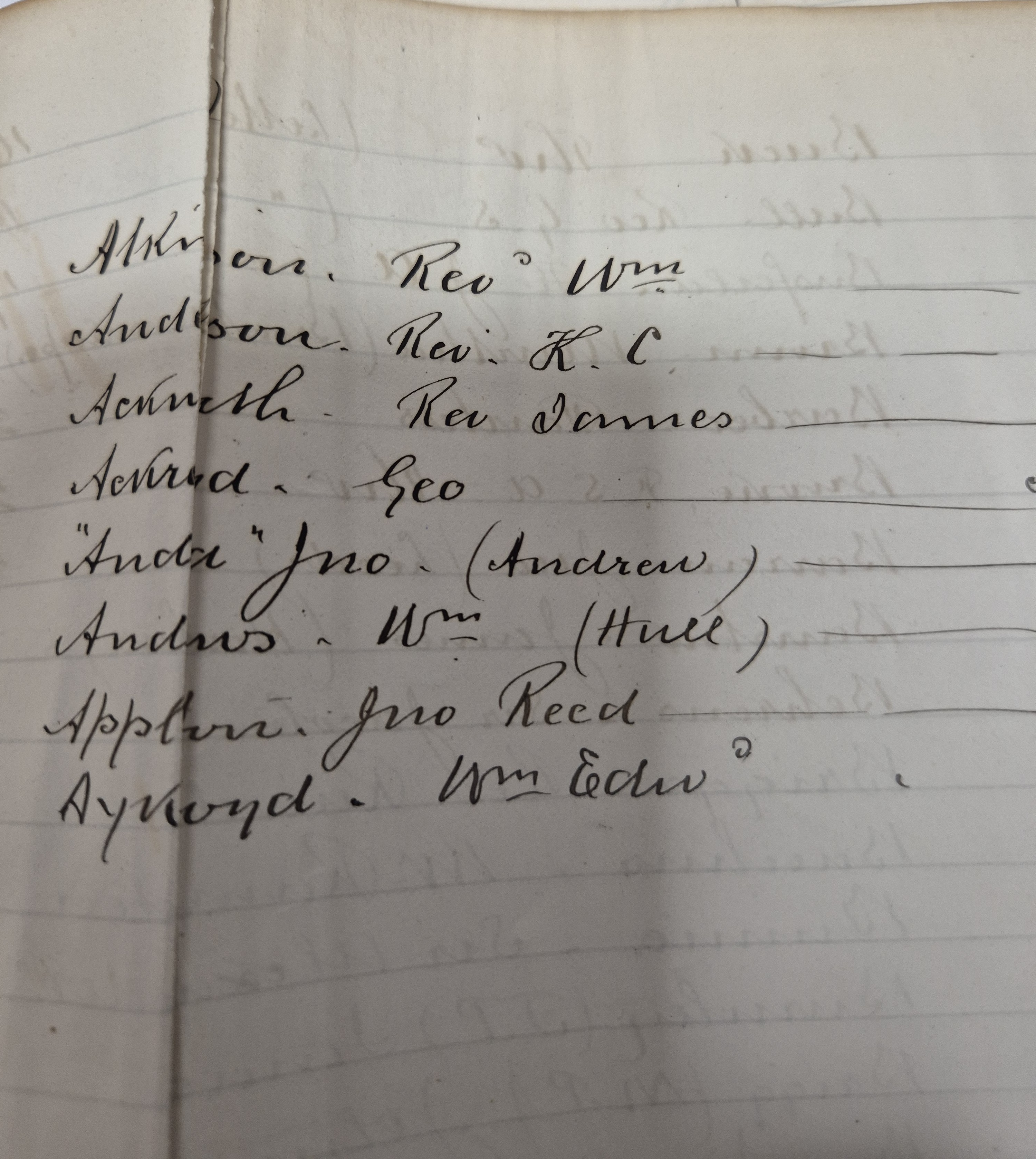
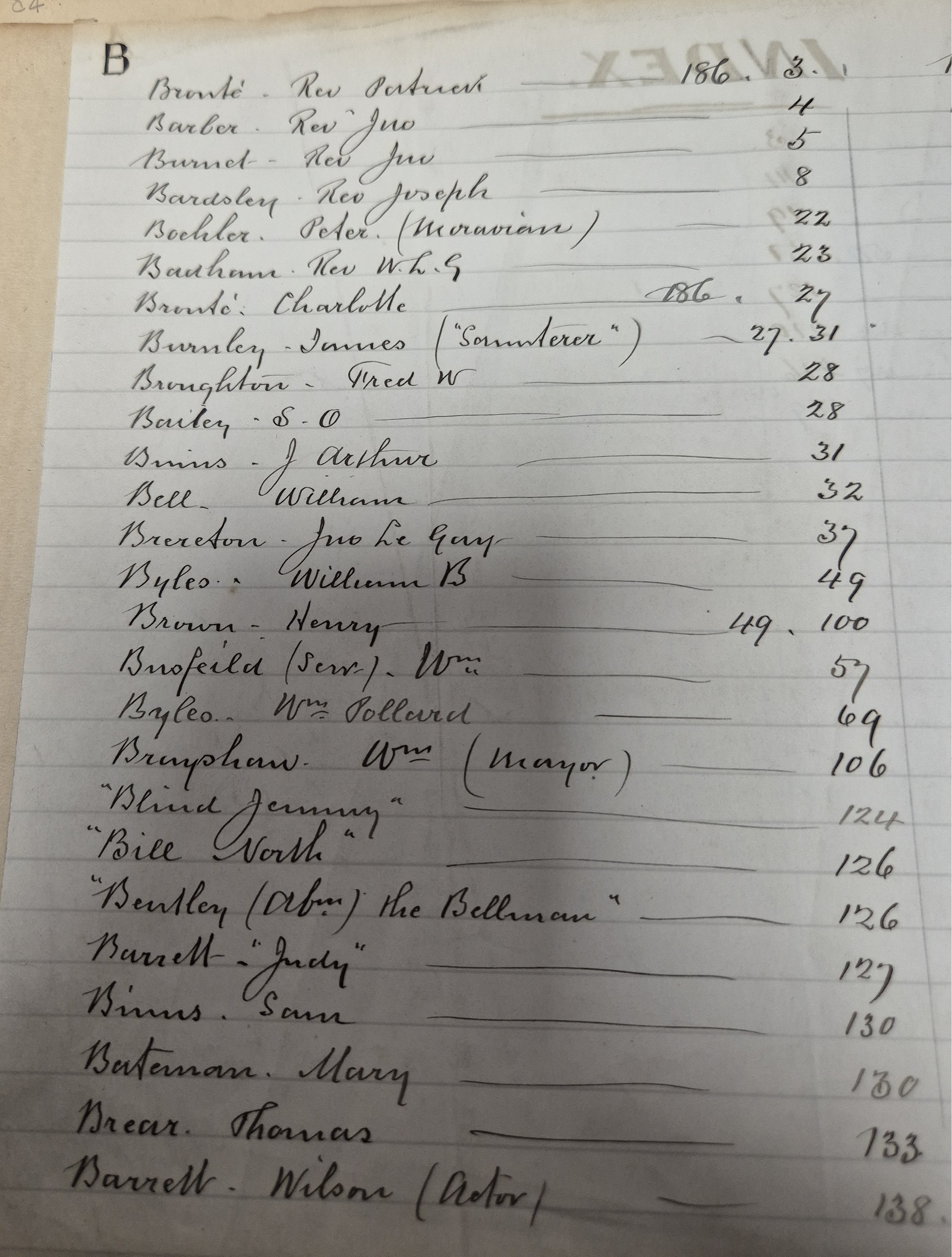
The Index: Scruton indexed his scrapbook, showing, therefore a list of the’worthies’ he was in communication with. Three of the pages are copied further below.
The Contrast: There is a brilliant, human irony in seeing a stuffy, formal letter written by a prominent civic leader contrasted against a whimsical profile doodle or an eccentric character sketch drawn right next to their signature.
3. Why This Completes the Scruton Legacy
This scrapbook bridges the gap between Scruton the meticulous researcher and Scruton the human being. It shows us a man who was deeply amused by the eccentricities of his contemporaries. For modern researchers visiting the Bradford Local Studies Library, items like this prove that local history isn’t just about cold dates and demolished stone walls—it is about the living, breathing characters who walked the streets of Ivegate and Kirkgate.
“Ye ‘Appy Hartist” (Image 1)
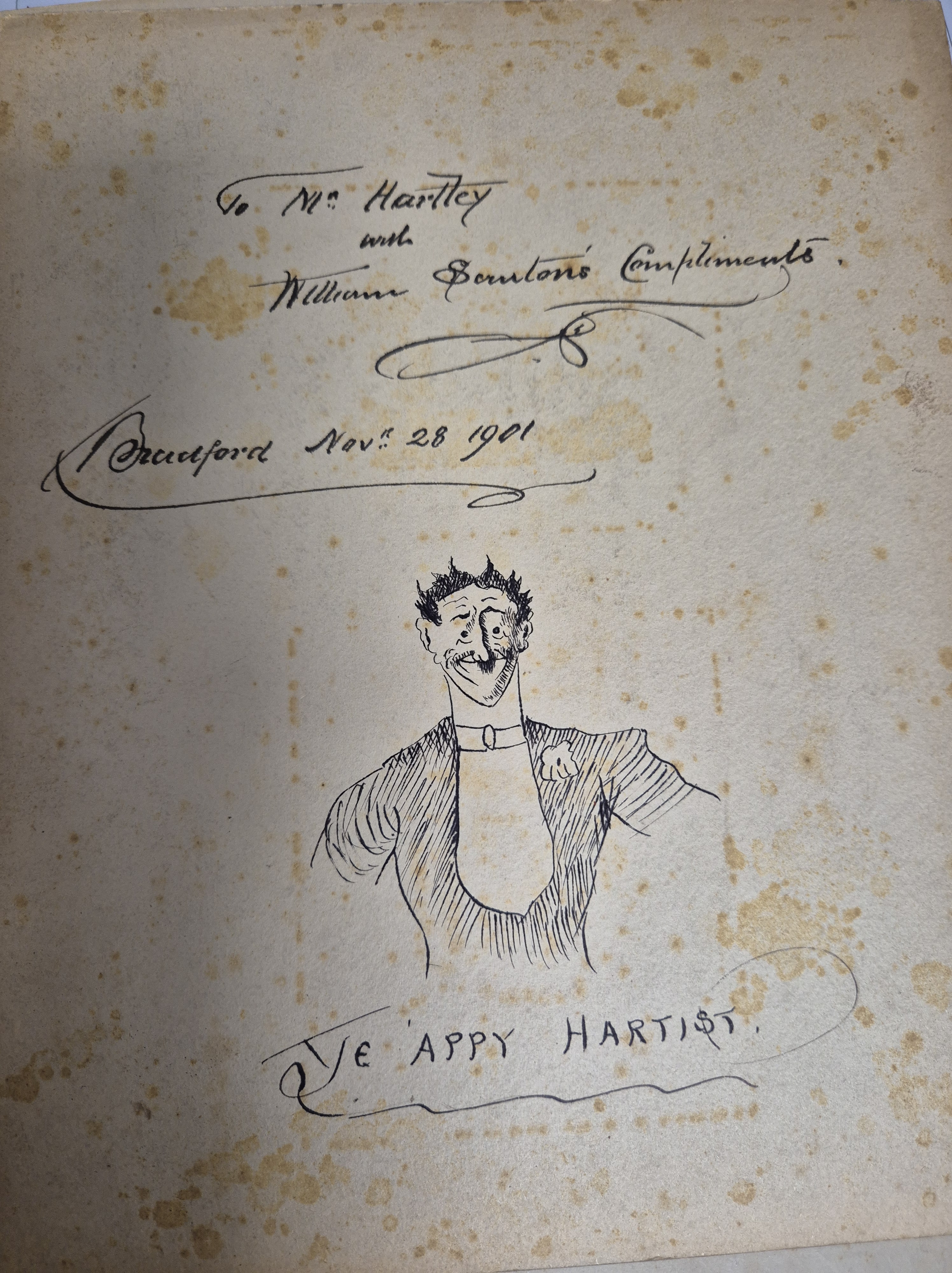
The Context: This is an original, playful self-caricature or a personalized greeting card drawn by Scruton himself, jokingly signing his name under a sketch of a smiling man in formal evening wear as “Ye ‘Appy Hartist” (The Happy Artist).
The Inscription: It reads: “To Mr. Hartley with William Scruton’s Compliments. Bradford Nov.r 28 1901.”
The Home of “Fair Becca” (Image 2)
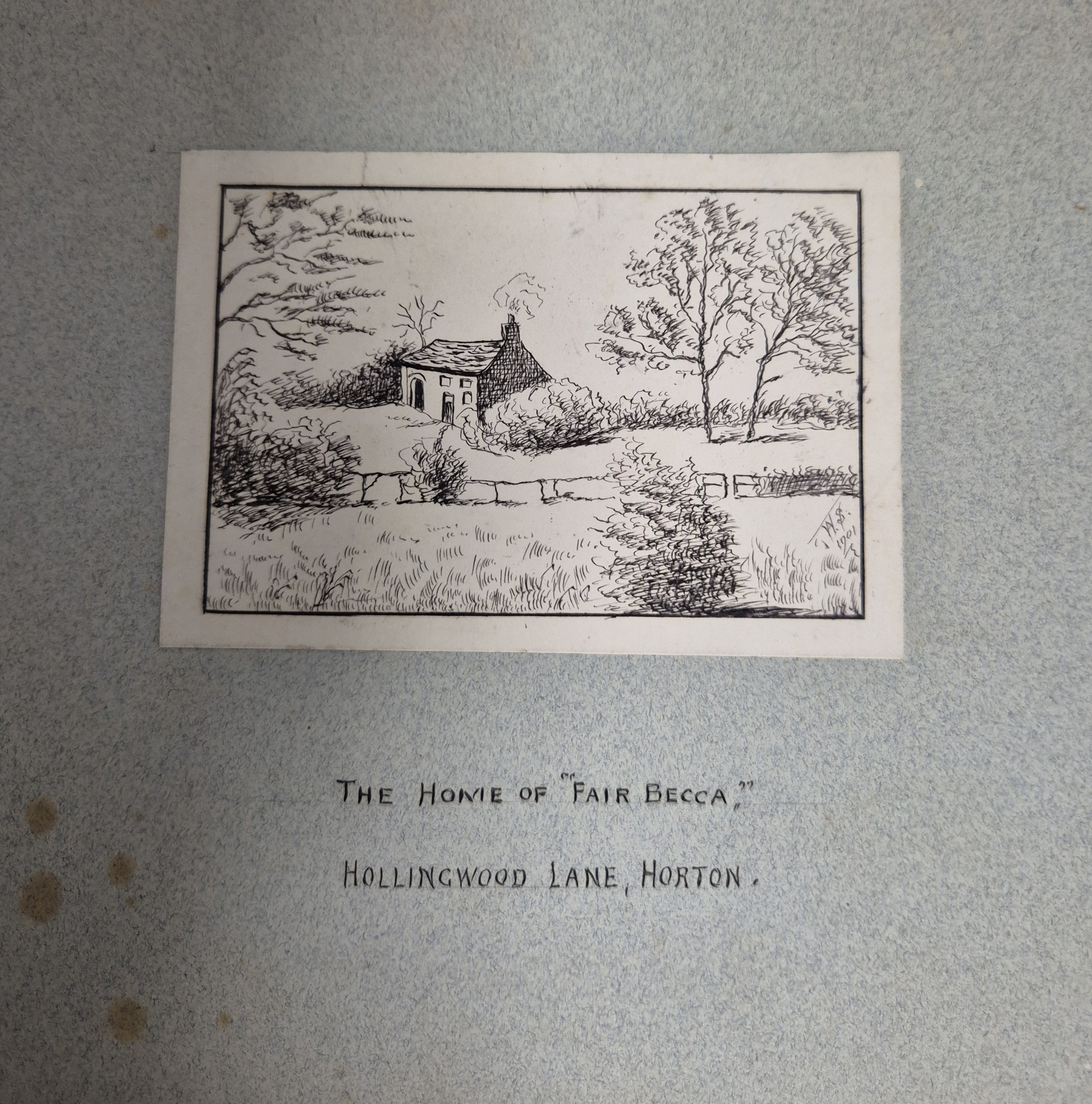
The Story: “Fair Becca” (Rebecca Berry) is a legendary, tragic figure in Bradford folklore. According to local lore, she was murdered in the 18th century near a well on Hollingwood Lane, which came to be known as “Fair Becca’s Well” or “Fair Becca’s Ghost.” Scruton loved documenting old folk stories and vanishing landmarks, making this precise architectural drawing highly characteristic of his preservation work.
Bierley Hall & The Engraving (Images 3 & 4)
- The Inscription Transcribed:
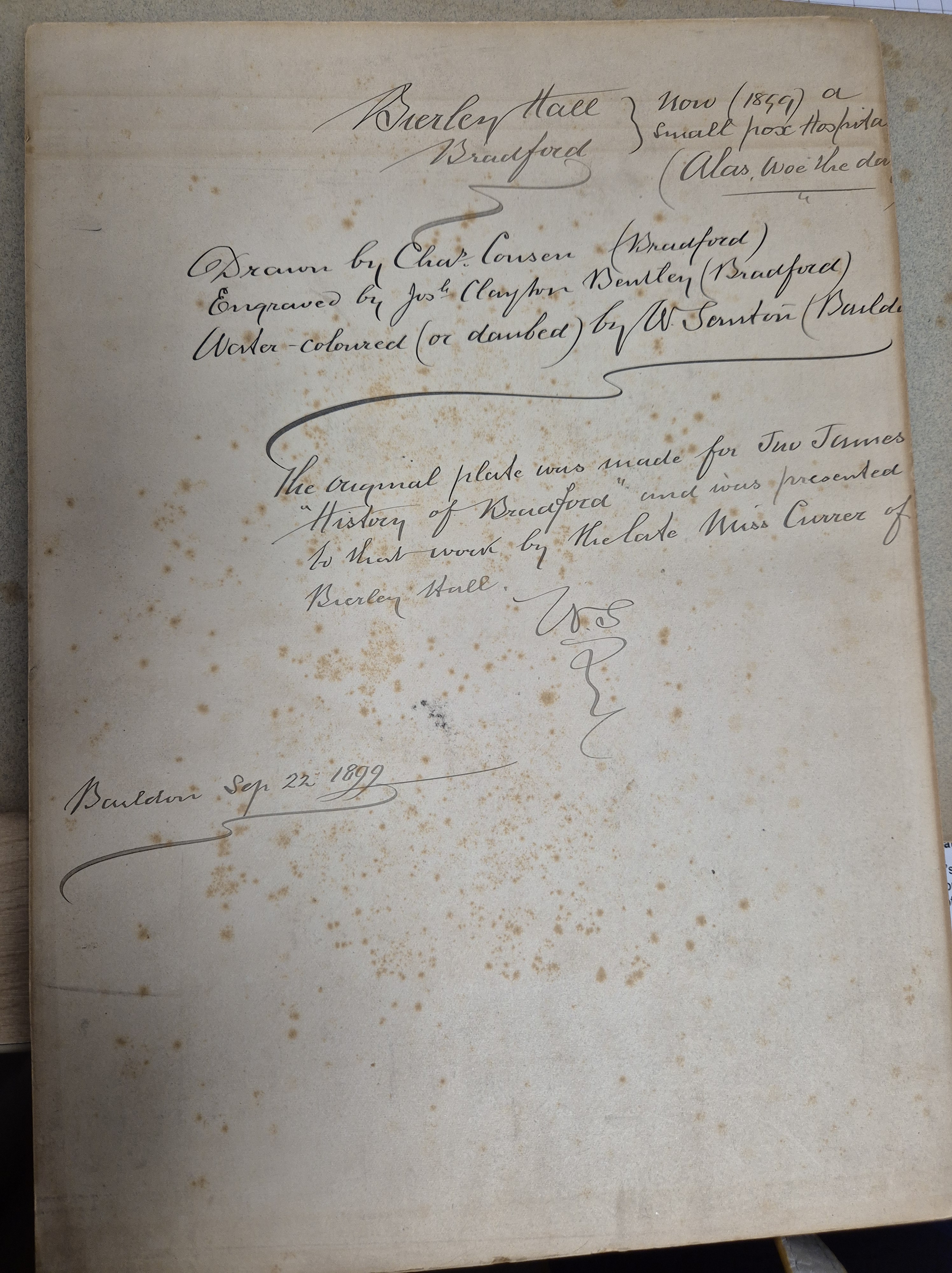
“Bierley Hall, Bradford. Now (1899) a small-pox Hospital (Alas, Woe the day!). Drawn by Cha.s Cousen (Bradford). Engraved by Jos.h Clayton Bentley (Bradford). Water-coloured (or daubed) by W. Scruton (Builder).””The original plate was made for Jno James’ ‘History of Bradford’ and was presented to that work by the late Miss Currer of Bierley Hall. W.S. Baildon Sep 22 1899.”
Historical Significance: This note is a treasure trove. It confirms Scruton hand-coloured (“daubed”) this specific print. It records the tragic conversion of the grand Bierley Hall estate into a municipal smallpox isolation hospital at the turn of the century. Frances Mary Richardson Currer, mentioned here, was an exceptionally wealthy heiress, a famous 19th-century book collector, and a patron of literature (Charlotte Brontë chose her pen name, Currer Bell, in tribute to her).
“The Coming Age” & New Year Letter (Images 5 & 6)
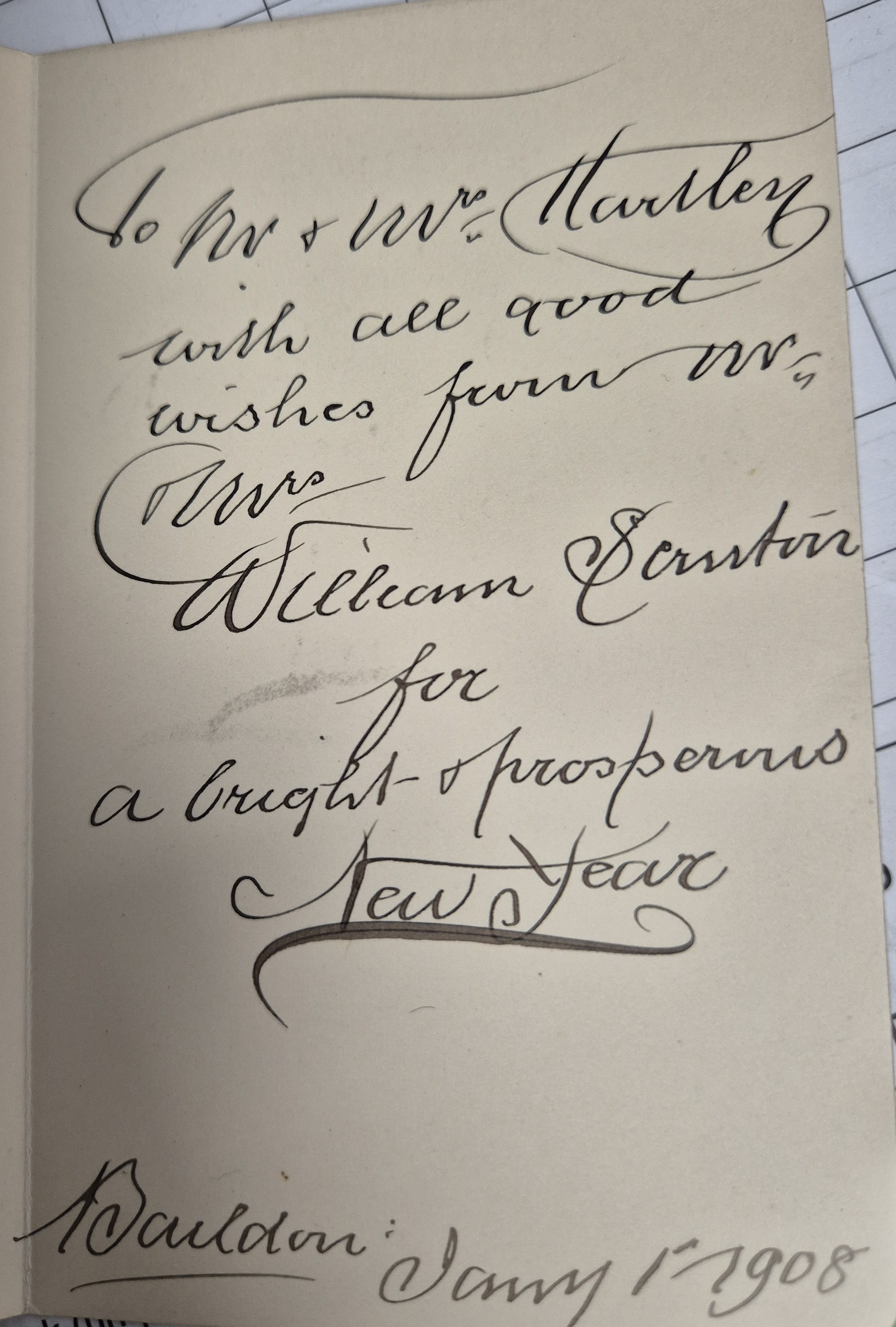
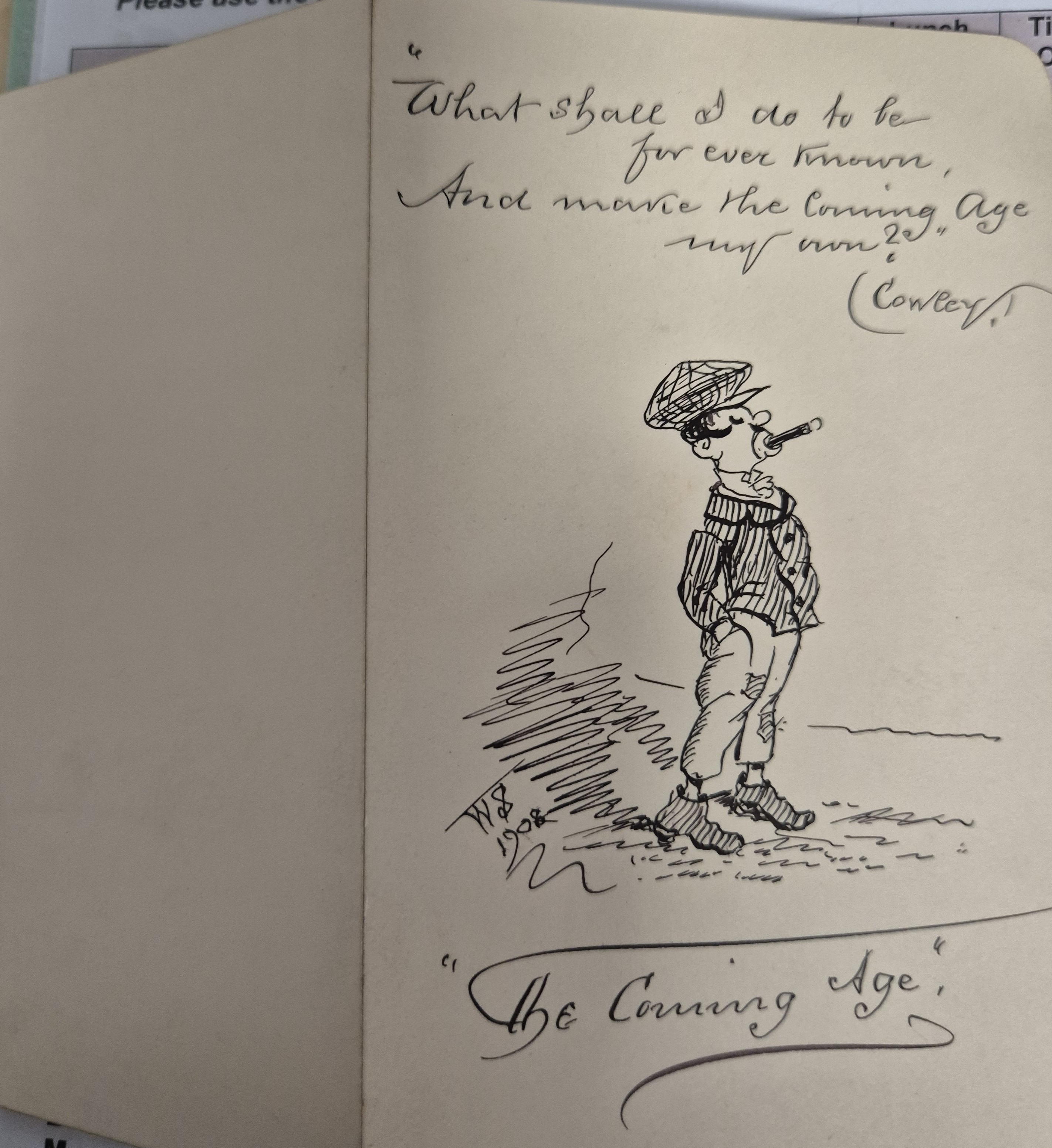
The Context: A hand-drawn, satirical cartoon card dated January 1, 1908, sent from Baildon to his close friends, the Hartleys.
The Artwork: The sketch shows a ragged wanderer smoking a pipe, symbolizing the uncertainty or humility of what the future holds, titled “The Coming Age”. Below, he pens a poetic verse: “What shall I do to be forever known, and make the coming age my own?”
The Greeting: On the reverse panel (Image 6), his exceptional, sweeping calligraphy wishes a “Bright & Prosperous New Year” to Mr. and Mrs. Hartley.
Portrait & Index Pages (Images 7, 8, 9 & 10)
The Notebook Indexes: Images 9 and 10 show pages from his ledger indexing historical figures, clergymen, and eccentric local characters in alphabetical order. Notably, under the letter B (Image 10), Scruton lists some of Bradford’s most legendary figures:
“Brontë – Rev. Patrick” (the father of the Brontë sisters—Scruton later wrote a book titled Thornton and the Brontës in 1898).
“Brontë – Charlotte”.
Famous street figures like “Blind Jemmy”, “Bill North”, and “Bentley (Abm) the Bellman”.
Scruton also illustrated stories of well-known legends and tales, such as the Bradford Boar and wrote about many different interests such as:
The Great Woolcombers and Weavers strike of 1825.
The Old Bradford gaslight company.
Charlotte Bronte.
History of different churches.
He had a passion for history, drawing and people, and amassed a collection of drawings, historical documents and other letters.
Bradford Local Studies Library is exhibiting some of the works by William Scruton throughout September. On Wednesday 16th September, there will be pen and pencil drawing workshops and a short talk on his work, from 2pm onwards.
Booking is essential as spaces are limited. This is a free event.
Contact Bradford Local Studies Library on 01274 433688 or email local.studies@bradford.gov.uk to reserve a space.