Salvation Army Anniversary

July 2015 marks the 150th anniversary of the foundation of the Salvation Army in the East End of London by pioneers and social justice reformers, William and Catherine Booth. As Christian Evangelicals, members demonstrate their faith by providing direct help to those who need it.

In 1905 General William Booth made a ‘great northward motor-car tour’, which included a weekend at Keighley, well documented in the local press. Photographs of the well received arrival in High Street, Keighley are in local history books. There was a civic reception at the Municipal Hall and meetings were held at the Queen’s Theatre. The General preached to a crowd of 2500 with an overflow of 1500, with 50 converts.

Today the Salvation Army is active in 126 countries. Records in Keighley Local Studies show a few of their activities and events in the local area and date back to 1913 (BK 462).

There is also a small Haworth family collection including Salvation Army certificates and photographs of the Brontë Home League, dating from the 1940s (BK 559).

Salvation Army Pamphlets

New school archive for Keighley Local Studies

Keighley Library recently received a donation amounting to over 36 boxes of photos, records and plans from the former Greenhead High School.

The origins of the school date back to the earliest Free Grammar School established for boys in 1713, as a result of an endowment of a house and garden with land by local man John Drake. It had 50 free scholars for English reading, Latin and Greek. However, Greenhead’s origins lay in the division of the Grammar foundation into Girls’ and Boys’ when Greenhead follows the Girls’ school branch of development. The Girls’ Grammar School, only established in 1872, stayed in the old Drake & Tonson School building in Strawberry Street but moved to Utley, Greenhead Road in 1934, hence Greenhead Grammar. The school became co-educational and a comprehensive in 1966 when the first boys arrived.

This collection is a wonderful record of the development of education through the decades, from school work displays, trips and drama productions to fashion in uniforms and hairstyles shown in the many photographs of staff and students. Today Greenhead is the University Academy, Keighley, a large multi-cultural school with many facilities unimaginable in 1872.

If anyone would like to view the collection, please quote catalogue BK 613 and give 24 hours’ notice.

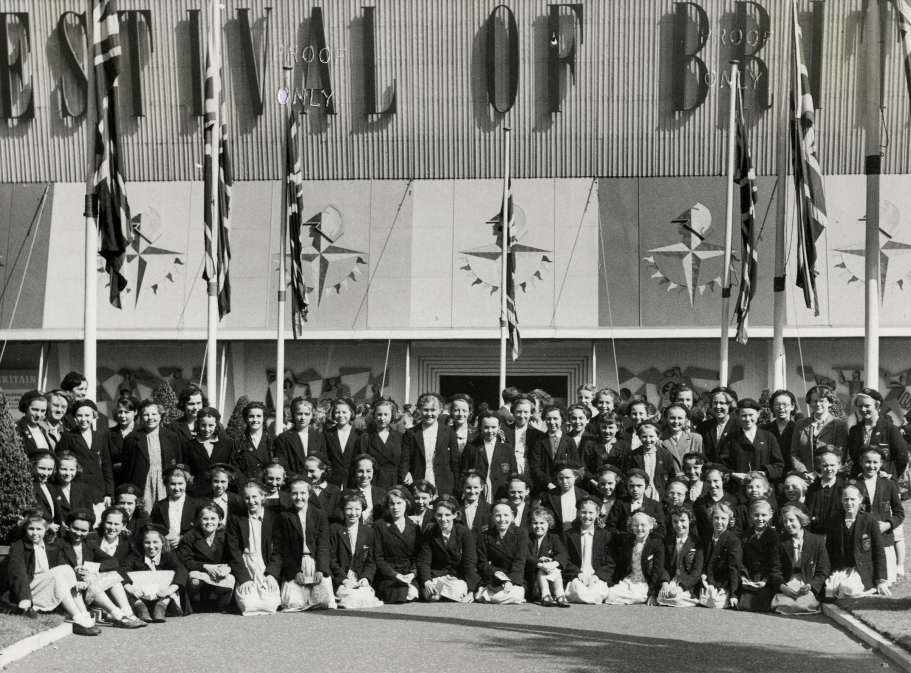
This photograph shows the Festival of Britain school trip in 1951.

Greenhead Pupils

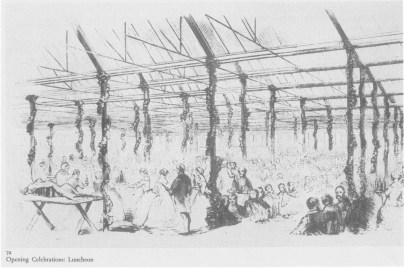
Salts Mill Opening Celebrations. Luncheon in the Combing Shed.

The mill was opened on 20 September 1853, the 50th birthday of Titus Salt. A full description of the opening, from which most of the following information has been taken, appeared in the Bradford Observer of 22 September, where it was described as “one of the most gigantic and splendid festivals that ever occurred in the annals of Industry.”

Luncheon was provided for about 3,200 people who were conveyed from Bradford to Saltaire in special trains. The guests included the Lord Lieutenant of the West Riding, local MPs’, magistrates, mayors and clergymen, and business and personal friends of Titus Salt, and about 2500 of his workpeople. Flags flew from the roof of the mill, and an arch of laurel and flowers surrounded the West entrance.  The guests were conducted through the principal rooms to the Combing shed where 28 long tables had been set up. The columns which supported the roof were decorated with pink and white draperies flags, banners, evergreens and flowers. The food provided included a baron of beef weighing 300 lbs, 40 hindquarters of beef, 40 chines of beef. 100 legs of  mutton, 10 lambs, 120 veal and game pies, 60 dishes of game, 30 dishes of roast chicken and turkey and 40 dishes of potted meat. There were also sweet dishes, fruit and numerous bottles of wine. 7000 knives and forks were required, and 4000 tumblers, 6000 wine glasses and 7000 champagne and other glasses. The meal lasted just over an hour and was followed by toasts and speeches.

Music and dancing were next provided for the company, and trains then transported them back to Bradford. In the evening a Soiree Musicale, consisting of songs and instrumental selections, was presented at the recently opened Sr. George’s Hall in Bradford.

Opening Celebrations at Salts Mill

Taken from Bradford Libraries Saltaire Resources Pack

Local Poets of Keighley and District: Bill O’th Hoylus End (William Wright)

In the celebrating of public events in Keighley, which town he has long made his home, or in the lampooning of Keighley’s public men, he is especially at home. No public matter there would be regarded as duly celebrated unless enshrined in the local laureate’s rhyme, no ceremony complete without his burly presence or his facile pen. He is the poet historian of the borough.

(William Wright: The Poets of Keighley, Bingley and Haworth: Chas F Forshaw (Ed) 1893)
Local Author’s collection, Keighley Local Studies Library.

William Wright

To Isaac Holden Esq. MP

Come, hand me down that rustic harp,
From off that rugged wall,
For I must sing another song
To suit the Muse’s call,
For she is bent to sing a pœan,
On this eventful year,
In praise of the philanthropist
Whom all his friends hold dear—
The Grand Old Man of Oakworth,
Beyond his eightieth year!

No flattery!  My honest Muse,
Nor yet be thou servile;
But tinkle up that harp again,
A moment to beguile.
Altho’ the bard be rude and rough,
Yet, he is ever proud
To do the mite that he can do,
And thus proclaim aloud—
The Grand Old Man of Oakworth,
Of whom we all are proud!

For base indeed were any bard
That ever sang on earth,
Did he not wish his neighbour well,
And praise his sterling worth.
Leave state affairs and office
To those of younger blood,
But I am with the patriot,
The noble, wise, and good—
The Grand Old Man of Oakworth,
The wise, the great, the good!

This worthy old philanthropist,
Whom all his neighbours greet;
Who has a smile for every one
Whom he may chance to meet—
Go to yon pleasant village,
On the margin of the moor,
And you will hear his praises sung
By all the aged poor—
The Grand Old Man of Oakworth,
A friend unto the poor!

Long may he live! and happy be,
The patriot and the sire;
And may some other harp give praise,
Whose notes will sound much higher.
His thirst for knowledge, worth, and lore—
His heart was ever there—
This worthy old philanthropist,
Beyond his eightieth year!—
The Grand Old Man of Oakworth,
Beyond his eightieth year.

See also:  BK 135 & BK361 held in the Archives @ Keighley Local Studies.

For more on Bill O’ Th Hoylus End

http://discovery.nationalarchives.gov.uk/details/rd/ea64b6b2-55a8-469c-823e-7cf6cb125fdd
http://www.haworth-village.org.uk/history/people/bill-hoylus.asp
http://www.gutenberg.org/files/29085/29085-h/29085-h.htm

And more can be learned about the subject of Bill’s poem, Sir Isaac Holden, inventor, entrepreneur and politician here, in our subscription to the Dictionary of National Biography

http://www.oxforddnb.com/view/article/13491?docPos=12

Ian Dewhirst in Keighley Library Then and Now!

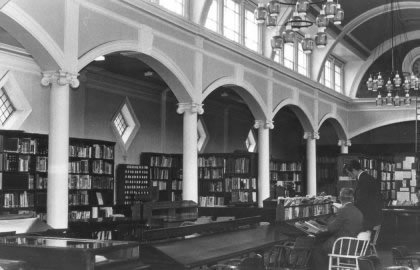
Ian Dewhirst was the Reference Librarian in Keighley Library from 1967 until his retirement in 1991.  Here are images of him doing a talk in 2015 and working in the library at the start of his career in Keighley.

Ian Dewhirst 2015

Keighley Public Library has the distinction of being the first in England substantially paid for by the Scots-born American industrialist Andrew Carnegie. The Borough council was to provide the site and adopt the Free Libraries Act. An architectural competition was held and the design of McKewan and Swann of Manchester was chosen. The design of the building was described as ‘Edwardian Free Style with Art and Craft influence which presages future 20th century developments in architecture more than it reflects 19th century eclecticism.’ (Sarr 1980)

Ian Dewhirst 1967