It is just over 100 years since the opening of the Lido in Lister Park.
It officially opened on 19th June 1915.
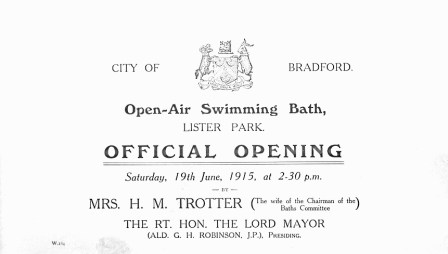
Here is a description of the bath from the official opening programme.
DESCRIPTION OF THE SWIMMING BATH.
THE entrance to the Bath is by a forecourt connected to one of the main avenues the park.
The Bath is surrounded by a close-boarded fence, seven feet high, fixed on the top of an embankment which has been formed from the material excavated for the pond; trees are planted on the slopes of the embankment and around the Bath and next to the inner side of the fencing flower beds and shrubs have also been planted.
The Swimming Pond is 150 feet long by 60 feet wide and will hold 286,000 gallons or 1,300 tons of water. The depth is 3 ft. 4 ins. at the shallow end and 6 ft. 10 ins. at the deep end.
Settling tanks have been formed at the west end of the Bath for the purpose of intercepting the solid matter in the water from the stream by which the pond will be supplied, and the outlet of the pond will discharge into the stream.
Six separate flights of steps, giving access to the pond, are recessed in the gangways so as to avoid any obstruction to bathers.
A diving stage, at the deep end of the pond, has been erected so as to enable diving competitions to take place in accordance with the conditions which govern the English Championships and with all regulations relating to diving competitions. There is also a spring diving-board fixed to the gangway.
On three sides of the pond there is a galvanized iron handrail, and at the shallow end a sparge pipe has been fixed to be used as a spray and for cleansing the surface of the water.
Spittoons are arranged around the pond.
Life-buoys are placed in convenient positions around the pond for use in case of emergency.
Dressing boxes and sheds, to accommodate seventy persons, are arranged on each side of the bath, and the gangway is of such a width that additional dressing boxes can be erected it necessary. There are two dressing rooms which can be used by swimming clubs or for the purposes of gala performances.
Six electric lamp standards have been fixed around the pond and two at the entrance for lighting purposes.
The main building is at the shallow end of the Bath and comprises entrance hall 11 feet wide, fitted up with two turnstiles and a collapsible gate, and on both sides of the entrance accommodation has been arranged for cycles.
Adjoining the entrance hall there is a small cafe with a projecting balcony, and from the balcony a full view of the bath can be obtained. There are balconies on each side of the cafe which can be used in connection therewith; a ladies’ retiring room is also provided as well as lavatory accommodation for men and women.
Staircases on each side of the entrance lead to the pond gangway, and from the gangway four flights of steps lead to the galleries and balconies.
The Attendant’s room is immediately under the entrance, and is placed so that the attendant has full supervision of the Bath. The foot and shower baths are supplied with hot and cold water and adjoin the Attendant’s room.
There is seating accommodation in the galleries for 480 persons for swimming exhibitions or gala performances, and an additional 560 persons can be seated by providing chairs on the balconies. There is also standing accommodation for 1,000 persons, and the total accommodation is 2,040.
The swimming pond has been constructed, and the water supply service arranged, under the supervision of the City Engineer and Surveyor (Mr. WHS. Dawson), and the remainder of the Bath to the designs and under the direction of the City Architect :Mr. W. Williamson, L.R.l.B.A.).

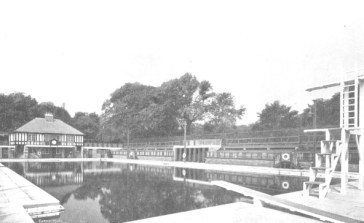
In the 1930’s there was a marked decline in the popularity of the bath, the reason being that it did not comply with the standards of hygiene demanded by modern swimmers. Cold and unfiltered water, inadequate dressing accommodation. etc. all contributed towards this end.
Under these conditions. it became obvious that something more up-to-date should be provided to meet the reeds of the ever-increasing number of swimming enthusiasts.
Therefore. the City Council, acting on the recommendation of the Baths Committee decided, after most careful consideration, to carry out a scheme of modernisation.
A filtration, sterilisation and heating plant has was installed, capable of treating the entire contents of the pools in a period of six hours, thus ensuring, at all times, water having a high standard of purity and maintained at a temperature of approximately 70 degrees Fahrenheit..
Surrounding the large swimming pool was a raised terrace on which sunbathers could recline, and to the rear of this were seats, arranged in tiers, for spectators, provision being made for the latter to obtain shelter during inclement weather. A spacious cafe with glass-fronted lounges was an added amenity. The new look lido was officially opened on 3rd May 1939.
In 1973 cutbacks meant the lido only opened briefly, and finally, in 1982, it was discovered repairs worth £60,000 were needed. The baths closed in 1983 and were finally demolished in 1991.