At 11.00am on 11 November 1918 the First World War was over. The fighting was over but life would never be the same again. In towns and villages across the country public memorials were erected to commemorate their men and women who died in the First Word War. As our thoughts turn to Armistice day, Susanne Young, a historian from the Wharfedale Family History Society has shared her research with us about the names on the Burley in Wharfedale memorial.
Clayton – An ancient settlement
Clayton was ancient settlement and was mentioned in the Domesday Book. It was part of the Manor of Bolton, under the control of Ilbert de Lacy. At that time it was known as ‘Claitone’, meaning ‘clay soil’. When Clayton ceased to he part of the Manor of Bolton, it was split into three parts: Clayton Village, Clayton Heights and Cockan, a now non-existent village which lay to the southwest of the present village.
Between 1160 and 1316, Clayton belonged to the following Lords of the Manor: Hugh Stapleton, William de Stapleton, Jordan de Birill and Hugh de Leaventhorpe. It was then acquired by the Bollings in 1324. The Bolling family. and their successors the Tempests, held the Manor of Clayton for nearly 300 years, until it descended to the Lacies of Cromwell – Bottom by marriage. After the Lacies sold the manor around 1740, it passed through many hands until 1894, when the district council was formed. The council fought off an attempt by Bradford Corporation in 1898 to amalgamate Clayton with the city of Bradford, and for many years the villagers enjoyed their independence. Inevitably though, in 1930, Clayton finally become part of the city of Bradford, much to the reluctance of many of the residents.
Up until the end of the 19th century, Clayton was almost all green land with very few buildings indeed. Looking at maps from 1893, it was only a very small village surrounded by fields. In the early 20th century much development took place but the village still had its green belt surrounding it. Even today, Clayton is separated from its nearest neighbours by fields. It must be a ramblers’ paradise. One can walk to Thornton. Queensbury and even Ogden reservoir through the fields and across moors.
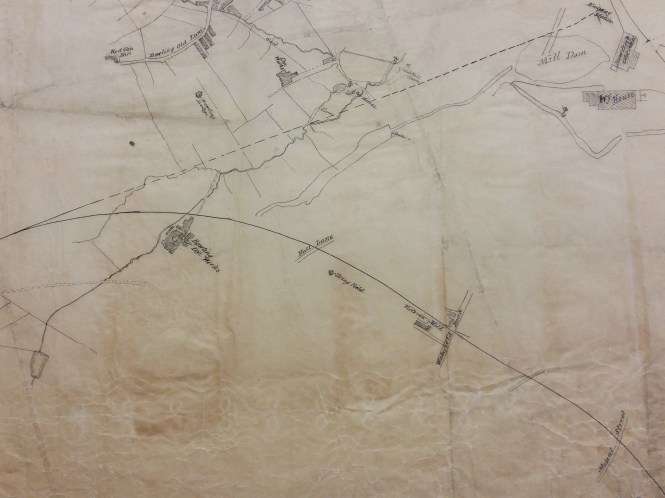
Prior to 1878, when the railway station opened, the only means of transport to and from the village would have been by foot or horse. The station was on the Bradford, Halifax and Keighley branch of the Great Northern Railway, and was situated on Pasture Lane. This meant that it was only 12 minutes to Bradford via rail and only 23 minutes to Halifax. Quicker than driving today it seems. The branch line Closed in 1955 and the entrance to the Queensbury Tunnel was blocked and sealed up.
The railway might have mode it easier for residents to leave the village, but there was not actually much need for this. Clayton was quite self-sufficient. Many shops had opened in the Clayton Lane area. In 1900 there was a draper, grocers, newsagent. shoemaker, beer retailer, butcher, milliner, confectioner, builder and even a clogger.
One of the focal points of todays village is Victoria Park. The park actually originates from the old village green. In 1897, a meeting of residents was held at which it was proposed that the village green and surrounding land be purchased to form a park. It was suggested that the park be created for Clayton residents to use forever, and donations were collected so that the project could succeed without any cost to ratepayers, although the park’s upkeep would be paid for by the rates. The scheme was started in commemoration of the Diamond Jubilee of Queen Victoria and the park finally opened on 23 July 1898. It was opened by Asa Briggs, the highly respected Clayton philanthropist.
The roundabout in Clayton is home to the “wells”. The wells were stone troughs which supplied water in days gone by. Householders without water supply would bring their own buckets here to fill up, and carters on their way to Queensbury or Thornton would stop here to let their horses drink. The area was a popular meeting place in times past.
One of Clayton’s biggest claims to fame is that it was the birthplace and home of Albert Pierrepoint, Britain’s last ‘Number One’ official hangman. In his role as state executioner Pierrepoint dispatched some of the country’s most notorious convicted murderers – while expressing some personal reservations about the value and use of capital punishment.
Alfred Wallis was a well-known and respected Claytonian. He started business in Oak Mills in 1860, with Asa Briggs and Joseph Benn. He was active in Clayton’s affairs for many years and he set up the Alfred Wallis Trust Fund, which can still be used today for the further education of Clayton’s young people. Another of the area’s characters was known as the ‘Clayton poet’. Sherwin Stephenson was born in the village in 1881. He became a talented poet, describing his experiences and life in Clayton. He penned such verses as; `Bonny Clayton’, `Teah Pot Spaht’, ‘The Old Brewery, Clayton’, ‘Cote Fields’ and ‘My Native Hills’, all celebrating the people and surroundings of Clayton. He even described the wells as a meeting place of the ‘Clayton Parliament’. A true ambassador for the village, Sherwin died in 1954. He is buried in Clayton churchyard, where his headstone resembles an open book.
Stephenson’s poems are a perfect reminder of how Clayton used to be. The village will never be the same again, but it is one of the few areas of Bradford which has retained its character somewhat. Stephenson would be proud.
The Medical Front in WW1
The commemoration in October of one of WW1’s heroines, Nurse Edith Cavell, also highlights the pioneering work carried out in other hospitals at home and on the Front during the First World War.
One of the innovations was the use of Sphagnum moss, or Bog moss, as an effective dressing for wounds. As hundreds of thousands of dressings were required, sufficient gauze and cotton wool became difficult to obtain. An Edinburgh surgeon, Dr Cathcart, revived the use of this soft moss which can absorb up to ten times its own weight in water. Dr Cathcart established a centre for the preparation of dressings from the moss, in order to supplement medical supplies at home and on the Front. Other such centres were established.
The moss grows abundantly on wet moorland and mountains in colours: white, yellow, crimson, green and brown and, under the direction of the moorland keeper, local working parties were organised to collect it. In the BK 10, Brigg collection in Keighley Library, there is a dried sample with a note attached which says “Rombalds Moor – very good, Keighley Moor – good”, as well as the letter and note shown (BK10/683/9/2).
Keighley Library also holds the publication, Recollections of the War Hospital Keighley and its Auxiliaries 1916-1919. Keighley’s War Hospital was the former Keighley and Bingley Fever Hospital at Morton Banks and included local auxiliary hospitals: Spencer Street, Fell Lane, and Victoria. The brochure gives an excellent account of Keighley’s own contribution to medical advancement during the war, as the following extract shows from page 44:
The selection of Keighley War Hospital as a centre for American Surgeons to see the latest developments in Military Surgery proved interesting interludes in the daily routine. To some 30 American Red Cross Surgeons a series of lectures on modern methods of treating wounds, gas gangrene, gas poisoning, &c., was delivered by Major Brander, while in the wards demonstrations and clinical discourses on methods of dealing with the more interesting and obscure results of modern warfare were given by Majors Dobie and Brander.
Up to June 1919 – 13, 214 soldiers were admitted to Keighley hospitals, they included mostly medical or surgical cases but also 105 German POWs and 156 soldiers suffering from gas poisoning. The Keighley Surgical Supply Depot, employing local women, produced over 108,700 swabs and bandages.
Keighley’s Great War Poets
On Saturday 10th October at Keighley Local Studies Library at 11.00am there will be a talk about Keighley’s Great War Poets by Andy Wade from Keighley’s Men of Worth project and regular writer in Keighley News.
The two definitive poets from Keighley wrote of their very different experiences of war.
Clara Jane Terry was born locally and was head dressmaker at Keighley Co-operative Society. Her poems were published under the pen name of Jean Clare.
This copy of her book called ‘Verses by Jean Clare – Songs of Peace and War’ is kept in Keighley library. The book was published in 1915 and includes a poem about refugees from Belgium, a tribute to British troops killed in action and a poem praising the actions of nurse Edith Cavell. Proceeds from the sale of the book were sent to the red Cross.
Clement Bartrim served in the army with the 3rd Battalion York and Lancaster Regiment.
Joining Up
The world today is very sad,
And eyes are dim with tears,
My life today is all askew,
I feel full twenty years.
To Mother, Dad and brothers too,
This morn I said goodbye,
And laughingly I said to them,
I was not born to die.
But now I am upon my way
A soldier soon to be,
To Halifax, the sergeant said,
And then, to Gay Paree.
‘Bout thirty I should say, or more,
For sure we ride in state
In carriages all to ourselves,
Oh yes, we must be great.
But what a silent throng we are,
A silence still and deep.
With thoughts of home we go to war
And wish that men would weep.
The poem below was written in about April 1917. Bartrim writes: ‘At this period we were working on the Somme battlefield, where the terrible fighting of July, 1916, had taken place, and some of our men were burying soldiers who had been lying there since then – there were some awful sights’
France
Oh land of horror, land of death,
We speak of thee with fearful breath,
But yet we hearken to thy call,
And for thy sake our manhood fall.
Our British blood
The test has stood,
And ever for our friendship’s sake
An English mother’s heart shall break.
Thy rivers red with blood shall run,
With British blood till set of sun,
And in the heaven’s gleaming fires
Shall light the way for soul that tires.
Never forget,
Oh France, the debt,
And e’en though doubt shall come with years,
Remember all our bitter tears.
Nurse Edith Cavell
As 2015 sees the commemoration of Nurse Edith Cavell’s life and work, Keighley Local Studies can look again at contemporary correspondence regarding the Cavell Memorial Fund and a report for the Edith Cavell Homes of Rest for Nurses. These original documents are part of the large WW1 archive in Keighley’s Brigg collection, ref: BK 10/683/7/9.
Edith Cavell was born in Norfolk and trained as a nurse eventually moving to Belgium where she became matron of the first Nursing School as well as a reforming manager of hospitals, clinics and nursing homes. When war broke out she began serving on the front line in Belgium. Despite some criticism, Edith made it her mission to care for all soldiers at the Red Cross hospital, including German and Austrian. Furthermore, in order to prevent her Allied patients being shot, she very bravely became involved in the Belgian underground. In fact Edith helped to successfully smuggle over 200 soldiers out of hospital and into neutral Holland. Unfortunately, in 1915, the Germans discovered the network. Edith was arrested and tried for treason. On 19th October, despite international protest, and still wearing her nurse’s uniform, Edith was shot by firing squad. She was just 49 years’ old.
In 1917, an appeal was launched, to provide homes of rest for nurses in need of temporary mental or physical respite. It became the Cavell Nurses’ Trust. Recently, Edith Cavell’s dedication and heroism has been acknowledged with a new commemorative £5 coin, issued by the Royal Mint to mark the WW1 anniversary years.