
Northern writer, historian and collector of stories, Ian Clayton, will be talking about his life and work at Keighley Local Studies Library on Saturday 12 March at 2pm.
Northern writer, historian and collector of stories, Ian Clayton, will be talking about his life and work at Keighley Local Studies Library on Saturday 12 March at 2pm.
A surprisingly common enquiry at Local Studies, is for information on local photographers operating out of Bradford in the 19th Century. Often, customers have found an old photo with a photographers name on the back and are curious as to who this was, or perhaps they are serious scholars of all things photographic!
The Library holds an index of photographers compiled from old Trade Directories by Local Historian Ken Kenzie, and an extremely useful website with a great deal of information and examples of photographers work can be found at:
Leeds and Bradford Photographic Studios 1840-1910

UNDERCLIFFE is set just to the north east of the city centre of Bradford, its main artery being Otley Road. The first mention of the area was, according to C. Arthur Sugden, in 1418, when a man named Robert Leggard was up before the Bradford Court ‘ ….charged with having taken stone from the lord’s soil, in his waste towards Undyrcliffe’.
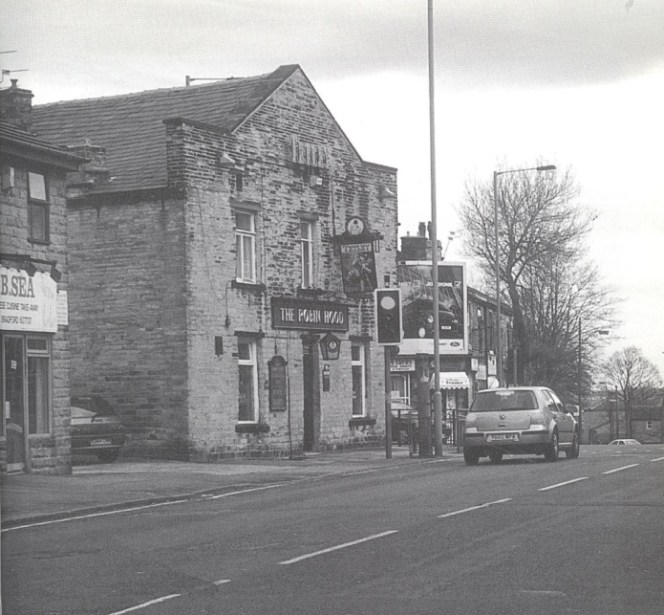
The now closed Robin Hood Pub, Harrogate Rd 2002 (Ann Birdsall)
The district was part of the moor of Bradford (now Bradford Moor). By 1611, Hundercliff, as it was then known, was a glebe in the West Riding of Yorkshire. On Johnson’s map of Bradford (1802) most of Bradford Moor had been enclosed, and in the area of Hundercliffe the only buildings of note were a few farmhouses and Undercliffe House, built by John Hustler. By 1880 however, a great transformation had taken place in the area. Undercliffe House was now surrounded by buildings. Quarries had sprung up and buildings had appeared everywhere.
Undercliffe today is 600 ft. above sea level, higher than its original position. There is little doubt that the district got its name from the fact that the earliest settlements were built ‘under-the-cliff’. But the village was ‘forced up the hill’. The expansion of Bradford pushed the village further and further towards Eccleshill to where it is today.
Undercliffe was the setting for the legend of the famous Bradford boar. During the mid to late 14th century, there was a ferocious boar that lived in Cliffe Wood on the moors of Undercliffe. The boar frequently drank from a well in the wood. The boar terrorized the populace and caused much damage to land and property; so much so that the lord of the manor offered a reward for anyone brave enough to slay the boar and bring its head to the manor house.
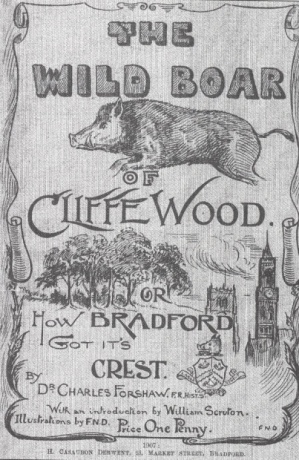
Cover of a poetry book by Dr Charles Forshaw, 1907.
A hunter took up the lord’s offer, and lay in wait near the well, ready to catch his quarry and thereby claim his reward. The boar duly arrived, and was shot by the hunter, who cut out the boar’s tongue as proof of his victory and set off for the manor house. A little time later, another hunter, who had heard of the lord’s offer, was passing through the woods and saw the slain boar lying near the well. Thinking of the reward he would receive, he cut off the boar’s head and he too set off for the manor house. Arriving there before the true victor, he claimed his reward for having disposed of the ferocious creature, but was unable to account for the boar’s absent tongue. The first hunter then arrived and explained the true circumstances of the defeat, showing the boar’s tongue as evidence of his veracity, and received his rightful reward; a plot of land called Hunt Yard in Horton.
Undercliffe today is renowned for its cemetery. It is possibly the most famous Victorian cemetery in Britain, outside of Highgate in London. Wealthy Victorians often lived quite modest, unassuming lives, but when they died they certainly left behind the most flamboyant memorials. Similar to the Egyptians, they showed a desire to display strength and prosperity in life and immortality and eternity in the after-life. The cemetery itself is not huge (around 25 acres) but it is crammed with magnificent memorials and monuments to the dead, especially those of the rich mill owners, wool barons and politicians of the Victorian era. A walk round the cemetery today will reveal a mausoleum built like an Egyptian temple, complete with sphinxes, a Graeco-Roman temple with carved angels, and a Gothic steeple based on the Scott Monument in Princes Street, Edinburgh. These are just some of the grander monuments. There are hundreds of other interesting, if less grand, gravestones of ordinary Bradford people, including many who died in the wars that affected the city from the Crimea onwards.

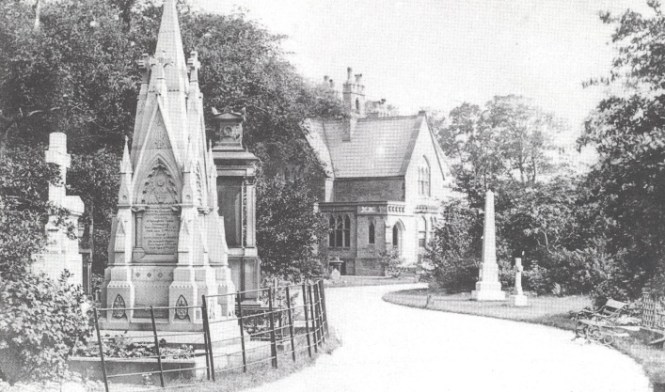
The cemetery is set in a stunning location, with great views over the city centre and the city as a whole. It is not uncommon to see film and documentary crews at work in the grounds. Go and take a look some time. It is a place of peace and tranquility set amongst this bustling city.
Further Reading
Sugden, A.C. Eccleshill and Undercliffe, in R.C. Allan The History of Bolton in Bradford-dale Robert C. Allan, 1927.
Beesley, I. Undercliffe. Bradford‘s Historic Victorian Cemetery
Ryburn Publishing. 1991
Bradford Libraries in conjunction with Bradford College are pleased to offer two new courses.
The popular course, Family History for Beginners, is starting again at Bradford Local Studies and Keighley Local Studies Libraries.
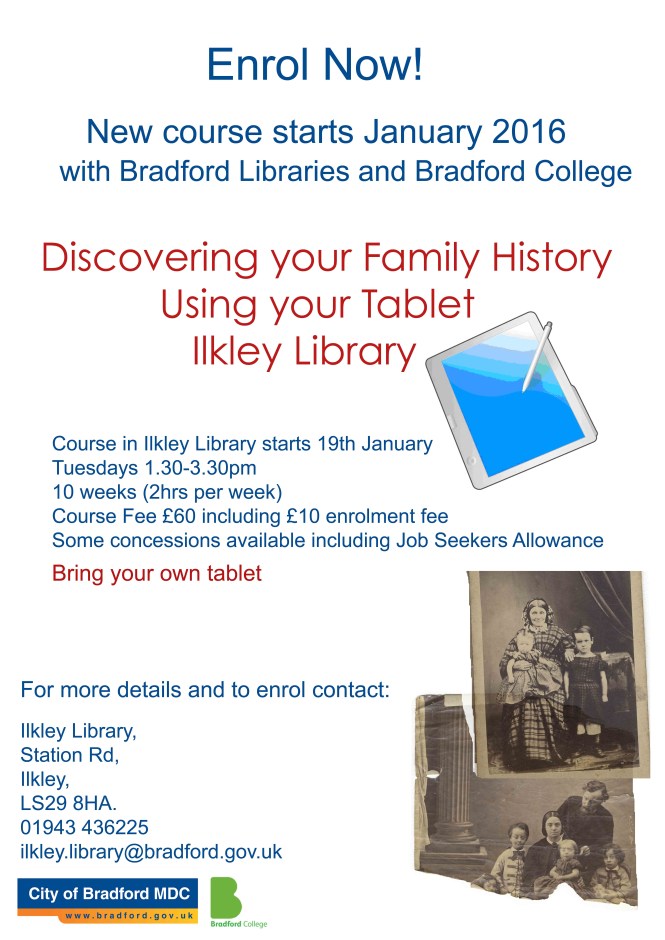
Ilkley Library are pleased to announce the start of a new course: Discovering Your Family History Using Your Tablet.
Please see the posters below for more details.

On 5th December the sculptured head of Humbert Wolfe, Bradford poet, was presented to City Library by Anthony Padgett, Sculptor. The sculpture was unveiled by the Lord Mayor of Bradford, Councillor Joanne Dodds, with a reading of Humbert’s poems by poet Stephen O’Connor.

Humbert’s poem ‘Requiem’, published in 1927 is often read at Remembrance events.
Requiem: The Soldier
Down some cold field in a world outspoken
the young men are walking together, slim and tall,
and though they laugh to one another, silence is not broken;
there is no sound however clear they call.
They are speaking together of what they loved in vain here,
but the air is too thin to carry the things they say.
They were young and golden, but they came on pain here,
and their youth is age now, their gold is grey.
Yet their hearts are not changed, and they cry to one another,
‘What have they done with the lives we laid aside?
Are they young with our youth, gold with our gold, my brother?
Do they smile in the face of death, because we died?’
Down some cold field in a world uncharted
the young seek each other with questioning eyes.
They question each other, the young, the golden hearted,
of the world that they were robbed of in their quiet paradise.
I do not ask God’s purpose. He gave me the sword,
and though merely to wield it is itself the lie
against the light, at the bidding of my Lord,
where all the rest bear witness, I’ll deny.
And I remember Peter’s high reward,
and say of soldiers, when I hear cocks cry,
‘As your dear lives (’twas all you might afford)
you laid aside, I lay my sainthood by.’
There are in heaven other archangels,
bright friends of God, who build where Michael destroys,
in music, or in beauty, lute players.
I wield the sword; and though I ask nought else
of God, I pray to Him: ‘But these were boys,
and died. Be gentle, God, to soldiers.’
Bradford Local Studies library has an extensive collection of books and news cuttings by this best selling poet.
