Heritage Open Day, Keighley Local Studies Library

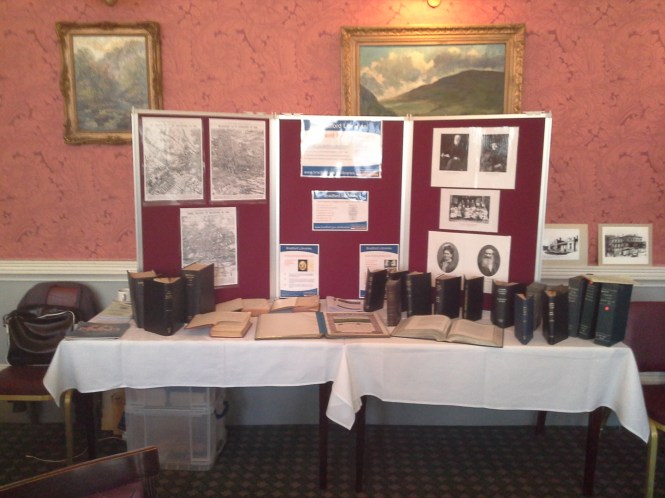
On 10th September as part of the Heritage Open Days Festival, Keighley Local Studies Library will be host to a variety of local societies and groups and will be exhibiting some of the treasures from their archives and collections.

This is a great opportunity not only to see some of the hidden gems of the Keighley archives, but also to meet local groups, see displays and exhibitions on the history of the local area, and to get help with your family tree and research.

It is also an chance to bring along your own stories, memorabilia and pictures to help celebrate the rich and diverse history and heritage of the Keighley District.

Amongst the groups exhibiting will be Keighley and District Local and Family History Societies, The Airedale Writers Circle, Silsden Local History Society, Oxenhope historians and local authors.  

The event will feature the exhibition from Men of Worth about the men of Keighley and District in the Battle of the Somme and Keighley’s Military Hospital along with a showing of the film ‘The Battle of The Somme’.

This is a free ‘drop in’ event and will run from 10.30am until 4.00pm. All are welcome.

KeiHeritage

Map of the week: a century of Bradford Hailstones

As I work on the reserve map collection the same local land-owners appear regularly. Examples are: Rev. Godfrey Wright, Mrs Giles and Miss Dawson. Godfrey Wright owned a great deal of property around Bradford, but seemingly lived near Doncaster. ‘Mrs Giles’ was clearly a member of a family who owned much of Horton, and she sold the land on which the Bradford workhouse (later St Luke’s Hospital) was built. ‘Miss Dawson’ was probably Eliza Dawson, grand-daughter of Joseph Dawson, partner in the Low Moor Iron Company. The name of Samuel Hailstone also occurs regularly. His importance to Bradford, and his fame as a Yorkshire naturalist, will ensure that his memory stays green.

Samuel Hailstone (1768-1851) was that rare combination, a lawyer and a botanist. His brother John Hailstone MA FRS took holy orders and became a professor of geology at Cambridge. Samuel himself was born in Hoxton, London but his family soon moved to York. In time he became articled to John Hardy, a Bradford solicitor, and Hardy & Hailstone eventually became partners. John Hardy was elected an MP and was the father of another politician Gathorne Gathorne-Hardy who was created Earl of Cranbrook. I understand that Samuel and John Hardy were the moving spirits behind the 1803 Bradford Improvement Act. More than forty years before Bradford became a borough this act established commissioners with a variety of local government powers such as street cleaning, lighting, and water provision.

Samuel continued to practise as a solicitor and was later in partnership with the Thomas Mason who became a director of the Bolling Iron Company and lived at Bolling Hall (see the previous map). Samuel Hailstone was the classic example of a wealthy and highly successful professional man. His politics were Liberal and, slightly unusually for non-conformist Bradford, he was an Anglican. He purchased the Bolton House estate although he never resided there. I get the impression that Yorkshire botany and geology were Samuel’s main interests. A collection of more than 2000 plant specimens was passed to the Yorkshire Museum on his death. But despite these studies he was active in issues affecting his chosen town. He helped found the Bradford Literary & Philosophical Society and also the Mechanics Institute. He served as a major in the Bradford Volunteer Infantry and was clerk to the Trustees of the Leeds and Halifax Turnpike Road.

This brings us to the maps. In Samuel Hailstone 1837 he offered for sale the land between Croft Street & Bridge Street. A small portion of a very large sale plan is illustrated here.

Map of the Week 011A

A second map shows land further south which is also divided into lots. This map is stylistically very similar and shows Samuel’s place of business and house. What is now called Croft Street took its name from Croft House, in Bowling Lane (now Manchester Road) which was was where Samuel lived in his early years.

Map of the Week 011B

In 1808, quite late in life, Samuel married Ann Jones, the daughter of a Bradford surgeon, and the couple had several children.  Samuel died at Horton Hall, Bradford in 1851. In his census return for that year he indicates that he is living alone, except for a house-keeper and five servants.

The Hailstones were a very high achieving family. One son, Samuel jnr., was also a noted amateur naturalist and a collector of crustacea. He pre-deceased his father in 1841. There were two surviving sons, Rev John Hailstone (1810-1871), the vicar of Bottisham, Cambridgeshire, and Edward Hailstone FSA (1818-1890). Edward took over the Bradford legal practice but is famous for a huge assembly of books and documents relating to Yorkshire history, especially those of the Sharp family who were the previous owners of Horton Hall. This was the project of his retirement when he lived at Walton Hall, near Wakefield. At his death the collection was left to the archives of York Minster where it can still be consulted today.

Derek Barker, Local Studies Library Volunteer

The Township of Idle

This article is an extract from The Illustrated History of Bradford’s Suburbs 2002

THE township of Idle, to the north of Bradford, has always been quite large in both area and population. William Cudworth described the extent of Idle in Round About Bradford (1876) as reaching ‘…from Apperley Bridge to Windhill Bridge, and from Buck Mill to Bolton Outlanes’. The population today, due to the new housing developments that rapidly appeared from the mid – 20th century onwards, is near to 10,000.

The origins of the name Idle can be the subject of much speculation. The spelling of the word in historical documents is often Odell or Ydell, and J. Horsfall Turner, the noted Bradford historian, stated that the spelling Idle was frequently used in the Calverley parish register for the best part of 300 years.  Another Bradford historian, William Claridge suggested that the village took its name from the fact that much of the locality was uncultivated moorland; land that was literally idle.

Idle is well documented through history, and indeed seems to have been settled, or at least passed through, as far back as Roman times.

One William Storey, when opening a quarry on Idle Moor in around 1800, found many Roman coins, and human remains enclosed in stone were also discovered. Written records mention Idle (or, rather, ldel) as far back as the 12th century, when Nigel de Plumpton is quoted as giving a piece of land there to the nuns of Esholt. The Plumpton Family are associated to quite a considerable extent with ldle’s past, and Sir William Plumpton and his son and heir (also William) took part in the Battle of Towton near Tadcaster in 1461. The younger William was killed in the battle, plunging the Plumptons into years of turmoil and dispute, which eventually saw the Manor of idle being first halved and then quartered, the portions being owned at any one time by George, Earl of Cumberland (father of Lady Anne Clifford), and Sir John Constable, who split his half between his two daughters. Possession of the manor eventually ended up in the hands of Robert Stansfield, of Bradford, who bought it in the 1750’s from the Calverley family.  A detailed account of this early period in Idle’s history is available in Cudworth’s Round About Bradford.

By the mid to late 19th century, Idle, like much of the Bradford district, was heavily involved in the textile industry.  A look at the Ordnance Survey map of 1893 shows many mills in the area, including Castle Mills, Union Mill on Butt Lane and the nearby New Mills.  By the 1870s around 1,100 people from Idle were employed in the township’s mills. Idle seems to have achieved some kind of parity in the size of the mills that operated there.   Cudworth states that no giant manufacturer dominated the neighbouring companies in the village.   Indeed he goes on to say that the villagers of the late 19th century were probably the most ‘equal’ in the entire land, with no man of exalted rank or great wealth residing in the township.  The villagers displayed a prominent love of their home but Cudworth found them rather ‘clannish’ in their attitudes to outsiders.

Another source of income and employment in 19th century Idle was quarrying.  Stone was dug underground from beneath Idle Moor and raised to the surface via deep shafts, so unlike areas such as Bradford Moor with its vast coal mining operations, the landscape was not utterly ruined.  Idle stone was well known and was considered superior to stone from many other areas.  It was used on public buildings in many towns in England, and was even exported as far as China, Australia and South America.  Among those involved in extracting Idle stone in the early 19th century were William Storey of nearby Apperley, William Child of Greengates, and later Thomas Denbigh, among others.

Idle grew rapidly during the 19th century, reflecting an increase in the population of the Bradford district as a whole.  In 1801 the township’s population had been around 3,400, yet by 1871 it had risen to over 12,000.

At this time the village itself was well established, along lines that are easily recognisable today.  At the top of the village, on Towngate, the Old Chapel of Ease, which was erected in 1630, was still in its original use.  The chapel came by its name due to the fact that the nearest parish church was at Calverley, quite a trek away, so the chapel was quite literally built for the ease of the people of Idle.  The building currently houses the highly successful Stage 84 drama school.  Adjoining the Old Chapel was the township’s lock-up, complete with stocks.  On the opposite side of Towngate and a little further down stands Holy Trinity Church, built in 1830.  Just across from the church is the former library building, a large Victorian structure which seems to loom over the road.

The rooms above the library were latterly used as meeting rooms for local clubs and societies but were once used for meetings of the Idle local board, which oversaw the township’s affairs. The library moved into former shop premises in a more centralised location just below the Green in the early 1990s.

Idle can aptly be described as a village of two halves.  First there is the top half, centred around High Street, which runs steeply downhill from Highfield Road to the Green, from around which the bottom half of Idle radiates.  It was at the junction of Highfield Road and High Street that workmen making road improvements uncovered three ancient cellars.  The discovery, in 1987, caused much excitement in the local community, and it was suggested that the cellars offered proof of the location of the old Manor House, lost to historians for many years.  The proof of this theory may never now be tested as the cellars, which may have had underground passages running to Holy Trinity Church, were subsequently filled in.  High Street is also home to the wonderfully named Idle Working Men’s Club.  The club has found international fame due to its name and has boasted celebrities such as jockey Lester Piggott and Tom O’Connor among its honorary members.

idpic2

Idle Working Men’s Club

The bottom half of the village still boasts an array of small local shops, but the lure of nearby supermarkets with their cheap prices has inevitably caused something of a decline.  In its heyday Idle had its own railway station and cinema, both now long gone.  The station was on the line between Laisterdyke and Windhill, which opened to passengers in April 1875.

Sadly there is now little evidence left of the railway line that neatly bisected the village, reinforcing the division between upper and lower Idle.

Idle today is a busy, well-populated suburb of Bradford.  Smart, early 20th century housing lines Highfield Road, and a modern complex of flats stands on Bradford Road, at its junction with ldlecroft Road. The village itself has many excellent facilities for its residents to enjoy.  Small shops around the Green almost give the centre of Idle the appearance of a Dales market town. Idle boasts its fair share of pubs – the New Inn and the White Bear at the very top of the village, the Alexander and the Brewery Tap down on Albion Road, and the White Swan, which stands on the Green, to name but a few.

idpic3

The Green, Idle

The village has two supermarkets within easy reach, and a new medical centre was built on Highfield Road in the early 1990s, and the village has numerous clubs and societies to occupy its residents.

Like many of Bradford’s other suburbs then, Idle is a popular, pleasant place to live, offering all the trappings of modern living, yet retaining something of its historic appearance and charm.  This is most definitely one part of Bradford that doesn’t live up to its name.

Further Reading

Cudworth, William. Round About Bradford, 1876. (Reproduced 1968, Arthur Dobson Publishing Co.)
Watson, W.  Idlethorp, 1951.
White, E. Idle Folk Idle & Thackley Heritage Group, 1995.
White, E. Idle, an Industrial Village Idle & Thackley Heritage Group, 1992.

‘The Battle of the Somme continues’

Bradford Libraries's avatarBradford Libraries World War One Blog

A World War One event will take place at Bradford Local Studies Library on Saturday 3rd September.

The event will feature a talk about Bradford men in the Battle of the Somme and will be accompanied by an exhibition by the Bradford World War One Group.

Tricia Platts from the group and author of ‘Bradford in the Great War’ will be giving the talk from 11.00am until 12noon.

The battle of the Somme was one of the bloodiest of World War One. After the first and bloodiest day, the troops continued to press their advance. As the Pals battalions were mourned at home, the battle raged on.

Exactly 100 years ago, on 3 September 1916, the Bradford Territorials were engaged in a heavy battle below the Thiepval Ridge. Since their attack on 1 July these Bradford men had remained in the same area and, under constant fire, they had suffered many casualties.

Somme Continues“. …

View original post 63 more words

Map of the week: A Bolling Hall mineral plan

Maps and plans offer one of the best ways of reconstructing Bradford’s industrial history. Recently I found a 200 year old example at the Local Studies Library which was highly relevant to the history of the Bolling Hall estate. Victorian hand-writing is not always easy to read but, with small adjustments to spelling and capitalisation, the plan is headed: ‘Copy of the plan of Black Bed coal and ironstone made by Mr Hinchcliffe showing the Black Bed coal left for the protection of Bolling Hall and its buildings pursuant to the agreement of 18th November 1814‘.

Map of the Week 010

The fragile plan is not easy to interpret. Pink blocks represent Bolling Hall and its attendant out-buildings. Many of the black lines are property and field boundaries. Some of these make sense today, others presumably delineate parcels of land associated with the out-buildings. This whole central area is slightly paler in colour than the region outside the precinct boundary, which is darker and I assume represents winnable coal. This is most apparent if you start at the house and continue towards the bottom right of the plan. The wavy line, in an inverted V shape to the right, is probably a geological fault. In his description of the area historian William Cudworth reported a Bolling Hall fault which threw minerals ‘down 28 yards to the south’.

Bolling Hall is a Grade 1 listed building given by the last owner, Mr GA Paley, to the City of Bradford in 1912. The gift was associated with the purchase of land for nearby Bolling Girls High School, now demolished. A good deal of refurbishment has been undertaken since, including the creation of some formal gardens facing the entrance. Architecturally the hall is complex. A medieval pele tower at the south-west front contains the modern entrance and is believed to date from c1370. The south-east front Georgian bay was created in 1779-80 and (with its sash windows) contrasts sharply with the 17th century masonry present elsewhere. Historically the building is associated with two important families, the Bollings and the Tempests, but who occupied the hall at the time of this plan?

Towards the end of the 18th century the owner was Captain Sir Charles Wood, a Royal Navy officer, a painting of whom is still displayed on the main staircase. Captain Wood died of wounds in the far east and was succeeded by his son Sir Francis Lindley Wood (1771-1846). In 1794 Sir Francis gave the nearby Bowling Iron Company permission to mine coal and iron ore under his whole estate. Both as a land-owner and Lord of the Manor of Bowling Sir Francis controlled access to an immensely profitable asset. After five years he evidently grew tired of being surrounded by mines and spoil tips, however rich they made him, and he moved to another of his houses, Hemsworth Hall near Barnsley. Bolling Hall and its estate was sold outright to the BIC in 1816 and was allotted to its partners. Thomas Mason had it until 1834 then it passed to J G Paley. It remained in the possession of the Paley family until gifted to the City.

BIC had been established in 1780. It smelted iron ore found in the roof of the Black Bed coal seam, both of these minerals being mentioned in the plan rubric. A deeper coal seam, the Better Bed, made sulphur and phosphorous-free coke which was ideal for iron smelting. This seam is not mentioned on this plan, nor is the shallower Crow Coal. The removal of the Black Bed and its ironstone naturally left a gap into which the overburden of rock could collapse, resulting in surface subsidence. The common practice was to leave pillars of minerals unmined to support the roof. Under especially sensitive areas, which included churches and the mine-owner’s house, no mining at all took place. To indicate such restraint must be the purpose of this plan.

Where were the nearest coal or ironstone mines? The first OS map of Bradford (1852) shows a line of ‘old pits’ both north and south of New Hey Lane (now Road). The  Bolling Hall mine may have been closer still. About half-way between the bottom right corner of the house and the bottom right corner of the map is a small square containing a dot. I’m sure this represents a coal shaft. How deep was it? Fortunately opposite the north gate of Bowling Park (at SE 1698 3157) was a colliery called Waterloo Pit. This is only a few hundred metres away from the hall itself and fortunately the depths of coal seams at this location are recorded on the British Geological Survey website. They are:

Crow Coal            9.8m

Black Bed           28.3m

Better Bed         63.1m

The hall is at the same altitude as the Waterloo Pit (150m above ODL) so I think we can be sure that in the region of the plan the Black Bed coal was being mined, or not as the case may be, at about 30m depth.

Both the Bowling and Low Moor Iron companies exploited the same seams of coal and iron ore which extended over the whole of south Bradford and the surrounding areas. Huge networks of tramways and mineral ways grew up to bring the precious substances to the coke ovens and blast furnaces. To charge a blast furnace you also needed limestone to help the slag to separate. In the first OS map, close to the railway line at Bowling junction, is a ‘limestone quarry’. If there were limestone bedrock at this point then it would be more than a kilometre buried, so clearly we are dealing with a surface glacial deposit. The extraction of erratic limestone boulders from glacial moraine is recognised elsewhere in the Bradford district.

We are left with the problem of who was Mr Hinchcliffe? The only contemporary man of this name mentioned by William Cudworth, or present in Baines’s 1822 Directory, was Joseph Hinchcliffe who was a well-known local schoolmaster. Could surveying have been one of his skills? But the surname is a common one and could be that of an unknown BIC employee. Eventually local iron ore was exhausted and when this plan was being drawn the iron industry in Bradford had only about a century of existence left. Ore could be brought by sea from more favourable reserves abroad but transport costs ensured that only shore based blast furnaces, like those at Scunthorpe, survived. A century later still the deep-mining of coal in the UK was completely finished. This situation would have been inconceivable to Mr Hinchcliffe in 1814, whoever he was.

Derek Barker, Local Studies Library Volunteer