The History of Whitakers Chocolatiers

whit2

The next in the series of talks in Keighley Local Studies library organised by the Keighley & District Family History Society will be on Monday 7th November.

The talk by John Whitaker will  feature the history of Whitakers Chocolatiers (there will be samples!)

The meeting opens at 7pm before the speaker begins at 7.30pm and will finish at 9pm. Please use the side entrance to the library on Albert Street.

All are welcome. There is a fee of £2.50 for non-members.

From Parks to Pavilions

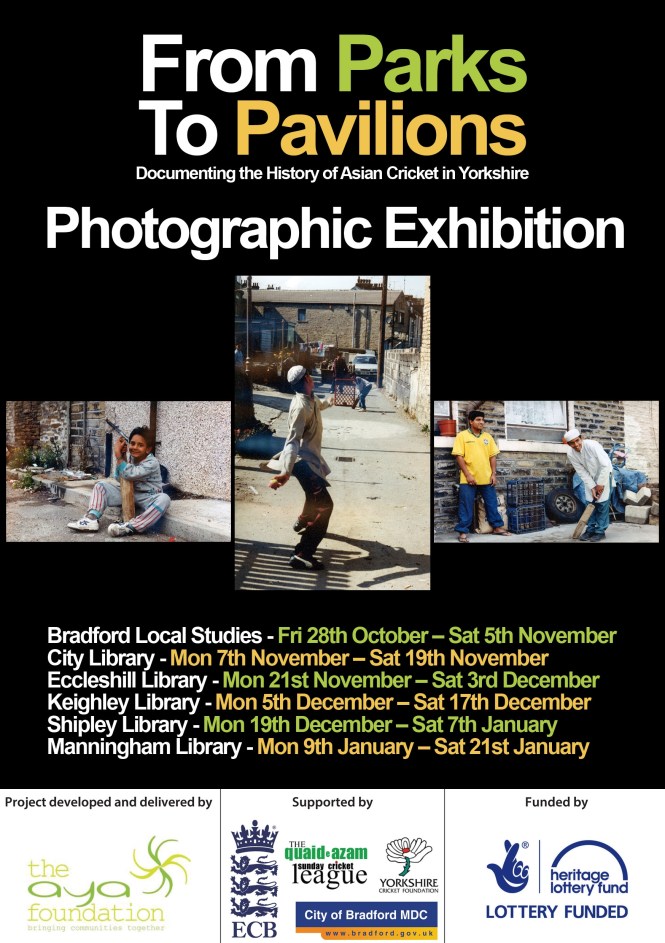
A photography exhibition illustrating the grass roots beginnings of Asian cricket in Yorkshire will be touring Bradford libraries over the coming weeks.
p2p

The exhibition contains photographs, taken by cricket enthusiast Mohanlal Mistry, of back-street cricket being played in West Yorkshire in the early 1990s. The exhibition has been displayed at Headlingley Cricket Ground for the one day international between England and Pakistan and at the Oval for the 2016 Asian Cricket Awards. This will be the first time that the exhibition is open to the public and free to visit.

It is part of the From Parks to Pavilions project which is documenting the history of Asian cricket in Yorkshire. The project was developed by the AYA Foundation, a community organisation specialising in promoting minority heritage, arts and culture, with support of Bradford Local Studies Libraries, the Yorkshire Cricket Foundation, the England and Wales Cricket Boards (ECB), and funded by the Heritage Lottery Fund.

This slideshow requires JavaScript.

Mobeen Butt, the curator of the exhibition and Project Lead of the From Parks to Pavilions project said: “The photographs perfectly capture how young Asians played cricket in the 1970s, ‘80s and ‘90s. They didn’t play on cricket grounds, in practice nets or even in parks – they played wherever they could, and that meant playing in alleyways, carparks and wastelands. They played with milk crates, traffic cones and crisp boxes for wickets and would carve out a bat from pieces of broken floor board or fence”.

The project aims to collect material and record interviews from members of one of the oldest Asian led cricket leagues in Britain, the Bradford based Quaid-e-Azam Sunday Cricket League.

As part of the project, the young people visited Bradford Local Studies library to find out about the oral history collection, the newspaper files and cricket memorabilia.

Maria Hussain, one of the young people working on the From Parks to Pavilions project said: “This exhibition is only a small part of our project. We’ve been to visit archives and museums. We’ve been to Lords, and we’ve been taught how to conduct oral history interviews and been on photography workshops. We will be producing a radio and video documentary and putting everything on YouTube for everyone to see!”

Councillor Sarah Ferriby, Bradford Council’s Executive Member for Environment, Sport and Culture, said: “It’s important to record the rich history of our South Asian communities participating in one of our great national sports. Cricket is still close to the hearts of local people and is a significant factor in community cohesion. We’re pleased to see the Heritage Lottery Fund get behind this as we have an enormous passion for sport across the Yorkshire region and it is a great unifier.”

To keep updated with the project visit: www.fromparkstopavilions.org.uk, follow @Parks2Pavilions on Twitter or join the ‘From Parks to Pavilions’ Facebook group.

All are welcome to take a look as it tours libraries in the coming weeks.

The exhibition will be in:

Bradford Local Studies Library from Fri 28th October – Sat 5th November
City Library from Mon 7th November – Sat 19th November
Eccleshill Library from Mon 21st November – Sat 3rd December
Keighley Library from Mon 5th December – Sat 17th December
Shipley Library from Mon 19th December – Sat 7th January
Manningham Library from Mon 9th January – Sat 21st January


 

Map of the week: Manningham village

It can be very difficult to orient yourself correctly when examining an old map. Map-makers often did not identify the direction of north and a building that would have provided an obvious fixed point, such as the parish church in the centre of Bradford, may not be drawn. The names of roadways may not be given, or if they are included they may differ from those known today. A plan of Manningham from the reserve collection exemplifies such difficulties.

The first image constitutes about half the original map which is annotated ‘late Miss Booth’s property, Manningham’. The crucial fact is that the road labelled as Lilly Croft Lane is now called Heaton Road. This thoroughfare leads from Bradford to Heaton, as the map indicates, in a direction that is a few degrees west of due north. Today there is another Lilycroft Lane, which is the road entrance leaving Heaton Road to the left. The block at the top left of the plan is a row of cottages, no longer existing, which were in front of the first Manningham Mill. This mill was rebuilt by Samuel Cunliffe Lister in 1873 after a disastrous fire. The mill building itself, which would have permitted instant positional recognition, is not drawn.

Moving east we cross the property of E.C.L. Kaye. He was Samuel Cunliffe Lister’s brother who retired early and took no part in the commercial life of Bradford. The field patterns here resemble closely those of the first OS map of the area; this was surveyed in 1847-50 and so provides an approximate date for our map. Skinner Lane in Manningham village has kept its name and the property outlines that are drawn again resemble those of the the first OS map. The road leaving the village to the east, and reappearing on the second image, is Dewhirst Lane.

map-of-the-week-014-b

In the first OS map this is called Duce Lane. I assume that Dewhirst is formally correct but that ‘Duce’ was a contraction by which it was generally known. Today it is Oak Lane. Whatever its name the lane ends at property belonging to Thomas & Isaac Rhodes. Here it joins Esp Lane, often called Hesp Lane, which evolved into North Park Road when the land  surrounding Manningham Hall was developed as a public open space (Lister Park) after 1870. Where you may just be able to make out the words ‘to Bradford’, at the bottom right of the image, is approximately the position of the beautiful Manningham Park gates. The road shown here links to Manningham Lane – Keighley Road, which is not drawn.

So, who was the late Miss Booth? As so often Cudworth provides the answer. He writes: (Skinner Lane) ‘was formerly the only outlet from Manningham to Duce Lane (now Oak Lane) which obtained its name from one Dewhirst (locally pronounced Duce) having long been resident there. In one square house, which is still standing in Skinner Lane, lived Jonas Booth with his maiden sister Catherine. Booth was one of the old race of stuff-makers, his warehouse being in the rear of his house. He died in 1837 bequeathing his property to his sister, who died the following year.’ Our map therefore presumably dates from 1838-39.

Derek Barker, Local Studies Library Volunteer

TREASURE OF THE WEEK. No. 3   FUDGE; or, The Bradford Oracle

In the basement of Bradford’s Local Studies are collections of nineteenth century pamphlets (and some of earlier date). Ranging from sermons and programmes of royal visits, to reports, articles, obituaries and regulations, they are a treasure-trove of local history. What follows is an account of one of these treasures. To consult any of these items please ask the staff. Card catalogues of these collections are located in the Local Studies Libraries. 

JND 187/12 (Please quote this number if requesting this booklet) 

FUDGE; or, The Bradford Oracle. A School Board Discussion. c.1880. 20 pages.

fudge100

The striking title ‘Fudge’ and the delightful Shakespearean quote on the title page: ‘I am Sir Oracle, and when I ‘ope my lips let no dog bark’, immediately whet the appetite. What on earth is this? Presented in the form of a dialogue between Smith, a retired Bradford merchant, just returned after ten years’ absence abroad, and Fudge, President of the Board School, at the date of this pamphlet (not stated but probably c. 1890) a relatively new institution, this slim pamphlet gives a spirited exchange on the subject of the cost and success (or otherwise) of the newly established Board Schools. No date, printer or author given, but a manuscript note (probably by journalist and historian William Cudworth) reads: Mr. Hanson (Fudge) is tolerably well drawn in some parts of this brochure but here and there is a little too much politeness and suavity of manner accorded.

08-10-2016-172142

This text is in the form of a play script, with the scene set in Market Street near the School Board Office.  It opens:

SMITH, Why bless me if that isn’t Fudge, looking as wise as Solomon! Weighed down with all the cares of Bradford! (aloud) Mr. Fudge (F. does not or will not hear, but continues his onward shuffle) Mr. Fudge!

FUDGE. Ha! Who’s that? (sees Smith) Oh Smith, is that you? Pardon my abstraction. How are you after your long absence?

  1. Very well, thanks, and right glad to see the old place again. How have you been? You seem quite bent with age or the rheumatics. Which is it?
  2. Ah, well my dear friend, I’m not a young man any more it is true, but care, care, that’s killing me!
  3. I’m sorry for it. Why what’s up?
  4. Well you know that for the last forty years I have been devoted in all manner of ways to the great cause of education, but the last three or four years of daily strife in its behalf has indeed subdued my natural hilarity, and imparted to me an appearance partaking somewhat I fear in a cross between a philosopher and an undertaker.
  5. Nay, nay, you are still in spite of your cares, a fine and handsome-looking man, Fudge. You’re not on the Scholl Board, I suppose!
  6. (In indignant surprise) Not on the School Board, my dear Sir! To be sure I am! Whatever can you be dreaming of? Why whatever would become of the Board, what of education at all, if I were not a member? Education, sir, particular Higher Grade Education, is, I humbly submit, my forte!
  7. Oh, I beg a thousand pardons. You see I’ve been so long abroad, and only occasionally had the luxury of seeing an English Paper.
  8. And what paper was that, my dear Sir?
  9. Oh, the Standard.
  10. Ah, no wonder you are behind hand. Had you consulted the Daily News, sir, or better still the Bradford Telescope, or the Woollen Observer, you would have been up to the mark.
  11. (takes out pocket book) Daily News or Bradford Telescope.
  12. Good! Mind not the Standard or Night Wail.

After this opening skirmish the discussion turns a touch political, with Fudge extolling the virtue of the new Board Schools compared with the Denominational and Voluntary Schools (which the Board Schools were replacing) and boasting of the money spent on producing superior scholars, while the retired merchant Smith querying both the cost and the attainments of the pupils. Clearly Fudge, as the name implies, believes only what he wants to believe, while the realist Smith is highly sceptical.

The dialogue reflects much of the opinion of Bradfordians of the time, yet can be read today, not only as a window on events over a century ago, but for some pointers today! It is certainly well constructed and fun to read. Who, I wonder, was the author?

Stackmole (Library Volunteer)


Bradford in its Hey Day – A day school

On Saturday 15th October, Bradford Historical and Antiquarian Society, in partnership with Bradford Local Studies Library ran a day-school entitled “Bradford In Its Hey Day – The Late Nineteenth Century”.

This was a very well attended event at the Bradford Club in Piece Hall Yard. Speakers included George Sheeran (A New Generation – Bradford Architects and Architecture 1880 – 1914), David Pearson (Railways In Bradford), Alan Hall (Notable Bradfordians) and George Ingle (The Textile Trade In Bradford). During the lunch break, attendees were also offered the chance to join a short tour of the historic Bradford Club.

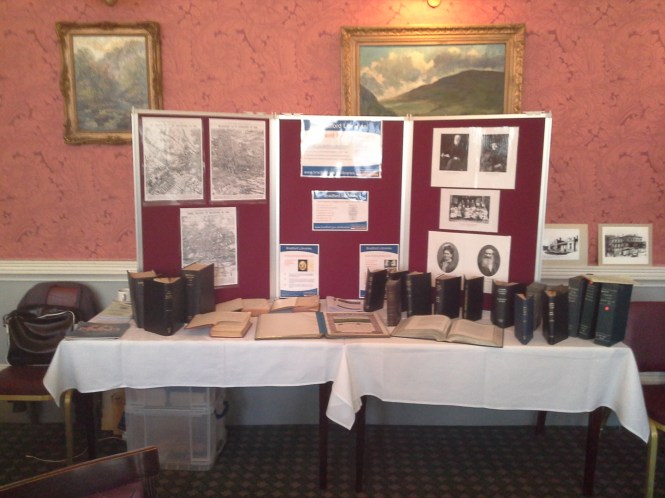
The Local Studies Library provided a stall highlighting many items of our stock relating to the period, including Trade Directories, maps and illustrations and a selection of bound volumes of material originally published by associations and institutions active in Bradford during the latter part of the nineteenth century.

20120516_023624

The stall attracted a good number of people during the day, many of whom were unaware of the resources the Library holds. We hope to see many of these people visiting us in the coming weeks following up on the research questions they were asking at the event.

All in all this was a very successful, enjoyable day all round.