Keighley and District Family History Society – Programme of Talks 2017

All talks are held in the Keighley Local Studies Library and begin at 7.30pm

Admission fees; Members £1; Non Members £2.50

 www.kdfhs.org.uk

Date Subject Speaker
     
January 9 The Great War on the Home Front Ian Dewhirst
February 6 The English Woollen Industry 1500 – 1750 Edgar Holroyd – Doveton
March 6 Annual General Meeting + Tips and problem Solving  
April 3 Murder in the Victorian family Martin Baggoley
May 8 Searching Surnames; Challenges Pitfalls & Downright Ridiculous Kirsty Gray
June 5 Transport in Keighley Graham Mitchell
August Summer Evening Meal  
September 4 The Golden Age of Postcards Graham Hall
October 2 The Murgatroyds of East Riddlesden Hall Patricia Atkinson
November 6 Off At A Tangent Mary Twentyman
December 4 The Ferrands of St Ives Bingley Susan Hart

TREASURE OF THE WEEK. No. 5 – BRADFORD’s MECHANICS’ INSTITUTE


In the basement of Bradford’s Local Studies Library are collections of nineteenth century pamphlets (and some of earlier date). Ranging from sermons and programmes of royal visits, to reports, articles, obituaries and regulations, they are a treasure-trove of local history. What follows is an account of one of these treasures. To consult any of these items please ask the staff. Card catalogues of these collections are located in the Local Studies Library.

Brief History of the Bradford Institution 

JND 193/5 (Please quote this number if requesting to consult this leaflet) 

Pamphlet volume JND 193 is titled ‘Bradford Tracts 1875-1885’. It contains 38 items ranging from booklets of 76 pages to several leaflets of only four. Item number 5 is one of the latter, well, just three pages actually. Yet it contains much useful information on the history of an important Bradford institution, the Mechanics’ Institute.

The Institute was founded on the 14th February, 1832, though an earlier attempt had been made in 1825. There were three objectives:

  1. The provision of an extensive and well-selected library for the use of all members and subscribers [Bradford’s public library was not founded for another 40 years];
  2. The supply of popular and attractive instruction through the medium of public Lectures;
  3. Foundation of Classes under well-qualified masters, in which every facility should be afforded for pursuing the various branches of useful knowledge.

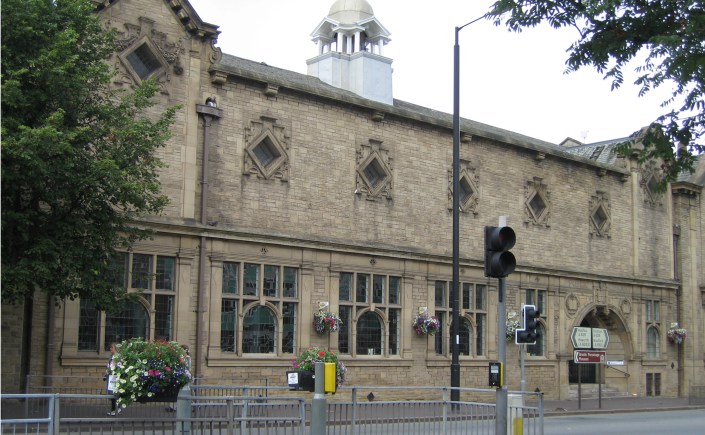
The growth of the Institute was rapid. Purpose-built premises were opened in 1840 at the junction of Well Street with Leeds Road, with an extension added in 1852. A much larger building was opened in 1871 bounded by Tyrrell Street, Bridge Street and Market Street.

The building, which stands upon an area of 1,000 square yards, contains elementary class-rooms for study of the sciences and higher branches, capable of seating upwards of 700 students, a School of Art … for 200 pupils; a large Reading Room supplied with telegraphic intelligence, 20 daily papers, 37 weekly papers, and 40 monthly and quarterly periodicals; a well-selected Library containing 12,000 volumes; a Lecture Hall seating 1,500. 

This fine building was demolished as part of the post-war re-development of Bradford.

There are many other sources of information about the ‘BMI’, but one feature of particular interest in this slim leaflet is a list of the classes operating in 1876, together with the teachers and average attendances. The classes were:

Reading
Writing
Arithmetic
Elementary Grammar
Elementary Geography
Phonographic Shorthand
Grammar and Composition
Elocution
Singing
Harmony
Bookkeeping
French
Italian
German
Plane and Solid Geometry
Machine Construction
Building Construction
Mathematics
Acoustics, Light and Heat
Magnetism and Electricity
Inorganic Chemistry
Organic Chemistry
Geology
Animal Physiology
Elementary Botany
Biology
Art

There were sub-divisions of some of these classes, and some exclusively for females.

(The Library of the Bradford Mechanics’ Institute still exists, one of only two in the country – the other is at Epworth – and is located on Kirkgate.)

Stackmole

Local Studies Library Volunteer

Map of the Week: Bailiff Bridge

map-of-the-week-015a

map-of-the-week-015b

Map of the week: Bailiff Bridge

Local history is so much easier to study if you are equipped with local knowledge. Unfortunately, even close to Bradford, there are communities which I scarcely know at all. Bailiff Bridge’s name presumably partially derives from the bridges built over the Wyke Beck at this point. It was notable, over many years, for the presence of Firth’s carpet mill but a lovely map from the LSL’s reserve collection long pre-dates this period. Like the previous plan of Manningham the first problem is how to orientate the map. North is not at the top and the Wyke Beck drawn here in reality runs approximately north-west, not due west as the map appears to suggest. If you rotate the map 45° clockwise the Wyke Beck is in the correct position and now at the bottom right of the map there is a prominent V made by the turnpike to Huddersfield and what is now Wakefield Road. The only problem is that this manoeuvre displaces the road from Bradford and Wyke (Wike) which is already in approximately in the correct position.

The presence of the ‘new turnpike road to Huddersfield’ is helpful for dating purposes. The Halifax, Bradford, Leeds turnpike was being planned and constructed in the mid-1820s. Clearly this, and the section to Huddersfield, was completed by the time the map was surveyed, which probably dates it to the early 1830s. We can reasonably assume that the collection of stables and farm buildings in the centre of the map preceded the roads since they are not at all on the same alignment. There is a public house drawn although not named. I made some progress with its name after computer searching nineteenth century newspapers, an electronic resource that Bradford Libraries provides. The Leeds Mercury reports that on various occasions in the period 1813-16 those executing the Wyke Inclosure Act met at the house of James Pollard, The Bailiff Bridge Inn, township of Wyke, in the parish of Birstal. Five years later similar reports of property sales in the area indicate that they took place at the ‘Punch Bowl Inn’. I assume that these two places are the same. At any event the Punch Bowl Inn must be correct because this features at the right location in the first OS map of the area, surveyed in the late 1840s.

I assume that the reservoir mentioned here is the mill dam (or pond on the OS map) and the mill itself is clearly marked as you can see. Clearly this is a water powered corn mill, and an on-line resource (Malcolm Bull’s Calderdale Companion) states that one Jonas Wright was a corn dealer here in 1822 and further that the mill was owned by the notable Richardson family of Bierley Hall, Bradford. Our map shows the tail race or goit, called here the ‘tail goight’, returning water to the beck. The second detail from the map shows another goit conveying water to the mill dam. Among other features of this delightful map are an overflow from the mill dam to the watercourse, an ancient fence, and an area of disputed land. Adjacent to the mill is a kiln. What is this: a brick kiln, a pottery kiln, a lime kiln, or a malting kiln? A malting kiln, drying germinated barley into malt, seems most probable. There would be a ready use for this commodity if the pub did its own brewing. Again the Leeds Mercury is helpful. In 1832 there is an advertisement concerning ‘Bailiff Bridge near Brighouse’ where at the Punch Bowl Inn there was a sale of land by auction. Lot 2 consisted of a dye-house, bleaching works, and a close of land. There is a comment to the effect that ‘this lot may be turned into a malt kiln and brewery’. Perhaps it was. Incidentally at this early date bleaching involved spreading damp cloths outside to be exposed to the sun. ‘Bleach fields’ were employed for this purpose.

By the time of the first OS map our corn mill seems to have remained while Holme Mill (woollen) and Bailiff Bridge Mill (woollen & cotton) have been newly constructed. But there are a few other events in the history of Bailiff Bridge that I must record. In 1839 there was a steeplechase held there. Four horses competed over a 3¼ mile course, and 14 subscribers invested 5 guineas in the event. Mr E. Dyson’s ‘Sir Mark’ won. Mr Wheatley a veterinary surgeon, presumably overcome by the excitement of the event, mislaid a brown bull and a terrier dog called Crab. He advertised for their safe return in the Leeds Mercury, and I do hope he got them back. Finally in ‘the year of revolution’, 1848, the Bradford Observer reported that HW Ripley had erected a school-room in Bailiff Bridge. Sir Henry Ripley (1813-82), as he became, was the principle partner in the Bowling Dyeworks and was eventually a very wealthy man. Some years after the gift of the school he constructed the workers’ village of Ripleyville, which has a good claim to be Bradford’s own Saltaire. When the school was opened Rev J Glyde addressed a celebratory meeting on the subject of education. Jonathan Glyde was the minister of Horton Lane Chapel with an enviable record of concern for society’s less advantaged. The school was just erected in time to feature on the first OS map and must have been roughly where the upper hatched block is on the road to Wyke. If any reader knows this area well I should very much welcome further information.

Derek Barker, Local Studies Library Volunteer

Bradford Family History Society – A list of talks for 2017

Bradford Family History Society hold a programme of talks at:

Glyde House
Glydegate
Bradford
BD5 0BQ

Talks are held on Monday evenings, 7.00pm (tea and coffee), with a 7.30pm start, and Thursday mornings from 10.00am (tea and coffee) with a 10.30 start.

There is an admission charge of £1 for members and £2 for non-members.

Date Month Description Speaker
Thu 5 Jan “The Turnpike Road System in England for Local & Family Historians” – A general history of the Turnpike Road system in England, with connections to information and sources for the family historian Edgar Holroyd-Doveton
Mon 16 Jan A Mormon Pioneer – How did John Croft born in Bingley in 1836 become one of the leading Mormon pioneers of the time? From his ordinary start as the son of a husbandman to Salt Lake City, Utah. Gaynor Haliday
Thu 2 Feb “Returned to the Regiment” – The life story of Lt. Col. Sir Gilbert Mackereth M.C. who was one of the commanders of the 17th Battalion Lancashire Fusiliers in WW1.  In addition, the exhumation of his remains from his threatened grave in Spain and return of his cremated remains and medals to Bury Terry Dean
Mon
20
Feb Lies, Damned lies & Registration – This talk looks at some of the “mistakes” – deliberate or otherwise – that have occurred on birth, marriage and death certificates. Knowing the sort of lies that informant’s make might help you to work out what the truth really is. Barbara Dixon
Thu 2 Mar Speed leaning in the Local Studies Library – Come and learn about various sources for family history research. Committee
Mon
20
Mar Hats & Huts – An illustrated account of the YMCA civilian volunteers who travelled to France to run the canteens and recreation huts provided for the use of the ‘Tommies’ when they were away from the front line. Sue McGeever
Thu 6 Apr More Deadly than the Male – Unusual Roles performed by Women in 20th century Conflict – The talk spans both First and Second World Wars with references to post-war conflicts, and covers roles on land, at sea (and undersea), in the air, in clandestine roles and on the home front, with examples of roles which many will find impossible to believe. Phil Judkins
Mon
24
Apr AGM followed by ‘Adoption – an overview and guidance for the family historian’. Lorraine Birch
Thu 4 May Classic Yorkshire Crimes – The talk includes a number of murders from across the county including Eugene Aram, Mary Bateman, the Luddites of 1812-13 and the case of Jonathon Martin. Martin Baggoley
Mon 15 May An introduction to Heraldry for family historians – Often wonder what those patterns on knights’ shields are? Now is your chance. Gillian Waters
Thu 1 Jun Visit – Borthwick Institute and York – All day trip setting off at 9am, cost £5 for members and £10 for guests. Drop off at Borthwick Institute and York centre. Please book in advance.
Mon 19 Jun Quaker Origins in the North – The former President of Friends Historical Society, will talk about Quaker origins in the North in 17th century England, and will explain the various Quaker sources for family historians. David Boulton
Thu 6 Jul Early Asylum Life – The lives of just some of the patients admitted to the West Riding Pauper Lunatic Asylum in Wakefield, Yorkshire between 1818 and 1869 David Scrimgeour
Mon 17 Jul Visit – Undercliffe Cemetery – Meet at the Lodge, Undercliffe Lane Entrance at 6.30pm Neil McLellan
Thu 3 Aug Visit – Fulneck – Meet in the Car Park at 10:30am
Mon 21 Aug The Golden Era of Postcards – the late 19th century Graham Hall
Thu 7 Sep Juvenile Crime in Victorian Bradford – young boys and girls in Bradford, in the early 1870’s,who had been sent to reformatories all over the north of England. Janet Senior
Mon 18 Sep Origins of surnames – Where did your name come from? Peter Watson
Thu 5 Oct The Chartist Land Plan in Calderdale & Queens Head – Chartism was a working class movement, which was most active between 1838 and 1848. This talk concentrates on the Chartist Land Plan with reference to subscribers in Calderdale, Queens Head, Mountain & Great Horton Anne Kirker
Mon 16 Oct Jowett Cars – Pride of Bradford – The early history of the company, models through the 1920’s and 1930’s, Wartime activity, the post WWII models and the demise of the company. Paul Beaumont
Thu 2 Nov Copyright – An interesting talk, with examples, of what copyright means for the family historian by the expert at West Yorkshire Archives. Stefanie Davidson
Mon
20
Nov DNA for Family Historians Carolyn Huston
Thu 7 Dec No place Like Home – the many and varied institutions that housed Britain’s children Peter Higginbotham
Mon 18 Dec How we did the research for the Low Moor Explosion – 21st August 1916. Including how we found Ronald Blackwell. Mary & Geoff Twentyman & Barbara Reardon

Battle of the Somme: historical film showing in Keighley Local Studies library

Bradford Libraries's avatarBradford Libraries World War One Blog

There will be a final opportunity to see the extraordinary and moving film ‘The Battle of the Somme’ in Keighley Local Studies library on Saturday November 19th at 10.00am before the DVD is returned to the Imperial War Museum.

The Battle of the Somme documentary was seen by millions of people across the world in 1916. At that time, film was a relatively young media. However, the government realised the power of film in controlling the war news. The film was released on 21st August 1916 by the War Office. This was a ground breaking British documentary film now accepted to be an early example of film propaganda, as well as a historical record of the battle.

On September 11th 1916, the film was first shown in Keighley. For the audience to see images of the war as it was happening, unfolding on the screen was a…

View original post 262 more words