New Scanner

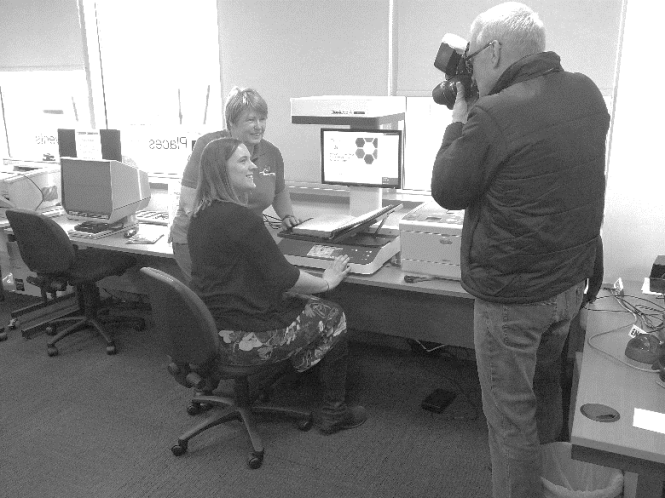
West Yorkshire Archives (Bradford) now have a brand new Covergold Bookeye 4 scanner. The Society has paid £6,000 to help in the purchase of this equipment which will help both visiting researchers and the archivists.

scanner

It is an A3 scanner that will not only scan books and documents using the traditional flat base,  but can scan books and documents that would not be allowed near a traditional scanner or photocopier as they cannot be laid flat. The scanner bed can be changed to be a V shape that will hold the book in place without damaging the spine. The scanner then produces an image that looks flat. Pure magic! Images can then be printed and/or saved on a USB stick. Don’t forget to take your own USB stick with you.

The scanner can be used by anyone visiting the Archives, but Bradford Family History Society Members will get a discount on the price of the paper copies or camera license (if using a USB stick). To get the discount just contact the Chairman with your name and membership number (chairman@bradfordfhs.org.uk).

Non-members can always join the Society please see our website at www.bradfordfhs.org.uk and go to the Membership page.


Neglected Bradford Industries: Iron-smelting

Bradford is famous for spinning and weaving but textile production was only one of a group of important industries which ‘Worstedopolis’ supported. Since several  are now almost forgotten by contemporary citizens I should like to draw attention to those which seem unreasonably neglected, in a series of short articles.

The production of copperas (iron sulphate) and glass in the Bradford area have been completely forgotten. Brick-making has escaped serious study until quite recently. It is the extent, rather than the existence, of quarrying, coal-mining and iron-smelting that has tended to pass out of memory. I shall try to provide a brief introduction to these industries and to some smaller concerns: pottery, fireclay production, lime burning and vitriol manufacture. My survey cannot be exhaustive since I know very little about soap boiling, clay pipe production, nail making or leather tanning. I hope any reader with knowledge of these activities will feel free to contribute. Although my main interest is in the history of technology I am not unaware that the successes I shall describe came at considerable human cost. In the period selected the rural poor were driven by a need for work into factories and crowded, unsanitary, housing. Some employers, like Titus Salt, were humane men but others were exploitative. Foundries, mines and vitriol works were dangerous places where often little thought was given to worker safety. Those who paid the price of progress seldom reaped its benefits.

Bradford had many advantages as an industrial centre. Building stone was relatively easy to acquire, and since the late eighteenth century there had been a vigorous brick industry. Cheap local coal was available, and could be coked to supply blast furnaces which made pig iron from locally dug ironstone. There had long been water-powered corn and textile mills but it was the introduction of steam engine power that really transformed any process that was capable of mechanisation. Cloth production was a principle beneficiary of this technology which in turn promoted the development of textile engineering in Bradford and Keighley. The town was originally a communications backwater. It was hard to move raw materials, or manufactured products, cheaply and speedily. Horse transport had been used for centuries and a network of pack-horse routes had developed throughout West Yorkshire. The construction of turnpike roads in the years 1734-1825 produced a substantial improvement in the situation. With the opening of sections of the Leeds to Liverpool canal in the 1770s, with its spur into Bradford, transport of bulk goods, especially coal and limestone, became far cheaper. Railway links were established by the 1850s.

Iron1

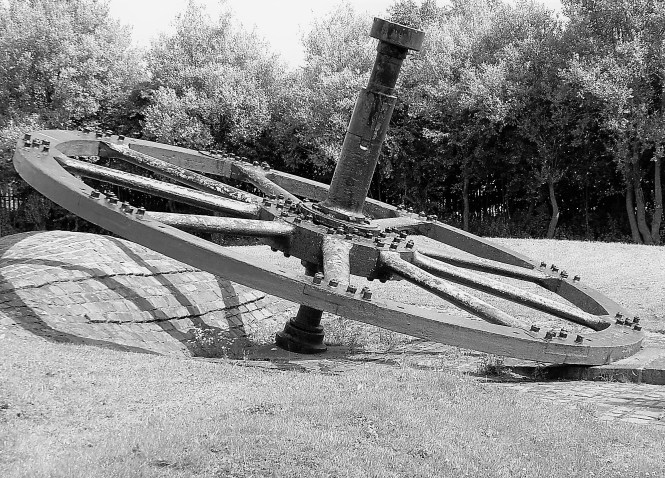
A 30.5 ton Rolling Mill flywheel presented by Alan Elsworth and preserved for display near the site of Low Moor Ironworks.

A century ago no community would be without its blacksmith but Bradford could boast a complete package of iron based technologies: ironstone mining, iron-smelting, and foundries. Historical sources, and deposits of slag, suggest that a medieval, bloomery furnace based, iron-smelting had occurred at Eldwick, Harden, Baildon, and Eccleshill, with charcoal being the fuel employed. Until their dissolution around 1539 northern Cistercian abbeys were heavily involved in iron-making but there is some documentary evidence of late Tudor smelting at Esholt and Hirst Wood, Shipley.  The origin of modern industry was the discovery in 1709, by Quaker ironmaster Abraham Darby of Coalbrookdale, that iron could be successfully smelted using coked coal. This advance took about 50 years to be widely accepted. Darby’s grandson was the creator of the famous iron bridge.

Iron2

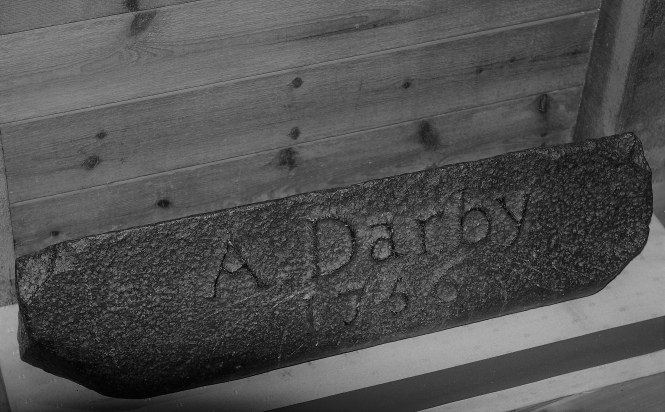
An iron pig produced by Abraham Darby in 1756, on display at Coalbrookdale Museum.

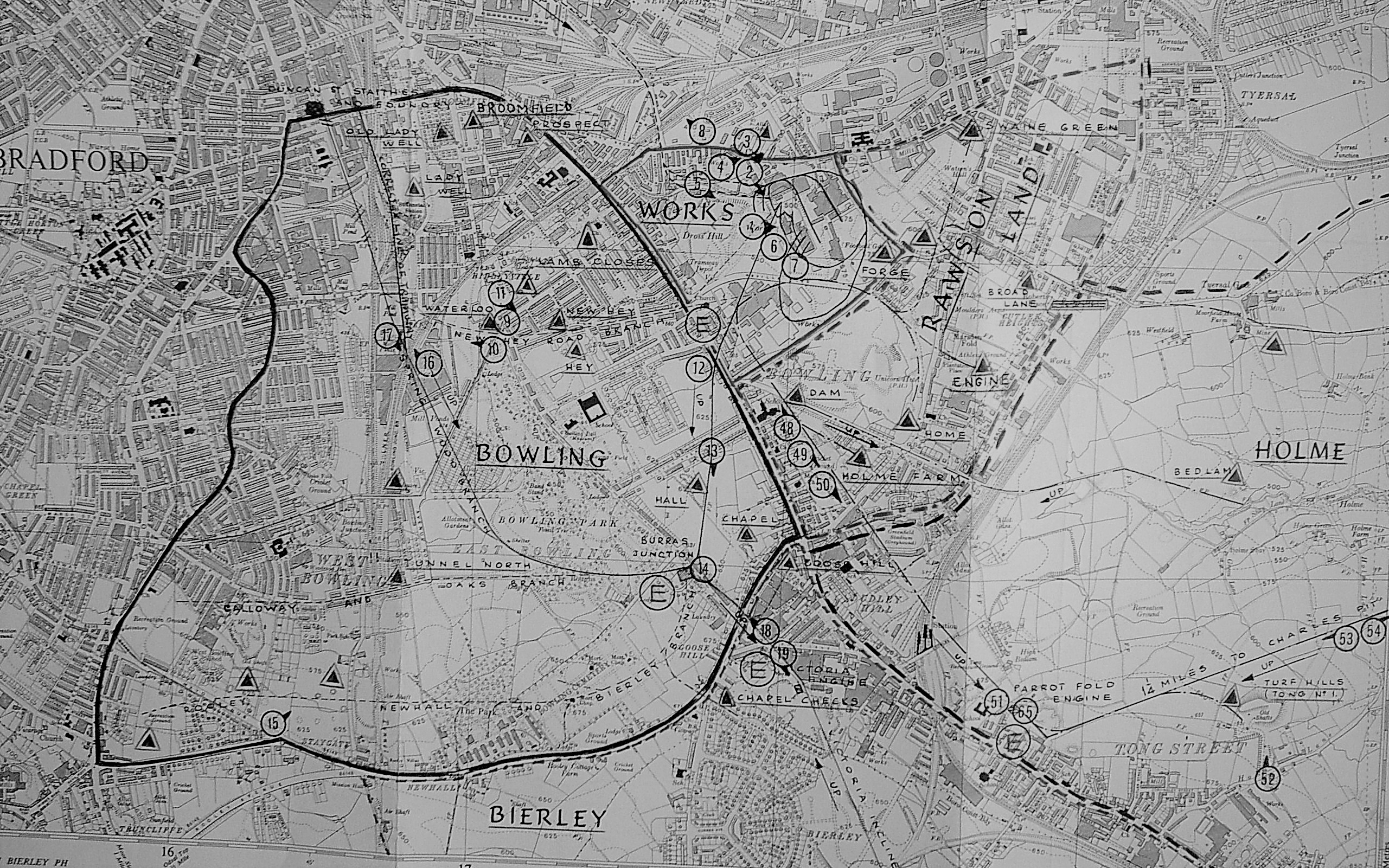
Bradford did not have the capacity to produce vast quantities of charcoal for blast furnace fuel but Darby’s discovery resulted in south Bradford’s Black Bed coal seam being mined for its rich roof deposits of ironstone. It was discovered that the deeper Better Bed coal seam was low in sulphur and phosphorus and so produced coke highly suitable for iron-smelting. The  industry was capital intensive but blast furnaces were set up at Birkenshaw (1782), Bowling (1788), Low Moor (1791) and Bierley (1810). Their products were cast iron and the ‘best wrought iron’, produced by Cort’s ‘puddling’ process. Cannon and shot were manufactured during the Napoleonic Wars. At a later date the companies did not adopt the Bessemer process to convert cast iron into steel for which Sheffield became celebrated. The furnaces are long gone but the ‘dross’ waste and some of the iron products remains. I vividly remember encountering some Low Moor cannon at Alnwick Castle. As local deposits were exhausted mineral carrying tramways transported vast amounts of coal and ironstone for miles towards the furnaces. In the 1960s a scholar called Derek Pickles studied the mineral ways supplying Bowling Iron Works. His detailed and fascinating work is curated by Bradford Industrial Museum but I know virtually nothing about him. Can anybody help me?

Iron3

A plan from Derek Pickles’s study showing mineral ways around Bowling Iron Works (top centre). The triangles mark collieries.


If you want to undertake further background reading the Local Studies Library has copies of three useful texts:

  • RCN Thornes, West Yorkshire: A Noble Scene of Industry, WYCC (1981)
  • Gary Firth, Bradford in the Industrial Revolution, Ryburn Publishing (1990)
  • C Richardson, A Geography of Bradford, University of Bradford (1976)

Derek Barker, Local Studies Library Volunteer

A Bradford Childhood Part 2 – 1944-1955

As a family we were what would be called these days “upwardly mobile” and our move from Thornbury to Eccleshill was a modest first step up the social scale:

 When I was about eight, we moved to our new home in a sunnier, less tightly packed part of Bradford where we were more likely to play in each other’s gardens than on the local wasteland and back streets as we did at our previous address. It soon became apparent, however, that there were several forbidden places of excitement close by and I began to explore them eagerly with my new friends.

One of my early adventures involved being in a group of boys that climbed up a nearby fire escape running down the side of a local mill:

We set foot on this first metal rung and began to climb. The first few steps were easy but, as you could see straight down to the ground through the open mesh of the steps and, as the railings were also quite open and apparently fragile, the climb became more challenging with every step upwards as the ground below grew increasingly distant. We got about two thirds of the way up and were just beginning to appreciate the view over the nearby roofs and chimneys when we noticed the whole structure began to wobble. We stopped and discussed the issue, but decided to carry on and see if we could make out the roof of the Ring O’ Bells pub from the top. Then we heard a voice from way below:

‘Oi! What do you think you’re doing? Get down here now!’

Our lives became less parochial after my father bought a car:

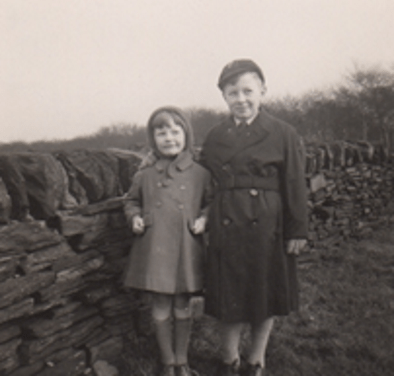
It was about this time we started to travel out to the Dales and other parts of Yorkshire almost every weekend in our second hand black Morris Eight saloon. It was very small, but it had real leather seats and a curtain to pull down over the rear window. Mum and dad sat at the front and Pauline and I sat in the back.

I think the windscreen wipers may have been hand operated and it had to be started with a crank handle. It had black painted wire wheels and chrome plated round hubcaps with a large ‘M’ pressed into them. We all absolutely loved it. The registration plate announced we were DNW613, but we, like so many other aspiring lower middle class families of the time, gave her our own name. We decided, for reasons that now completely escape me, to call her ‘Flossie’. It was my father’s pride and joy and we were all required to put on our best clothes to take a trip in her. My mother would wear her grey suit and my father his grey flannels and the green Harris Tweed jacket with leather buttons and elbow pads that he kept for weekends. The car had two doors, narrow running boards and a spare wheel attached at the back over the small boot. My father often smoked his pipe when driving, which, combined with the smell of waxy shoe polish from my shoes, made me feel quite sick. He had special leather driving gloves with string backs and he almost always wore his flat cap. There was no radio and no heating.

ecc1

Our journeys and holidays at that time still provide me with many of my better memories:

I still miss the grass, the moors, the large skies, the limestone, the becks and brown rivers, the hills, the cry of the curlew, the bleat of the lambs, the waterfalls, the wild places, and the villages of the Dales. When I was a child I saw in Grassington a farrier shoe a carthorse and, in Reeth, a wheelwright put together an entire cartwheel, hub, spokes, metal tyre and all. I saw farmers cutting wheat with simple farm machinery and making stooks from the sheaves in the fields.

If it rained all day, we drank coffee in the car from my mother’s flask and nibbled ginger biscuits; if it was warm and sunny my sister and I would scramble up the sides of the nearest hill and look down on the tiny figures of our parents sitting by the car in their little picnic chairs, reading the paper or drinking tea. We collected stones, twigs, sheep’s wool, broken birds’ eggs, and cast-off feathers. We picked bilberries by my father’s hatful and took them home for my mother to bake in a pie. It was all very simple, very innocent, and we loved it.

ecc2

I expect all of us of a certain age remember the year of the coronation:

We had been in our new house perhaps a year when preparations for the queen’s coronation began. It was a more innocent age and everybody seemed keen to participate in the occasion as well as be an onlooker. I can’t remember much deviation from our normal lessons at school, but at home there was quite a lot of excitement and activity. All the residents did something to decorate their house. In our case, where others in the street were satisfied with bunting, my father erected in the centre of the front garden a white flagpole planted firmly in the lawn and supported by guy ropes attached to huge metal tent pegs. It reached beyond the top of the roof. For the week before the coronation, he ran the union flag up the pole every morning before leaving for work and took it down again in the early evening. At each event anybody in close proximity was expected to line up to attention on the path by the side of it (there were usually half a dozen kids, or so, and a sprinkling of adults) and salute whilst singing the national anthem at the same time. I think we may have had a special ceremony during the day when the news of the conquest of Mount Everest came through immediately before the big day on 2nd June 1953. There was not the faintest hint of irony in any of this.

When the Queen came to Bradford some time after her coronation, dozens of us went to see her as she was driven down Pullen Avenue to the roundabout by The Ring O’Bells and on into the Harrogate Road and beyond.
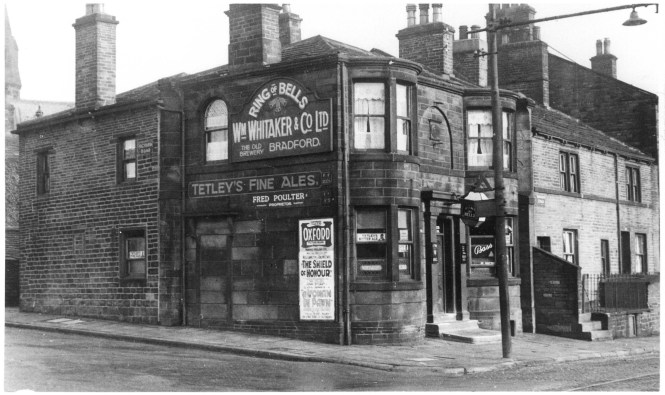
Ring o Bells Harrogate Rd, Eccleshill

The Queen’s car slowed to less than walking pace as it came close. There was a soft light within the car that caught the glimmer of her youth, the richness of her dress and the brightness of her jewels. She looked utterly beautiful; she was like a film star; glamorous and self-confident, important and revered. She passed slowly, smiling and waving, then, towards the tail end of the crowd, the chauffer kicked onto the accelerator and she was silently swept away at speed into the vastness of the Yorkshire night.

Last time I wrote about a few memories I didn’t put in my memoir and I said I’d try to think of a few more.

Does anybody remember when Leeds, Bradford Airport was simply called Yeadon Aerodrome? I remember watching De Havilland Dragon Rapides take off and land from there many times.

Perhaps you were there at the air display my family and I attended when a jet flew very low along the whole length of the runway at the same time as breaking the sound barrier, crowds of spectators being only yards away either side of it!! How’s that for Health and Safety!! I can still recreate the resulting BANG inside my head!! The jet later climbed almost vertically into the sky and disappeared into the clouds. This makes me think it was probably a prototype English Electric Lightning, but I can’t be sure.

Another memory is of walking one summer evening with my father and looking over the top of a high wall into the premises of the Jowett Motor Car Works.

Jowett Motor Manufacturer.jpg

I think they may already have been experiencing difficulties because my father said something about it and I could also see for myself nothing but rows and rows of (presumably) unsold Javelins and Jupiters filling the whole of the car park outside their factory.

Do you remember the Jowett Javelin, often referred to as the doctor’s car as it was steady and reliable and slightly upmarket? I saw quite a few out and about in Bradford when I lived there.

Jowett Javelin advertisement c1950

Next time I’ll tell you about my junior school and the teacher who prepared me for the 11+.


Bob Nichol
ecc3


TREASURE OF THE WEEK. No. 11 DEUTSCHE EVANGELISCHE KIRCH

THE GERMAN EVANGELICAL CHURCH. 1881. 8 pages.

 JND 245/7 (Please quote this number if requesting this item.)

German Church2.1

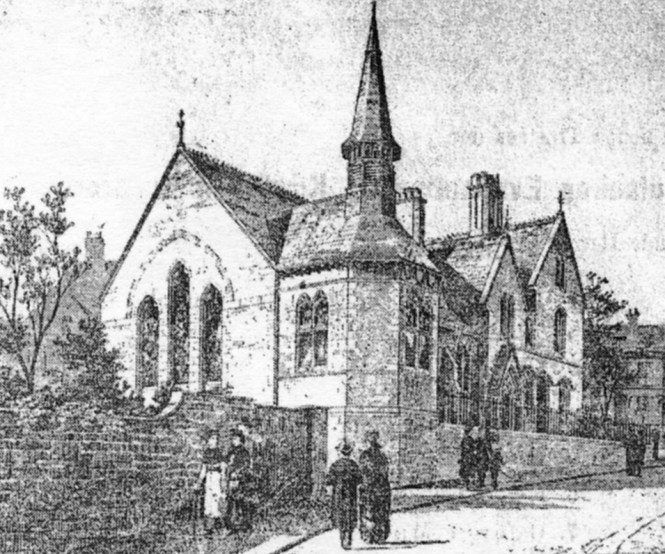
This slim leaflet is a report on the origin of the German Evangelical Church in Bradford and, in particular, the progress of the fund to build a permanent place of worship.

‘The origin of the German Evangelical Church in Bradford is soon told. The town contains a large resident German population, of which a considerable number have brought or inherited from their native country the attachment to the Evangelical faith. No special and suitable provision for their spiritual wants had been made until 1876, when a Church Mission was held in the town, which, at the suggestion of the Rev. Vincent J. Ryan, was extended to the German inhabitants. The Rev. J.S.G. Krönig, of Hull preached to them in their own language. A committee was formed, who carried on divine service, with the help chiefly of Moravian ministers of the neighbourhood of Bradford, till in November, 1876, they received a pastor from Germany.’

A Grand Bazaar was held in 1879, the purpose of which was to raise funds to build a church for the German population of Bradford. The impressive list of the many members of the German nobility who gave patronage to the bazaar reminds us how different pre-war imperial Germany was:

His Royal Highness The Grand Duke of Hesse
Her Royal Highness the Grand Duchess Sophie of Weimar
Her Imperial Highness the Crown Princess of Germany and Princess Royal of England
Her Highness Princess Marie of Scwarzburg-Sondershausen
Countess Maria zu Münster
His Excellency Count zu Münster

Local celebrities were also much in evidence, including:

Sir Henry and Lady Ripley
Rt Hon W E Forster
Lord Frederick Cavendish
The Lord Bishop of Ripon
Mrs Julius Delius

Not forgetting the Band of the 103rd Royal Bombay Fusiliers!

The Bazaar made £422 1s. 7d., and with donations of £903.55 and promises of £1100, plus another £300, “some £2500 was made. This left £1500 more needed.” The Church was built and still stands, on the corner of Great Horton Road and Chester Street. Hundreds of university and college students pass the Church every day, most of whom will barely notice it. Currently it is home to the Delius Arts & Cultural Centre and Artwork Creative Communities. In addition to presenting a picture of Germany before the First World War, this ‘Treasure from the Stacks’ is also a reminder that the establishment of religious centres for immigrant cultures in Bradford is nothing new.

Stackmole

Map of the Week: A View from the Bridge

The Queens Road bridge, which carries the traffic from Manningham over Canal Road towards Bolton, Eccleshill and Idle, was in place when the 1889 OS map of the area was surveyed. The Local Studies Library reserve collection has a map from 1880 which seems to have been part of the preparatory planning for this structure. Early users, descending from Manningham, would have seen on their right the railway line and Valley Road coming from Bradford, very much as now. To their left, approximately where a stone reclamation site is now located, was Manningham Station. This pre-dated the bridge and was, in the years 1868-1965, the first stop out of Bradford on the Midland Railway (later LMS) line. Manningham and Frizinghall stations were closed, well within living memory, by Dr Beeching. Subsequently Frizinghall station has been reopened.

The three maps included in this article, though all undated, are clearly from the mid-twentieth century.  Their relatively late origin has one great advantage inasmuch as their interpretation can be supported with photography.

The first map shows the situation on the city side of the bridge. To display the annotations correctly it has to be displayed with the city centre to the left of the map which doesn’t feel right to me. Valley Road should be running across the top of the plan but is not drawn. The canal is evidently ‘disused’ which places our plan quite certainly after 1922. The arrangement of the buildings resembles the 1930s OS maps quite closely, so that is a probable date.

Map of the Week 021 A

The curved building that is aligned on Station Road, unnamed in this map, is a wool-combing mill. The blue waterway is the Bradford Beck and the idea behind the map, which is not explained, may have been to show how the beck could be culverted and taken under Canal Road at a time when a new sewer was being constructed. The six circles, and the ancillary buildings between them, represent the Bradford Gas Works. You can see this arrangement clearly in an image on the Britain From Above website:

Valley Road Gas Works

Strangely the 1936 OS map does not name the Gas Works but does indicate that it was served by a network of railway lines which presumably distributed coal, arriving on trucks from the Midland Railway, to the coke ovens.

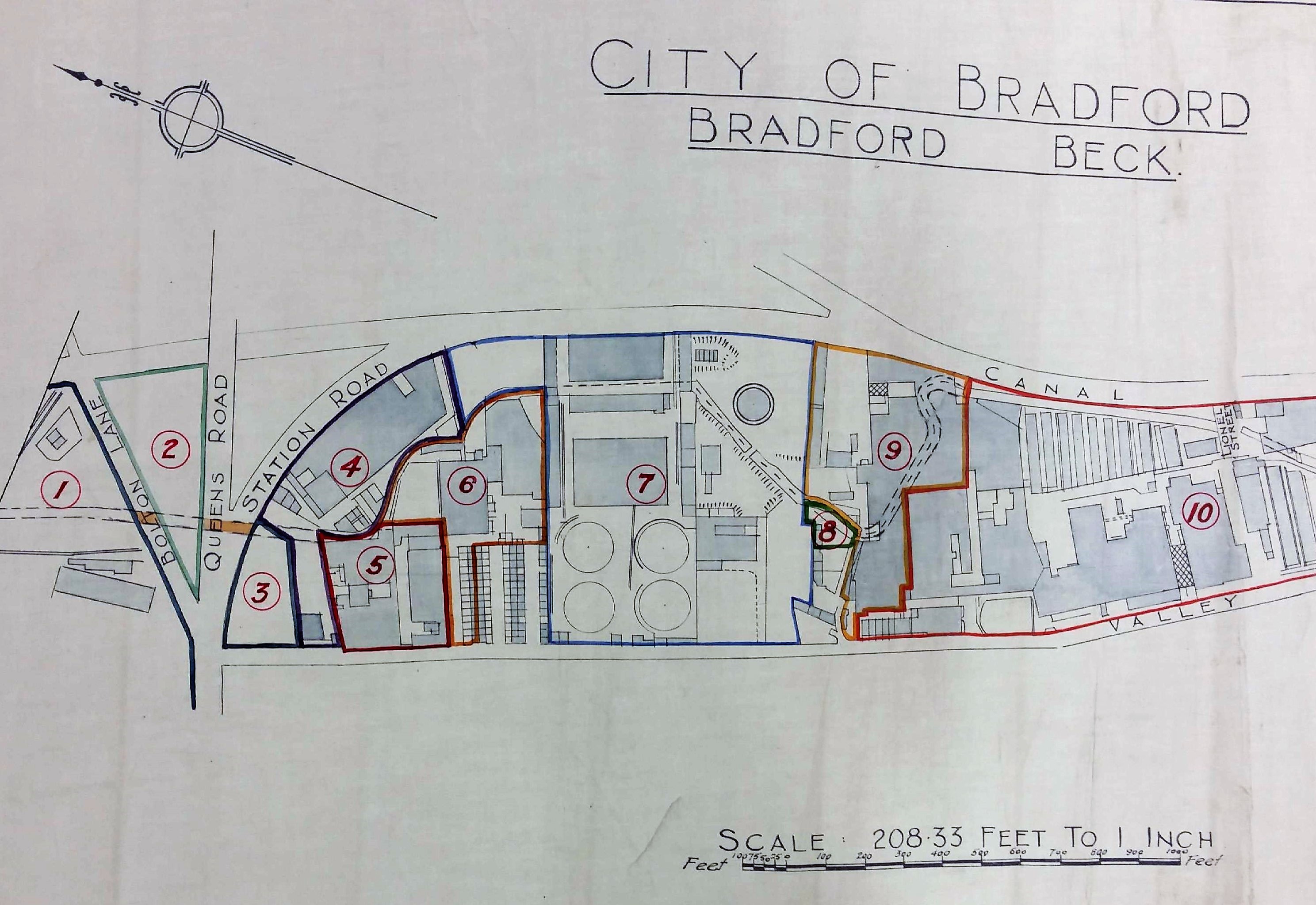
The second plan shows the same area but is orientated more naturally.

Map of the Week 021 B

The map is undated but in the list below the railway is identified as London Midland & Scottish so it clearly pre-dates nationalisation in 1948.  It is stamped ‘SG Wardley, City surveyor & engineer’.  I believe Wardley was in post around 1946-1960s.  Readers who have known Bradford longer than me will have their own views about whether the major city plan that he espoused produced bloom or blight. The great advantage of the second map is that land occupiers are clearly identified:

1 London Midland & Scottish Railway Company

2 Bradford Corporation

3 Bradford Corporation Street Drainage & Works

4 Bradford Woolcombers Mutual Association Ltd

5 Beck Properties Ltd

6 J F Raspin Ltd

7 The Bradford Corporation, Gas Committee

8 Wm. Whitaker & Co Ltd

9 R Clough & Co Ltd

10 The Bradford Corporation, Electricity Committee

Contemporary trade directories reveal that Raspin’s and Clough’s were both firms of commission wool-combers. The well-known Wm. Whitaker & Co Ltd were brewers until the 1920s but by the 1950s were bottlers and wine & spirit merchants. Unfortunately my limited research cannot place them securely in this position nor explain why they needed such a small patch of land. Can anybody help? Between Raspin’s mill and the Gas Works were three long-vanished roads: Hopwood St, Valley St and Valley Row. Small portions of the Bradford Beck are shown and the relationship of Canal Road with Valley Road is much clearer than in the first map. Towards the end of the 1930s gas production was abandoned at the Valley Road works which became exclusively a distribution centre. Production continued at Birks Hall works, Laisterdyke, eventually the largest in Yorkshire.

The final building on this map is the Valley Road Electricity Generating Station. I understand that its chimney was taller than the famous example at Manningham Mills. Its wooden-construction cooling towers were known as Davenport Towers. The works consumed millions of gallons of water, and hundreds of tons of coal, weekly. It had been built in 1896 and extended in 1939 and again in 1947.

In the Local Studies collection we have a plan of the whole Power Station of which the third map is a detail. The map is annotated ‘Electricity works, Canal Road’. The British Electricity Authority (Yorkshire Division) is recorded as the operator. I believe that this body was only in existence between 1948-55. The station was finally demolished in the mid-1970s.

Map of the Week 021 C


Derek Barker, Local Studies Library volunteer.