Small Town, Saturday Afternoon

This slideshow requires JavaScript.

On Saturday 14th July, Trevor Simpson by-passed the defenders: Wimbledon, the World Cup and a hot, blue sky day in Yorkshire to strike gold for Keighley Library in a talk about – you’ve guessed it – local music heritage. He was as hot as Billy Fury and music events’ mogul, Janet Mawson, was as relieved as Gareth Southgate when an audience of upward of 70 people turned out.  In fact the Library was very lucky to get Trevor because, as a former referee, if his talk had been scheduled for the afternoon of the previous week, when the dream was very much alive and England was taking on Sweden, he would probably have shown us the red card.

Trevor Simpson has two passions in life: football and music, or is that music and football? As a referee, he officiated for the football league at the highest level for every club except West Ham United. He even put Gaza in his place during a Tottenham versus Manchester United match at White Hart Lane. He was also a linesman at a World Cup qualifier but enough said on that score.  Musically, Trevor started out as a mobile disc jockey and moved on to hospital radio in December, 1981 and is still a DJ after some 37 years. He reckons it is well worth breaking a leg to get in to hospital to listen to his show. One of his more amusing requests was for Johnny Cash’s Ring of Fire from a chap who was recovering from a haemorrhoid operation. However, it was in the days after the war when music began to change again and youth culture began to grow, along with Saturday night culture, that Trevor, with a real feel for social history and a recognition that those days marked unique and exciting change, began to collate and collect memorabilia and information about the local music scene that he so loved.  He used this information and first-hand experience to write and illustrate two original, bestselling books. Both called Small Town Saturday Night, the first volume is a musical journey through the 1960s, chronicling the development of the popular music culture in the next town from Keighley, Halifax. The second volume continues with the story of the dance halls, groups, the Champion Jack Dupree and the two local music festivals, looking at the period 1954-1970.

These two books formed the basis of the talk and although the focus was on Halifax, it translated well to a love affair with the music scene in virtually any 1960s Northern town.  In fact, some in the audience had been to the same venues and gigs as Trevor,  including Keighley’s musical heritage volunteer, Malcolm Hanson, who remembered trips to Halifax, especially to the Princess Ballroom, with his friends, often walking there and staggering back in the early hours to Denholme. We heard about the acts such as Dusty Springfield, Cliff Richard, Marty Wilde, Rod Stewart, Shirley Bassey and the time the Jackson Five were given a sound ticking off for being tardy about their second set after a brotherly bust-up before the show. Stories of colourful entrepreneurs were of equal interest from the young, ambitious dance instructor, Pearl Paling of the Princess Ballroom; the three huge wrestlers, Shirley Crabtree (alias, “Big Daddy”) and his brothers, to the budding entrepreneur who refused to book, “the Be-attles” with “someone called Cilla Black” because in true Yorkshire fashion, they were, “How much?!!..”. Trevor also illustrated these stories and anecdotes with a film he made of all the venues he spoke of. We also heard a cassette of some of the stars that had kindly recorded “hello” to the patients for his hospital radio show, including that someone called Cilla Black. All this really made the history come to life and the whole experience was an enjoyable and memorable one to match such a major sporting day. Let’s hope for a return visit please.

The next Keighley Musical Heritage event will be held on Heritage Day, 15th September and will be a celebration of the 1970s hosted by volunteer, Malcolm Hanson, who is still gathering memorabilia from bands and fans. Malcolm can be contacted for this at the following:

Email: Malcolm.b.hanson@gmail.com or call Malcolm on 01756 798730

Sadly, the two great books by Trevor Simpson packed full of information, photographs and memorabilia are now out of print but we do hold reference copies in Keighley’s Local Studies Library.

Small Town Saturday Night by Trevor Simpson (Milltown Memories Publications, Hebden Bridge, 2007), ISBN 978-0-9548960-2-7

Small Town Saturday Night (Volume Two) by Trevor Simpson (Milltown Memories Publications, Hebden Bridge, 2008), ISBN 978-0-9548960-3-4

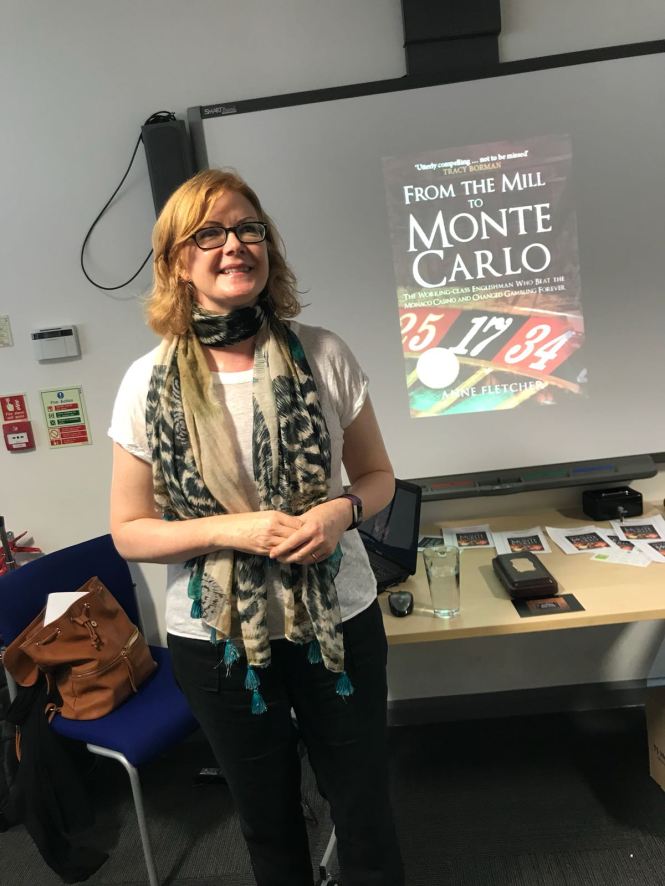
From the Mill to Monte Carlo: The Working-Class Englishman who Beat the Monaco Casino

Many thanks to Anne Fletcher for sharing the wonderful story of her great-great-great uncle Joseph Hobson Jagger in her fascinating talk in Bradford Local Studies library at Bradford Festival on Saturday.

Based on her newly published book, Anne told the story of a man who went from Bradford mill worker to Monte Carlo millionaire. Amongst the men ‘who broke the bank at Monte Carlo’, Joseph Hobson Jagger is unique. He is the only one known to have devised an infallible and completely legal system to defeat the odds at roulette and win a fortune. But he was not what might be expected. He wasn’t a gentleman or an aristocrat, he wasn’t a professional gambler, he was a Yorkshire textile worker who had laboured in the Victorian mills of Bradford since childhood.

Joseph Jagger was an exceptional man who travelled nearly a thousand miles to the exclusive world of the Riviera in a time when most people lived and died within a few miles of where they were born. The trains that took him there were still new and dangerous, he did not speak French and had never left the north of England. His motivation was strong. Joseph, his wife and four children, the youngest of whom was only two, faced a situation so grave that their only escape seemed to be his desperate gamble on the roulette tables of Monte Carlo. Today Jagger’s legacy is felt in casinos worldwide and yet he is virtually unknown.

In  this true-life detective story, Anne uncovers how he was able to win a fortune, what happened to his millions and why Jagger should now be regarded as the real ‘man who broke the bank at Monte Carlo’.

‘From the Mill to Monte Carlo’
By Anne Fletcher
978-1-4456-7139-0

20180714_140915

AFMill-to-Monte-Carlo

Keighley’s Gallant Sons

Bradford Libraries's avatarBradford Libraries World War One Blog

This was a published list in the Bradford Daily Telegraph of all the Keighley men who volunteered in the early part of the war, before the introduction of the Military Service Act.

A copy is available to view in Keighley Local Studies Library, but can also be viewed here:

Keighley’s Gallant Sons

View original post

‘From the Mill to Monte Carlo’. A talk by Anne Fletcher

Come and meet Anne Fletcher on Saturday 14th July at 12pm on the first floor of City Library, Bradford, and then come and join her for a free talk and chat at 2pm in Bradford Local Studies Library, Margaret McMillan Tower (side entrance).

This is the story of the man from Bradford who beat the casino. Anne Fletcher is his great-great-great niece and in this true-life detective story she uncovers how he was able to win a fortune, what happened to his millions and why Jagger should now be regarded as the real ‘man who broke the bank at Monte Carlo’.

Free event, all welcome

Mill-to-Monte-Carlo


Treasure of the Week no. 21. The Low Moor Iron Works – what poetry!

Low Moor Iron Works: a poem. By John Nicholson. 1829 (1856 reprint).

JND 187/1 (Please quote this number if requesting this item.)

Tres 21 John Nicholson

Image reproduced from ‘Poets of Keighley, Bingley, Haworth and District’ by Charles F Forshaw.

In common with other writers of the early nineteenth century, John Nicholson (1790-1843), ‘The Bard of Airedale’ found romance in the achievements of industry.  The coal-fired flares of the iron works at Low Moor were compared to the smoking volcanoes of Etna and Strombolo. Beyond romance though, were the utilitarian products that issued

When first the shapeless sable Ore
Is laid in heaps around Low Moor,
The roaring Blast, the quiv’ring Flame,
Give to the mass another name;
White as the Sun the Metal runs,
For Horse Shoe Nails, or thund’ring Guns;
The trembling hair-spring of a Watch,
An Anchor, or a Cottage latch –
Most implements the Farmers have,
And those of Steamers on the wave
The Tailor’s Needle, or the Shell
The levell’d once where Princes dwell;
The Engine, Boiler, Cobler’s awl,
The Carronade, the pond’rous ball;
The place where Steam first moved his wings,
The Nails in Beggars’ Shoes and Kings’;
The Anchor’s Chain, the Fisher’s Hook,
The Sword – the Hatchet – and the Crook,
The sounding Anvil, all the blades,
The cause of many thousand trades;
No pen can write, no mind can soar
To tell the Wonders of Low Moor.

The importance of the Low Moor Iron Works in the manufacture of weapons is noted:

Throughout the world thy heavy Guns are known:
From the Pacific to the Indian shore,
Nations have heard their dread tremendous roar.

And at the Woolwich arsenal:

There Pyramids of balls for battle form’d,
By which each fortress of our foes is storm’d,
The bursting bombs of every size are there,
To guard the land Britannia holds so dear.

But now

Silent the Cannon, peaceful all the host;

In particular, and prophetically, the coming of the railways is noted: the days of the Courier, the Pilot, and the Duke of Leeds, stage coaches all, are ending:

Ye panting horses, smoking on the road,
Mark’d with the whip, and struggling with your load;
Your race of cruelties will soon be done,
The mail without you soon will swiftly run.

Summing up, Nicholson tells how Low Moor helped make Bradford:

What millions sterling have been made,
What tens of thousands have been paid,
What thousands here has genius fed,
Since the first blast has rear’d its head,
Crown’d with flame that dar’d on high,
And cheer’d the midnight cloudy sky.
But for Low Moor, old Bradford Town,
Had never like a City grown.

This poem was first published in 1829 and reprinted in 1856 by J Dobson of the Market Place, Bingley.

Nicholson started his working life in the mills but aged 32 moved to Harden Beck and became an established poet. After success with works such as Airedale in Ancient Times and The Siege of Bradford, he tried his luck in London, but soon returned to Bingley. In the 1841 Census, John (aged 50) and his wife Martha (45) were living with their eight children, aged 6 through to Ann (22) and Sarah (20), both worsted warpers, and Thomas (20), a wool sorter. John Nicholson was drowned while trying to cross the River Aire on stepping stones on a stormy night.

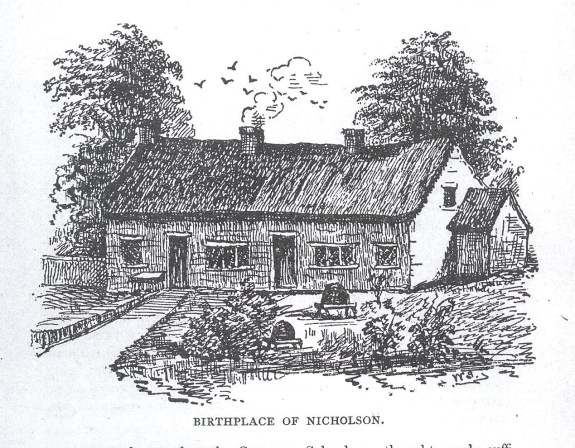
Tres21 birthplace of Nicholson

Image reproduced from ‘Poets of Keighley, Bingley, Haworth and District’ by Charles F Forshaw.

The Low Moor Iron Works have long since gone, but the recent re-opening of Low Moor station would surely have pleased ‘The Bard of Airedale’!

Stackmole