

Photo by Pixabay on Pexels.com
The Local Studies Service now have our own Facebook page. So if you are on Facebook and are interested in local history, news and events, why not give us a like and follow the page.
Photo by Pixabay on Pexels.com
The Local Studies Service now have our own Facebook page. So if you are on Facebook and are interested in local history, news and events, why not give us a like and follow the page.
 We are starting a new Local Studies Newsletter. This will contain local history news and events as well as many interesting snippets about the whole district.
If you are interested then please sign up here:
https://public.govdelivery.com/accounts/UKBMD/subscriber/new?topic_id=UKBMD_124
A Terrible Calamity in Bradford: being the entire story from beginning to end, of the Fall of Ripley’s Mill Chimney on Thursday, Dec. 28th, 1882, along with All the Particulars, List of Killed, Accounts of Startling and Extraordinary Escapes, etc. Published by Willie Reynolds.
JND 187/11 (Please quote this number when requesting this item.)

1882 was, the author claims, a disastrous and eventful year:
From its very commencement it was a year ever to be remembered by poor and rich alike, if such events as the useless Egyptian war, outrageous practices and barbarous murders in Ireland, destructive fires in all parts of England, colliery accidents, and calamities of all kinds by land and sea could make it so.
In Bradford the year ended in the collapse of the chimney at Ripley’s Mill in Spring Street off the Manchester Road, at a few minutes past eight on Thursday morning, killing 53 people and seriously injuring 50. The mill was used for spinning and top making and was occupied by several companies. The chimney was said to weigh over 4,000 tons and was 255 feet high. It had been built over twenty years earlier but was never regarded as being quite safe. A week before its fall, pieces of lime and stone had fallen from it. After slight repairs, the architect passed it as being safe. But high winds, incessant rain, frost and heavy falls of snow followed. The gigantic stack collapsed at a point a few feet above the ground.
This modest leaflet of sixteen pages gives an account of the collapse, details of prior warnings and graphic eye witness reports. A list of those killed is given with their ages and we note that many children were killed. The youngest were 8-year-old Susan Woodhead, 9-year-old Emma Pearson, and Edgar North, Arthur Smith and Lydia Lightowler, all 12.
The pamphlet is of interest, not just for the details of the tragedy, but for how it was published. No author is given but we assume it was the publisher. It was priced at One Penny and “The proceeds from the sale of this work is intended for the ‘relief’ fund for the sufferers by the accident.” It was to be “had by all News Agents and News Lads”. One imagines that Willie Reynolds took it upon himself to interview participants, research background, write up the story – and well-written it is – print (probably out of his own pocket), then do the rounds of local newsagents, recruit an army of news lads, then collect and distribute the income, all within a short space of time. That was no mean achievement. No Facebook, Twitter or Internet in 1882!
Stackmole
The years of Brontë anniversary celebrations continue in to 2018 with the 200th anniversary of Emily Jane Brontë’s birth on 30th July 1818. Emily is probably the most controversial sister of the three to survive into adulthood and be published. Whereas Charlotte’s and Anne’s characters and influences are more clearly defined and documented by themselves and their contemporaries, still little is known of Emily’s inner life and full and true character, despite gleanings from her sisters’ observations and their associates. Wuthering Heights, Emily’s only published novel, similarly continues to confound and disturb readers and literary critics alike, while her poetry is much admired and reflects the truest love of Haworth’s moorland and its natural world.
This year will see some wonderful celebrations of Emily’s life and works in film, music, talks, tours and moorland walks, including the launch of the Brontë Stones, a unique celebration of the Brontë’s legacy. Check out the Brontë Society, and Parsonage Museum’s fabulous events and workshops will continue throughout the year, please see: www.bronte.org.uk/whats-on
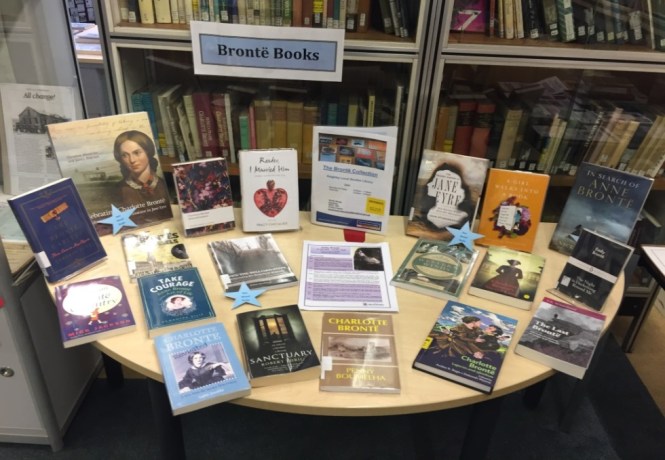
Nowhere can compete with the Brontë Society Collections, Museum and Parsonage Library in Haworth but Keighley Local Studies Library is proud to be Bradford Council’s repository for a very important collection of books, articles and news cuttings, including a small archive on the Brontës and Haworth in general. In these anniversary years, the Library is adding to this with newly published works reflecting contemporary scholarship and the latest research, with book stock for both reference and for loan. (Please see list of new books below) We also have a new fact sheet on Emily Brontë and this accompanies the full booklet about the Brontë collection and other leaflets celebrating the Brontë family and their contacts in the local area, please see:
www.bradford.gov.uk/libraries/local-and-family-history to download free copies or better still, call into Keighley Library to pick up a copy and see the collection for yourself. The library is open daily from 9am until 7pm and on Saturdays 9 am-5 pm, closed Sundays.
Telephone: 01535 618215; email: keighleylocalstudies@bradford.gov.uk
During July, Bradford Local Studies Library hosted a display on Bradford’s Police History. The display has been co-produced by the Ripon Museums Trust and the Bradford Police Museum and has been well received by customers in the Library.


