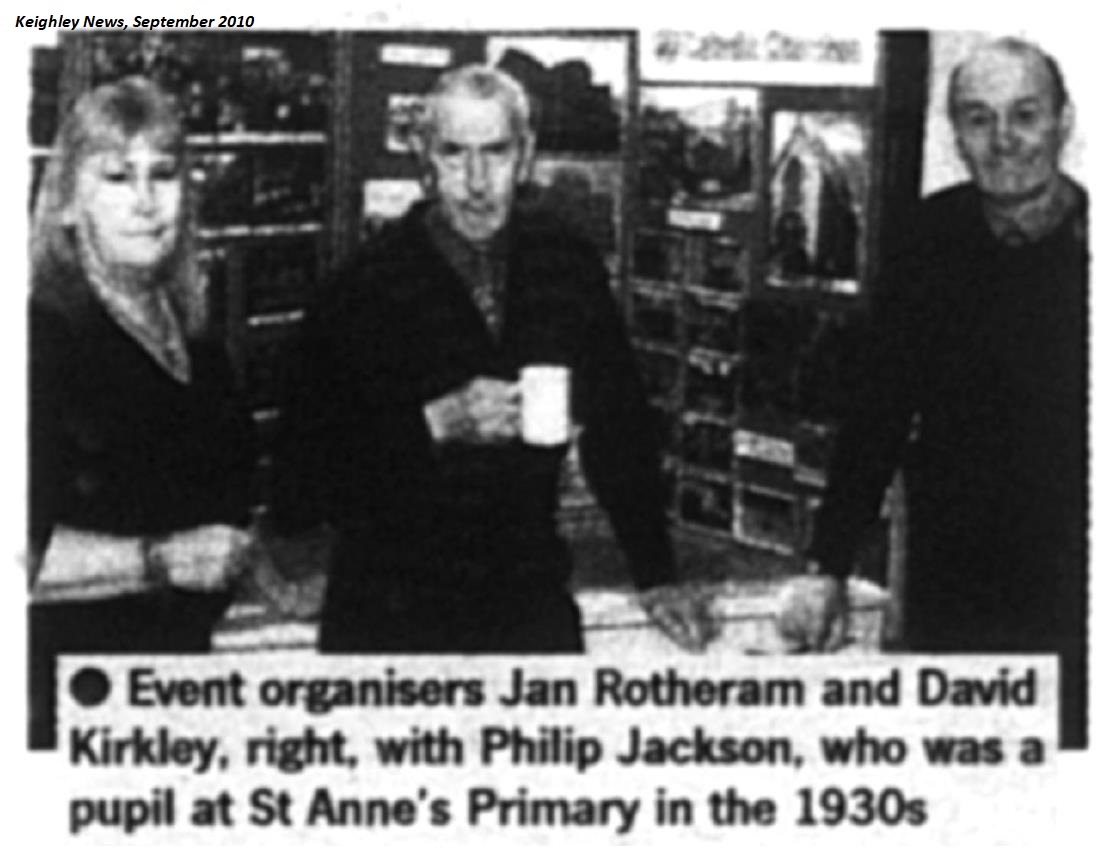
It was with great sadness that staff at Keighley Library heard of the recent death of David Kirkley. David had not only become a major contributor to Heritage Days and Keighley local history but also a friend to the library staff.
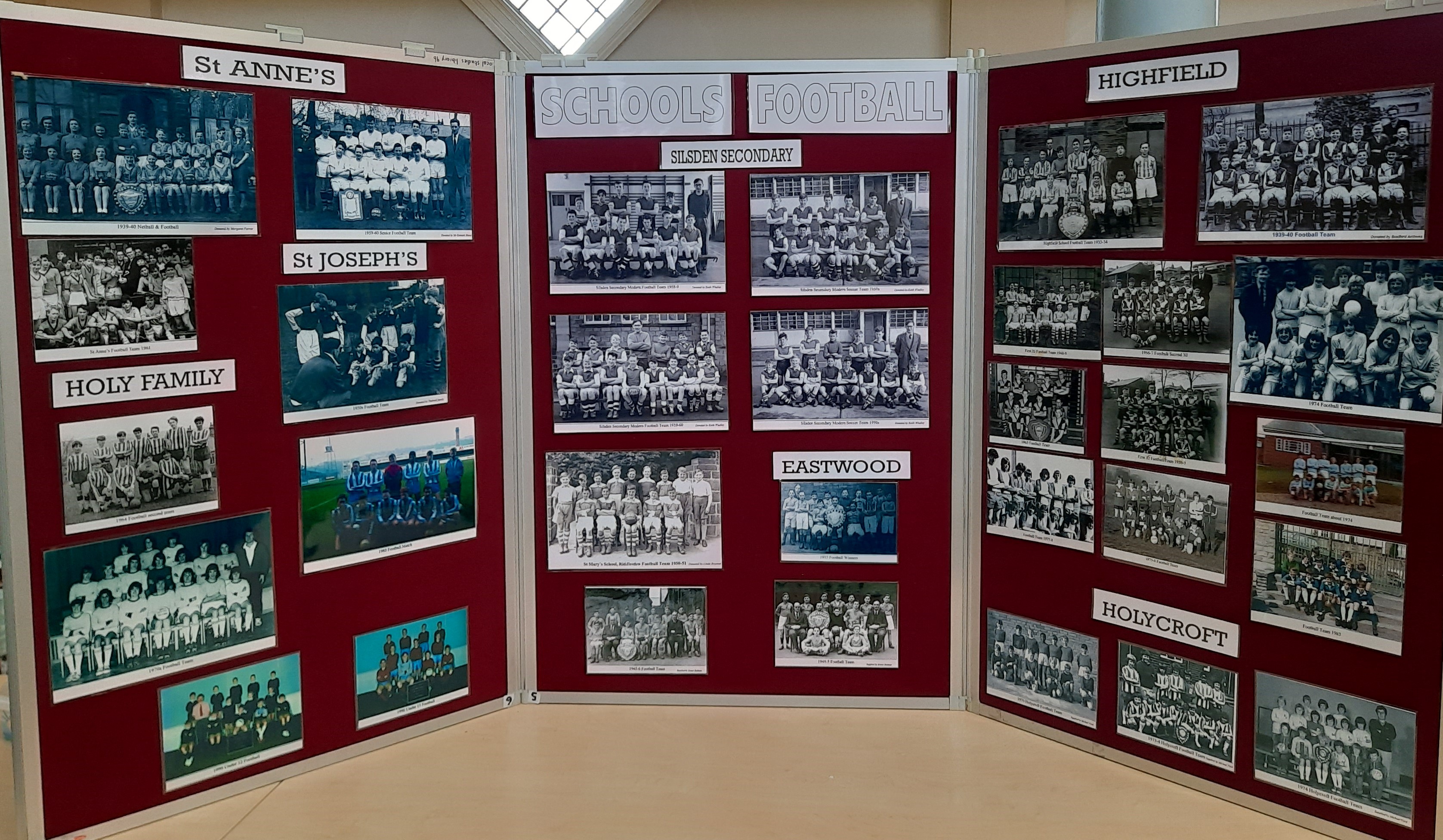
David was the other half of the Schools’ Heritage Group, together with Jan Rotheram. This was set up a few years ago and ever since, their wonderful photograph collection has provided a source of displays for Heritage Days and other events held in Keighley Library, in particular the Local Studies Library on the first floor. These displays always won a brilliant reception from locals, as families and friends pointed out their old school selves or others they recognised and reminisced about the “best days” of their lives. In 2022, David had put on another great display for us of local school sport photographs to accompany a talk on Keighley and football in the 1950s by Mike Halliwell.
Before Covid, David came at least once a week to Local Studies for a catch up with other locals, equally enthusiastic about Keighley’s history and we learned a lot from them and their projects in our turn. David supported this historic library in both word and deed and was amongst the first to support the wonderful musical heritage events. We, the staff, always enjoyed chatting to him, he was a knowledgeable, reliable, kind and helpful gentleman and we shall all miss him very much indeed. We are not surprised that in other areas of his life such as the Cougars’ rugby club, he was held in such high regard, a local legend indeed.
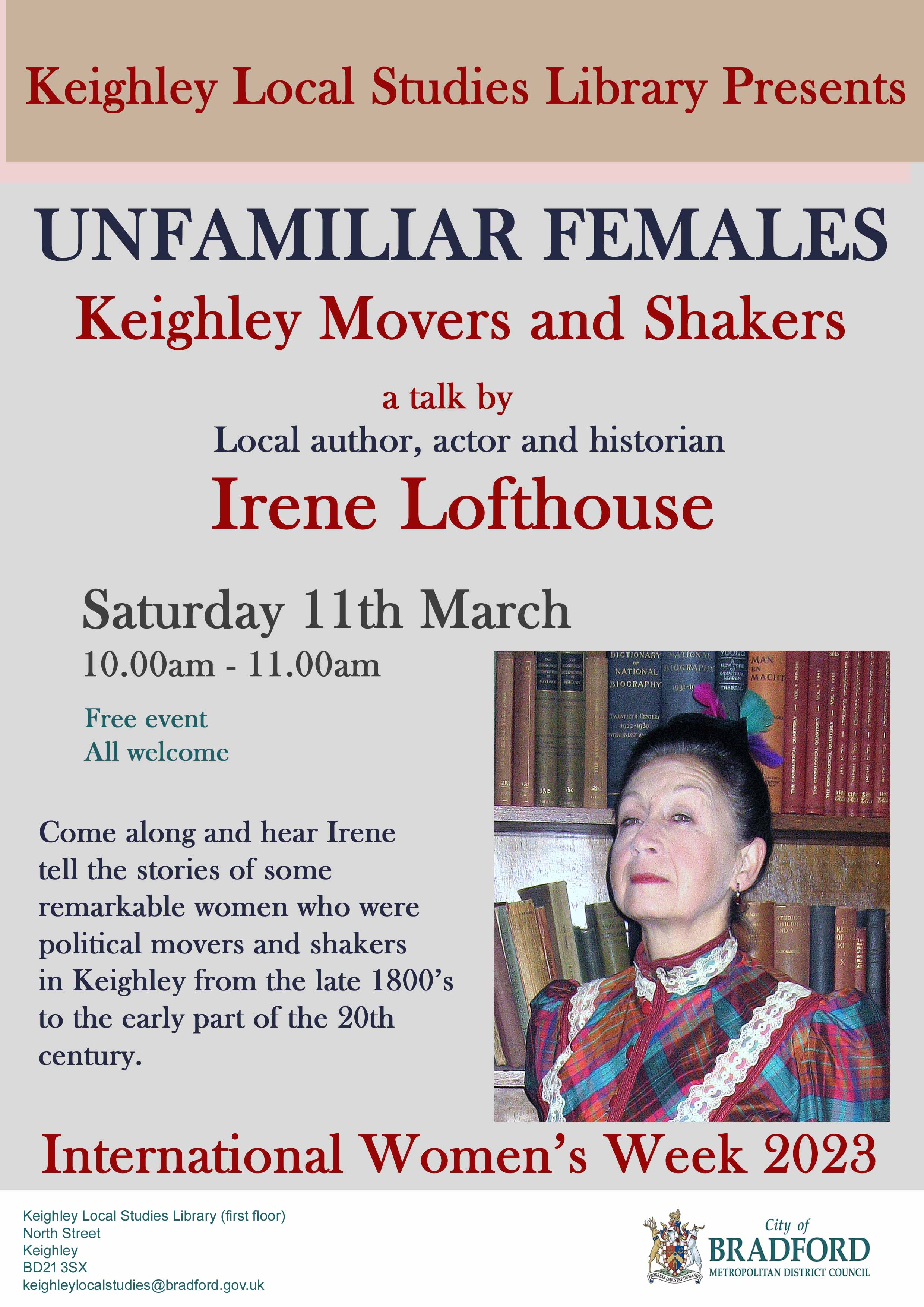
International Women’s Week in Keighley Local Studies Library was celebrated with another popular talk by Irene Lofthouse in full costume. Over 50 people ignored any remaining difficulties of ice and snow to hear about some of the inspirational women of Keighley at the turn of the century.
Margaret Winteringham (first British born female MP in Parliament, child and family welfare campaigner); Rachel Leach (early Dalton mill owner and business woman); Lady Ethel Snowden (campaigner, speaker for women’s rights, ILP member, BBC Board of Governors); Frances Smith (mill worker, councillor, champion of child welfare and public health and first woman director of the Co-op Society Ltd); Margaret Pickles (a Keighley Guardian, a member of the Keighley Union Relief Committee who championed better conditions for the poor and taking children’s upbringing outside the workhouse environment) were just some of the women brought vividly to life by this entertaining actor-historian Irene Lofthouse, who, we are proud to say, does much of her research here in Keighley using our renowned Local Studies’ collection. Our holdings include the Lady Ethel Snowden Library, Down Memory Lane articles by the late Dr Ian Dewhirst MBE, news cuttings, local histories and archives, including a large collection of resources on local mills and their owners. Please see our leaflet guides on this site.
Women in Publishing
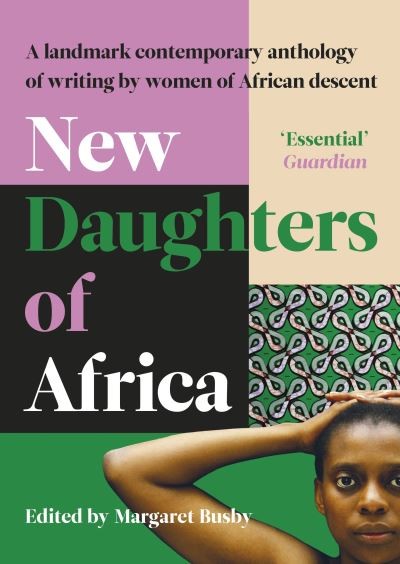
Keighley Local Studies also put on a display about women in publishing with reference to an excellent online article on the British Library website by Dr Margaretta Jolly, Professor of Cultural Studies at the University of Sussex. This examines the progress made by women in the world of publishing, alongside women’s suffrage and rights’ movements that inspired publications such as the Spare Rib magazine and the establishment of Virago press whose archive is now held at the British Library. The article also notes the emergence of greater diversity in the industry to be inclusive of the working class and also minority ethnic representation with a look at Margaret Busby OBE Hon. FRSL, the youngest and first black woman director of a publishing company. There is plenty online about Margaret Busby who is a patron of Independent Black Publishers and was appointed Chair of Judges for the Booker Prize in 2020. Her latest book New Daughters of Africa (ISBN: 9780241997000), an international anthology of writing by women of African descent, is available from Bradford Libraries.
There is a great reading list attached to this article but check out the following sites for more information:
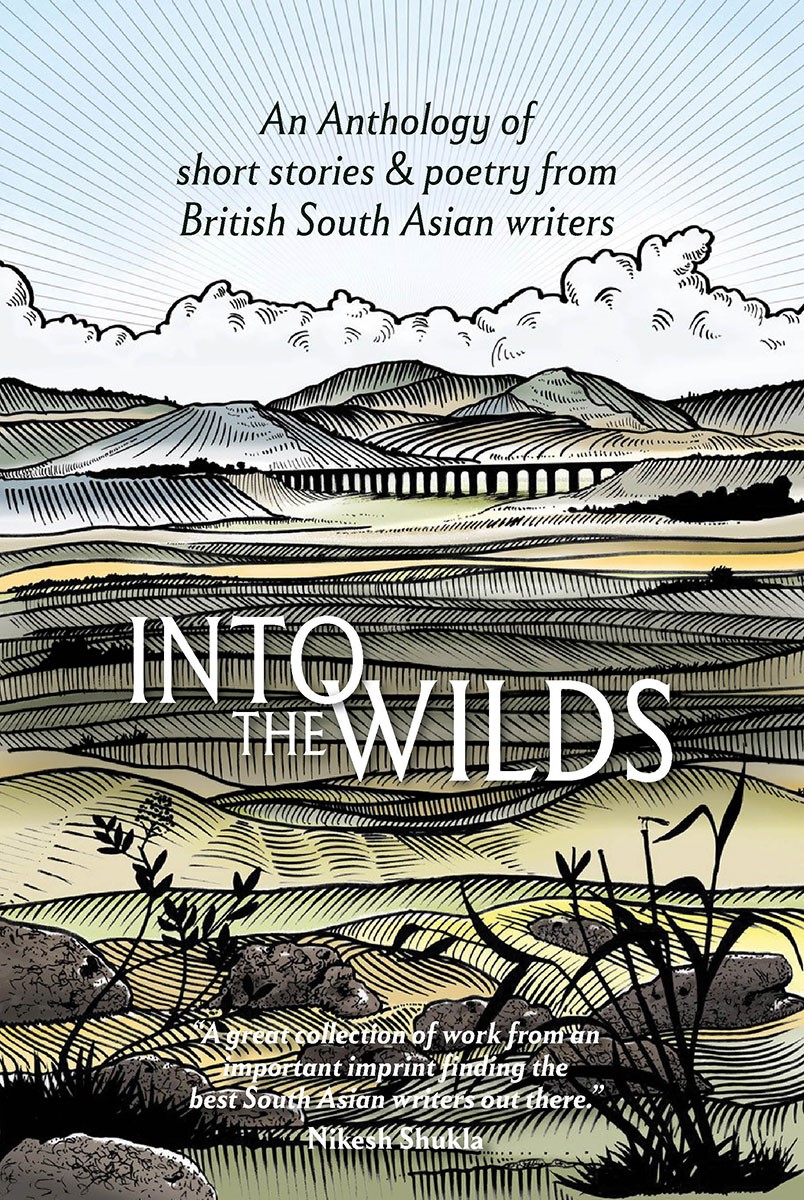
We also featured the emergence in Bradford of two female Asian publishers at Bradford based Fox & Windmill, Habiba Desai and Sara Razzaq.
This is the first independent book publishing company for British South Asian writers, established in 2021. Their inspiring collection of short stories and poetry from British South Asian writers, Into the Wilds, bridges the gap in the publishing industry for writers from a different background.
The printing industry itself was also covered with reference to another article about women’s experiences in the printing industry today but also the first woman to have her own printing press and to employ and to train the first young women in the industry, Emily Faithfull (1835-1895). Emily, a vicar’s daughter, trained as a printer and typesetter and launched the Victoria Press in London in 1860. Its aim was to promote women’s rights to skilled and decently paid employment. The Press printed The English Woman’s Journal, considered the first British feminist periodical, edited by activist-poet Bessie Rayner Parkes. Emily was appointed publisher-in-ordinary to Queen Victoria in 1862. The full article can be read at the following site: https://www.printweek.com/briefing/article/women-at-work-the-push-for-gender-diversity-in-print
Keighley Local Studies also holds a small selection of 19th century broadsides (single sheets of commentary, song or poetry) and previously has collaborated with Piston, Pen & Press an AHRC-funded project that aimed to “understand how industrial workers in Scotland and the North of England, from the 1840s to the 1910s, engaged with literary culture through writing, reading and participation in wider cultural activities”. Check out their web site for more information please:
It just goes to show that inspirational women are everywhere, should be celebrated and their struggles and achievements recorded. We are pleased that Bradford Libraries and Archives on their bookshelves, displays and in their Local Studies’ departments can share in their journey past, present and future.
Discover the woman who owned the first ‘Dalton Mill’ and fought off intimidation; another who championed the first children’s allowance, now Family Credit; why a female councillor resigned from the Labour Party in 1947; who stood up to Lord Reith as one of the first woman members of the BBC Board; which Keighley lass wrote The Feminist Movement – way before the 1970s -and more anecdotes along the way.
Join writer/historian Irene Lofthouse as she shares stories about some of the lesser-known women of Keighley, their achievements and legacies that still resound today. Then visit the exhibition of portraits by local artist #SophiePowell.
It is true that local history is only a second behind national current affairs. Given today’s volatile political climate and workers’ unrest, an examination of early 20th century history, is not the antiquated process that the notion of progress might lead us to hope for in 2023.
Keighley Library holds a small but important collection of ILP records (BK11) and also the Snowden collection that includes the libraries of early ILP members: Lord Philip Snowden and his wife, Lady Ethel Snowden, so we thought that we would look into these important and still very relevant local connections for this anniversary year.
The national Independent Labour Party was led by Keir Hardie who became its first chairman and had its inaugural meeting in Bradford at Laycocks’ Temperance Hotel, Albion Court, off Kirkgate on 13 January, 1893. Its foundations were rooted in the turmoil in the Bradford textile trade which was facing competition from France and rising foreign tariffs on British goods. This had led to greater local competition and an intensification of machine led production with pressure to produce more by fewer workers for the same wages. The Manningham Mills strikes of 1890 and 1891 saw powerful links forged between the ILP and local trade unions that the Liberal and Tory parties had failed to make. However, most importantly from an historical perspective, the ILP’s critical eye, focused as it was on established politics in such challenging times for lower paid workers, helped to lay the foundations for the growth of the “working class” affiliation with the less radical Labour Party that was emerging under Ramsay MacDonald and ultimately that party’s much greater political success in replacing the Liberal and Tory norm at both local and national levels of government.
In Bradford today, the founding meeting of the ILP is still marked by the large mural on the north side of Leeds Road near the city centre on the wall of the Priestley Theatre in Little Germany.
The ILP in Keighley
Keighley is joined with Bradford in its reputation as being part of the heartland of Labour politics at the Party’s time of emergence. In fact, in the 1890s, Keighley had one of the largest ILP branches in the country.Nevertheless, it seems that the politically dominant Liberal elite in Keighley was able to deter the political success of the ILP in the town.
The 1880s-1890s were full of discontent for working men and women in Yorkshire but despite this, the established party of choice, the Liberal party, still won elections – the largest single group on the Borough Council from 1882-1908. Furthermore, in spite of early electoral successes by 1900, consisting of four ILP town councillors and three School board members (both including Philip Snowden), ILP representation on the Council declined so that from 1904 to 1912 there were no Keighley town councillors for the ILP.
One argument could be that the successful influence and patronage within other areas of the town’s community life: employment, culture, education, religion and temperance were such, that voters could not ultimately be persuaded to embrace the ILP’s more radical politics. Liberal leaders such as Sir Isaac Holden, Sir John Brigg and Sir Swire Smith had brought much success to Keighley, both as employers in successful and expanding industry but also socially and culturally. They were instrumental in the establishment and success of the Mechanics’ Institute, its popular and nationally successful technical education for young working men and women and also the establishment of a Carnegie Public Library for all in 1904. Keighley’s sizeable Irish population also backed the Liberals at a crucial time in Keighley because of the staunch Liberal Home Rule policy. It is also worth remembering that the ILP in Keighley had fewer funds than either Bradford’s ILP branch or Keighley’s Tory and Liberal parties that relied less on the coffers of lower paid workers. One more point is that voting was still restricted to women who were ratepayers and heads of the household and that excluded many potential radical votes from single working women, paid little within poor working conditions, many in the textile trade. Lady Ethel Snowden was to do much to support women’s suffrage and Philip Snowden also became a champion of this cause.
Another argument might run that as a smaller town than Bradford, there was perhaps less room for independent opposition in such an economically, socially and culturally interconnected town. The Liberal elite were employers, sometimes landlords and held good standing within Keighley’s Non-conformist and temperance led community. Minority radicals would have had to have the mesmerising charisma of John Wesley to pull in supporters who would be going against the grain of such family and communal loyalties. Keighley, as a small town, also appears to have had some class fluidity for the educated and skilled working men. David James, former Bradford District Archivist and Labour historian, points out that some Chartist sympathisers had also been able to do well and gain influence within various organisations in Keighley and that this had also subsequently somewhat clipped their radical wings, (David James, “Local Politics and the Independent Labour Party in Keighley” in Keith Leybourn and David James (eds), The Rising Sun of Socialism 1991), p.106.
However, despite the ultimate failure of an early political conquest in Keighley, the influence of the ILP, as in Bradford, was still a pervasive one. It endured and promoted an alternative political option to Liberalism and Toryism in frustrating times for those working people, particularly with skill and education, and it offered a means of publicly active criticism, not least through its growing relations with developing trade unions. Finally, and again in the words of David James, above all, “…it sowed the seeds of a successful independent working-class political party, though it was the Labour Party that was to reap the harvest.” (ibid., p.118).
Lord Philip Snowden, Chancellor of the Exchequer for the first Labour Government
Although he never became Keighley’s MP, it was in Keighley that Philip Snowden was to cut his political teeth.
Born in Cowling in 1864 to cotton and worsted weavers from Ickornshaw, his parents were staunch Methodists and members of the Temperance society. It was an upbringing that was to shape his later political career.
“I was brought up in this radical atmosphere it was then that I imbedded the political and social principals which I have held ever since”
Philip was one of three children but unlike his two elder sisters, due to the shrewd saving of his father, he did not enter the local mill to work at the aged 10. Instead, Philip who was a bright child stayed on at school and attended the newly established board school from 1874, becoming a pupil teacher in 1877.
His interest in politics started when his family was forced to move to Nelson on the closure of Cowlings mill in 1879.Taking up a job as a clerk in an insurance office in Burnley. His early leaning however, were to favour the Radical Liberal ideals of his father.
In 1886 he won a competition to join the civil service and started to work as excise man. Over the next few years he travelled the country working in Liverpool, the Orkneys and Aberdeen. However, his civil service career was cut short when in 1889 whilst at Plymouth he sustained a back injury that that left him paralysed. He returned home to Ikornshaw to be nursed by his widowed mother and over the next few years he learned to walk again but walked with a stick for the rest of his life.
Whilst convalescing he put his frustrations into reading and began to read widely on the subject of socialism. Between 1892-1995 his leaning went from the Radical Liberal to moving over to the Socialism of the Independent Labour Party.
His contribution to local politic in Keighley was a significant one, he joined the Keighley ILP in 1895 only a few years after its formation and he became editor of the Keighley Labour Union Journal in 1898. By 1899 he was a Labour councillor and School Board member. His journalistic abilities along with his fine oratory skills made him popular figure and he drew large crowds to his speeches. At the Labour Church and he went on to tour the nation giving talks on socialism.
Philip was now making a name for himself with in the Labour moment, one of the big four alongside Keir Hardie, Ramsey MacDonald and Bruce Glasier. He served as chairman of the National Administrative Council of the ILP.
The early 1900s saw his gradual withdrawal from the Keighley political scene and his attentions tuned first towards Leeds and then west to the Lancashire. Local politics had shown its limitations, and he became of the belief that real social change could only be achieved through entry to parliament. His attempt to stand as the ILP candidate in Keighley in 1895 had been thwarted by lack of funds. He did not give up and after two failed attempts at Blackburn in 1900 and in Wakefield 1902, he was eventually elected as Labour MP for Blackburn in 1906.
It was also around this time that he met Ethel Annakin a young school teacher, feminist and socialist. Like minded and both ambitious for their political causes they married in Otley in 1905, against his mother’s wishes. A leading suffragist it was Ethel that was to convert her husband to the cause. He was also becoming a recognised expert on economic issues and advised David Lloyd George on his 1909 peoples budget.
The couple were travelling when war broke out and they found themselves on the other side of the Atlantic. Snowden’s opposition to the Fist World War was contrary to the Labour Party’s patriotic support and he found himself once again aligned with the left and the anti-war ILP. Such views were against the grain at the time, saw him defeated at the next general election in 1918.
In 1922 he was elected as the Labour MP for Colne Valley. Only two years late in 1924 the first Labour Government was formed, and he was appointed Chancellor of the Exchequer under Ramsey MacDonald. He went on to reprise his role as Chancellor in 1929 as part of the second Labour government.
It was when he continued as chancellor 1931 under the National Government that he met with controversy. After he introduced a budget that had been rejected by the previous labour cabinet, he was expelled from the Labour party.
Struggling with ill health he did not stand in 1931 instead he given a peerage. They became viscount and Viscountess Snowden of Ikornshaw. Philip turned to journalism in later years, but he suffered from increasing ill health and died on 15th May 1937.
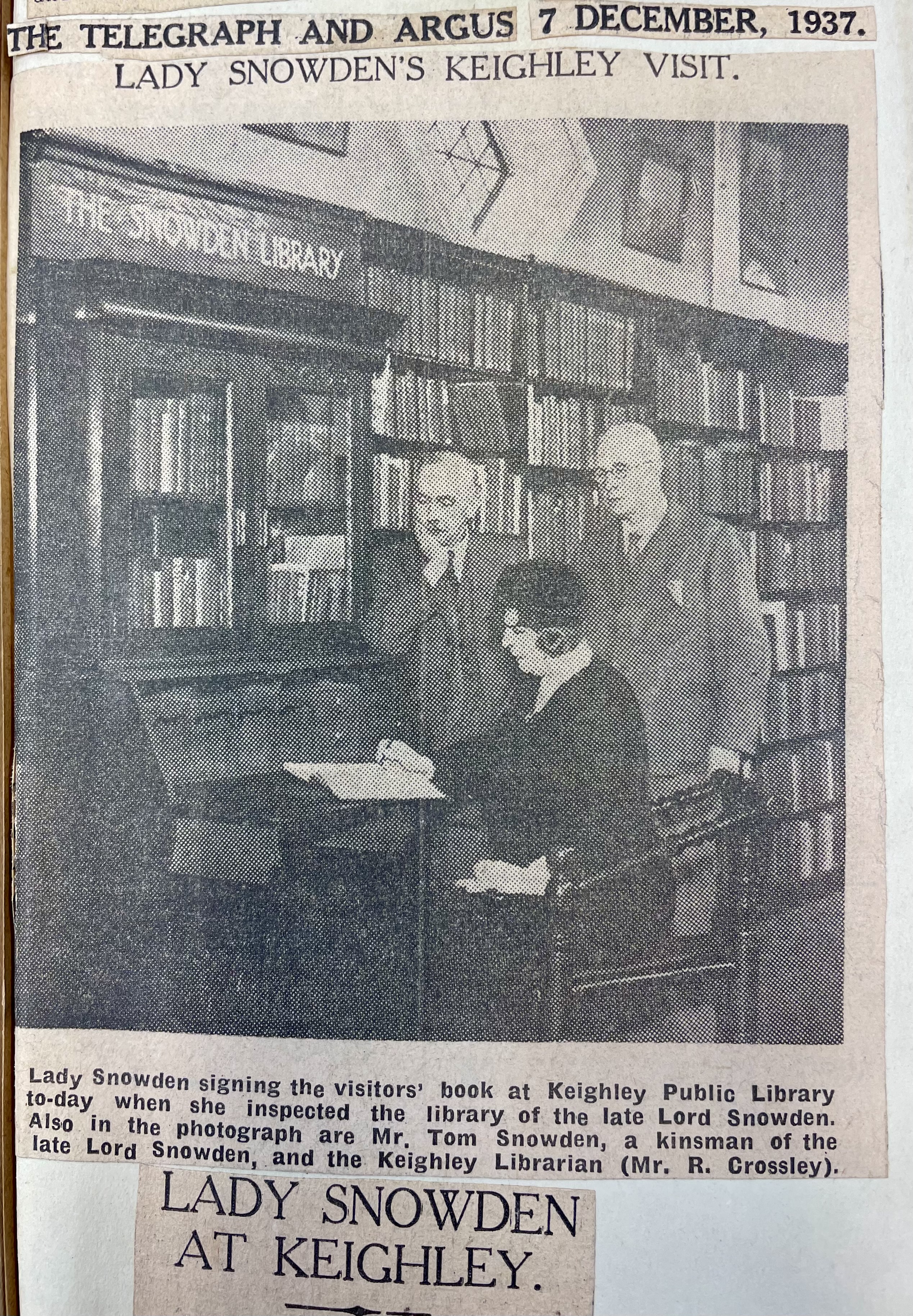
The town had obviously made an impact on her husband for it was to Keighley library that Lady Ethel Snowden gave his 3,000 strong collection of books along with his writing desk. Her books joined those of her husbands on her death in 1951.