Lister Park Lido

It is just over 100 years since the opening of the Lido in Lister Park.
It officially opened on 19th June 1915.

Opening Notice

Here is a description of the bath from the official opening programme.

DESCRIPTION OF THE SWIMMING BATH.

THE entrance to the Bath is by a forecourt connected to one of the main avenues the park.

The Bath is surrounded by a close-boarded fence, seven feet high, fixed on the top of an embankment which has been formed from the material excavated for the pond; trees are planted on the slopes of the embankment and around the Bath and next to the inner side of the fencing flower beds and shrubs have also been planted.

The Swimming Pond is 150 feet long by 60 feet wide and will hold 286,000 gallons or 1,300 tons of water. The depth is 3 ft. 4 ins. at the shallow end and 6 ft. 10 ins. at the deep end.

Settling tanks have been formed at the west end of the Bath for the purpose of intercepting the solid matter in the water from the stream by which the pond will be supplied, and the outlet of the pond will discharge into the stream.

Six separate flights of steps, giving access to the pond, are recessed in the gangways so as to avoid any obstruction to bathers.

A diving stage, at the deep end of the pond, has been erected so as to enable diving competitions to take place in accordance with the conditions which govern the English Championships and with all regulations relating to diving competitions. There is also a spring diving-board fixed to the gangway.

On three sides of the pond there is a galvanized iron handrail, and at the shallow end a sparge pipe has been fixed to be used as a spray and for cleansing the surface of the water.

Spittoons are arranged around the pond.

Life-buoys are placed in convenient positions around the pond for use in case of emergency.

Dressing boxes and sheds, to accommodate seventy persons, are arranged on each side of the bath, and the gangway is of such a width that additional dressing boxes can be erected it necessary.  There are two dressing rooms which can be used by swimming clubs or for the purposes of gala performances.

Six electric lamp standards have been fixed around the pond and two at the entrance for lighting purposes.

The main building is at the shallow end of the Bath and comprises entrance hall 11 feet wide, fitted up with two turnstiles and a collapsible gate, and on both sides of the entrance accommodation has been arranged for cycles.

Adjoining the entrance hall there is a small cafe with a projecting balcony, and from the balcony a full view of the bath can be obtained. There are balconies on each side of the cafe which can be used in connection therewith; a ladies’ retiring room is also provided as well as lavatory accommodation for men and women.

Staircases on each side of the entrance lead to the pond gangway, and from the gangway four flights of steps lead to the galleries and balconies.

The Attendant’s room is immediately under the entrance, and is placed so that the attendant has full supervision of the Bath.  The foot and shower baths are supplied with hot and cold water and adjoin the Attendant’s room.

There is seating accommodation in the galleries for 480 persons for swimming exhibitions or gala performances, and an additional 560 persons can be seated by providing chairs on the balconies.  There is also standing accommodation for 1,000 persons, and the total accommodation is 2,040.

The swimming pond has been constructed, and the water supply service arranged, under the supervision of the City Engineer and Surveyor (Mr. WHS. Dawson), and the remainder of the Bath to the designs and under the direction of the City Architect :Mr. W. Williamson, L.R.l.B.A.).

Entrance

Lister Park Lido

In the 1930’s there was a marked decline in the popularity of the bath, the reason being that it did not comply with the standards of hygiene demanded by modern swimmers. Cold and unfiltered water, inadequate dressing accommodation. etc. all contributed towards this end.

Under these conditions. it became obvious that something more up-to-date should be provided to meet the reeds of the ever-increasing number of swimming enthusiasts.

Therefore. the City Council, acting on the recommendation of the Baths Committee decided, after most careful consideration, to carry out a scheme of modernisation.

A filtration, sterilisation and heating plant has was installed, capable of treating the entire contents of the pools in a period of six hours, thus ensuring, at all times, water having a high standard of purity and maintained at a temperature of approximately 70 degrees Fahrenheit..

Surrounding the large swimming pool was a raised terrace on which sunbathers could recline, and to the rear of this were seats, arranged in tiers, for spectators, provision being made for the latter to obtain shelter during inclement weather. A spacious cafe with glass-fronted lounges was an added amenity. The new look lido was officially opened on 3rd May 1939.

In 1973 cutbacks meant the lido only opened briefly, and finally, in 1982, it was discovered repairs worth £60,000 were needed.  The baths closed in 1983 and were finally demolished in 1991.

Heritage Exchange at Shipley

Library DisplaySaturday 4th July saw Bradford Local Studies Library attending a Heritage Exchange Day at Shipley St. Paul’s Church.

The Local Heritage Exchange event, ‘Celebrating Our Community Heritage’ was a considerable success with 26 groups and services taking part and around 170 people attending from all local areas, as well as further afield.

The library had a stall advertising our services and also had a selection of archive photographs of the Shipley area which proved incredibly popular.

Links with partner organisations were revisited and established and new customers encouraged to visit the Local Studies Libraries at Bradford and Keighley.

The reasonably priced creamcakes weren’t too bad either!

Showing photos

Salvation Army Anniversary

July 2015 marks the 150th anniversary of the foundation of the Salvation Army in the East End of London by pioneers and social justice reformers, William and Catherine Booth. As Christian Evangelicals, members demonstrate their faith by providing direct help to those who need it.

In 1905 General William Booth made a ‘great northward motor-car tour’, which included a weekend at Keighley, well documented in the local press. Photographs of the well received arrival in High Street, Keighley are in local history books. There was a civic reception at the Municipal Hall and meetings were held at the Queen’s Theatre. The General preached to a crowd of 2500 with an overflow of 1500, with 50 converts.

Today the Salvation Army is active in 126 countries. Records in Keighley Local Studies show a few of their activities and events in the local area and date back to 1913 (BK 462).

There is also a small Haworth family collection including Salvation Army certificates and photographs of the Brontë Home League, dating from the 1940s (BK 559).

Salvation Army Pamphlets

New school archive for Keighley Local Studies

Keighley Library recently received a donation amounting to over 36 boxes of photos, records and plans from the former Greenhead High School.

The origins of the school date back to the earliest Free Grammar School established for boys in 1713, as a result of an endowment of a house and garden with land by local man John Drake. It had 50 free scholars for English reading, Latin and Greek. However, Greenhead’s origins lay in the division of the Grammar foundation into Girls’ and Boys’ when Greenhead follows the Girls’ school branch of development. The Girls’ Grammar School, only established in 1872, stayed in the old Drake & Tonson School building in Strawberry Street but moved to Utley, Greenhead Road in 1934, hence Greenhead Grammar. The school became co-educational and a comprehensive in 1966 when the first boys arrived.

This collection is a wonderful record of the development of education through the decades, from school work displays, trips and drama productions to fashion in uniforms and hairstyles shown in the many photographs of staff and students. Today Greenhead is the University Academy, Keighley, a large multi-cultural school with many facilities unimaginable in 1872.

If anyone would like to view the collection, please quote catalogue BK 613 and give 24 hours’ notice.

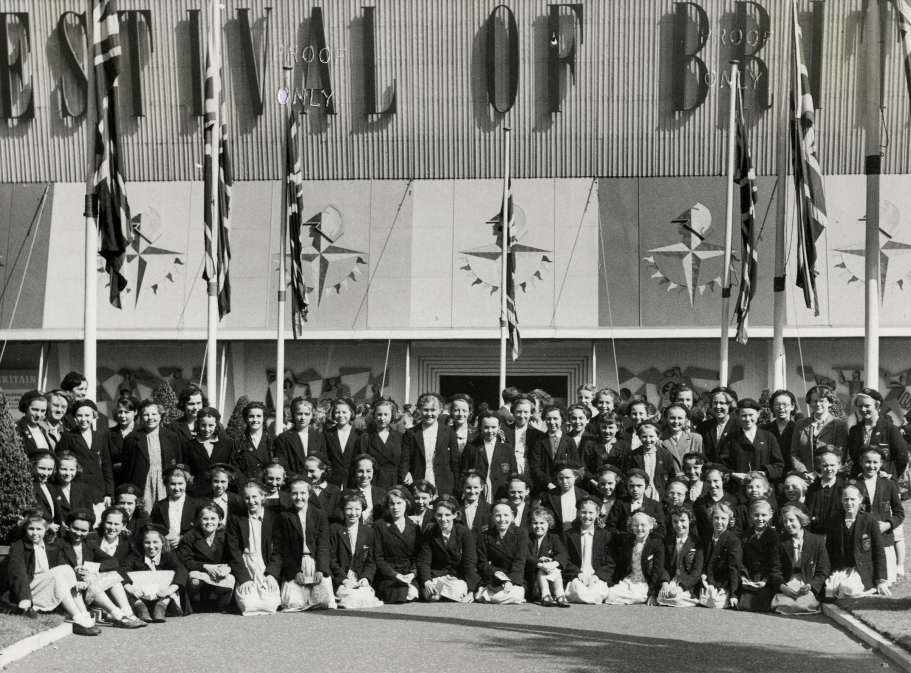
This photograph shows the Festival of Britain school trip in 1951.

Greenhead Pupils

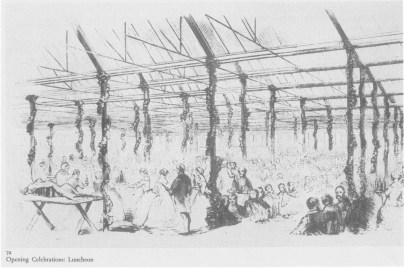
Salts Mill Opening Celebrations. Luncheon in the Combing Shed.

The mill was opened on 20 September 1853, the 50th birthday of Titus Salt. A full description of the opening, from which most of the following information has been taken, appeared in the Bradford Observer of 22 September, where it was described as “one of the most gigantic and splendid festivals that ever occurred in the annals of Industry.”

Luncheon was provided for about 3,200 people who were conveyed from Bradford to Saltaire in special trains. The guests included the Lord Lieutenant of the West Riding, local MPs’, magistrates, mayors and clergymen, and business and personal friends of Titus Salt, and about 2500 of his workpeople. Flags flew from the roof of the mill, and an arch of laurel and flowers surrounded the West entrance.  The guests were conducted through the principal rooms to the Combing shed where 28 long tables had been set up. The columns which supported the roof were decorated with pink and white draperies flags, banners, evergreens and flowers. The food provided included a baron of beef weighing 300 lbs, 40 hindquarters of beef, 40 chines of beef. 100 legs of  mutton, 10 lambs, 120 veal and game pies, 60 dishes of game, 30 dishes of roast chicken and turkey and 40 dishes of potted meat. There were also sweet dishes, fruit and numerous bottles of wine. 7000 knives and forks were required, and 4000 tumblers, 6000 wine glasses and 7000 champagne and other glasses. The meal lasted just over an hour and was followed by toasts and speeches.

Music and dancing were next provided for the company, and trains then transported them back to Bradford. In the evening a Soiree Musicale, consisting of songs and instrumental selections, was presented at the recently opened Sr. George’s Hall in Bradford.

Opening Celebrations at Salts Mill

Taken from Bradford Libraries Saltaire Resources Pack