Treasure of the week no. 15: Tinners and bonnet-makers: The working classes of 1851

JND 197/23 (Please quote this number if requesting this item)

BAKER, Robert.  The Present Condition of the Working Classes. Considered in two lectures delivered before members of the Bradford Church Institute. Bradford: H. O. Mawson, C. Stansfield, J. Dale, H. B. Byles, and other Booksellers.  1851. 62 pages.

working

I recommend this substantial booklet to anyone interested in mid-nineteenth-century Bradford. The print is small and the prose dense, but it is factual (with statistical tables), wide-ranging, objective, detailed, and contemporary with the scene it describes: a sort of textbook of the times. Chapter headings are:

  • The Working Classes as a Body Considered
  • Their Hours Work – Legal and Conventional
  • Their Intellectual State
  • Their Social State
  • Their Morality
  • Strikes

But who were the working class? The author excluded ‘Domestic Servants, Labourers, and those who work in Manufacture and Mines’, but the list of those included in one of the statistical tables gives a useful picture of the ‘Labour Trades’ of old Bradford:

  • Bakers
  • Brewers
  • Butchers
  • Brick-makers
  • Bricklayers
  • Joiners
  • Masons
  • Painters
  • Sawyers
  • Plasterers
  • Blacksmiths
  • Cabinet-makers
  • Engineers
  • Iron manufacturers
  • Nail makers
  • Glass maker
  • Potters
  • Tinners
  • Wheelwrights
  • Shipbuilders
  • Coach makers
  • Curriers
  • Boot & Shoe makers
  • Tailors
  • Carters
  • Hawkers
  • Milliners & dress-makers
  • Sempsters & stresses
  • Stay-makers
  • Straw-plaiters
  • Strawboard-makers
  • Bonnet-makers

An aside it is frequently unknown how the library acquired its pamphlets, but not this one. It is stamped: British Museum Duplicate Transferred.

Stackmole
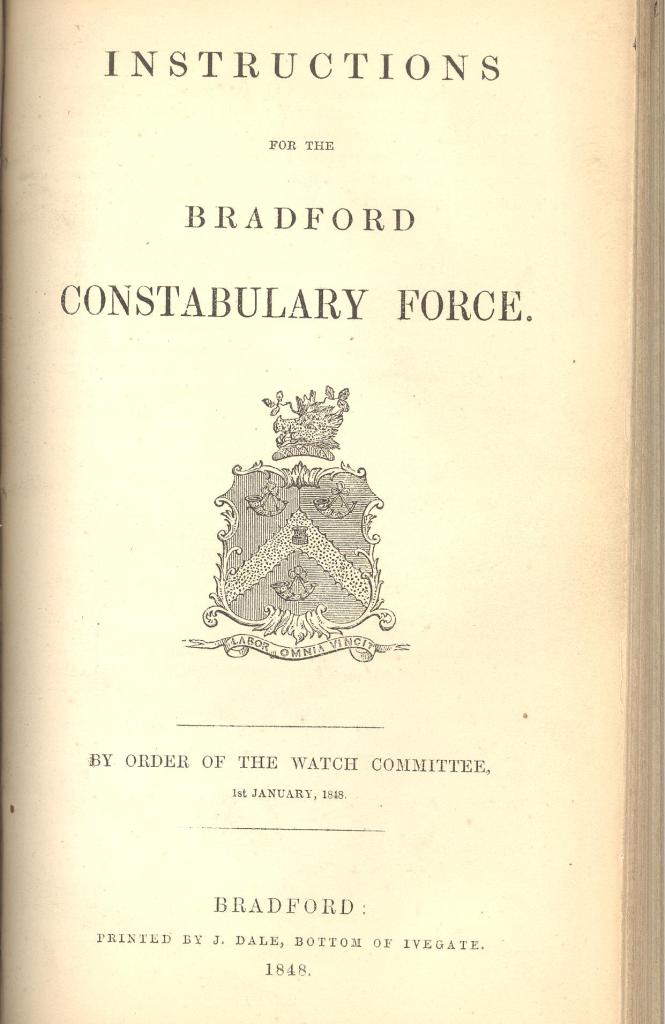
TREASURE OF THE WEEK No. 14: POLICE DUTIES IN 1848

JND 197/17 (Please quote this number if requesting this item)

BRADFORD CONSTABULARY FORCE. Instructions for the Bradford Constabulary Force. Bradford, J. Dale, Printer. 1848. 76 pages.

jnd 197 17 001

This weighty booklet published ‘By Order of the Watch Committee’, describe the duties of the early police force in Bradford.

After describing the duties of the various ranks of the police force from Constable, through Sergeants, Detective Officers, Superintendent to Chief Constable, further details are given of these various duties. Topics covered include:

  • Felonies
  • Misdemeanours
  • Riots
  • Assaults
  • Breaches of the Peace
  • Breaking open and entering Homes
  • Arresting Offenders
  • Executing Warrants
  • Removing Articles from the Pinfold
  • Opening Sewers
  • Keeping Order in the Streets
  • Affrays and Riots at Night
  • Felonies, Robberies, etc.
  • Calling for Assistance
  • Giving Evidence

The publication includes several forms and lists, including details of The Riot Act; Names of Keepers of the Keys of Fire Engines, and Sweeping of the Streets.  In the latter all 130 streets, or parts of streets in Bradford Town are listed with how often they are to be ‘swept’ (i.e. patrolled). Most are to be swept once a week, but Hall Ings, Broadstones and Well Street are three streets which are to be swept three times weekly. There is an impressive and immaculately compiled six-page index. Under ‘A’ are:

  • Abusive Language, Constable cannot Arrest for
  • Affrays
  • Arrest, How to be made
  • Assault
    Whether a Constable may Arrest for
    When a Constable cannot Arrest for
  • Assistance, Calling for

A fascinating and detailed insight into a community developing social control.

Stackmole

Treasure of the week no. 13: Arctic explorer defends the Church in Bradford

JND 197/14 (Please quote this number if requesting this item)

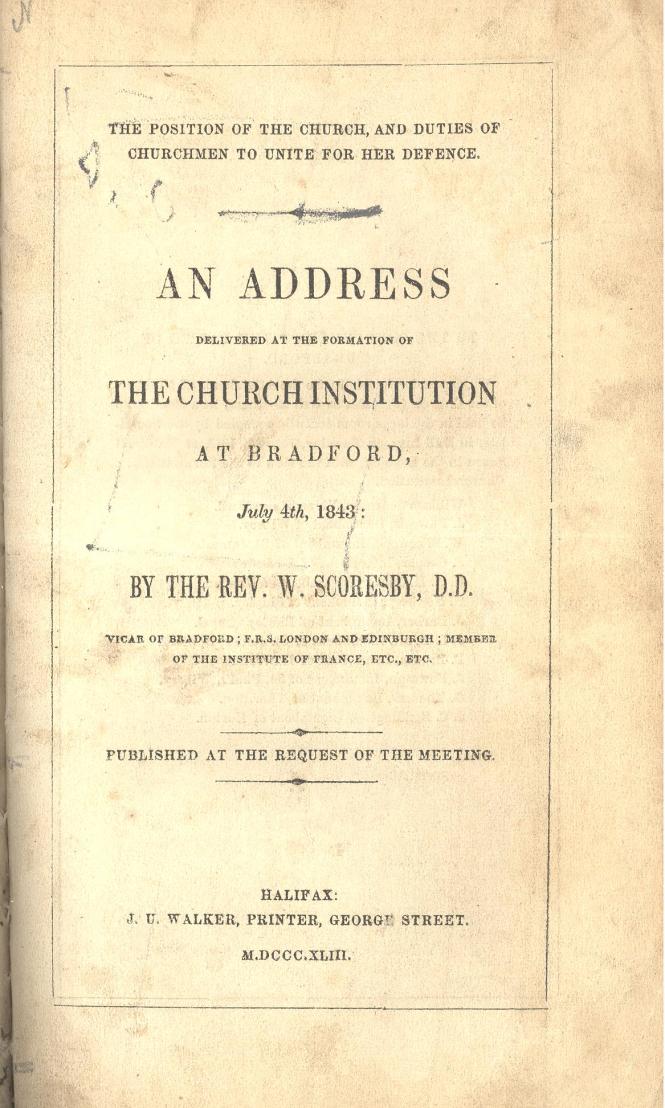
SCORESBY, Rev. W.  The Position of the Church, and Duties of Churchmen to Unite for her Defence. An Address delivered at the formation of The Church Institution at Bradford, July 4th, 1843. Published at the request of the meeting. Reprinted for the Halifax Guardian by J. U. Walker of Halifax. 28 pages. 1843.

jnd 197 14a 001

In the early years of the reign of Queen Victoria, the established Church of England was under threat from the growing number of rival non-conformist churches such as the Methodists, Baptists and Quakers. This pamphlet records an address by the Vicar of Bradford, the Rev. William Scoresby, to the Bradford clergy, at the formation of The Church Institution which would focus on the defence of the Church. After the meeting the following invitation was issued:

‘To the Churchmen of the Parish of Bradford’:

We, the undersigned, Invite the Attendance of Members of the Church (Females as well as others) at a meeting to be held in the large room recently occupied by the Socialists, in Hall Ings, on Tuesday, July 4th, 1842, at Half-past Seven in the Evening.

William Scoresby, Vicar of Bradford
J. Fawcett, Incumbent of Wibsey
W. Sherwood, Incumbent of St. James
J. Cooper, Incumbent of St. Jude’s
G. A. Hamilton, Incumbent of Wilsden
T. Newbery, Incumbent of Shipley
J. Barber, Incumbent of Bierley Chapel
J. L. Frost, Incumbent of St. John’s, Bowling
P. Bronte, Incumbent of Haworth
J. Bourne, Incumbent of St. Paul’s, Wibsey
G. Thomas, Incumbent of Thornton
J. C. Boddington, Incumbent of Horton

It is interesting to see who were the ministers of the churches in Bradford at this time – the Anglican Churches.

The phrase ‘Females as well as others’ is a little odd. Who are the ‘others’? 1843 is a little early for ‘transgenders’!

The appearance of Patrick, father of the famous Brontë sisters, and ‘Socialists’ in the same 1842 document is also a surprise; it got me wondering when the phrase ‘socialist’ was first used.

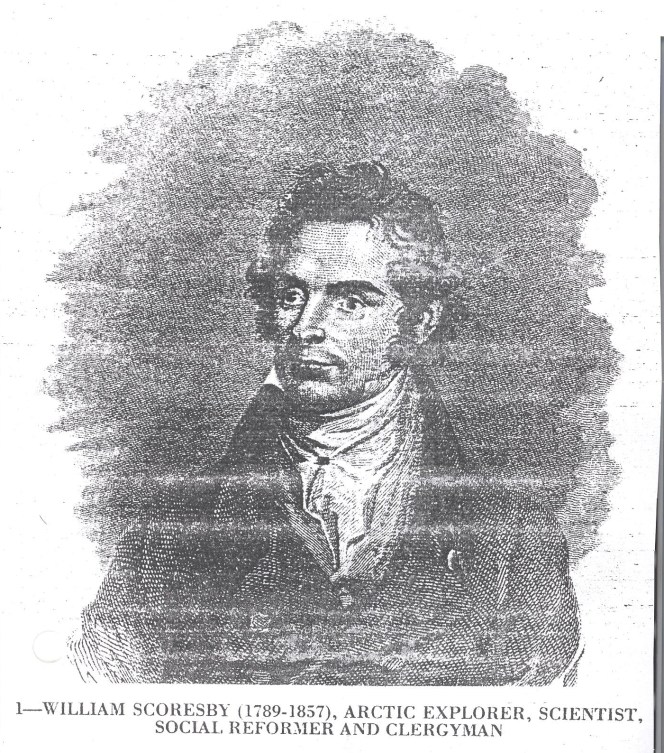
The Rev. Dr. Scoresby was a renowned scientist and explorer before coming to Bradford. He was Vicar from 1839 to 1847. He did not have an easy time.

Stackmole

jnd197 14b 001William Scoresby 001

TREASURE OF THE WEEK No. 12 “TAKE THE SAFEST PATH, FOR I AM FOLLOWING YOU

JND 193/21 (Please quote this number if requesting this item)

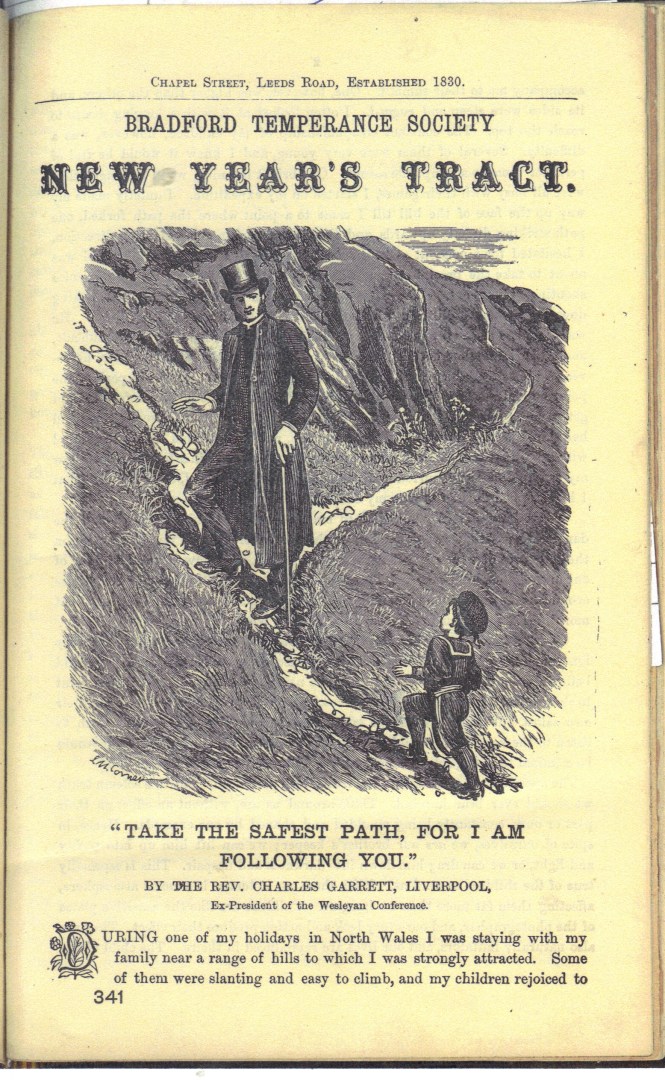
GARRETT, Rev. Charles. “Take the Safest Path, for I am following you”. Bradford Temperance Society New Year’s Tract.
Scottish Temperance League Monthly Pictorial Tract. 1881? 4 pages.

08-10-2016 17 33 34.JPG

“I beseech the readers to realize the tremendous power which they possess and to resolve by God’s help to tread the path of abstinence, if for no other reason, because the children are following them.”

The Temperance movement was huge in late Victorian Britain. The striking illustration on the front page of this tract was inspired by a holiday in North Wales taken by the author of this tract, the Rev. Charles Garrett of Liverpool, ex-President of the Wesleyan Conference.  Although it may be hard to resist the temptation to drink alcohol, like climbing a mountain, it should be done for the sake of our children, and others, who are following you.  And of course, to take the ‘safest path’.

This New Year’s tract was, as we now say, syndicated.  Presumably the Bradford Temperance Society subscribed to copies of the Monthly Pictorial Tracts produced by the Scottish Temperance League, and then sent to its members.

Stackmole

TREASURE OF THE WEEK. No. 11 DEUTSCHE EVANGELISCHE KIRCH

THE GERMAN EVANGELICAL CHURCH. 1881. 8 pages.

 JND 245/7 (Please quote this number if requesting this item.)

German Church2.1

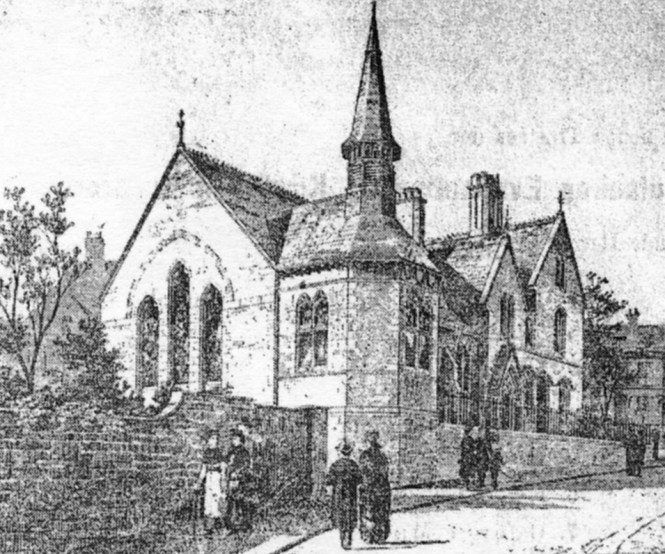
This slim leaflet is a report on the origin of the German Evangelical Church in Bradford and, in particular, the progress of the fund to build a permanent place of worship.

‘The origin of the German Evangelical Church in Bradford is soon told. The town contains a large resident German population, of which a considerable number have brought or inherited from their native country the attachment to the Evangelical faith. No special and suitable provision for their spiritual wants had been made until 1876, when a Church Mission was held in the town, which, at the suggestion of the Rev. Vincent J. Ryan, was extended to the German inhabitants. The Rev. J.S.G. Krönig, of Hull preached to them in their own language. A committee was formed, who carried on divine service, with the help chiefly of Moravian ministers of the neighbourhood of Bradford, till in November, 1876, they received a pastor from Germany.’

A Grand Bazaar was held in 1879, the purpose of which was to raise funds to build a church for the German population of Bradford. The impressive list of the many members of the German nobility who gave patronage to the bazaar reminds us how different pre-war imperial Germany was:

His Royal Highness The Grand Duke of Hesse
Her Royal Highness the Grand Duchess Sophie of Weimar
Her Imperial Highness the Crown Princess of Germany and Princess Royal of England
Her Highness Princess Marie of Scwarzburg-Sondershausen
Countess Maria zu Münster
His Excellency Count zu Münster

Local celebrities were also much in evidence, including:

Sir Henry and Lady Ripley
Rt Hon W E Forster
Lord Frederick Cavendish
The Lord Bishop of Ripon
Mrs Julius Delius

Not forgetting the Band of the 103rd Royal Bombay Fusiliers!

The Bazaar made £422 1s. 7d., and with donations of £903.55 and promises of £1100, plus another £300, “some £2500 was made. This left £1500 more needed.” The Church was built and still stands, on the corner of Great Horton Road and Chester Street. Hundreds of university and college students pass the Church every day, most of whom will barely notice it. Currently it is home to the Delius Arts & Cultural Centre and Artwork Creative Communities. In addition to presenting a picture of Germany before the First World War, this ‘Treasure from the Stacks’ is also a reminder that the establishment of religious centres for immigrant cultures in Bradford is nothing new.

Stackmole