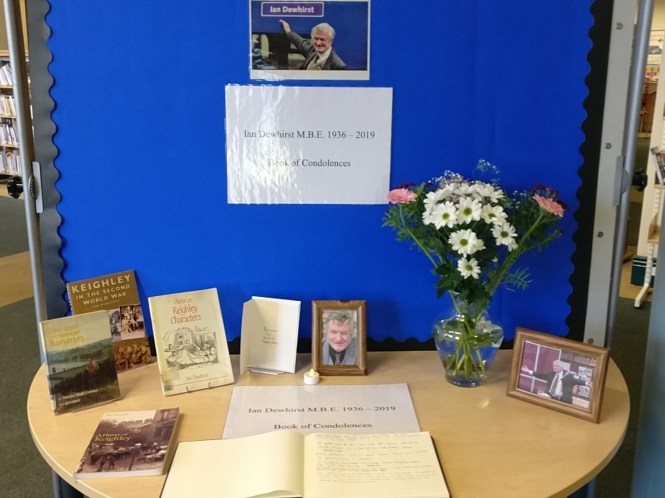
Staff in Bradford Libraries but most especially Keighley Library, are deeply saddened by news of the death of Ian Dewhirst MBE, himself a former Keighley Library Reference and Local Studies Librarian.

Ian Dewhirst MBE 1936-2019
Ian began his career in Keighley Library when he left National Service in the army in 1960 and soon became a popular and much respected Reference Librarian. His local knowledge became unsurpassed due to his dedication to and love of local history, including local dialect, in Keighley and Yorkshire generally. People were impressed and many consequently donated to him a growing archive of documents that together now comprise a unique and much valued collection of Keighley town and its local area.
However, Ian also had a rare talent for delivering the most entertaining talks and for making people laugh and all just a bit surprisingly from local history. He was the Footlights of Keighley, the stand alone raconteur who could bring the house down in just a few words. His talent was spotted by local journals, newspapers and television on which he made a number of rewarding appearances. Once retired from libraries in 1991, his diary was always full and, such was his reputation that rarely a week went by in the library even in 2019, when enquirers didn’t ask to be referred to him or ask for a contact number. He was a living legend in every sense of the word. A kind, patient and generous spirited man, he would always help front line staff in Local Studies if they had a particularly awkward query. He was a true inspiration and a champion of Keighley Library and especially Local Studies to which he would make regular visits to research his Down Memory Lane column in the Keighley News and articles in a variety of Yorkshire journals.
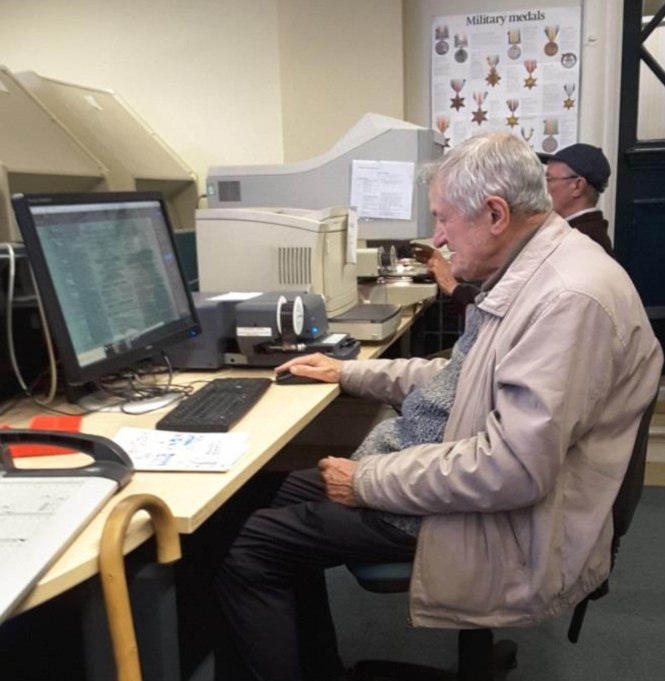
Ian was sceptical of some library developments, especially the growing use of IT and staff could never get him to sign up for email or to use a computer. He remained a determined upholder of traditional communication. Nevertheless, in the last months of 2018, he did use the scanner when all other methods became unavailable. He even posed for a photo when we mischievously asked him to pose because let’s face it; Ian Dewhirst on a computer really was local history in the making. Unfortunately, his final verdict was, “If that’s the future, I’m not impressed!”
Pop music in the library was another matter, however. The thought of live music shattering what was left of any quiet time (silence no longer applicable) was initially anathema to Ian, an “Edwardian” style librarian as he proudly thought of himself. However, seeing how Janet Mawson had linked the pop to local music heritage in the form of bands and local memories of gigs, he not only altered his opinion but proceeded to give a great introductory talk at the June event in 2018. Nevertheless, he insisted on wearing a colourful tie sporting well laden book shelves that he drew attention to whenever the opportunity arose during the course of the afternoon. Janet was pleased to let him know that following the event a number of local music books were loaned or requested. He was pleased to hear it.
Ian Dewhirst MBE brought real life and energy to local history with an enviable lightness of touch that fronted great dedication, knowledge and scholarship. He was a one-off and we library staff are privileged to have known him and to have occasionally worked alongside him.
He will be greatly missed by us all.
I had the privilege of knowing Ian for almost 34 years through working at Keighley Library and there were many occasions where I was able to work with him upstairs which was then known as the Reference Library.
Ian would always go the extra mile when helping the public with their enquiries and also helped staff like myself if we were unsure about certain questions asked of us.
One of my most treasured memories of Ian was the lunch break. Every week he would have a bowl of soup and pour in a packet of ready salted crisps. I found it so funny but Ian thought it tasted exceptionally good. Our lunch breaks were never boring as he would chat away and always have an interesting story for us, whether it was from the past or present.
I will remember Ian as a kind gentleman. I used to see him most weeks and he always went out of his way to talk to me in the library or whenever he spotted me in town. He was a bright star in Keighley and will be sadly missed.
Ann Watkin
Customer Support Assistant
Keighley Library
END OF AN ERA – MY TRIBUTE TO MR. IAN DEWHIRST MBE.
Just 4 words, END OF AN ERA. They were not even my words, but were spoken by Steve Wood, the local historian for Haworth to sum up the sudden passing last week of Mr. Ian Dewhirst MBE. Never will such words ring more true.
I’m afraid I was guilty of taking Ian’s presence for granted, he was a constant in my day to day life in the library. He first came to my attention some 40 years ago when he was drafted onto the panel at the last minute when I attended a job interview for an assistant in the lending library. From then on I saw him virtually every day in his capacity as Reference Librarian. Much has been said already about Ian’s enormous presence, enthusiasm, dedication and of course his endless knowledge.
When Ian took early retirement in 1991 our paths still crossed all the time. I would bump into him around town or else he was always in the library, be it one of his talks, an opening speech for an event, a book signing or to do his own research. It wouldn’t be most people’s idea of retirement, in fact he was in more demand than ever, but I’m sure he would not have wanted it any other way. Some 28 years after his retirement we are still receiving a steady stream of letters and e-mails from people all over the country wanting to be put into contact with Ian, to do a talk for their society or for the answer to some obscure query or other. We duly passed them all onto him and they always received a reply. Anyone expecting Ian to e-mail would have a long wait though as he NEVER embraced modern technology, no mobile phone or computer. I don’t blame him, he had no use for the internet as all the information and knowledge was in his head!
In June, 2018 I was tasked with putting on a 1960s rock ‘n’ roll music event in the Local Studies Library. I had already got 2 bands lined up to perform. One was ‘The Presidents’ who were Keighley’s first rock ‘n’ roll band and the other ‘The Doveston Brothers’ who had twice reached the dizzy heights of the London Palladium. Now I just had to find a compere to hold the show together, a crucial job! I started by compiling a list of possible candidates, I’ll be honest and admit that Ian was not top of that list. Ideally, I was looking for someone who had been a part of the local 1960s music scene themselves. I knew from previous chats with Ian that he did not like that sort of music and I feared he probably took a dim view of whatever else went on around it. He once told me that he had been a guest on some chat show on the radio and they asked him to choose a record. I was amazed when he said his choice was ‘Allentown’ by Billy Joel. ‘Allentown’ is an anthem to blue collar America, representing both the aspirations and frustrations of America’s working class during the decline of the manufacturing industry in the late 1970s;
‘’Well we’re living here in Allentown
And they’re closing all the factories down’’
Wow, good choice Ian, I get why he chose it now given that much the same decline was going on in his own hometown.
My quest to find my compere was proving frustrating, would love to do it but on holiday, too ill, too old now for that kind of thing etc. Part of me was thinking just ask Ian Dewhirst, whilst the other part was clouded by something else I remembered. With the onset of records, videos and later compact discs and the library counter starting to resemble a ‘shop’ (Ian’s words) selling carrier bags, maps and children’s badges amongst other things. Ian had said that ‘it was becoming less a place of peace and quiet and more like a market place!’ Furthermore, it seemed all very well attracting young people into a library by putting on a Punch and Judy show and getting them to shout ‘he’s behind you’ at the top of their lungs, but then it becomes difficult to persuade children that the library should be a reasonably quiet place. I also knew that Ian was inclined to speak his mind and that I could be handing him the perfect public platform on which to ‘vent his spleen’. The devil in me wanted to know what might happen when two different worlds collide, I concluded that whatever happens, you could be sure that Ian would be entertaining. There was another reason I was veering towards asking Ian and that was that I was well aware he would guarantee me an audience as his loyal supporters followed him everywhere. I decided to give Bruce Russell from ‘The Presidents’ a phone call for a second opinion. I hardly had chance to read the names on my dwindling list when Bruce said ‘Janet, go for Ian Dewhirst, I’d pay good money to see him’!! I replied ‘yeah, but Bruce, he has no interest in rock ‘n’ roll whatsoever and will probably only be able to speak about dance bands at the Mechanics Institute’. Bruce assured me that it didn’t matter and I agreed.
When I asked Ian if he would do the honour of being my compere, he looked bemused and said ‘oh, good heavens, are you sure?’ I replied ‘I’m sure, I’m sure’. The poster to advertise the event was another matter. When I showed it to people they looked at the acts, nodding their approval. Then when they came to Ian’s name at the bottom (which had a speech bubble by his mouth saying ‘miss it, miss out’) they said ‘oh, oh Ian Dewhirst’. This was usually followed by a raised eyebrow and a ‘that’s a strange choice!’
Come the day of the ‘Showtime 1960s’ event , I made sure I briefed the Doveston Brothers beforehand that they must not take it personally, but if we start counting, we probably won’t get very far before Ian says something along the lines of ‘of course none of this would have happened if they had not abolished National Service’. Ian also insisted on starting bang on 1 o’clock as stated on the poster despite the fact that folk were still piling in. ‘Cometh the hour, Cometh the man’. Ian was a total star from the word off, he had the audience which had swelled to over 200 eating out of the palm of his hand in no time. He did indeed acknowledge that rock ‘n’ roll had passed him by in a flurry of 2 years National Service and helping out in his dad’s newsagents shop. The only song he liked was ‘Peggy Sue’ by Buddy Holly , but he died and that was that!! He made fun of songs with ridiculous titles like ‘Does Your Chewing Gum Lose Its Flavour on the Bedpost Overnight?’ and ‘How Much Is That Doggie In The Window?’ If Maurice Chevalier had been alive today and brought out a song called ‘Thank Heaven for Little Girls’, he would have been locked up! He related a story from his teens when he was riding in the countryside with his dad on a tandem and requested some information about sex. His dad didn’t fall off the bike but apparently it all went quiet and after a couple of miles his dad simply said ‘both the man and the woman have to agree, Son’ which brought the house down!
After the Doveston Brothers performance, Ian did indeed acknowledge that he must have absorbed more of the burgeoning culture than he thought because he did indeed recognise some of the songs.
When I looked back at the visitor’s book, amongst the many comments people have written expressing how much they enjoyed the show and the wonderful memories it evoked, two stand out for me. Someone had written ‘loving the two bands and the comedian!’ I remembered back to when I had first started working in the library and one day I took a phone call from a chap asking for Ian who informed me that ‘he is the funniest man I have ever come across’. I was a bit puzzled because at that stage I had only ever encountered Ian working in the Reference Library and had never attended any of his talks, so just replied ‘is he?’ That chap turned out to be none other than Jeremy Beadle!! The other comment was a bit odd; it simply said ‘Ian in a suit and tie?’ Funnily enough, it had not escaped my notice that Ian was sporting quite a natty tie for the occasion with little books printed all over it. Another subtle nod I guess to times long past.
Me, I found out that day what can happen when two different worlds collide. It’s called magic!!!
Brian Doveston e-mailed me a couple of days later to let me know how much the day had meant to him and to express regret that he had not come out singing ‘ How Much Is That Doggie In The Window?’ He ended his e-mail with the words, ‘Mr. Dewhirst, what a lovely man’.
My colleague and I watched a precious two minute clip of Ian’s performance last Tuesday night through sad eyes. Oh, how I wish now that we had recorded the whole of Ian’s part in the show for posterity and to look back on. It was an 82 year old Ian in full flow, pulling out all the stops. He was still at the top of his game, as sharp and witty as ever. I’m sure as the years pass I will watch that clip and it will make me smile and bring back happy memories.
I will conclude my tribute by adding that there will never be another Ian Dewhirst, moving forward this town will miss him so much in ways that we do not realise yet. I was looking at the Book of Condolence in the foyer of the lending library and the first entry was so poignant, from some children, the next generation, it read ‘sorry we never got to hear you talk, we bet you were really good’. He will always be here in spirit and his legacy will always live on, but it is still END OF AN ERA.
Janet Mawson.
Customer Support Assistant – Keighley Library.
Friday, 25th January, 2019
What a genuine and generous man Ian Dewhirst was, always happy to
help you if you were ever stuck with an enquiry, willing whenever asked
to give his time. His talks, always popular, brought many people into the
library to hear him speak on may subjects. Branwell Brontë, Women &
the Vote, Gordon Bottomley, Keighley Music, are just a few I have heard
him talk about over the years working at the library, such a vast
knowledge he had and so willing to share it.
Ian would come into the library regularly to do his research, or to collect
an enquiry that someone had left at the library counter for him to pick up,
knowing he would be in to do so. Over the last few years he would more
often than not bring us something, be it a map, a pamphlet, or old
minutes from a disbanded society, we were always more than happy to
receive it. In essence his contribution to the Keighley library archives is
beyond measure, and he will be very much missed.
Angela Speight, Customer Support Assistant, Keighley Library
Back in 2000, as a new Keighley Reference and Local Studies Library Assistant, I knew little about the library contents and local history of the area coming from t’other side of
Bradford. My Managers recommended reading Ian Dewhirst’s History of Keighley and it wasn’t long before I met the author and local celebrity himself. Since then, Ian Dewhirst MBE has never failed to offer help and advice with difficult enquiries and never once been patronising or impatient with me or any customer who waylaid him on a busy day of research in the library. His love for history, its better understanding and dissemination, both popular and academic, has been an inspiration and all freely and generously given. What’s more he was totally unique – a Reference and Local Studies Librarian who could bring the house down with laughter in a talk about local history. He will be greatly missed indeed.
Gina Birdsall, Customer Support Assistant, Keighley Library