All the girls were sent to school at different times to be educated for governesses and Branwell himself took on some more detailed study of the Classics when he decided to become a tutor. The following standard work for governesses during the nineteenth century was included in the small Brontë library: Miss Richmal Mangnall’s Historical and Miscellaneous Questionsfor the use of young people (1813 edition). It included various questions and answers, arranged like a quiz book. This apparently continued to be used in the education of young women until the turn of the twentieth century.
The education for a governess was not so extensive as that received by boys but Charlotte and Emily went to Brussels to improve their French and German in order to plan for opening their own school and expanded their knowledge of European history, drawing and music and foreign literature such as the works of the French author Victor Hugo (The Hunchback of Notre Dame).
Each child owned at least one Bible and a Book of Common Prayer. They also attended Church services and Sunday school. Patrick had always emphasized the importance of reading the Bible. Juliet Barker also speculates that Aunt Branwell may have had some “Methodist Magazines” full of miracles and apparitions (The Brontës p.146). Later all the children would take their turn as teachers in the new (1832) Sunday school at Haworth. As adults all the siblings struggled with their faith at different times in their lives and this was a period of lively religious debate, even in Haworth and Keighley.
Living as they did virtually on the moors, it is not surprising that the Brontë family had access to books on the natural world and apart from the classics and religion, the books in Patrick’s library were largely on natural history. They had several books that were illustrated by Thomas Bewick, such as the History of British Birds and probably his illustrated editions of Fables for Children (The Brontës, p. 150). Another popular book at the time was also Gilbert White’s Natural History of Selborne. They would also possibly have had access to local herbal remedies, botanical and natural folklore and folktales through their servants and local village contacts.
Bewick’s History of British Birds (British Library)
When the Brontë children were not busy writing and illustrating their own stories and histories, they were all receiving home education at the hands of Patrick and Aunt Elizabeth. In this second article in our series, we take a look at the early years of the Brontë home school experience.
2: Home School – early days
According to Juliet Barker, Patrick used various copies of the Bible and Prayer Books as a tool for instructing his children in the classics. Branwell received the most dedicated instruction generally but his sisters attended some of his lessons including ancient history. There was also the use of English verse versions of Virgil by John Dryden. Emily translated Virgil’s Aeneid from Latin and later Anne knew enough to teach both Latin and Greek as a governess.
Anne Bronte
Standard texts for education included Oliver Goldsmith’s History of England, J. Goldsmith’s A Grammar of General Geography and Thomas Salmon’s New Geographical and Historical Grammar. A book popular in all such households of the time was Hannah More’s Moral Sketches. Other favoured books of the time used by them were John Milton’s Paradise Lost and John Bunyan’s Pilgrim’s Progress (a couple of other lively recommendations for the young grumblers in your lockdown household). Patrick also had his Cambridge classic texts of Homer and Horace.
All the children would receive some education in history and modern languages such as French and German and shared a great interest in Napoleon and the Duke of Wellington. Other works familiar to the children were the novels of Walter Scott and the Romantic poets such as Lord Byron, also of course, Shakespeare and such books as Swift’s Gullivers’ Travels and The Arabian Nights.
Adult Fare: holidays, unemployment and leisure reading
Poetry
All the Brontës reflected the contemporary interest and love for poetry. It is known that Charlotte knew much by heart including verses in French. Writing to her friend Ellen Nussey in 1834, Charlotte advised her to read William Shakespeare, John Milton, Oliver Goldsmith, Alexander Pope, William Wordsworth and Robert Southey, amongst others. In fact, both Charlotte and Branwell wrote to poets of the day, Charlotte to Robert Southey, then Poet Laureate, from whom she got mixed feedback and Branwell to Wordsworth and Hartley Coleridge, receiving a letter of encouragement from the latter. Emily enjoyed the work of the Scottish poet David Moir whose poetry was published in Blackwood’s Magazine under the pseudonym “Delta” (The Brontës p.274).
Robert Southey letter to Charlotte (British Library)
The Brontës, including Patrick, were influenced by Sir Walter Scott, Patrick had his own copy of the Lay of the Last Minstrel. Anne and Emily were particular fans. As early as 9 years old, Emily borrowed the scenery of Scott’s novels for Gondal and made him the chief man of her play ‘Tales of the Islanders’ (The Brontës p146).
Juliet Barker recounts (p.634) the receipt of a parcel of 20 books from Smith, Elder &Co for Charlotte including Hazlitt’s Essays, Charles Lamb’s Letters, Jane Austen’s Sense and Sensibility and Meinhold’s Amber Witch. There were also books on feminine issues: Julia Kavanagh’s Women in France during the Eighteenth Century, Alexander Scott’s Suggestions on Female Education, Woman’s Friendship and Woman and her Master. Jane Austen, however, was never a favourite of Charlotte’s.
After her sisters’ deaths, on a visit to the Lakes with her later friend, Elizabeth Gaskell (they met in 1850), Charlotte reveals a liking for John Ruskin and Thomas Arnold and a loathing for Tennyson (The Brontës p. 652). She loved Harriet Martineau’s Deerbrook, however. Harriet Martineau wrote novels and books on political economy and became a correspondent of Charlotte’s before a major falling out later. Harriet went as far as giving Charlotte the gift of her recent book Eastern life, present and past, the copy is inscribed and is part of the Brontë collection at Keighley Local Studies Library.
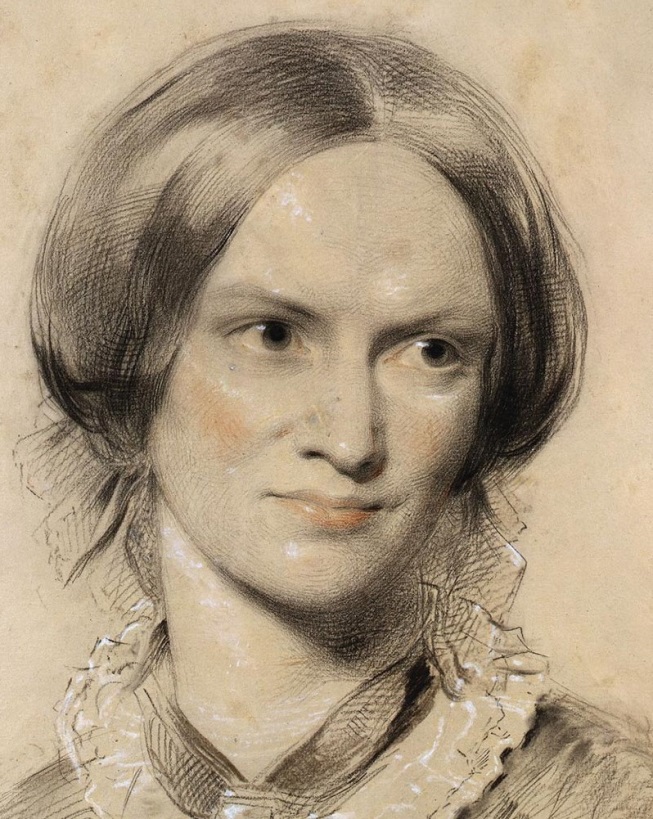
Charlotte Brontë
Such wide-ranging interests would have been shared with, and by the sisters. There were also the influences of educated friends’ reading: such as Martha and Mary Taylor (who were the first to go to Brussels), Ellen Nussey and the sisters’ mutual association with the publisher George Smith of Smith, Elder & Co. and his involvement with the London literati such as Charles Dickens and William Thackeray (Vanity Fair) for whom Charlotte was full of awe and admiration (The Brontës, p. 552) and whom she eventually met in a meeting arranged by George Smith. There is an excellent radio drama on BBC iPlayer of Charlotte’s and Anne’s visit to London to the home of George Smith called Charlotte in Babylon. It’s in 4 parts: https://www.bbc.co.uk/programmes/b074bnfv
https://www.britannica.com/biography/Thomas-De-Quincey Thomas de Quincey was another writer contacted by Branwell. An English essayist and critic, born in Manchester, he was a great admirer of Samuel Taylor Coleridge and Wordsworth with whom he associated and at different times rented out the home of Wordsworth in Grasmere. He struggled as a writer but became famous later for Confessions of an English Opium-Eater.
Branwell Brontë
Gina Birdsall and Angela Speight, Keighley Local Studies
In our next article we will look at the education of the older Brontë children for tutor and governess roles.
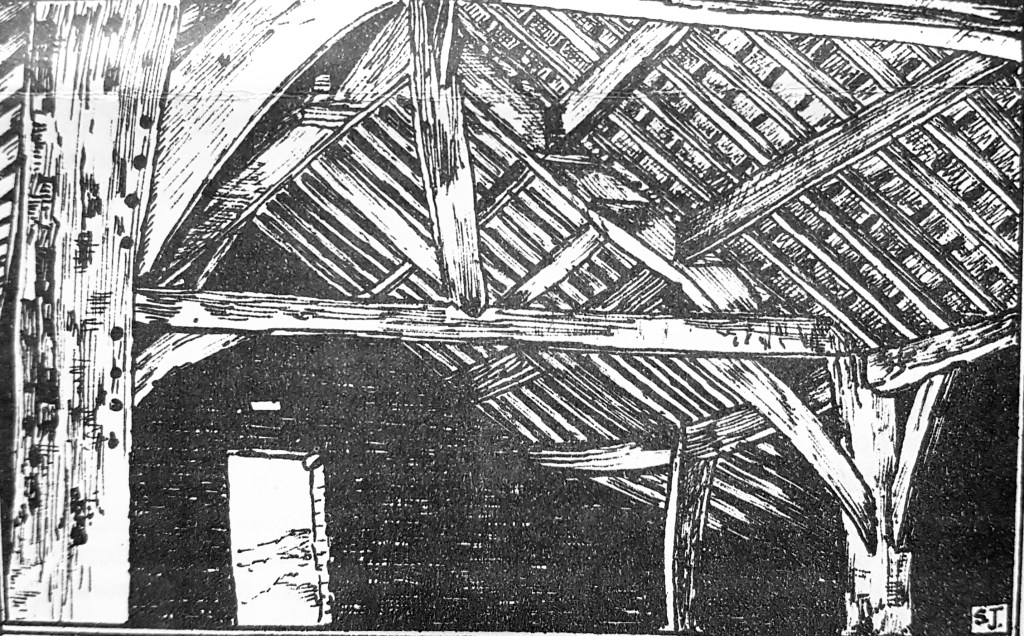
The Archaeology Group Bulletin gave its readers an opportunity to publish interesting historical structures or objects observed on country walks, and then to receive informed comment about them. I cannot think of an obvious forum for such interactions today. That is not to say there is not still considerable interest in local history. There is a Bradford Historical & Antiquarian Society which, in more normal times, holds regular meetings at the Bradford Club. Some of its members undertake research of real value which is published in an excellent journal, The Bradford Antiquary, copies of which can be found in the Local Studies Library. Bradford U3A has groups devoted to Archaeology and Old Buildings, and there are area historical societies in several parts of the city. But where would you present an interesting farm building that you had just seen? In March 1965 a gentleman from Allerton sent Sidney Jackson some photographs of a barn he had examined at High Bradley, near Skipton. SJ redrew an illustration for the Bulletin, which seemingly couldn’t cope with photographic images. The building was identified as an ‘aisled barn’ and attention was drawn to the roof truss and supporting wooden pillars. The basic design consisting of a central ‘nave’ and two supporting aisles, a pattern that echoes the Roman basilica and was widely used for church design.
If you would like to examine an almost identical building I can strongly recommend the Grade 1 listed, seventeenth century, Great Barn at East Riddlesden Hall: I have included a recent photograph.
The barn is 120 feet long, 40 feet wide, and consists of eight bays. The external stone walls, pierced for lights especially at the gable ends, are load-bearing so this is not a timber-framed structure, although many wooden members are incorporated. The oak upright timbers support the roof trusses. They stand on stone bases since wooden posts buried in the soil inevitably rot within a century or so. The oak roof trusses are of the ‘king post’ type. The supporting timbers running lengthways along the roof are called purlins. The purlins engage on the ‘principle rafters’: the other roof members are ‘common rafters’. The rafters support stone slates which keep the barn weather-proof and mean that the pitch of the roof is kept relatively low, unlike a steeply pitched thatched roof. There is a solid stone and brick floor and two pairs of doorways with arched porches. Doors placed opposite one another in a barn indicate that it was once used for threshing. The through draught helping the separation of grains from the chaff. The stone surface was the threshing floor which needed to be kept clean. The aisles are fitted with cattle stalls so, like many northern barns, it was used both for crop storage and stock. In his original article Sidney Jackson rightly pointed out the value of such barns to those who appreciate fine carpentry.
In this first article in our new series, we take a look at the books used and of the bookish backgrounds of the educators: Maria and Elizabeth Branwell (Mother and Aunt) and Patrick Brontë, Rev. of Haworth Parsonage.
1: Home Tutors
Maria (1783-1821) and Elizabeth Branwell
Born into a prosperous merchant family, prominent in the affairs of Penzance when Britain was a great sea power in the world, the two sisters did not lack education, access to books or knowledge of current affairs through newspapers, most important no doubt, given the family’s close dependence on their developments abroad. Within Penzance society, the girls also became quite the socialites, mixing regularly in company before the close deaths of their parents and elder brother.
Amongst the books noted by Sharon Wright (Mother of the Brontes, 2019) are works of poetry, The Lady’s Magazine, gothic literature, such as the 1794 blockbuster, The Mysteries of Udolpho byAnn Radcliffe, also remarked upon by Jane Austen in Northanger Abbey. They were also members of the Penzance Ladies’ Book Club which subscribed to magazines, reviews and the latest bestsellers. As Sharon Wright notes, when Maria met Patrick on a visit to Yorkshire, she was an educated gentlewoman with an independent income and good social connections.
After humble, rural beginnings Patrick, with a single-minded devotion to learning, became very well educated with a charity scholarship to study Theology at St John’s College, Cambridge, graduating in 1806. Such an education for the Church would have included a thorough grounding in the Classics, Greek and Latin histories such as Tacitus Agricol and poetry, e.g. Virgil’s Georgics. Such was his proficiency that Juliet Barker notes his prize books of Samuel Clarke’s 1729 edition of Homer’s Iliad and Richard Bentley’s 1728 edition of the works of Horace (The Brontës, p.10).
Rev. Patrick Brontë
If you have lacked an education in the classics which many of us have, Natalie Haynes on Radio 4 has done much to revive interest in them outside the public school system, check her enthusiastic and entertaining programmes now available on BBC iPlayer at: https://www.bbc.co.uk/programmes/b077x8pc/episodes/player
Patrick, Maria and Elizabeth were all from backgrounds steeped in folk tales, myth and legends. Patrick coming from a rural Irish background and Maria and Elizabeth from a Cornish one, as Sharon Wright says, “ghosts and smugglers, legends and liturgy.” Emily Brontë, especially, also spent time working alongside the servants such as Tabby Aykroyd and they, rather like grandparents, would have had a fund of local knowledge on the Haworth area, local family stories and folklore.
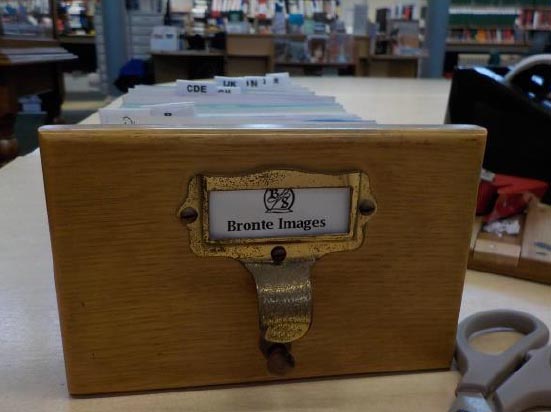
Brontë images index at Keighley Local Studies Library
Look out for our next article which will feature the Brontë’s Home School.
The Mother of The Brontës: When Maria met Patrick. By Sharon Wright. Pen-and-Sword Books, 2019. 182pp.
Maria, let us walk, and breathe, the morning air, And hear the Cuckoo sing, And every tuneful bird, that woos the gentle spring.
(‘Lines, Addressed to a Lady on her Birth-day’ by Patrick Brontë)
After the flush of books published recently on her children and husband celebrating their various anniversaries, it’s nice to see this full-length work on Maria Brontë (née Branwell). So often Maria remains in the shadows but now, in this excellent book by Bradford-born journalist and playwright, Sharon Wright, she features in her own right.
The book opens with a wide-ranging, absorbing, and impressively detailed account of Penzance in the late 18th century. This is followed by an account of Maria herself, her upbringing, her large and complex family, and their social, religious, military and political worlds. A picture emerges of a bright, independent and mature young lady, cultured, religious, and at home in a middle-class social scene.
Well charted is the chaos at Woodhouse Grove School at Apperley Bridge from where Maria’s aunt, Jane Fennell, pleaded for the help of her practical and level-headed niece. Here Maria was courted by the school’s examiner in classics, Patrick Brontë. There is a full account of the couple’s unusual wedding ceremony, including a description of the wedding clothes researched by dress historian Eleanor Houghton, and a lyrical account (imagined) of the wedding parties’ three-mile walk to Guiseley Parish Church.
An edge is taken off the romance by the reminder of the troubled background of England in 1813. The French Wars were sucking the country dry, the industrial revolution was laying waste to traditional employment, and a series of poor harvests combined with high prices was causing widespread hunger among the poor. Maria must have welcomed it when the couple and their growing family moved to Thornton which had a cultured society somewhat akin to that enjoyed in Penzance.
The old Thornton was a sizeable village with the parsonage fronting a busy road. We learn from church records that the parsonage had a stand for a cow and a horse, not that Patrick could afford a horse, but some of his visitors could. An analysis of socialite Elizabeth Firth’s diary helps to chronicle visits made and books read by people in the area. Both Patrick and Maria found time to write and Maria’s sole surviving essay on the Advantages of Poverty, as with her letters, is reprinted in full; though with the annual arrival of babies plus young children to look after, Maria would have had little time for writing and socializing, even with the appointment of Nancy and Sarah Garrs as servants.
With the move to Haworth we are on more familiar ground. The disputes with the Haworth Church Land Trustees and Patrick’s early duties in front of a resentful congregation are well chronicled. ‘The inhabitants of the hilltop town were hard working, hard drinking and hard to impress’ writes our author. But Maria’s elegance, fashionable dress, and her ease with social elites did her husband proud. Though all too soon the sad, long, and painful death of Maria followed. The burden placed on Patrick with six young children and a large parish led to the summoning of Maria’s sister, Elizabeth, from Penzance, to help out.
Author Wright’s wide experience as a journalist on regional newspapers has paid handsome dividends as shown by her wide ranging research and easy writing style. She quotes from the Lady’s Magazine, featuring ‘gothic bluebooks’ and ‘shilling shockers’ which were high on the publishing scene in the early 1800s. She paints a delightful picture of both Maria, and later, her daughter Charlotte, curled up in a chair reading this mutually-owned magazine, and probably enjoying the same stories. It was all a long way from Sunday School!
This is a fine book. It is no surprise that the publishers needed a reprint. The book does not merely chronicle the life and times of the mother of the Brontë children; it puts her centre stage as an influential life-enhancing individual who played a major part in the family’s life and their subsequent development and success.