Despite having to abandon their 2020 programme of meetings and visits due to the Coronavirus, the Bradford Historical and Antiquarian Society have been able to produce their annual journal, The Bradford Antiquary. Copies are now available in several of our libraries.
The contents of this 81st issue are:
From Donkey-Boy to Oxford Don: the childhood of Dr Joseph Wright of Thackley by Christine Alvin.
The Birds and the Beasts. Text of a 1830s tract on the ‘Factory Question’.
‘We Can Take It Again’ by Norman Alvin. On a wartime air raid
‘No food or fire – decent people’: Bradford during the first national coal strike of 1912 by Derek Barker and Jane Wheeler.
Bradford in Fiction by Astrid Hansen. Bradford through the eyes of Willie Riley, J B Priestley, John Brain, A A Dhand and others.
Some Empsall Treasures A selection of topics from the library’s collection of 19th century pamphlets ranging from Homeopathy and the Henpecked Husbands’ Club to the Disorders of Horned Cattle and Spirit Writings! A window into a Bradford long gone.
W E Forster and the 1870 Education Act by Dave Welbourne
A Shelter for the Cabmen of Bradford by Laura Bird of The National Tramway Museum
The Ancestry of the Phoenix Dynamo Company, Thornbury by Gina Bridgeland
Rural Tanners in late 16th and 17th century Bradford by G D Newton
Book Reviews
Society News
Going back to 1882, The Bradford Antiquary provides an unrivalled history of Bradford, Keighley and the West Riding. The Editor, David Pendleton, is always pleased to receive ideas for, and submissions of, possible articles (davidpendleton1@gmail.com).
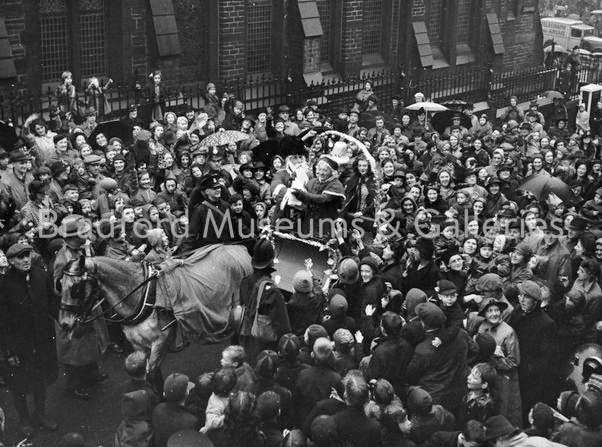
Arrival of Father Christmas, Busbys’, Manningham Lane, Bradford C.H. Wood, (Bradford Museums’ Photos)
The first purpose built department store in England was Brixton’s Bon Marché opened in 1877. https://www.brixtonbuzz.com/2018/03/brixton-history-bon-marche-department-store-in-the-edwardian-sun-and-the-straw-boater-riot/ It was not until the end of the 19th Century that electric lighting was common in shops and with that came some wonderful Christmas lighting. Busbys’ department store was founded in 1908 (merging with Debenhams in 1958) and over the succeeding 70 years became one of the most popular shops in Yorkshire. At Christmas, Busbys’ Santa’s grotto was a must visit for many families in the Bradford district. The following quotes are taken from Busbys’ A Shop Full of Memories by Michael Callahan and Colin Neville (Bradford Museums, Galleries & Heritage, 2008).
“I was chosen to be ‘Little Red Riding Hood’, and I felt very proud to be doing this. The day the Grotto opened we started out for Busbys’ on a big flat lorry from Dockfield, in Shipley. There was Mother and Father Christmas and their fairy, and myself in the lorry, and we were joined by some of the Hammond Sauce Band and they played Christmas songs and carols along the route. We had a big bags of sweets, and all along Manningham Lane there were children and mothers just lining the road and we threw sweets to them all along the way; it was such a big event. In the Grotto I had my own little sweet shop and talked to the children while they were waiting to see Father Christmas. The Grotto was so big; it was never-ending! There was a lot to see – and it was magical. Dorothy West” p.70
“As the electrician at Busbys’ from 1972-75 I have great memories of the family atmosphere there. The highlight and privilege was wiring all the working models and fairy lights for the Grotto. Seeing the children’s faces from behind the scenes was magical. Keith Brown” p. 71
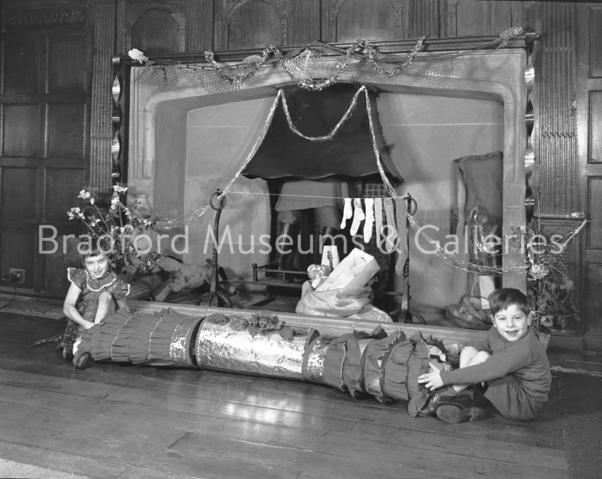
Father Christmas’s Grotto, Busbys’ Department Store, Bradford C.H. Wood, (Bradford Museums’ Photos)
“My memory is being taken to see Santa Claus when very small. My memory is a huge display of lights and tinsel and magic. We had to walk down paths and over bridges, pull strings, and glitter snowed down on us. It seemed as though we walked for ages before we saw Santa… that walk and the magic has never been equalled in any display since. A.Wallace” p.59
‘I must have been the only child who didn’t enjoy the visit to Santa’s Grotto. I was aged about 3, and when we finally reached Santa he said, “what do you want little girl” I replied, “I want to get out of here!” Anonymous, p. 61
Mill Christmas
Messrs. Heatons’, Keighley, decorated for peace celebrations, 1918 (Keighley Local Studies)
Many textile mills decorated workplaces, and even some machinery, for royal events but also for Christmastime:
‘We would buy a few packets of crimped paper, which we cut and made into streamers to decorate the room at the mill. We would have a walk round at dinner time to see the other rooms and decide which we liked best. As Christmas drew near there was always someone singing carols during meal-times. Someone would start “Hark the herald angels sing” or “While shepherds watched”, and soon it was taken up by another and another, till soon almost everyone had joined in. It was in the mill that I was introduced to Handel’s Messiah. Most of the mill workers, if they could sing, would be taking part in the Messiah at their own places of worship. They put in a bit of practice while working.’ Picking up Threads Reminiscences of a Bradford Mill Girl by Maggie Newberry (Bradford Libraries, 1993), p. 52
At Christmas we’d take some sherry and mince pies, and happen a Christmas cake, and have a break for about an hour in the afternoon. The weavers, you could hear them going mad, but we weren’t with them, we just sat round our mending tables and had us own bit of fun. We never went in any other part of the mill at all.’ Woman. Born 1915 From Textile Voices A Century of Mill Life by Tim Smith and Olive Howarth, BHRU (Bradford Arts, Heritage & Leisure, 2006), p. 115
Salt’s Mill (Saltaire) Limited, final Christmas party for the burling and mending department, (n.d.) BHRU, (Bradford Museums’ Photos)
Artists’ and Writers’ Christmas
David Hockney: One Tuesday afternoon in December 1951 three boys from Bradford Grammar School boarded the trolley bus. The three, namely Hockney (David), Taylor, M.S. (later Oxford University scholarship), and Dixon, M. (minor), had all been subjected to a ‘half Tuesday’ – detention – for a variety of misdemeanours. It was decided a visit to Busbys’ to see Father Christmas and the grotto was in order. We joined a long queue. After what seemed like hours we finally arrived at the head of the queue. Alas! We were approached by a very imposing commissionaire in uniform complete with bristling moustache who enquired ‘where were our parents?’ On being informed they were at home he said ‘sorry, but we could not see Father Christmas’. He politely showed us the Emergency Exit and kicked us out! On the wall immediately opposite was the famous Busbys’ sign with the marching guardsmen and the slogan ‘The Store with the Friendly Welcome’. The now world famous David Hockney was heard to mumble ‘some friendly welcome!’ “ Michael Dixon in Busbys’ A Shop Full of Memories by Michael Callahan and Colin Neville (Bradford Museums, Galleries & Heritage, 2008) p.71. See also https://capitadiscovery.co.uk/bradford/items?query=the++Hockneys
Charles Dickens: On 28th December 1854, ‘Mr Christmas’ himself, Charles Dickens (author of such Christmassy works as A Christmas Carol, Pickwick Papers and The Chimes) read from his works to a packed audience at the new St George’s Hall in Bradford. Special trains were put on for journeys to Halifax and Huddersfield, such was the popularity of the event. However, for some female members of the audience, the evening might not have turned out quite as Dickens had initially promised, that is like “a small social party assembled to hear a tale told round the Christmas fire…” because, as a skilled actor, his dramatic readings of the violent murder of Nancy in Oliver Twist, for example, had been known to cause women in the audience to swoon into a dead faint.
J.B. Priestley: Much later in time, a great fan of Charles Dickens, a young Bradford born J.B. Priestley, who would frequently forego dinner to buy books, was said to have “spent one Yuletide with a chum at an old inn near Bradford where he smoked a church-warden pipe and tried a brew of punch”, in order “to sample Christmas very much as Dickens’s Mr Pickwick would have done.” (Rebel Tyke Bradford and J.B. Priestley by Peter Holdsworth (Bradford Libraries, 1994), p.45
Nativity play at Heaton Middle School, Bradford, BHRU, (Bradford Museums’ Photographs)
The school nativity has long provided a Christmas gift that keeps on giving to parents and teachers alike. Let’s hope that this year will be the only year that for many has to be watched only on film at home or not at all. If you have never seen or been part of one, Gervase Phinn gives some lovely and humorous accounts from his Yorkshire School Inspector days, such as at St Helen’s school where the teacher, Mrs Smith had asked the children to write parts of the Christmas story in their own words, one child read,
’The three kings were very rich and they wore beautiful clothes and had these crowns and things. They looked at the stars every night. One night one of the kings said, “Hey up, what’s that up there, then?” “What?” said the other kings. “That up there in the sky? I’ve not seen a star like that one.” The star sparkled and glittered in the blue sky. “You know what?” said another king. “It means there’s a new baby king been born. Shall we go and see Him?” “All right.”’
The narrator continued: ‘They shouted to their wives: “Wives! Wives! Go and get some presents for the baby king. We’re off to Beth’lem to see Him.” “OK,” said the wives.’ Head Over Heels in the Dales (Michael Joseph, 2002), p. 95 These books are available for loan, follow: https://www.bradford.gov.uk/libraries
Charity in Depression Christmas, 1932
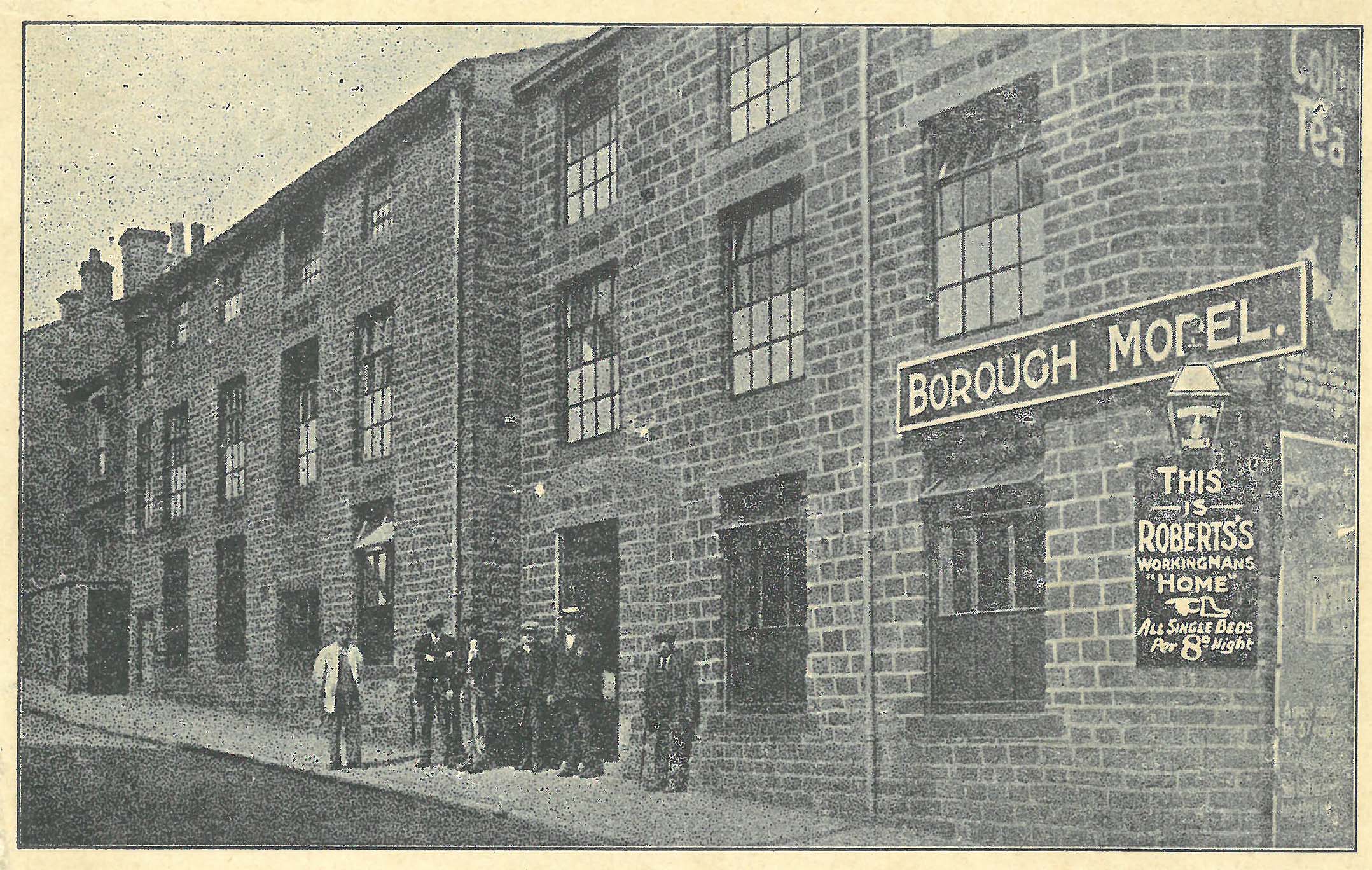
Roberts’s Model Lodging-house, Leeds St, Keighley, c.1924, (BK36, Keighley Local Studies)
In 1861, Francis Middlebrook wrote, “Mother went to Keighley workhouse to see all the inmates get rum and tea”, the latter being donated by William Busfield Ferrand of St Ives. Keighley News 24 Dec 1982
In Keighley at the two lodging houses, Mr Edward Roberts, landlord, provided a ham and egg breakfast and an anonymous donor provided parcels of tea and sugar. Mr Roberts organised an annual fund and as a consequence each resident was also given free lodgings, tobacco and cigarettes on Christmas day. Each child in various Keighley institutions was also given a new shilling piece by a Mr Asa Smith. Keighley News 10 December 1982
Unruly Christmas
The Keighley Police Force in 1865, (Ian Dewhirst MBE archive)
Hearth and home in Victoria’s reign was not for everyone. With no regular police force yet, law and order in Bradford and Keighley was kept by Watchmen. In Keighley, there were 6 patrolling the streets. One of these kept a diary between the years 1848-1853, now held in Keighley Local Studies Library archive (BK 309) and was called, James Leach. He had a very busy Christmas in 1848. In his diary he reported that at one o’clock on Christmas Day morning Mrs Wilkins’ Star Inn had “company in her house from 15 to 20 persons”. They were still drinking there at a quarter to three on Boxing Day. On 27th December one Zyckriah Ashton was found in Cony Lane drunk and very ill. On the 28th December at one o’clock there was fighting at the Black Horse amongst a group of men and at two o’clock Mr Lapish of New Town was found drunk and disorderly. On the 31st , Samuel Smith, ‘comonley caled Mucky Sam’, ‘threw Patrick Waterhouse over the batlment at Damside a depth of 5 yards & cut & wounded im daingerousley’. The New Year started in a similar way…
War Time Christmas, 1939
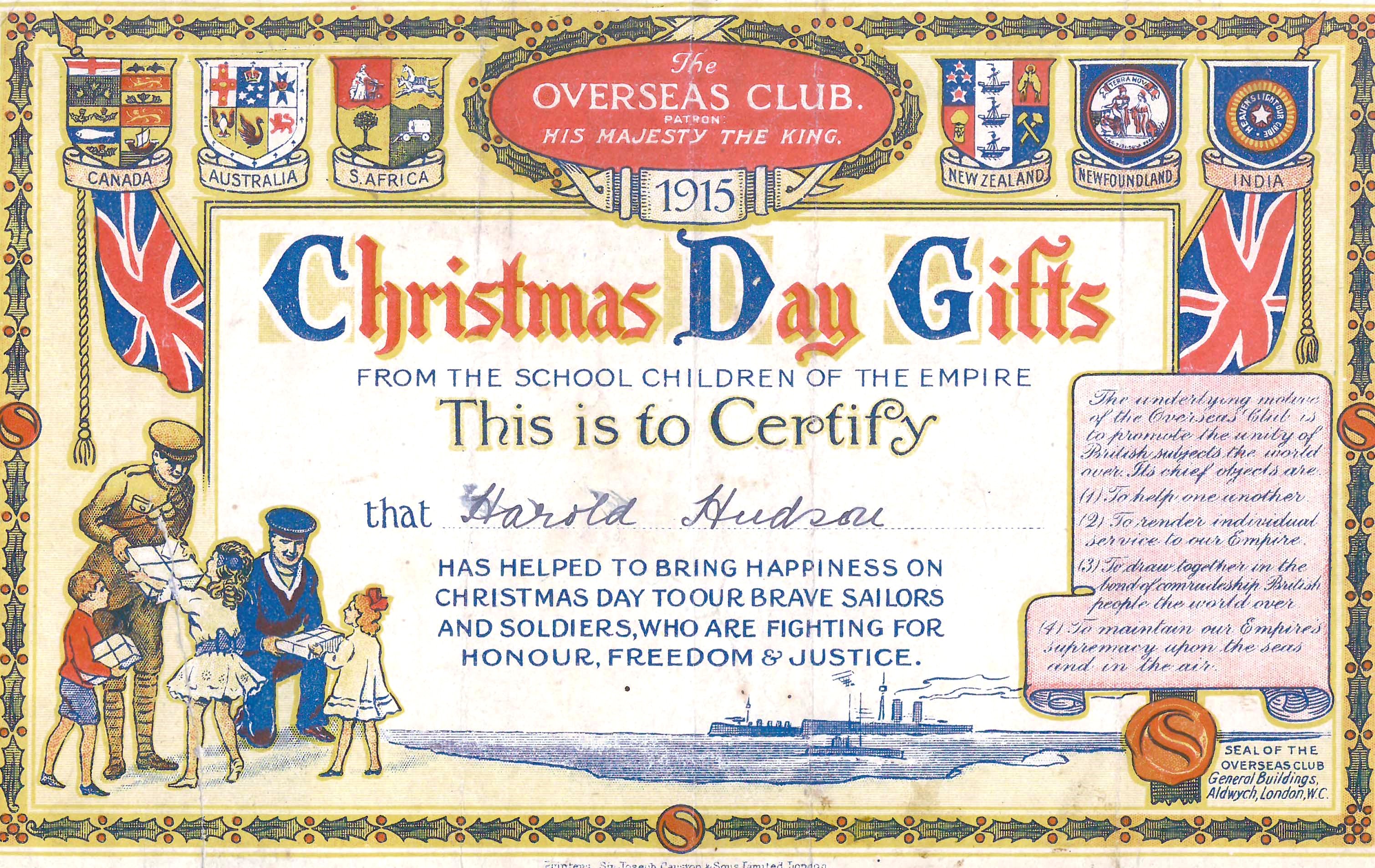
Christmas war certificate for donations made. (BK10/683, Keighley Local Studies)
During WW2, Keighley people on the Home Front, as in other districts, did their best to provide “comforts” for those serving in the forces. They provided funds for recreational and rest huts. During November, four large bales of knitted woollen comforts were despatched to France, also to the Navy and Air Force. “Cigarettes, sweets, candles etc.,” were also sent. Firms such as Ward, Haggas & Smith; Clapham Bros., and Dean, Smith and Grace also had schemes to provide comforts as well as Christmas parcels to their work people serving in the Forces. Keighley News, 9 December 1939 For those Evacuees remaining in Keighley and the Worth Valley over the holidays, there was a large Christmas party on 4th January with a film show, community singing and a play. On other days, there were to be games in schools, walks and visits to museums and places of interest. Keighley News 23 December 1939.
Hospital Christmas
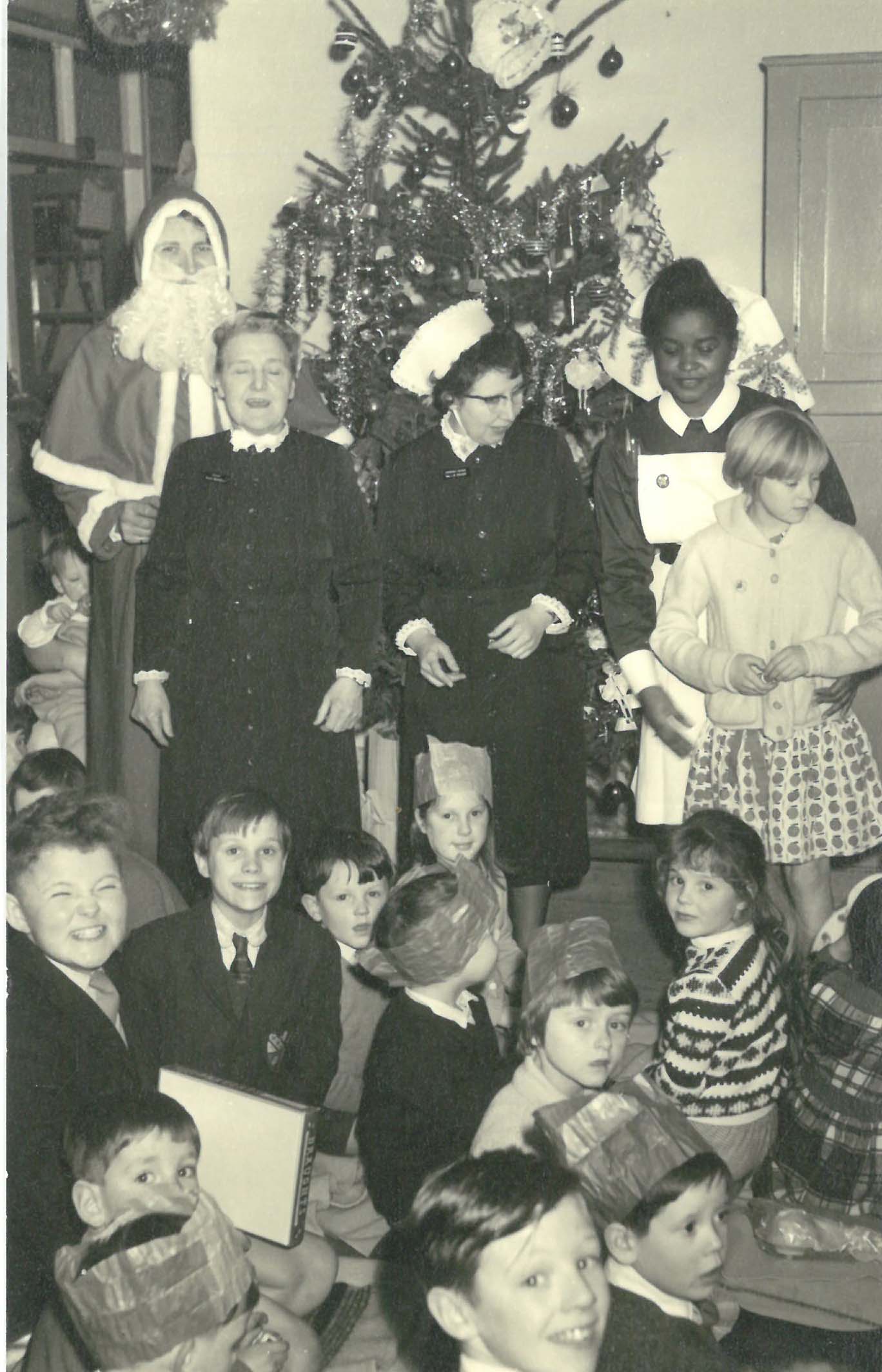
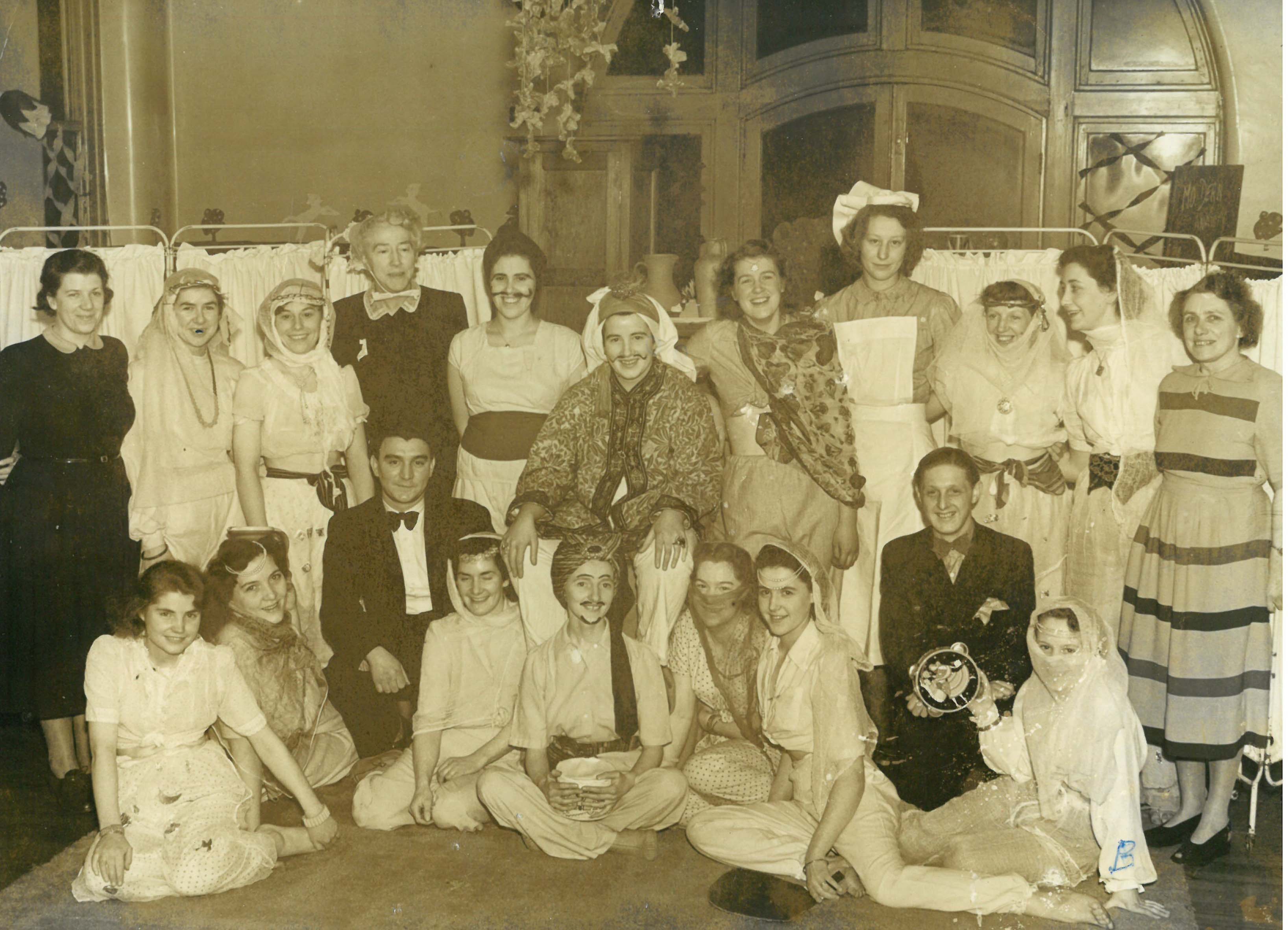
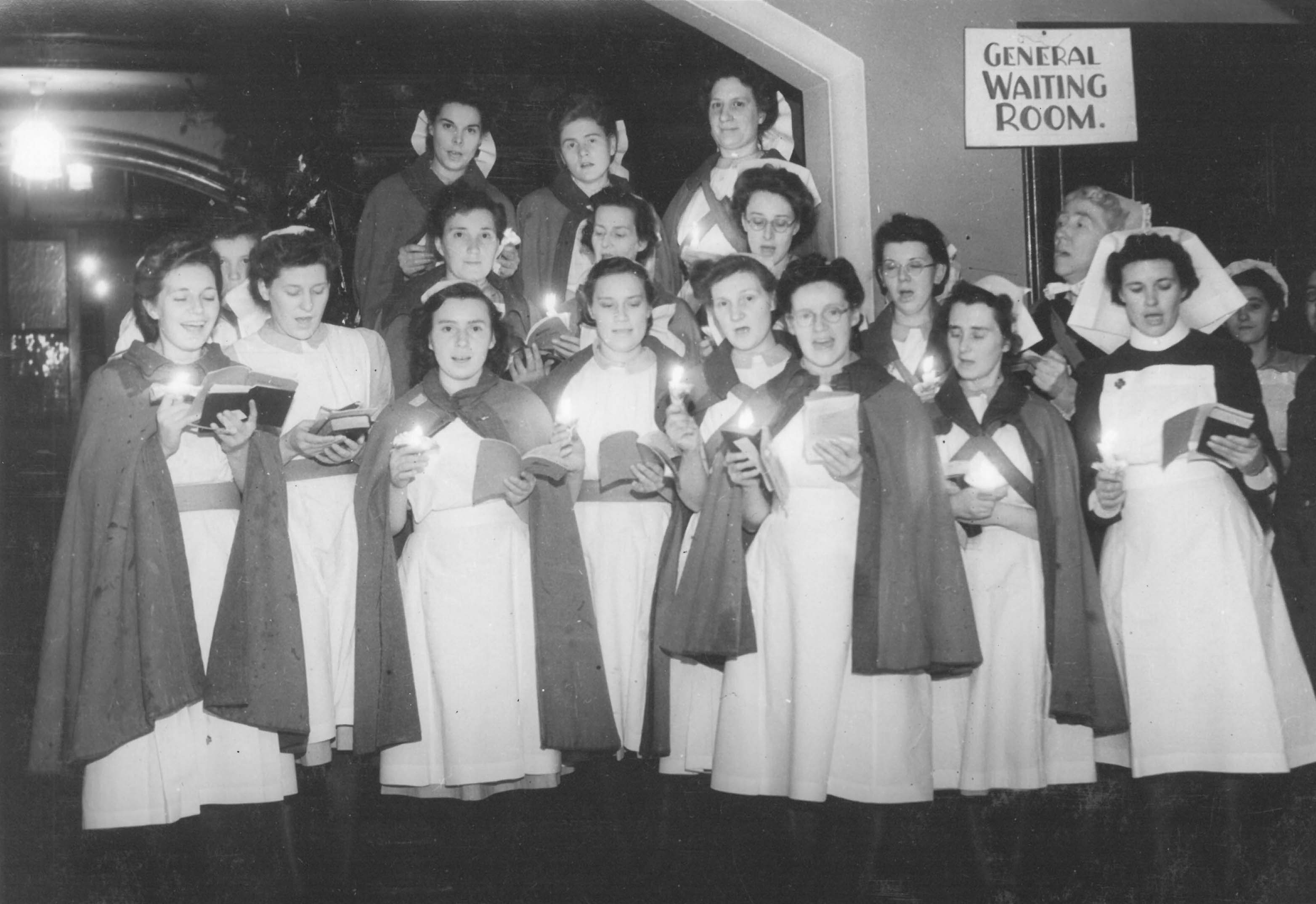
Keighley and District Victoria Hospital held regular children’s Christmas parties even during the war years. Ian Dewhirst noted that in 1943, the visiting Santa Claus was none other than Dr Joseph Chalmers, hospital surgeon. Nursing staff also performed a pantomime, “Boy Blue” and patients received presents from the Matron’s Christmas Fund and the Workpeople’s Collection Committee. Keighley News21 December 2001.
Victoria Hospital children’s Christmas party c1950
Another shadow, another queue, hopefully we shall soon be on the bright side…….
Father Christmas at a works’ children’s party, 1955 C.H. Wood (Bradford Museums’ Photographs)
To join the library, borrow books and examine local 19thC newspapers using our online services from home, as well as gain free access to Ancestry and Findmypast, follow the link below:
Bradford’s Oral History collection is housed in Bradford Local Studies Library. It consists of 800 tape recorded interviews (also transcriptions) with local people’s memories including subject areas such as textiles, health, war, immigration to Bradford.
Photograph of merchants on the main floor of the Wool Exchange, Bradford 1954. (C.H. Wood, Bradford Museums and Galleries)
By the 1850s it’s estimated that Bradford processed two thirds of the country’s wool production and was generally known as the wool capital of the world. People sought work in Bradford as local rural employment declined but eventually they came from all parts of the world. In 1974, Bradford became a metropolitan district and absorbed other areas such as Keighley that had also experienced early economic and population growth due to its textile trade and related engineering industries.
Despite this propitious beginning and rapid production and success, the District’s textile industry has declined over the years and now the local economy relies on a diversity of industries and technologies. Nevertheless, much of the industrial landscape remains but far from being predominantly the “dark satanic mills” of dereliction and waste, today very many of the old mills have been re-purposed in unique and creative ways so that they can continue to contribute to the social, economic and cultural development of the District. Today we see mills playing a role in pioneering digital technology, film, performance art and culture and they will be an essential consideration in the “Northern Powerhouse” agenda for the District.
Architectural innovation and majesty
Fabric Huge by Mark Keighley
The early mill owners built grand houses that we still admire such as Heathcote, Ilkley (John Thomas Hemingway, Richardsons’ wool merchants); Cliffe Castle, Keighley (Butterfield family, worsted manufacturers and merchants), Eastwood House, Keighley (William Sugden, worsted spinner); Lady Royde Hall, Bradford (Henry Illingworth, worsted spinner, manufacturer). However, they also built their mills on a grand scale too, continuing to use the best architects around. Amongst the most splendid mill examples still standing today are Lister’s (Manningham) Mills, Bradford built by Samuel Cunliffe Lister to replace the original Manningham Mills, destroyed by fire in 1871. Built in the Italianate style of Victorian architecture (listed Grade II), the architects were a local firm, Andrews & Pepper who went on to design many fine buildings in Bradford. For all architect details, please see: https://www.bradfordtimeline.co.uk/arch.htmSalt’s Mills built by Sir Titus Salt and designed by Bradford’s Town Hall architects Lockwood & Mawson, is also now Grade II listed and in it floor size at the time was the largest industrial building in the world. It has been described as an Italianate palace as the architecture is after the 15thcentury Italianate style; Dalton Mills , Keighley (Grade II listed 1134129 ) was built for J. and J. Craven, worsted spinners and manufacturers the complex originally consisted of 3 ornate mills in an eclectic classical style (minarets style towers included) round a small courtyard, Tower Mill, Genappe Mill and New Mill. They were designed by William Sugden of Leek, Staffordshire who also built the Secular Hall in Leicester https://www.pinterest.co.uk/jonathan1505/the-sugdens-of-leek/ All these mills can be examined in more detail individually on the English Heritage Listed Buildings web site: https://historicengland.org.uk/sitesearch
As well as this grand architecture, mill owners built houses for workers, public buildings such as Institutes, offices and warehouses, some similarly ornate such as in Saltaire Model village and Little Germany in Bradford. In the last century, mills themselves that were structurally still sound began to be refurbished to produce flats and apartments. These were also popular because of their location near scenic waterways, such as in Saltaire at Victoria Mills and in Bingley. Another of Bradford’s main developments is that of Lister’s Mill. Once the largest silk factory in the world, the Grade II listed buildings have now been converted by Urban Splash into apartments, penthouses and commercial units. The following site shows the transformation with excellent photographs: https://historicengland.org.uk/whats-new/in-your-area/yorkshire/saving-monumental-bradford-mill/
Conditioning House, Bradford, is another large and prestigious building development and won the UK Property Award for best residential development in Yorkshire 2018/19. Smaller mills all over the District have also been converted such as Hewenden Mill, Haworth, and others such as Baildon Mills are in the pipeline, so maintaining Bradford’s unique industrial architecture.
The Great Exhibition of 1851 exposed weaknesses in Britain’s manufacturing and industrial educational policy and pinpointed deficiencies in technical drawing skills of students going into industry and manufacturing. Subsequently, the Department of Science and Art was created to raise standards, together with the National Art Training Schools of South Kensington to provide specialist instruction in drawing, designing and modelling. A system of national scholarships was also established. In the late 19th century, students of Keighley Mechanics’ Institute particularly benefited and won many scholarships, encouraged by Swire Smith of Fleece Mills. He travelled through Europe examining different educational methods and skills, gave lectures, served on the Royal Commission on Technical Instruction (1880) and contributed papers to the Technical Education Bill (Technical Instruction Act 1889) and its committee. He received a knighthood in 1898. Keighley Local Studies library holds his archive and a collection of pamphlets.
Digital Technology
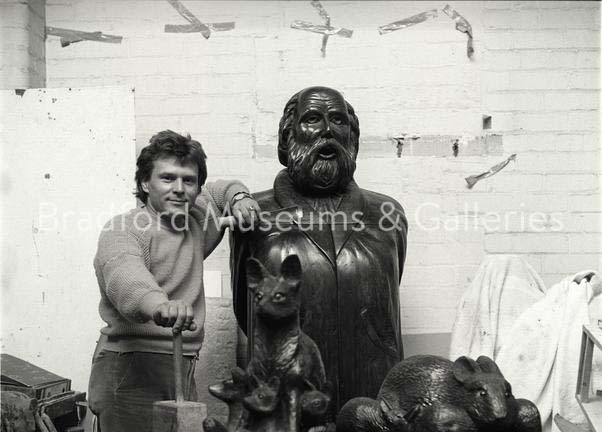
Salts Mill, small industrial unit, sculptor, Andrew Orlowski, who came to England during 1980 after studying at the famous Academy of Sculpture, in Poland. (BHRU, Bradford Museums and Galleries)
The repurposed Salt’s Mill played a role in training and employment when it opened new units for crafts but also in new technologies when it gave space to Pace Electronics, a British company pioneering digital technology for satellite receiving equipment. Today the mill houses the Advanced Digital Institute (ADI).
Into the future, Bradford’s mills are set to play an important role in developing the use of drone technology and smart city management. Dalton Mills, Keighley has already been noted in the report findings of the first phase of the pioneering “Flying High” programme. Bradford is one of only five areas designated “drone cities” for this leading project for the drone industry. For details follow the following links:
Illingworth, Morris PLC. Employee of the spinning mill on Thornton Road, Bradford. (BHRU, Bradford Museums and Galleries)
Since the Industrial Revolution, Britain’s population has been on the move to find work as rural employment became scarcer. Bradford District witnessed large Irish migrations and the use of orphans from as far away as London to be employed in the textile trade. The German worsted merchants built Little Germany warehouse area and also became cultural philanthropists, supporting buildings such as St George’s Hall. The composer Frederic Delius and the painter William Rothenstein came from such families in Bradford. After World War 2, Displaced Persons were given European Volunteer Worker status and recruited to work in the mills in the Bradford District. By 1987, there was upwards of 10,000 people of Austrian, Italian, Baltic and Eastern European origin living in Bradford, many working in textiles and its related industries (Wool City by Mark Keighley, G. Whitaker & Co. Ltd., 2007, p.143). The largest recent migration, however, was that from the new Commonwealth and Pakistan. Most of the new Commonwealth workers became employed in textiles as well as public transport and the Health Service, making valuable contributions to the local economy and its diverse cultural development. In the late 1960s, textile firms relied so much on workers from India and Pakistan for combing and spinning processes that without them it is recorded that textile production and profit would have seriously faltered. (See also Textile Voices edited by Olive Howarth, BHRU 1989 and Here To Stay, Bradford’s South Asian Communities, BHRU 1994)
Arts, Culture and Heritage
The move to re-purpose rather than demolish mills, championed by such schemes as the Prince’s Regeneration Through Heritage initiative has led to some becoming social, retail but also performance art and cultural hubs.
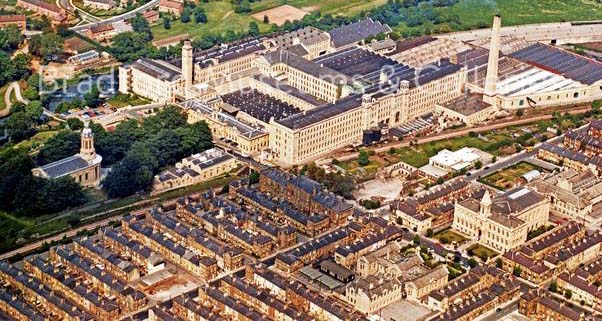
Aerial view of Salt’s Mill, 1973 (Bradford Museums and Galleries)
Amongst the first in the country, and the most outstanding in Bradford, is Salt’s Mill whose wide ranging contribution has led to Saltaire village becoming recognised as a UNESCO World Heritage Site. The original vision of entrepreneur Jonathan Silver (1949-1997) as a retail and leisure scheme, Salt’s Mill became a major cultural centre as it was progressed from Bradford Festival productions in the mill to the exclusive 1853 Hockney Gallery in the former spinning mill. Today it still houses the largest continuous exhibition of art works by the world famous English artist, David Hockney. You will also find there today a large book shop, antiques centre, craft and outdoor retail, cafes and restaurants and the Early Music Shop, (See Salt & Silver A Story of Hope by Jim Greenhalf, Bradford Libraries, 1998) Other mills have also been adapted to the benefit of the local community and encouragement of the Arts. Dalton Mill complex in Keighley, has also been refurbished in part and now has an arts centre and thriving Business Park. Melbourne Mills opposite Dalton, and like Salt’s Mill, has also contributed to the long tradition and progressive link between mills, music and Yorkshire bands. In the mid-19th Century this consisted of one of the first Yorkshire mill brass bands, Black Dyke Mills band being created, today there are pop and rock bands using recording and rehearsal studios as launched by “Jam on Top”. The mill also houses a radio station. https://www.keighleynews.co.uk/news/16158221.teenage-musicians-top-thanks-big-local/
Examples of smaller conversions also include Antiques at the Mill, Cullingworth; Ponden Mill B & B, Stanbury and Albion Mills business centre, Greengates.
Film and Television
Because of their impressive and historic architecture, and it has to be said because of some dereliction, Dalton Mill in Keighley and Saltaire’s mills and village have frequently been used as film locations. Dalton Mill most recently was filmed for the popular television series Peaky Blinders.
Dalton Mills, Keighley (Keighley Local Studies)
This availability of impressive film locations has contributed to Bradford marking its tenth anniversary in 2019 as the world’s first UNESCO City of Film and helped it to highlight how Bradford is leading the way in film literacy with a programme that is regarded as one of the best of its kind in the UK, promoting new ways of learning in primary schools (Emma Clayton, T&A, 12 Feb 2019 pp. 2-3). Bradford has now launched a unique FilmMakers 25 project to spot and nurture talent and to teach skills of film making to students across the District.
It’s good to see that Bradford District’s mills not only continue to contribute to the local economy but now also to the District’s cultural development and progress, with a key role to play in the development of some of the most advanced technology in the world. The regeneration of textile mills in the area is now a key part of the “Northern Powerhouse” agenda. This is a fine testimony to Bradford District’s diversity and spirit of hard work and enterprise as Bradford now makes its bid for the title of UK City of Culture 2025.
Bradford and Keighley Local Studies Libraries hold a wealth of books and archive records and resources if you would like to find out more about mills and the textile industry. Bradford is also fortunate to have its own Industrial Museum that hosts regular widely acclaimed exhibitions.
Belle Vue Studio collection: a unique collection based in Bradford’s Museums and Galleries. The studio became a popular destination in the 1950s for those coming to work in Bradford from other parts of the world. Digitisation of the photos is almost complete: https://www.migrationmuseum.org/tag/bradford-heritage-recording-unit/
Bradford’s Oral History collection is housed in Bradford Local Studies Library. It consists of 800 tape recorded interviews with local people’s memories including subject areas such as textiles, health, war, immigration to Bradford.
The Local Studies research appointment service has been suspended at the present time as one of the steps taken by Bradford Libraries in line with the Government regulations. There will be no access to study spaces during this time.
This is a perfect time to delve into local and family history and Bradford Libraries will continue to offer the free use of AncestryLibrary and Find My Past from home at the current time. This is available to anyone with a library card.
Local studies library staff are continuing to provide a telephone and email service to answer enquiries involving the unique local collections. You can contact Bradford Local Studies Library on 01274 433688, email local.studies@bradford.gov.uk or Keighley Local Studies Library on 01535 618215, email keighleylocalstudies@bradford.gov.uk.
Apologies for any inconvenience and we hope to see you back soon.
An email and telephone service is available for local and family history enquiries. Please contact us with details of your request using the details below.
In addition we are now able to offer access to visitors by appointment only, to use local studies publications and original records for study and research.
Booking a session
To make an appointment, contact us by email or telephone. We will allocate you a session for research.
We only have limited slots so the date or time you want might not be available but we will do our best to accommodate your needs. Please book your appointment as far in advance of your visit as possible.
To keep staff and visitors safe, all items required must be pre-ordered. Access will be limited to local studies and archive material.
Please note that we require at least 72 hours notice and at busy times this may be significantly longer.
On booking your appointment via telephone or email, our team of library staff will help to search the catalogues to identify appropriate items if required. They will then prepare the items for use prior to your visit.
It is essential that all materials/documents are ordered and an appointment made in advance. No requests can be made on the day.
Customer details (name and contact details) will be taken in compliance with the NHS Test and Trace system. These will be retained securely for 21 days after which the information will be securely destroyed.
To ensure a safe and productive visit we request that you follow the guidelines below which have been designed in line with current advice to prioritise the safety of all.
Please arrive at the allotted time.
Please wear a face covering during your visit. Wearing gloves is optional.
Please sanitise your hands on entry and exit.
Please observe social distancing and keep 2 metres distance from staff and customers at all times.
No food or drink will be permitted during your visit.
We are unable to provide face to face support to our customers such as assistance with using documents and no general browsing facilities are available at the present time.
Our card catalogues are not available to public access at present.
There will be no access to public PC’s however Wi-Fi is available using your own equipment.
Please bring all stationery required as we are not able to supply or lend any stationery.
Photocopying, scanning or printing services will be unavailable at the present time; however researchers are permitted to photograph items from the collection for personal use or study with their own equipment. No other kind of reproduction will be permitted without the necessary permissions which must be arranged via email.
If you have requested the use of a microfilm/fiche reader we request that you use the antibacterial wipes provided to clean the surfaces before and after use and follow the disposal guidelines for the wipes.
When you have finished your research visit please place the research items in the designated area. Please do not leave the documents in the study area or return them to shelves or cabinets.
We hope that you have a safe, comfortable and productive visit. If you have any further enquiries please don’t hesitate to contact us via email or telephone.
Arrangements for disabled visitors
Arrangements for disabled visitors remain the same.
Please let us know when booking if you have any special requirements.
If you require someone to accompany you when you visit, please let us know at the time of booking.
Online services
Please remember too that many of our online offers are still available remotely or from home. These include AncestryLibrary, Find My Past and British Library Newspapers. For further information please visit: