Keighley’s updated Roll of Honour is unveiled.

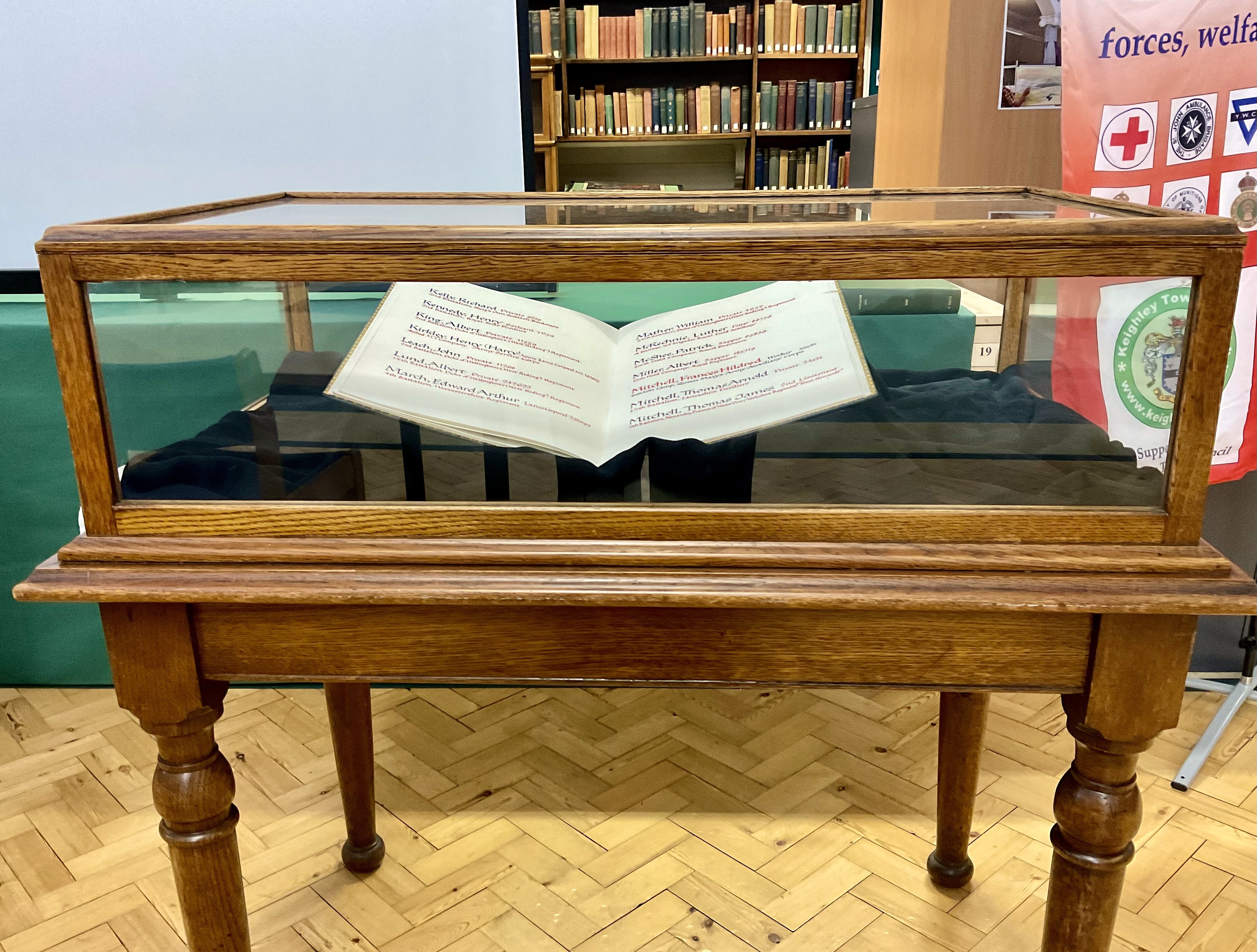
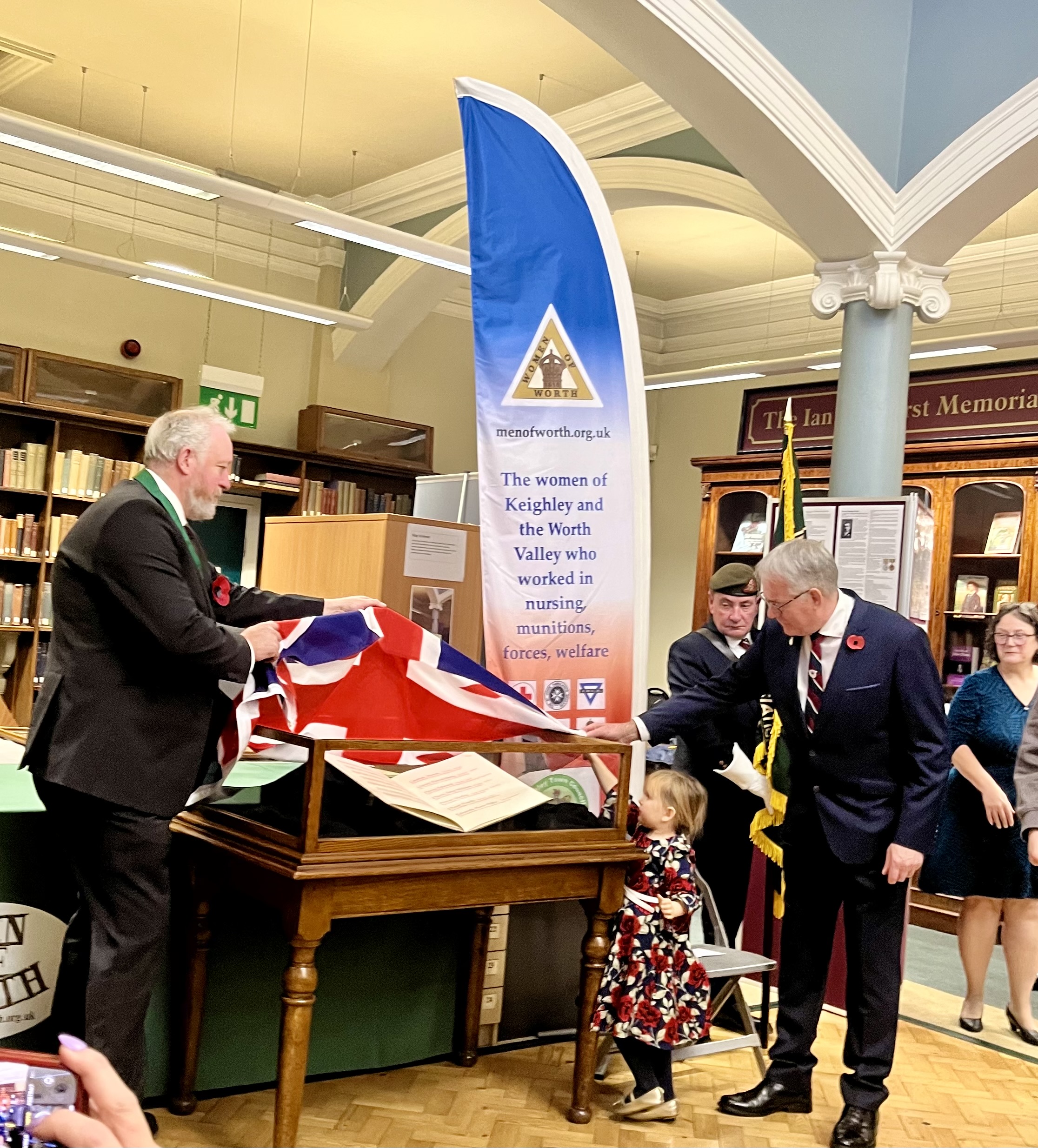
KEIGHLEY’S revised Great War roll of honour was formally unveiled during an event at Keighley Local Studies Library on 9th November. The names of 102 servicemen and one woman who gave their lives during the First World War had been missed from the original roll.  

The unveiling was performed by three-year-old Libby Griffiths, Ryan Firth, 16, and Liam Firth, 14. All three are descendants of Private Jowett Coulton, who was born in Keighley and lived in the town before emigrating to Canada, where he enlisted in the army. He was killed in action in France.
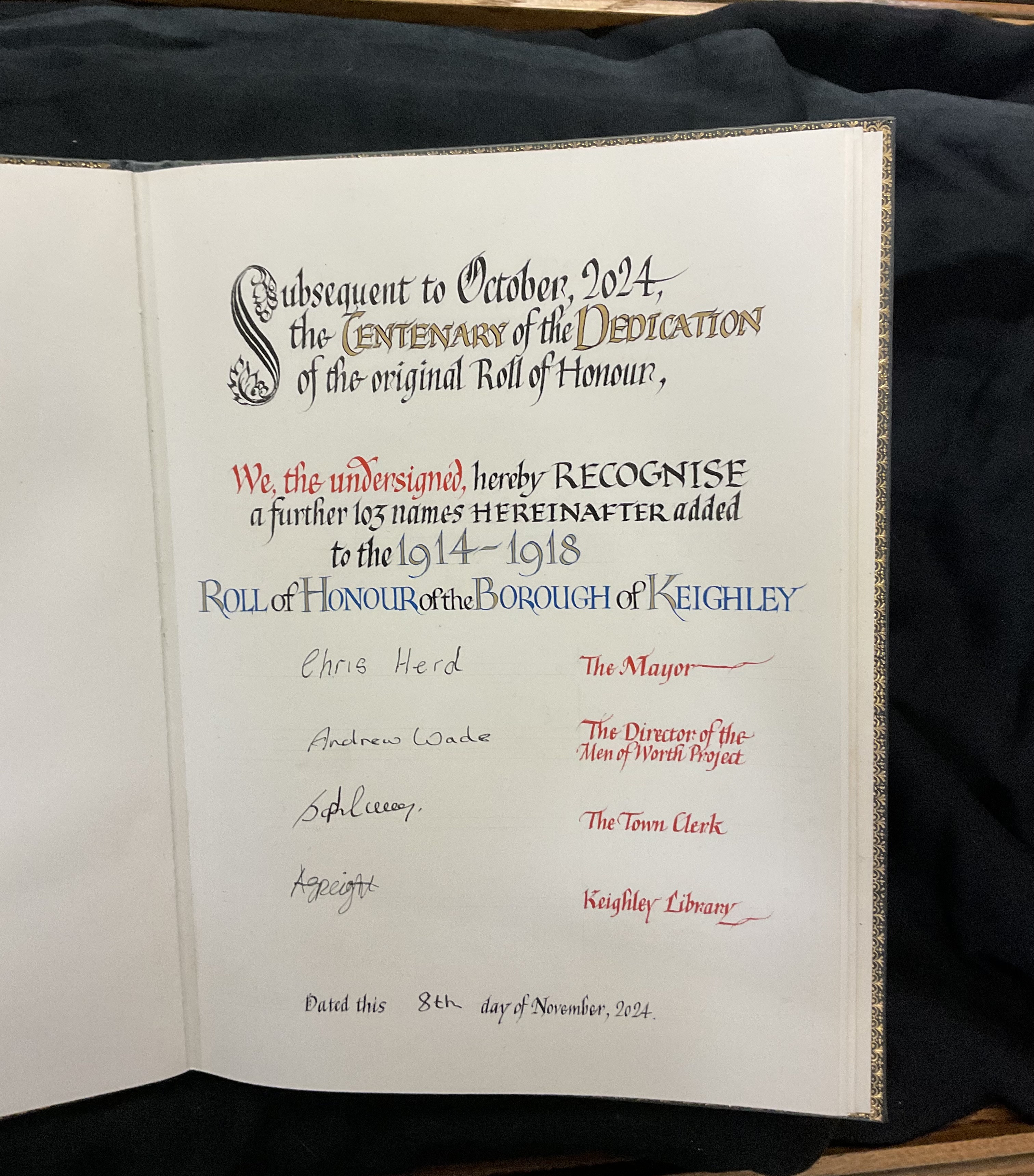
The Updated Roll of Honour on display upstairs in the Local Studies Library, Keighley Library.

 The Men of Worth Project were awarded funding by the National Lottery’s Heritage Fund in early 2024 and this has been supported with funding from Keighley Town Council.

The purpose of the grant was to add more names to the Borough of Keighley Roll of Honour and to celebrate the centenary year of the original book and our wonderful Borough of Keighley War Memorial, which was unveiled in Keighley’s Town Hall Square on 7th December 1924, attended by several thousand people.

Lord Mayor of Bradford Councillor Bev Mullaney, Bradford Council Leader Councillor Susan Hinchcliffe, Director of the Men of Worth Project Andy Wade and Bradford Councillor Caroline Firth.

Other relatives of those honoured were present, together with guests including West Yorkshire Deputy Lieutenant David Pearson, MP Robbie Moore, Lord Mayor of Bradford Councillor Bev Mullaney, deputy town mayor Cllr Chris Herd, Bradford Council leader Cllr Susan Hinchcliffe, district and town councillors and standard bearers.

Irene Lofthouse portrays Frances Hildred Mitchell, the first woman to be added to the Roll.

Cultural historian Irene Lofthouse adopted the guise of Frances Hildred Mitchell – the first woman to be recognised in the roll alongside the men. Frances was a Queen Mary’s Army Auxiliary Corps worker she died aged just 23, from influenza and pneumonia while still nursing in military hospitals a year after the war had ended.
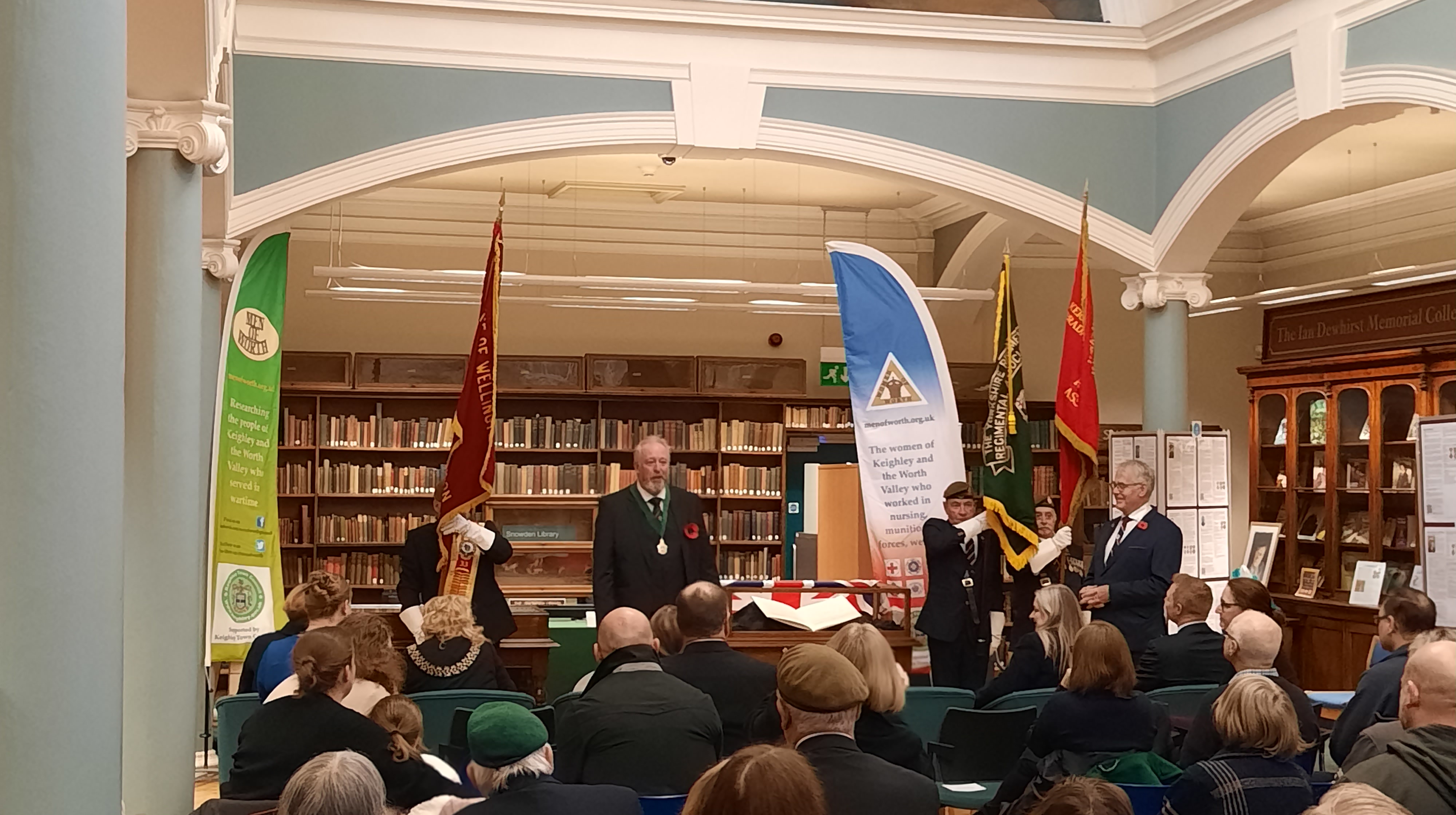
Deputy Town Mayor Councillor Chris Herd with Standard Bearers

The new Roll of Honour and the original Roll of Honour are on permanent display upstairs in Keighley Local Studies Library and an exhibition by The Men of Worth Project on all those added to the new Roll of Honour is on display until December the 6th 2024.

December the 7th marks the 100 year anniversary of the War Memorial and Roll of Honour, at noon, an interpretation plaque will be unveiled at the town’s war memorial. For more information about the project please see the link below.

Book Review – We who served … Stories of Addingham and the Great War, 1914-1918.

We who served … Stories of Addingham and the Great War, 1914-1918. By Catherine Snape.

Addingham Civic Society (email: info@addinghamcivicsociety.co.uk), 2015. x + 310 pp. ISBN: 978-1508859536. £10.00.

wewhoserved

“From Addingham, a close-knit village of millworkers and farmers, with a population of less than 2,000, over 400 men marched off to fight in the 1914-1918 war.

The war brought many changes and much hardship. Families rallied to help each other in the hope that their menfolk would return. More than 80 did not, but the true unsung heroes are those who did, and the families who supported them through those long dark years and helped to rebuild their community.

The book tells about these families, their remarkable stories of stoicism, hope and sacrifice, and about their men who went to war.”

This text from the book’s cover indicates the nature of this attractively-produced book.

Chapter One establishes the pre-war context, covering Addingham’s changing society, its businesses and shops, children at work, industrial unrest, and the outbreak of war. Chapter Two features each of the years 1914 to 1919 with text taken from local newspapers. Chapter Three looks at the Home Front, featuring attitudes to Germans, postal services, the fear of invasion, the garrison town of Skipton, the White Feather Movement, women in the workforce, women’s magazines, volunteering, local war hospitals, DORA (Defence Of the Realm Act), conscription and war memorials. Chapter Four – Taking the King’s Shilling – looks at joining the army, its requirements and service conditions, daily life in the army, postal and medical services, and prisoners of war. Chapter Five – For King and Country – covers the service given by Addingham families, medals, where the servicemen lived and what news was received from the Front.

An impressive 140 pages (almost half the book) gives copious details of all the Addingham men who served, with supplementary lists by the categories: Regulars and Reservists, Territorials, Places men served, Naval personnel, Lord Derby recruits, and the ultimate sacrifice. An impressive range of sources has been used, including illustrations, many from the Addingham Digital Archive

This book came about in response to publicity surrounding the centenary of the outbreak of the First World War:

One objective was to research the names on the Addingham war memorial in the Main Street, but when it became apparent that there were names of village servicemen who were not on the memorials, it was decided to extend the research to the lives, times and service of all men who served their country in the armed forces.

This book joins others that have been compiled in memory of those who fought and died in the 1914-18 war, and those who lived through it, three of which – those on Bradford, Low Moor and Ilkley – were reviewed in the 2015 issue of The Bradford Antiquary.

Bob Duckett

Review reprinted from the Bradford Antiquary, 2016, courtesy of the Bradford Historical and Antiquarian Society.

Holocaust Memorial Day

Friday 27th January is Holocaust Memorial Day.

To mark the occasion, a display has been mounted in Ilkley Library featuring the hostel ‘Loxleigh’ that was established in 1939 on the corner of Mount Pleasant and Cowpasture Road.

During the tense pre-war period the British Parliament had agreed to admit an unspecified number of children from Hitler’s Germany who were in danger of being sent to concentration camps. Agonising decisions were made by parents to send their children alone on the ‘Kindertransport’

In Ilkley, a committee for the Care of Refugees was established and the hostel was opened, made possible by the efforts of the local Quaker community and earlier immigrants from Europe, many of whom had been successful in business in the West Riding.

The display features the stories of some of those who passed through the hostel including Sigi Wassermann and Edgar Klugman who came on the kindertransport and the story of Arnold Vanderhorst who came in 1945. Arnold had survived the war by hiding in woods near Arnhem. After the war, malnourished, Arnold was sent to the hostel in Ilkley to recuperate and then to join a new foster family in Ilkley.

On Friday, January 27th at 11.00 at City Hall, Bradford there is the annual Holocaust Memorial Day event, all are welcome.

On Monday January 30th at 11.00 in Ilkley there will be a short walk and talk from the Ilkley Library to the Kindertransport hostel in Cow Pasture Road by Nigel Grizzard.

Here we reproduce an extract from ‘Ilkley at War’ by Caroline Brown

Refugees in World War Two

The first boys coming to the hostel in Ilkley arrived on 6th March 1939, all of Jewish ancestry. These boys were aged between fourteen and sixteen and attended schools in Ilkley. Some of those placed in Ilkley came with the last children’s transport from Germany at the end of August 1939. One of the boys later described to a reporter of The Ilkley Gazette his joy at meeting a brother in England after he had lost all hope. It had been the last train to leave Germany with passengers bound for England. Another boy described waving goodbye to his parents and then a rush to get to the ship.

 ‘A very nice station master wired to Ostende for us in order to hold up the ship a few minutes…we arrived at Ostende and ran across the quay; the passengers on board were waving to us – and porters threw our luggage on board. Saved!’

Once on board ship he recalled:

‘It is fearfully wet and stormy. There are so many emigrants; it is all so sad – so many people who have lost their fatherland. We rejoice when we see the lights of Dover but we are so exhausted.’

 He describes the hostel at Ilkley:

‘I found myself in a very nice little room, with green curtains and a little cupboard and bed…everyone was very kind but I felt terribly lonely and I was tired to death by the unfamiliar work.’

 Members of the Ilkley Quaker Community later recalled the difficulty they had in locating these children in the gloom of Leeds Holbeck Station in the blackout.

In August 1939, a writer and teacher from Vienna, themselves refugees, became permanent wardens. In the months and years that followed, many other refugees, younger and older, passed through the hostel fleeing from persecution in Europe, sometimes sleeping eight to a bedroom.

iaw156x

The six boys who arrived at the Hostel in Mount Pleasant, Cowpasture Rd, Ilkley from Dovercourt on 6th March 1939 as refugees from Vienna under the care of the Ilkley Committee for Refugees. Their ages are 14 – 16. Mr H Ferry, Warden of the Hostel is on the right.

Many of the boys learned occupations such as agriculture, joinery and mechanics and entered employment in various parts of the country; others were preparing for emigration and did not remain long. Some joined the forces and others were able to join relatives in Britain and overseas..

The Bradford Territorials

On Saturday November 21st, Bradford Local Studies Library was proud to host a talk, “The Bradford Territorials” given by Tricia Platts of the Bradford World War One Group. The well attended event gave an informative insight into the Territorials, and particularly Bradford’s own Victoria Cross recipient, Samuel Meekosha.

There is a display about Samuel Meekosha in the Local Studies Library in Bradford.

20151121_111820